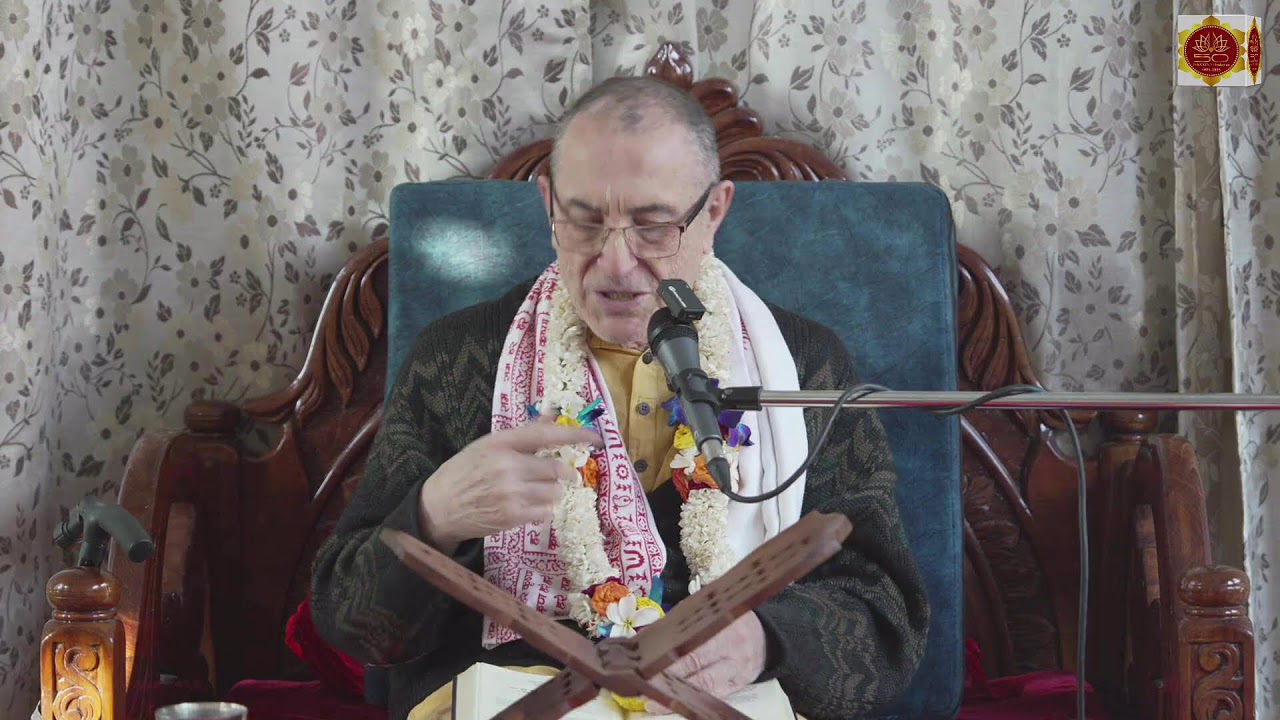
Delivered in ISKCON Vrindavan on 08.11.2025, the Śrīmad-Bhāgavatam reflection attributed to H.G. Hari Sauri Prabhu centers on a celebrated Vaishnava commentary by Śrīla Viśvanātha Cakravartī. The discussion highlights a pivotal exchange in which the gopīs identify Lord Kṛṣṇa’s true position through affectionate yet incisive reasoning, revealing how divine love frames theology not as abstraction but as lived, relational truth.
According to Śrīla Viśvanātha Cakravartī, the gopīs then replied, “But that Supreme Lord You are blaming is none other than Yourself, O most clever of speakers. Everyone in the world knows this! Why should we be ignorant of this fact?” In response, “All right,” Lord Kṛṣṇa then told them, “if this is true, I must be God,” a playful concession that crystallizes the theological paradox: the Supreme hides His sovereignty (aiśvarya) to intensify intimate sweetness (mādhurya).
Viewed academically, this dialogue exemplifies Gaudiya Vaiṣṇava hermeneutics, where rasathe aesthetics of spiritual emotionbecomes a mode of knowing. The gopīs’ argument functions as a devotional epistemology: through unwavering prema-bhakti, they perceive Kṛṣṇa’s divinity more clearly than formal logic alone could permit. The exchange models a pedagogy of līlā, where revelation unfolds through relational reciprocity rather than declarative authority.
For many listeners in Vrindavan, this scene resonates personally. Moments of spiritual doubt and recognition, humility and assurance, mirror the gopīs’ bold clarity and Kṛṣṇa’s playful affirmation. The narrative encourages practitioners to approach scriptural study (śravaṇa) and remembrance (smaraṇa) with trust and tenderness, recognizing how devotion refines perception and turns philosophy into lived experience.
These insights harmonize with broader dharmic values across Hinduism, Buddhism, Jainism, and Sikhismcompassion (karuṇā), nonviolence (ahiṁsā), truthful living (sat), and selfless service (seva). While the idiom here is Bhakti and the locus is Vrindavan, the underlying ethic is universal: love unveils truth, and humility invites wisdom. Such convergence affirms unity in spiritual diversity and strengthens inter-traditional respect without diluting theological distinctiveness.
Practically, the episode invites steady sādhana: attentive chanting, reflective study of Śrīmad-Bhāgavatam, association with saintly communities (satsaṅga), and service offered without expectation. As the gopīs’ words reveal, devotion illumines reality more fully than prideful scholarship; and as Kṛṣṇa’s response implies, the Divine freely meets the sincere. In this way, ISKCON Vrindavan’s study of SB fosters both rigorous understanding and a compassionate ethos that supports harmony among dharmic traditions.
Inspired by this post on Dandavats.