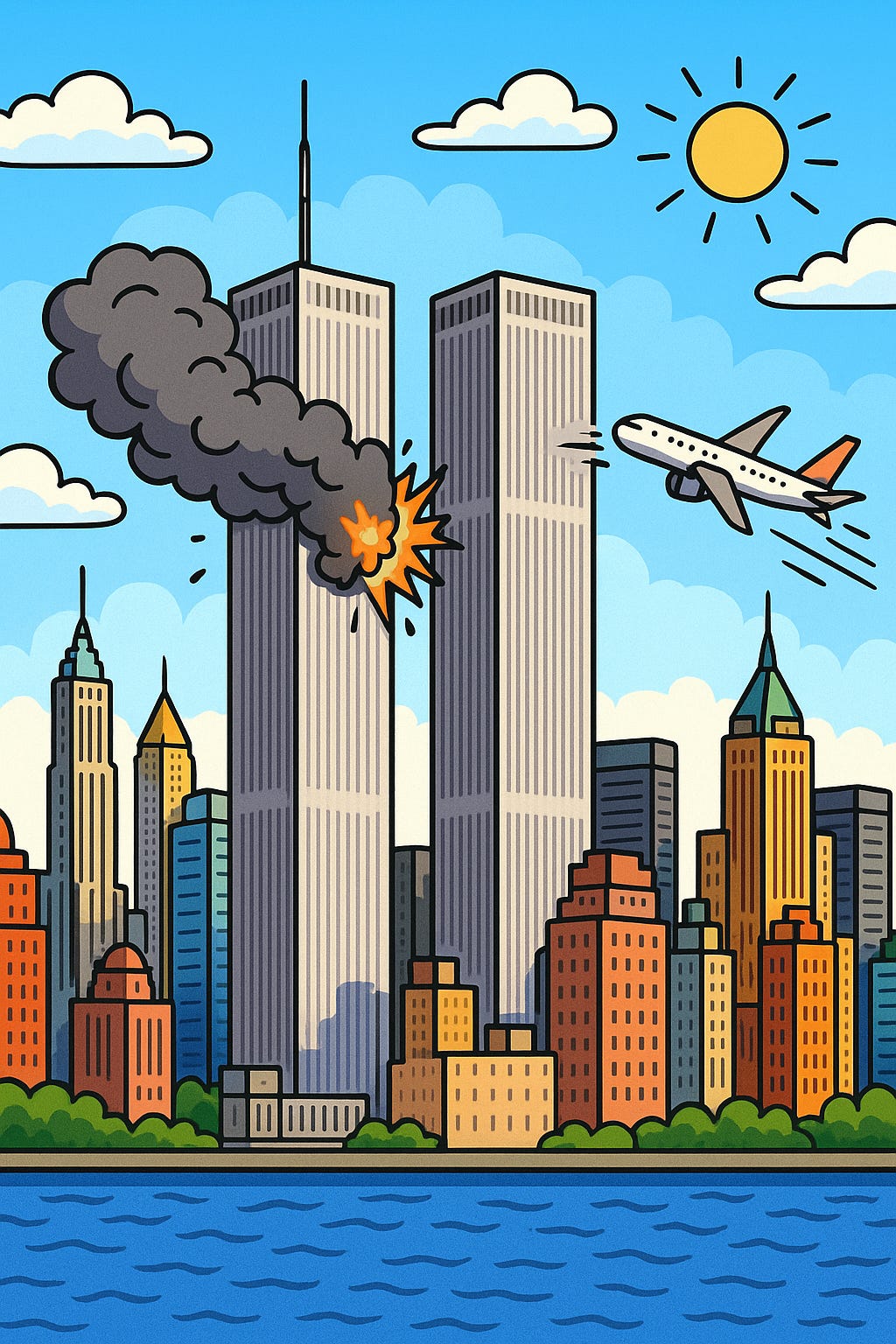
The recent crash of flight AI 171reportedly after a loss of thrust shortly after take-offended in profound tragedy as the aircraft struck a three-storey medical college hostel. While lives were lost both on board and on the ground, the hostel building, though damaged, remained standing. Public comparisons quickly surfaced, contrasting this outcome with the dramatic collapses of the World Trade Center towers on September 11, 2001. A careful structural engineering analysis shows why such comparisons are misleading.
Collective memory often blends emotion with inference. Many who watched the live broadcasts of 9/11 remember the shock of seeing high-speed, fully fueled commercial jets deliberately accelerating into the towers. That singular combination of impact energy, fuel load, and fire behavioracting upon a specific high-rise structural systemdiffers substantially from an aircraft attempting to avoid buildings after losing thrust. Recognizing these distinctions honors both truth and empathy, while encouraging constructive, fact-based dialogue that strengthens social unity across communities, including dharmic traditions.

A concise summary clarifies the core distinctions. First, AI 171 appears to have impacted at low thrust while maneuvering, which reduces kinetic energy on impact and subsequent damage potential. Second, the hostel’s conventional beam–column “lattice” framing disperses loads across many members, often conferring inherent redundancy and residual stability even after local damage. Third, the WTC towers employed a different system: a tubular steel perimeter (an exoskeleton of closely spaced exterior columns) coupled to a central steel core through long-span floor trusses. Fourth, on 9/11 the impacting aircraft were traveling at high velocity with full fuel and were directed at the buildings, maximizing impact energy and creating severe, multi-floor fires that undermined structural capacity.

Conventional mid-rise buildingssuch as typical hostels or officesrely on an internal skeletal frame of beams and columns. This familiar “lattice” configuration distributes gravity and lateral loads through many load paths, improving robustness. Local damage can be significant yet not always globally destabilizing, especially when impact energy is limited and firefighting access is possible.

Iconic skyscrapers, however, often employ alternative systems to resist wind, seismic forces, and gravity loads efficiently at great heights. Early giants like the Empire State Building adopted a “pipe-style” concept: a stiff, continuous exterior acting with substantial internal framing and a central service zone for elevators. Later systems evolved, including the World Trade Center’s “tube” concept: a dense perimeter of large steel columns (the exoskeleton) connected to a steel service core via long-span trusses. This configuration achieved extraordinary efficiency and usable floor space, but it also meant that the floor trusses and their connections were critical to linking the perimeter and core into a single, unified system.
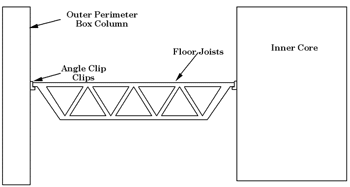
In such tube-and-truss systems, large-scale, high-speed impacts followed by multi-floor fires can trigger compound effects. The initial impact can sever columns, displace fireproofing, and damage trusses. Subsequent firesfed by jet fuel initially and then by building contentsraise steel temperatures, reducing stiffness and strength. Long-span trusses can experience significant deflection under high thermal loads, transferring abnormal forces back to the perimeter and core. As connections weaken and members lose capacity, progressive collapse becomes possible. This phenomenonprogressive, not instantaneousaligns with observed sequences on 9/11 and with independent investigations, including those by NIST, that concluded the WTC collapses were driven by impact damage and fire-induced failure.

Comparisons with the Burj Khalifa further illustrate how system choice affects performance. Burj Khalifa employs a buttressed core with a hexagonal core and Y-shaped wings, each supported by its own network of columns and walls. The massing strategy creates a cluster of interlocked “towers,” enhancing torsional rigidity and providing multiple load paths. In principle, such a configuration offers considerable redundancy, energy absorption capacity, and load redistribution potential under abnormal loads, including localized impact scenarios. While no high-rise can be considered invulnerable, differences in system topology, member continuity, and compartmentalization meaningfully influence resilience.
WTC 7 also invites questions. It was not struck directly by an aircraft, yet it collapsed later the same day. Available evidence indicates that debris damage from the nearby tower collapse combined with uncontrolled, multi-floor fires led to a critical internal failure (notably at Column 79, per NIST findings), initiating a progressive collapse without the need to posit explosives or sabotage. This modefire-induced, progressive failure within a unique structural configurationdiffers sharply from the hostel’s limited, direct-impact damage and the broader fire suppression context.
The larger lesson is clear: structural performance depends on system design, impact conditions, fire dynamics, and the ability to redistribute loads after damage. A low-thrust, avoidance-impact scenario against a conventional frame cannot be equated with high-velocity, fuel-rich impacts into tube-and-truss supertalls. Responsible analysis rejects simplistic analogies, prioritizes verified engineering mechanisms such as impact energy, fire-induced material degradation, connection behavior, and progressive collapse, and maintains empathy for those affected.
In times of tragedy, societies are best served by compassion, clarity, and unity. Fact-based understandinggrounded in structural engineering, fire science, and documented investigationssupports meaningful conversation without inflaming division. Framing such discussions with mutual respect aligns with the shared ethical foundations of Hinduism, Buddhism, Jainism, and Sikhism, encouraging solidarity and a commitment to truth that elevates public discourse.
Inspired by this post on RightViews.