
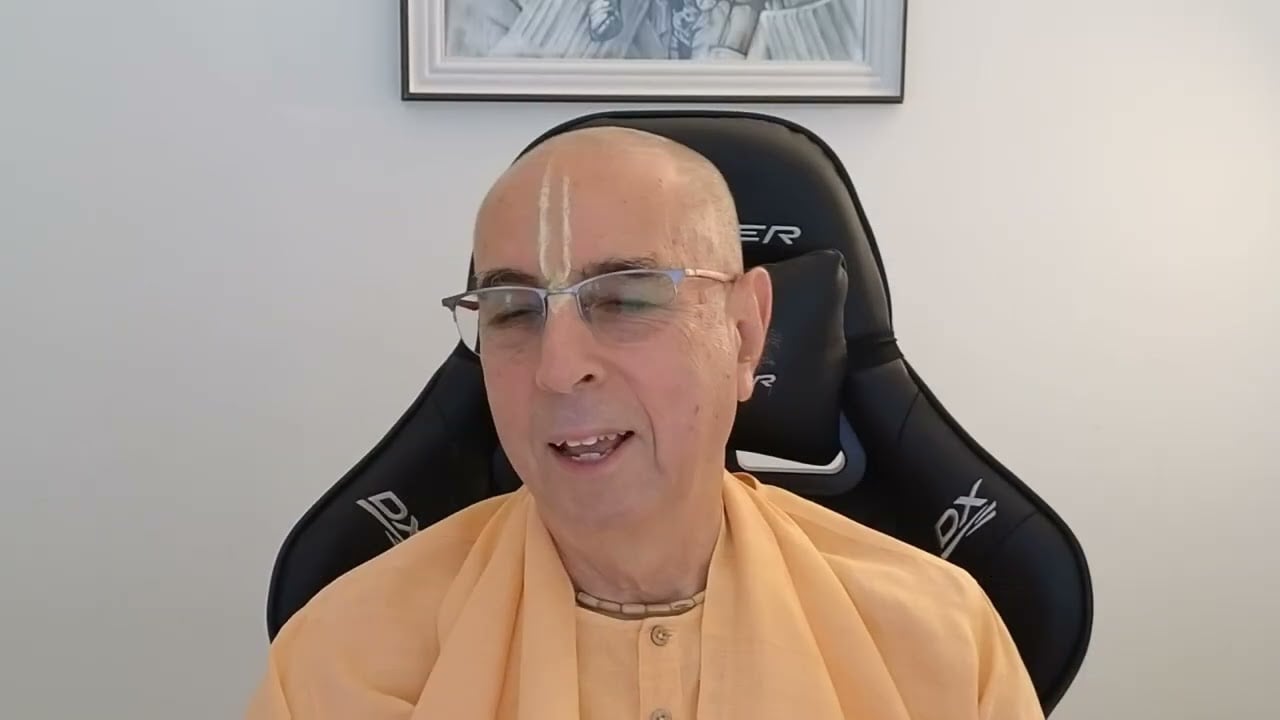
The July 05, 2026 Hungary discourse on Brihad Bhagavatamrita 1.2.53-62 invites a careful reading of one of Gaudiya Vaishnavism's most refined theological works. The text, composed by Sanatana Goswami, does not merely present devotional sentiment; it organizes devotion into a disciplined inquiry into divine mercy, spiritual hierarchy, and the inner life of bhakti. In this section, the reader is drawn into a world where devotion is not judged by social status, external achievement, or intellectual display, but by the depth of loving dependence upon Lord Krishna.
Brihad Bhagavatamrita occupies a distinctive place in Sanskrit devotional literature. Its first canto, traditionally understood as an inquiry into the essence of the Lord's mercy, follows Narada Muni as he searches for the devotee who has received the fullest grace of Bhagavan. This search is not a competition in the ordinary sense. It is a theological journey through increasingly intimate forms of relationship with the Divine, showing how dharma, jnana, karma, renunciation, ritual, and devotion find their proper meaning when they culminate in loving service.
Verses 1.2.53-62 belong to this broader movement of spiritual evaluation. The passage should be read with sensitivity to Sanatana Goswami's method. Rather than producing a flat doctrine, the text unfolds through dialogue, praise, humility, and redirection. A devotee may be glorified, yet that devotee often points elsewhere, recognizing a deeper expression of divine intimacy in another servant of the Lord. This literary structure teaches a crucial principle of bhakti: genuine spiritual advancement is inseparable from humility.
The discourse title identifies the passage as part of a teaching delivered in Hungary, in English, through the channel Niranjana Swami Official. Even from the available post structure, the focus is clear: the session is centered on scriptural study, not entertainment or casual commentary. The presence of a video embed also suggests a living oral tradition, where Sanskrit theology is not locked within manuscripts but transmitted through hearing, reflection, and practical application.
A technical reading of Brihad Bhagavatamrita requires attention to three interrelated concepts: bhakti, kripa, and rasa. Bhakti is not simply religious emotion; it is disciplined loving service directed toward Bhagavan. Kripa, or mercy, is not arbitrary favoritism; it is the Lord's gracious response to surrender, longing, and relationship. Rasa is not mere aesthetic pleasure; it is the matured spiritual flavor of a relationship with Krishna. These concepts help explain why Sanatana Goswami's work remains central to Gaudiya Vaishnava philosophy.
The first canto's search for the recipient of the Lord's greatest mercy has a subtle ethical effect. It prevents spiritual life from becoming self-congratulatory. Each devotee who is honored becomes a window into a greater mystery. The result is not rivalry but reverence. This is especially important for a dharmic readership committed to unity among Hinduism, Buddhism, Jainism, and Sikhism, because the deeper lesson is that authentic spiritual traditions honor sincerity, self-discipline, humility, compassion, and the transformation of consciousness.
In Gaudiya Vaishnavism, Lord Krishna is approached not only as the Supreme Reality but also as the object of intimate love. This does not diminish the dignity of other divine manifestations or devotional paths. Rather, it reveals the particular theological emphasis of the tradition: the Supreme is most fully known through loving exchange. The movement from reverence toward intimacy is one of the great themes of Brihad Bhagavatamrita, and it gives the text both its philosophical depth and its emotional force.
The verses under consideration should therefore be understood as part of a carefully layered devotional map. Sanatana Goswami is not reducing spirituality to rank or sectarian superiority. He is showing that the heart's relationship with the Divine can mature through increasingly personal forms of service. This is why the text often presents exalted personalities with profound respect while still moving the discussion forward. The journey is pedagogical: it trains the reader to look beyond external greatness toward inner absorption in Krishna.
A central lesson of this passage is that devotion cannot be measured by ordinary categories of power. Wealth, learning, ritual precision, institutional authority, and social recognition may all have a place in religious life, but they do not automatically reveal the heart's surrender. The bhakti tradition repeatedly insists that the Lord is conquered by love, not by display. This insight remains deeply relevant in modern spiritual culture, where visibility can easily be mistaken for realization.
The Hungary setting adds a meaningful contemporary dimension. A Sanskrit devotional text composed in medieval India is being studied in Europe in 2026, demonstrating the global movement of Indian spirituality and the continuing relevance of Sanatana Dharma beyond geographical boundaries. Such transmission is not merely cultural export. It is a sign that questions of grace, humility, longing, and divine relationship remain universal human concerns.
For modern readers, Brihad Bhagavatamrita offers a disciplined alternative to fragmented spirituality. It does not encourage vague sentiment divorced from practice. It asks the practitioner to hear, reflect, compare, refine, and submit the heart to scriptural wisdom. The text is emotionally rich, but its emotional richness is supported by philosophical structure. This combination of feeling and rigor is one reason the work has remained influential in the Krishna consciousness tradition.
The passage also highlights the importance of hearing from realized teachers. In dharmic traditions, knowledge is not treated as information alone. It is received through parampara, tested through practice, and deepened through character. A lecture on Brihad Bhagavatamrita therefore functions on multiple levels: it explains a text, preserves a lineage, and invites the listener to examine the quality of personal devotion.
Humility is not weakness in this theological framework. It is spiritual accuracy. The more clearly a devotee perceives the greatness of Krishna and Krishna's devotees, the less room remains for pride. This humility is not self-hatred or passivity; it is the freedom to recognize truth without needing to occupy the center. In practical life, such humility can soften relationships, reduce conflict, and make spiritual communities more compassionate.
Another important feature of Sanatana Goswami's presentation is the harmony between hierarchy and unity. The text can speak of gradations in devotional intimacy while still honoring all sincere service. This is a subtle point. Hierarchy, when misunderstood, becomes domination. In bhakti, hierarchy becomes a way of appreciating depth, intimacy, and service without contempt for others. This distinction is essential for preserving unity among dharmic traditions while allowing each tradition to speak in its own authentic voice.
The study of Brihad Bhagavatamrita also challenges the modern habit of separating philosophy from emotion. In this work, theology becomes tender, and tenderness becomes theologically meaningful. Love is not treated as irrational. It is the highest form of knowledge when purified of ego and directed toward the Supreme. This insight resonates with the broader dharmic understanding that true knowledge transforms conduct, perception, and the heart.
The relevant verses can be approached as a meditation on spiritual recognition. Who is truly blessed? Who is truly wealthy? Who is truly advanced? The text redirects these questions away from external measures and toward divine relationship. In that redirection, readers are invited to reconsider their own assumptions about success, piety, and fulfillment.
The connection with the Bhagavata Purana is especially significant. Brihad Bhagavatamrita may be understood as a theological distillation of Bhagavata themes, especially the supremacy of devotion and the sweetness of Krishna's personal relationships with His devotees. The Bhagavata tradition does not merely teach that God exists; it teaches that the highest perfection is loving participation in divine reality.
From an academic perspective, the text's narrative form is as important as its doctrine. Narada's journey allows theology to be encountered through movement, surprise, and dialogue. This method prevents abstraction from becoming dry. It also mirrors the seeker's own journey, in which initial assumptions are refined through contact with deeper examples of faith.
For practitioners, the passage encourages steady self-examination. Devotion is not proven by claiming closeness to God, but by becoming more eager to serve, more willing to honor others, and more dependent on grace. In everyday terms, this means that scriptural study should make a person more truthful, patient, grateful, and compassionate. Without such transformation, even profound theology remains incomplete.
The discourse also serves as a reminder that Krishna consciousness is not limited to temple ritual or philosophical debate. It concerns the full reorientation of life. Speech, memory, work, relationships, and aspiration can all become connected to bhakti when guided by sincere intention. This is why traditional texts continue to matter: they train the imagination to see life in relation to the Divine.
A mature reading should avoid sectarian misinterpretation. The emphasis on Krishna's devotees in Gaudiya Vaishnavism need not create distance from other dharmic paths. Hindu, Buddhist, Jain, and Sikh traditions each preserve disciplines of self-transformation, ethical seriousness, and liberation from ego-centered life. The distinctive contribution of Brihad Bhagavatamrita is its luminous account of divine love, and that contribution can be appreciated without diminishing the sanctity of other dharmic commitments.
In a world marked by distraction and spiritual consumerism, the text's patience is striking. It does not offer instant enlightenment. It asks the listener to contemplate, compare, hear again, and allow the heart to be educated. This slower mode of learning can feel demanding, yet it is precisely what gives scriptural study its power. The heart is not transformed by novelty alone; it is transformed by repeated contact with truth.
The July 05, 2026 teaching on Brihad Bhagavatamrita 1.2.53-62 therefore stands as more than a dated lecture entry. It represents the continuation of a living scriptural culture in which Sanatana Goswami's insights are heard, interpreted, and applied across continents. The passage calls readers toward humility, reverence, disciplined study, and a deeper appreciation of divine grace. Its enduring message is simple but demanding: the highest wealth of life is loving devotion, and the surest sign of that devotion is the heart's eagerness to honor Krishna, His devotees, and all sincere seekers of truth.
Inspired by this post on Dandavats.








Leave a Reply
You must be logged in to post a comment.