
Draupadi Amman occupies a remarkable place in the devotional, artistic, and ritual life of South India, especially within Tamil Nadu and Tamil-speaking communities across the world. She is not approached only as Draupadi of the Mahabharata, the royal woman whose dignity was attacked in the Kuru court, but as Amman: a living mother-goddess whose presence is experienced through temples, vows, festivals, processions, storytelling, and acts of embodied devotion. Her worship reveals how Hindu traditions preserve memory not merely through texts, but through sculpture, performance, community ritual, and the emotional life of devotees.
The title “Draupadi Amman” itself brings together two dimensions of sacred identity. “Draupadi” recalls the epic heroine born from sacrificial fire, wife of the Pandavas, queen of Indraprastha, witness to adharma, and moral force behind the restoration of justice. “Amman,” meaning mother, places her within the South Indian goddess tradition, where divine femininity is not abstract or distant but immediate, protective, fierce, compassionate, and rooted in the village, the family, and the land. In this form, Draupadi becomes both an epic personality and a guardian deity.
Her sacred image therefore must be read on several levels at once. It is an icon of Mahabharata memory, a theological statement about Shakti, a social symbol of feminine dignity, and a ritual center around which entire communities organize their religious calendar. The sculpture or painted image of Draupadi Amman is not simply an object of beauty. It is a consecrated body through which devotion, protection, justice, and continuity are made visible.
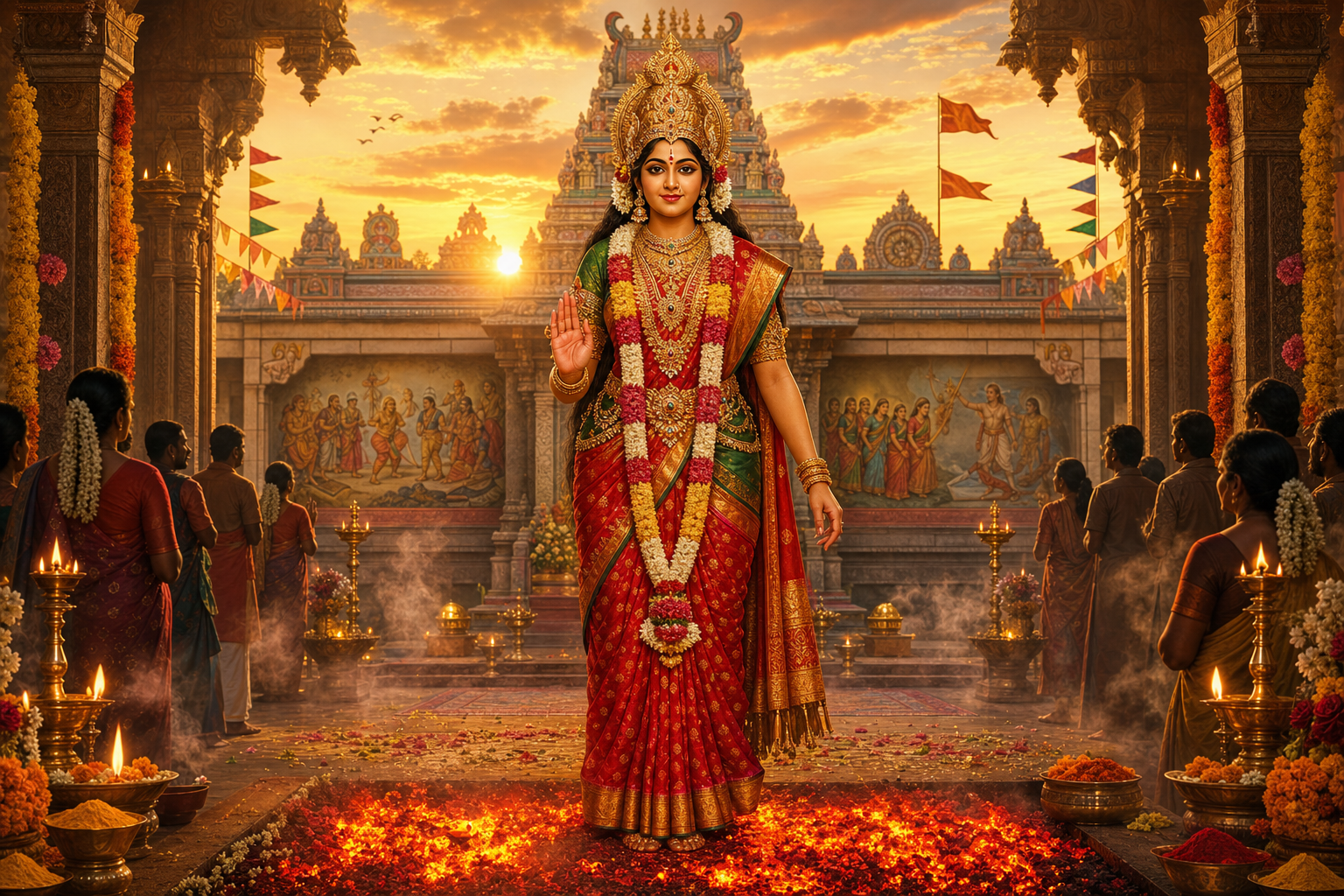
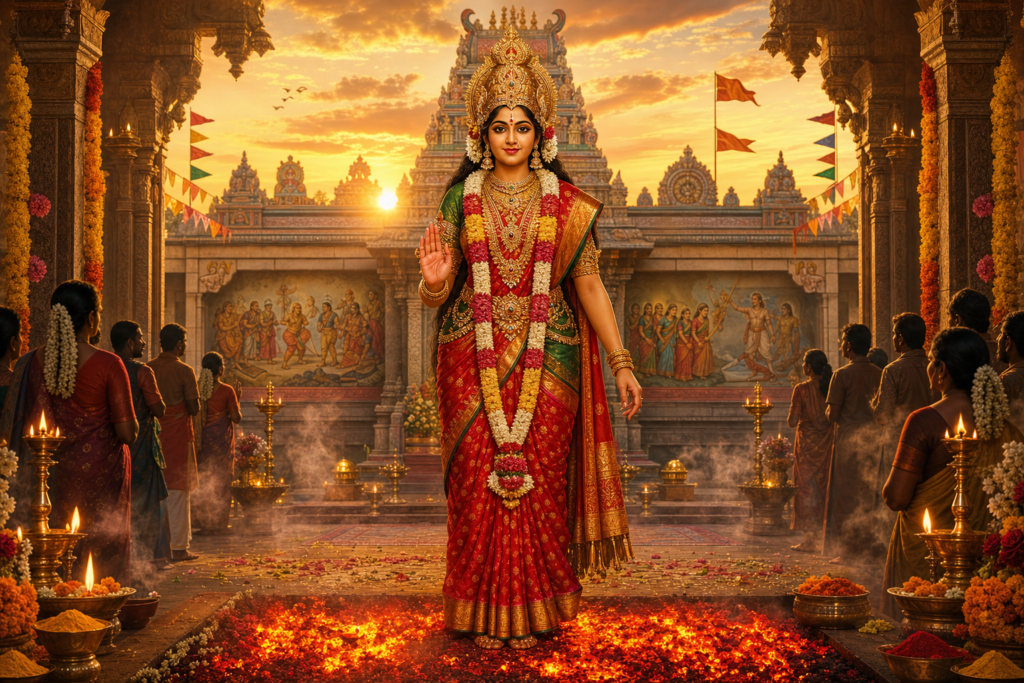
In many Draupadi Amman temples, the goddess is represented in regal posture, often standing with a composed yet commanding presence. The upright stance is significant because it visually communicates sovereignty, moral steadiness, and divine authority. Unlike images that emphasize passive grace alone, Draupadi Amman’s form often holds together softness and severity. Her body is graceful, but her presence is not fragile. She stands as one who has endured humiliation, witnessed violence, invoked dharma, and emerged as a source of power for generations of worshippers.
The face of Draupadi Amman is central to her iconography. A calm face, wide eyes, and steady gaze suggest awareness rather than withdrawal. The goddess sees. She witnesses injustice, protects the vulnerable, and receives the vows of devotees who come to her in distress. In the emotional world of the temple, this gaze carries deep meaning. Many devotees experience it as maternal attention: the feeling that suffering has not been ignored, that moral injury has been seen, and that divine justice remains possible even when human systems fail.
The crown or headdress often associated with Draupadi Amman points to her royal identity. She is not only a village deity but also a queen linked to the Pandavas and the epic world of kingship, exile, war, and restoration. Her crown reminds the devotee that dharma is not limited to private virtue; it also concerns public order, ethical governance, responsibility, and the protection of dignity. Through her, the Mahabharata’s political and moral questions enter the local temple space.
Her clothing, frequently rendered in bright and auspicious colors, carries the visual language of the South Indian goddess tradition. Red, when present, may evoke Shakti, fertility, blood, heat, courage, and the transformative energy of the divine feminine. Yellow and gold may suggest auspiciousness, prosperity, purity, and royal brilliance. Green may evoke growth, renewal, and the nurturing aspect of Amman. These colors are not decorative accidents; they help worshippers perceive the goddess as a living force who sustains both household and community life.
The jewelry of Draupadi Amman also deserves attention. Ornaments in Hindu iconography do not merely indicate wealth. They signify fullness, auspicious power, and the capacity of the divine to bless the world. Necklaces, earrings, armlets, waist ornaments, and anklets transform the image into a radiant center of sacred abundance. In ritual practice, adorning the goddess is itself an act of devotion. The community offers beauty back to the one from whom beauty, protection, and prosperity are believed to flow.
Some local forms may include weapons or symbolic gestures associated with protection, while others emphasize her queenly dignity and maternal presence. This variation is important. Draupadi Amman worship is not a single fixed artistic formula but a living religious tradition shaped by region, lineage, temple history, and community memory. The flexibility of her iconography reflects the broader strength of Hindu religious life: unity of meaning without uniformity of expression.
Draupadi’s birth from fire is one of the most important keys to understanding her sacred symbolism. In the Mahabharata, she emerges from the sacrificial fire of King Drupada’s yajna. This origin makes her more than an ordinary human heroine. Fire marks her as a being of purpose, intensity, and destiny. In Vedic and Hindu ritual thought, fire purifies, transforms, carries offerings to the divine, and reveals what is hidden. Draupadi Amman’s connection to fire therefore shapes both her mythology and her worship.
This fiery symbolism reaches its most dramatic ritual expression in Theemithi, the fire-walking ceremony associated with Draupadi Amman festivals. Devotees walk across a bed of embers as an act of vow, faith, purification, and surrender. The ritual is often connected to the goddess’s chastity, truth, and fire-born power. It is not a spectacle in its sacred context; it is a disciplined act of bhakti in which the devotee’s body becomes the site of trust, endurance, and divine relationship.
Theemithi demonstrates a principle central to many Dharmic traditions: truth is not only believed, but practiced. The body participates in devotion. Feet touch fire, vows are fulfilled, fear is confronted, and the devotee emerges with a renewed sense of connection to the goddess. For outside observers, the ritual may appear astonishing. For participants and communities, it is a profound form of religious discipline, linking personal suffering to the larger moral universe of Draupadi Amman.
The episode of Draupadi’s humiliation in the Kuru court is another major source of her spiritual meaning. Her attempted disrobing is not simply an episode of personal insult; it is a crisis of dharma. Elders fall silent, power becomes arrogant, law is manipulated, and a woman’s dignity becomes the battlefield on which the moral collapse of a kingdom is exposed. Draupadi’s questions in that assembly remain among the most powerful ethical moments in Indian epic literature.
In the devotional imagination, Draupadi Amman is revered because she does not accept injustice as normal. She questions, remembers, vows, and becomes a force through which adharma is eventually answered. Her iconography must therefore be understood as the image of a goddess who embodies moral memory. She represents the refusal to erase suffering and the insistence that dignity is sacred. This is one reason her worship continues to speak deeply to women, families, and communities facing vulnerability or social injury.
The symbolism of hair, especially Draupadi’s vow connected with her unbound hair after the Kuru court outrage, also holds deep cultural significance. In many Indian traditions, hair can signify honor, vow, austerity, beauty, grief, or power depending on context. Draupadi’s unbound hair becomes a sign of unresolved injustice. Until dharma is restored, the wound remains visible. Theologically, this transforms personal grief into sacred resolve.
Draupadi Amman’s association with chastity should be interpreted with care and depth. In her tradition, chastity is not a narrow social control imposed on women; it is often understood as tapas, truth-force, inner heat, discipline, and spiritual integrity. Her power does not arise from weakness or submission. It arises from an uncompromised inner alignment with dharma. This makes her a complex and powerful goddess: tender as mother, fierce as witness, and luminous as one who carries the authority of truth.
The presence of the Pandavas in Draupadi Amman temples further expands her religious world. Many temples include or ritually remember the Pandavas, Krishna, Arjuna, Bhima, Yudhishtira, Nakula, Sahadeva, and related Mahabharata figures. This creates an epic environment in which devotees do not encounter Draupadi in isolation. They encounter a sacred network of relationships, duties, loyalties, failures, vows, and divine interventions. The temple becomes a local Kurukshetra of memory and reflection.
Krishna’s relationship with Draupadi is especially meaningful. In the Mahabharata, Krishna is her protector, friend, and divine ally. In devotional interpretation, this bond reveals that bhakti is not merely formal worship but intimate trust. Draupadi’s appeal to Krishna during crisis has become a symbol of surrender when worldly support collapses. This symbolism naturally connects Draupadi Amman worship with broader Hindu teachings on grace, refuge, and divine companionship.
Her temples are also significant as centers of oral and performative tradition. In Tamil regions, Mahabharata episodes associated with Draupadi are transmitted through recitation, drama, ritual theatre, and community storytelling. Traditions such as Terukkuttu and Kattaikkuttu have played important roles in bringing the epic into public space. Through performance, Draupadi is not confined to manuscript or sculpture. She speaks, suffers, challenges, blesses, and becomes present before the community.
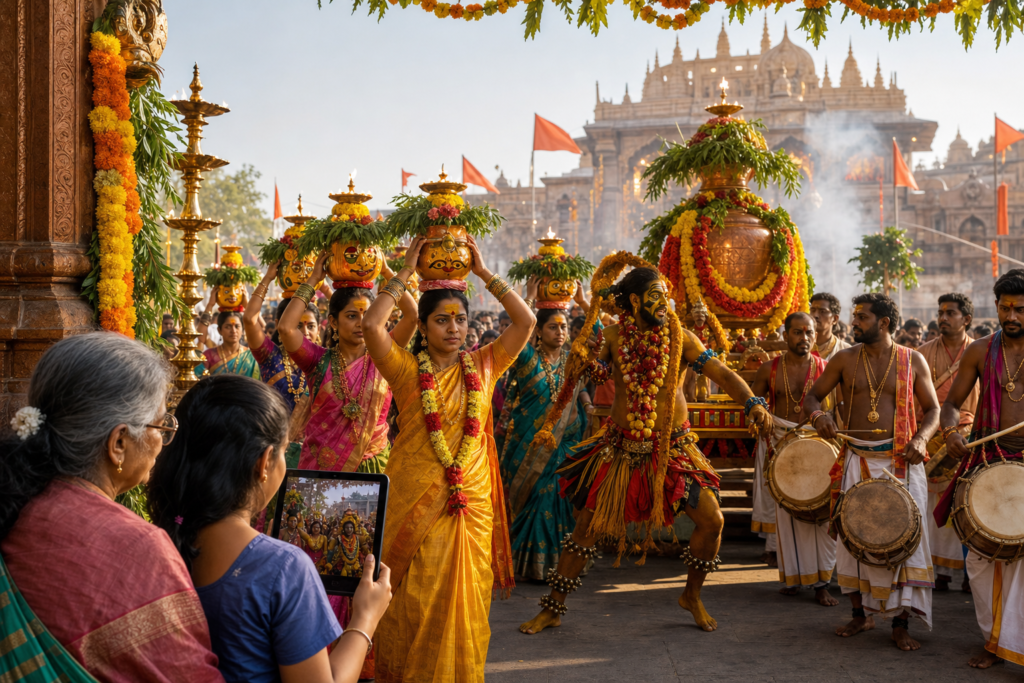
This performative dimension is crucial for understanding the living nature of Draupadi Amman. A temple festival may include processions, vows, music, dramatic enactment, offerings, fire rituals, and collective meals. The goddess is experienced through sound, movement, heat, fragrance, color, and shared emotion. Such practices show that Hindu temple culture is not limited to doctrine. It is embodied knowledge, carried through generations by priests, performers, families, artisans, and devotees.
Draupadi Amman’s worship also demonstrates the close relationship between Sanskritic epic tradition and regional devotional culture. The Mahabharata provides the narrative foundation, while Tamil religious life gives the goddess a distinct ritual body. This is not a contradiction. It is one of the great strengths of Sanatana Dharma: sacred narratives can become local, intimate, and regionally expressive while retaining their connection to the larger civilizational memory of India.
In many communities, Draupadi Amman is also understood as a village guardian. As Amman, she protects boundaries, heals affliction, receives vows, and sustains collective well-being. This protective function connects her with other South Indian goddess traditions, including Mariamman, Angalamman, Kali, and forms of Durga and Bhadrakali. Yet Draupadi remains distinct because her divinity is inseparable from the Mahabharata’s ethical drama. She is both guardian mother and epic queen.
The temple image of Draupadi Amman therefore carries a layered theology of Shakti. Shakti is not merely energy in a general sense; it is conscious divine power, the active principle through which protection, transformation, justice, and grace operate. Draupadi’s Shakti is forged through fire, tested through humiliation, clarified through vow, and celebrated through worship. Her iconography makes that power visible in humanly approachable form.
Her worship also offers a valuable lens for studying Hindu Goddess traditions beyond simplistic categories. Draupadi Amman is not only benevolent or only fierce. She cannot be reduced to fertility, anger, chastity, kingship, or village protection alone. She contains all these dimensions. This complexity mirrors the wider Hindu understanding of Devi, where the divine feminine may nourish, discipline, destroy evil, protect devotees, grant prosperity, and awaken wisdom.
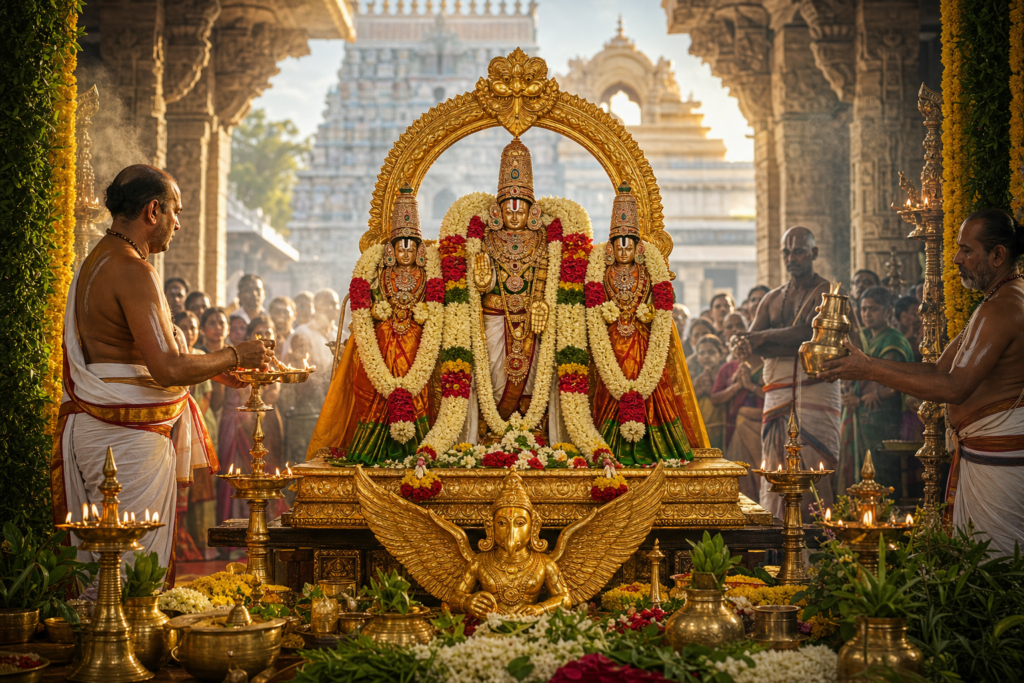
From an art historical perspective, Draupadi Amman’s iconography belongs to a living temple environment rather than a museum-only context. Sculptures, festival icons, painted panels, and processional images are ritually activated through consecration, worship, adornment, and movement. The image is bathed, clothed, decorated, praised, and carried among devotees. Its meaning changes with festival time, seasonal rhythm, and ritual sequence. The icon is stable, but the devotional experience is dynamic.
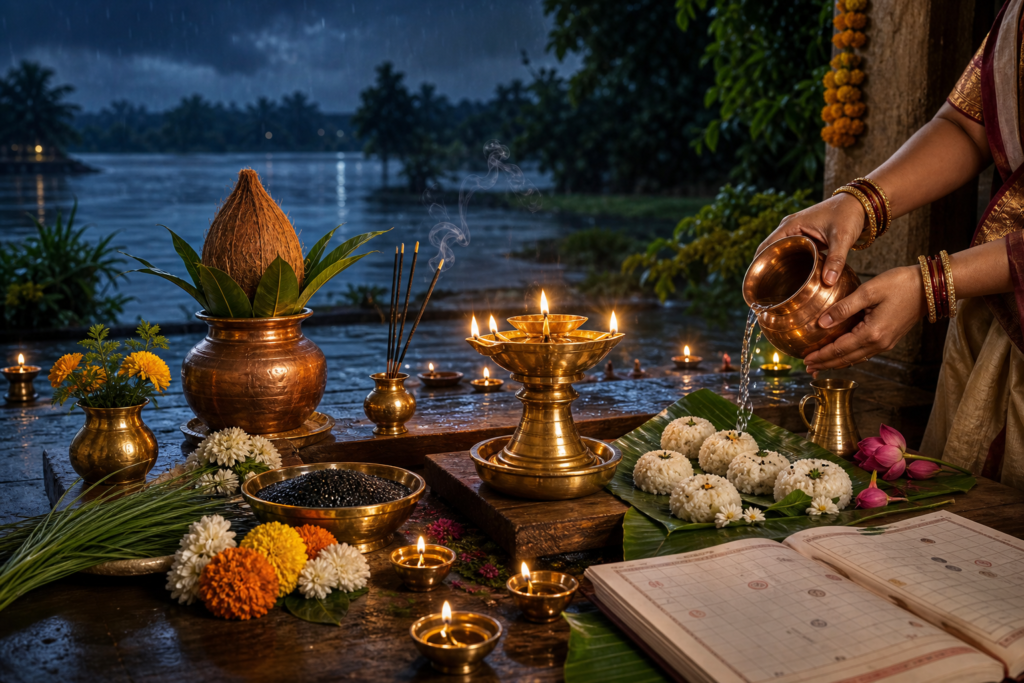
The ritual decoration of Draupadi Amman also reveals the theology of presence. Flowers, turmeric, kumkum, lamps, silk, jewelry, sandal paste, and garlands do not merely beautify the goddess. They mark relationship. Devotees give what is fragrant, pure, bright, and precious because the goddess is treated as present. This devotional realism is central to Hindu temple worship: the divine is not remembered from a distance but hosted, honored, and approached.
The emotional power of Draupadi Amman worship lies in the way it transforms pain into sacred strength. Her story does not deny suffering. It does not pretend that the righteous are never humiliated or that society always protects the vulnerable. Instead, it insists that suffering witnessed by dharma is not meaningless. Draupadi’s endurance becomes a source of courage, and her worship allows devotees to bring their own wounds into a sacred space where justice and compassion are both honored.
This aspect is especially relevant in modern discussions of gender, dignity, and spiritual resilience. Draupadi Amman is not an abstract symbol imported into contemporary concerns; her tradition has long preserved a powerful language for speaking about violated dignity and moral accountability. Her presence reminds society that dharma requires courage, not silence. It asks families and communities to treat women’s honor, speech, and agency as sacred responsibilities.
At the same time, an academic reading must avoid flattening Draupadi Amman into a modern political slogan. Her sacred power is richer than any single social interpretation. She belongs to ritual, theology, art, performance, and lived devotion. Her worship includes grief and justice, but also celebration, beauty, family continuity, village identity, and divine motherhood. The full tradition must be approached with humility, because it carries meanings formed through centuries of practice.
Draupadi Amman also contributes to unity among Dharmic traditions by emphasizing shared values: truth, restraint, devotion, courage, compassion, justice, and the sanctity of vows. Hinduism, Buddhism, Jainism, and Sikhism each preserve distinct teachings and practices, yet all recognize the importance of ethical discipline, self-mastery, reverence, and the transformation of suffering into wisdom. Draupadi’s story, when read in this broader Dharmic spirit, becomes an invitation to protect dignity and uphold righteousness without hatred.
The Mahabharata itself is a civilizational text because it refuses easy moral simplification. Draupadi Amman’s worship carries that complexity into ritual life. She is wronged, but not broken. She is fierce, but not cruel. She demands justice, but remains aligned with dharma. She is queen, wife, devotee, goddess, mother, and witness. Her iconography succeeds because it compresses this vast moral world into a form that devotees can stand before, worship, and emotionally understand.
The fire-walking devotee, the artisan shaping her image, the performer reciting her story, the priest adorning her with flowers, and the family offering prayer all participate in the same sacred ecology. Each role keeps Draupadi Amman alive as more than a literary memory. This is why her worship continues to thrive. It belongs to the heart of Hindu cultural heritage, where scripture, sculpture, ritual, and community are woven into one continuous tradition.
In the end, Draupadi Amman’s sacred iconography teaches that divine femininity is not limited to gentleness, nor is power separated from compassion. Her image holds both. She is the fire-born queen who becomes mother, the wronged woman who becomes guardian, the epic heroine who becomes Devi, and the local Amman who carries a pan-Indian moral memory. To stand before her is to encounter grace with force, beauty with discipline, and devotion with the demand for dharma.
Her continued worship across Tamil Nadu and among Tamil communities abroad shows the enduring vitality of Hindu temple traditions. Draupadi Amman remains a living goddess because devotees continue to experience her as present, protective, and morally awake. Her iconography is therefore not only an artistic subject; it is a spiritual language. Through crown, gaze, color, fire, vow, and festival, it tells a story of dignity restored, Shakti awakened, and dharma made visible.
Inspired by this post on Hindu Blog.


Leave a Reply
You must be logged in to post a comment.