
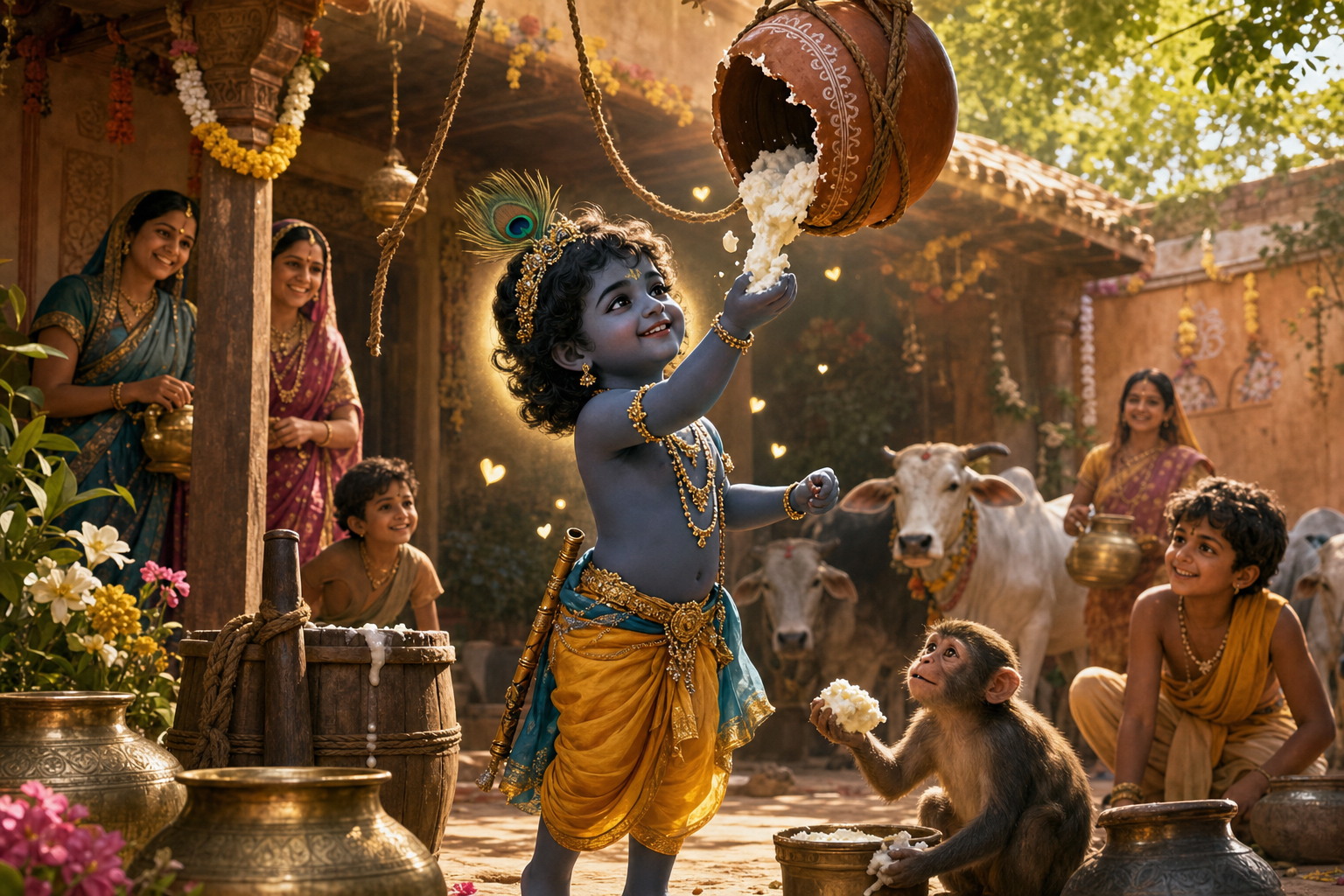
Krishna’s childhood thefts in Vrindavan occupy one of the most beloved spaces in Hindu storytelling, especially in the devotional imagination shaped by the Bhagavata Purana, Vaishnava poetry, temple traditions, kirtan, and household worship. The image is simple and unforgettable: butter disappears from pots suspended high above the floor, the gopis search for the culprit, and the child Krishna, dark-skinned, radiant, playful, and adorned with a peacock feather, somehow stands at the center of the mystery. Yet the tradition does not remember him merely as a mischievous child. It remembers him as Makhan Chor, the butter thief, and Chit Chor, the thief of the heart. These names do not reduce divinity into wrongdoing; they reveal how divine play can overturn ordinary categories and lead the mind toward a subtler understanding of love, surrender, and spiritual freedom.
At the literal level, the stories are charming episodes from Krishna’s childhood in Gokula and Vrindavan. The gopis churn milk into butter, preserve it carefully, and hang it beyond the reach of children. Krishna gathers his friends, climbs on their shoulders, breaks the pots, distributes the butter, and sometimes feeds it to monkeys. When confronted, he appears innocent, clever, or tenderly defiant. This domestic setting matters. The narrative does not begin in a battlefield, a royal court, or a forest hermitage, but in the intimate economy of village life. Milk, curd, butter, mothers, children, neighbors, cattle, courtyards, and shared laughter become the field in which theology unfolds.
The symbolism of butter is central. In an agrarian and pastoral culture, butter is not a casual object. It is nourishment, wealth, labor, and refinement. Milk must be protected, cultured, churned, and patiently transformed before butter emerges. In devotional interpretation, this process becomes a metaphor for the human heart. The mind, like milk, is fluid and easily disturbed. Through discipline, remembrance, love, and satsanga, it is churned until the essence appears. That essence is not merely emotion but a softened, clarified, and inwardly rich state of being. Krishna steals butter because he is drawn to the innermost essence of the devotee, not to outward display.
For this reason, Makhan Chor is inseparable from Chit Chor. The butter thief becomes the thief of consciousness, attention, and affection. In Sanskritic and bhakti traditions, the heart is not treated as a sentimental organ alone; it is a center of cognition, intention, memory, longing, and identity. When Krishna steals the heart, he does not impoverish the devotee. He relieves the devotee of possessiveness. The theft is paradoxical because what is taken is precisely what was never secure under egoic ownership. Love for Krishna exposes the illusion that the self can possess itself independently of the divine ground of being.
This is why Krishna’s thefts create delight rather than fear. Ordinary theft violates trust, damages social order, and causes suffering. Krishna’s thefts, by contrast, occur within the theological frame of lila, divine play. Lila does not mean randomness or moral carelessness. It indicates a mode of divine action that is free, overflowing, and not driven by lack. Krishna does not steal butter because he needs food. He steals because the act draws the gopis into relationship, intensifies remembrance, and transforms the ordinary household into a sacred arena. The point is not the butter itself but the awakened intimacy between the divine and the devotee.
The gopis’ complaints therefore carry a devotional ambiguity. On the surface, they protest. They go to Yashoda and describe Krishna’s mischief. Yet their speech is filled with attention to him. Their complaint becomes remembrance, and remembrance becomes devotion. In bhakti psychology, even reproach can become a form of worship when the mind remains absorbed in the beloved. The gopis hide butter from Krishna, but the hiding itself becomes an invitation. They want to protect their homes, yet they also want him to come. The human heart often moves in exactly this way: it safeguards its attachments while secretly longing for the divine interruption that will loosen them.
The hanging butter pots offer another layer of meaning. They are placed high, beyond normal reach, suggesting the guarded interior life of the devotee. People often keep their deepest tenderness, vulnerability, and longing suspended above ordinary contact. Social life requires roles, boundaries, and self-protection. Krishna’s childhood play imagines the divine as one who finds a way past these defenses. He climbs through cooperation, using the bodies of his friends as a living ladder. The image is playful, but it also suggests that spiritual awakening is not purely solitary. Community, friendship, song, and shared devotion can lift the individual toward what cannot be reached alone.
The breaking of the pot is equally significant. A pot is a container, a boundary, a form. In Indian philosophical language, the pot is often used to discuss limitation, space, and identity. Pot-space appears separate from vast space only because of the vessel that encloses it. When Krishna breaks the butter pot, the action may be read as a symbolic rupture of narrow selfhood. The stored essence is released. What was hoarded becomes shared. The household treasure becomes prasada-like delight. The destruction is not nihilistic; it is a breaking open that permits circulation, generosity, and relational abundance.
Krishna’s act of feeding butter to monkeys deepens this interpretation. From a purely economic standpoint, it appears wasteful. From a devotional standpoint, it reveals that divine abundance resists possessive calculation. The butter that the gopis worked to preserve enters a wider field of life. Animals, children, friends, and neighbors become participants in joy. This does not deny the value of labor; rather, it challenges the idea that value reaches completion only in private possession. In Krishna bhakti, delight expands when it is distributed. Sacred wealth is not diminished by sharing.
Yashoda’s role is essential because she grounds the theology in maternal love. She is not a distant philosopher analyzing an avatar. She is a mother trying to raise a child who is also the Supreme. Her confusion, affection, discipline, and wonder create one of the most profound tensions in Hindu devotional literature. The divine who sustains the cosmos can be tied with a rope. The infinite can cry. The source of dharma can be scolded for stealing butter. This is not a contradiction to be solved away; it is the heart of vatsalya rasa, the devotional mood in which the devotee relates to God through parental affection.
The famous Damodara episode, in which Yashoda binds Krishna, belongs to the same symbolic universe. The rope is always too short until devotion completes what measurement cannot. In theological terms, the infinite cannot be bound by material means, but the infinite freely allows itself to be bound by love. This principle helps explain the butter thefts. Krishna is not captured by law, status, ritual pride, or intellectual mastery. He is captured by bhakti. The butter he steals is the softened heart, and the rope that binds him is love purified of arrogance.
There is also a subtle ethical lesson in these stories. They do not teach that theft is acceptable in human conduct. Dharma traditions distinguish carefully between ordinary moral law and symbolic divine action. Krishna’s lila is not a license for adharma. Instead, the stories invite reflection on the transformation of intention. When human beings steal, they usually act from lack, greed, envy, or domination. When Krishna steals, he acts from fullness and awakens fullness in others. The difference is not superficial. It marks the distinction between ego-centered taking and divine reclamation of what already belongs to the sacred.
This distinction is important for modern readers who may approach the stories through ethical literalism. If the narrative is read only as a behavioral example, it becomes confusing. If it is read as sacred symbolism, its depth becomes visible. Hindu narrative literature often works through layered meanings: historical memory, village humor, ritual culture, metaphysics, rasa theory, psychology, and devotion can coexist in the same episode. Krishna’s butter thefts belong to this multidimensional literary world. They are playful enough for children, emotionally rich enough for devotees, and philosophically suggestive enough for serious study.
The names Makhan Chor and Chit Chor therefore function as devotional theology in compact form. Makhan Chor points to the visible story: Krishna steals butter. Chit Chor points to the inward event: Krishna steals the mind and heart. Together they express a central bhakti claim: the divine does not remain confined to temple sanctums, scriptures, or formal rituals. The divine enters kitchens, courtyards, friendships, complaints, songs, and ordinary work. Spirituality is not separated from daily life. It ripens within it.
Vrindavan itself becomes more than a geographic setting. It is a theological landscape where the ordinary laws of social distance are softened by love. Cows, rivers, forests, mothers, children, flute music, and village pathways form an ecology of devotion. In this world, Krishna is not approached primarily through fear or command but through intimacy. This intimacy is not casual familiarity; it is a sacred closeness in which the devotee forgets self-importance. The gopis do not love Krishna because he is useful to them. They love him because his presence reveals the deepest sweetness of existence.
The butter motif also resonates with the broader Indian concern for extracting essence from appearance. Vedic ritual, Upanishadic inquiry, yogic practice, Buddhist analysis, Jain discipline, Sikh remembrance, and bhakti devotion all, in distinct ways, ask human beings to move beyond surface identification. The methods differ, and each dharmic tradition preserves its own integrity, vocabulary, and discipline. Yet the shared civilizational concern is recognizable: what is the essence of life when ego, fear, greed, and illusion are churned away? In Krishna bhakti, that essence is tasted as prema, divine love.
This point supports unity among dharmic traditions without erasing difference. Krishna’s symbolism belongs specifically to Hindu and Vaishnava devotional worlds, but its ethical and contemplative insights can be appreciated across a wider dharmic horizon. The butter thief reminds the practitioner that spiritual life is not merely external conformity. It requires inner refinement. It asks for a heart made soft through practice, humility, compassion, and remembrance. Where traditions differ in metaphysics, they can still recognize the practical need to reduce ego and cultivate truthfulness, non-possessiveness, and care.
The theme of non-possessiveness is especially strong. Butter is produced through effort, and effort naturally creates attachment. The gopis’ butter represents the fruits of labor, and their attempt to guard it reflects a normal human tendency. Krishna’s theft does not mock labor; it sanctifies it by redirecting its fruit toward divine relationship. In the language of the Bhagavad Gita, action becomes liberating when its fruits are offered rather than hoarded. The child Krishna dramatizes this principle through play before the adult Krishna teaches it philosophically on the battlefield of Kurukshetra.
The emotional power of these stories lies in their recognizability. Many people know the experience of protecting something carefully, only to discover that life, love, time, or grace has entered and rearranged everything. The guarded heart is often like the suspended butter pot. It is placed high because it has been shaped by memory, hurt, duty, and caution. Krishna’s arrival symbolizes the sacred possibility that what is most protected may also be what most needs to be offered. The delight comes not from loss itself but from discovering that surrender can be sweeter than possession.
Rasa theory helps explain why the stories are emotionally effective. Rasa refers to aesthetic flavor, the distilled emotional experience evoked by art, performance, poetry, and devotion. Krishna’s butter thefts blend hasya, the flavor of humor, with vatsalya, maternal tenderness, and madhurya, sweetness. The result is not abstract doctrine but relishable theology. Devotees do not merely learn that God is loving; they taste that love through narrative. The story becomes a vehicle of spiritual emotion, allowing theology to enter memory through delight.
The flute, though not always central in the butter-theft episodes, belongs to the same symbolic field. The flute is hollow, and because it is hollow, divine breath can pass through it as music. Butter is churned until its essence emerges; the flute is emptied until sound emerges. Both images point to a spiritual discipline of interior transformation. The heart must be softened, and the ego must become hollow enough for divine presence to move through it. Krishna’s symbols are therefore not decorative details but carefully layered instruments of contemplation.
Krishna’s dark complexion also carries theological significance. In many devotional traditions, his dark or blue-black form suggests depth, mystery, raincloud fertility, and the immeasurable nature of the divine. A raincloud gathers water and releases life; Krishna gathers longing and releases grace. The child who steals butter is not merely an adorable village boy but the same boundless reality who nourishes worlds. His smallness is part of the wonder. The infinite appears in a form intimate enough to be chased, scolded, embraced, and loved.
The peacock feather similarly evokes beauty without domination. The peacock is associated with color, rhythm, monsoon, and aesthetic splendor. Krishna’s ornamentation does not establish royal distance; it creates enchanting nearness. He is beautiful in a way that disarms the mind. In devotional experience, beauty is not superficial. It is a path of knowledge. The mind that is hardened by argument may soften through beauty, song, and story. Krishna steals not only butter but the rigid seriousness that prevents wonder.
From a comparative philosophical perspective, Krishna’s thefts challenge the assumption that sacred authority must always appear as solemn command. Many religious imaginations emphasize law, judgment, and transcendence. Hindu traditions certainly include law, discipline, renunciation, and metaphysical rigor, but Krishna’s childhood lila adds another dimension: the divine can also be playful, intimate, and irresistibly sweet. This does not weaken theology. It expands it. A tradition that can see God in cosmic form and in a butter-stealing child possesses a remarkable range of spiritual imagination.
The social world of the gopis also deserves careful attention. Their labor sustains the pastoral economy, and their voices animate the narrative. They are not passive figures. They observe, complain, tease, love, and interpret. Their relationship with Krishna is complex because devotion itself is complex. It includes irritation, longing, laughter, surrender, and awe. In many bhakti traditions, the gopis become exemplars of total absorption because their minds return to Krishna even when they speak against him. Their apparent grievance conceals uninterrupted remembrance.
This uninterrupted remembrance is one of the practical lessons of the symbolism. Spiritual practice is not limited to formal meditation or ritual time. It can transform complaint, work, cooking, child care, music, and community life into remembrance. Krishna’s presence in the butter pot suggests that the sacred is not absent from the material world. The problem is not matter itself but forgetfulness. When daily life is churned with awareness, even ordinary tasks can disclose spiritual meaning.
Theologically, the butter thefts also express a distinctive understanding of grace. The devotee may prepare the butter through effort, but Krishna decides when and how to take it. This preserves both discipline and divine freedom. Human effort matters; the butter must be churned. Yet grace cannot be mechanically controlled. The gopis can hang the pots, guard the house, and complain to Yashoda, but Krishna remains unpredictable. Such unpredictability is not chaos. It is the freedom of a divine presence that cannot be reduced to transaction.
This has implications for the modern spiritual seeker. Contemporary life often encourages measurable productivity, controlled outcomes, and personal branding. Krishna as Makhan Chor disrupts that mentality. He suggests that the most valuable part of the self is not the public identity but the hidden essence refined through love and discipline. He also suggests that spiritual life cannot be fully managed like a project. At some point, the carefully guarded interior world must be opened to grace, vulnerability, and transformation.
The symbolism further warns against spiritual pride. Butter can represent the refined product of practice, knowledge, austerity, or virtue. Once such refinement appears, the ego may claim ownership over it. Krishna steals the butter to prevent the devotee from turning spiritual progress into another possession. This is a subtle but important insight. Even goodness can become a source of pride when it is hoarded as personal achievement. Bhakti redirects the refined heart back to the divine source from which its refinement came.
In this sense, Krishna’s theft is liberating. He steals what binds. He steals possessiveness, self-importance, emotional hardness, and the illusion of independent control. He steals the heart only to return it enlarged. The devotee loses a guarded self and gains participation in divine joy. This is why the stories continue to be sung, painted, danced, and retold across generations. Their power lies in the way they make surrender feel not like defeat but like sweetness.
The phrase Krishna Is A Thief Who Creates Delight captures this paradox. The delight is not accidental. It arises because the theft occurs in the realm of love. In ordinary life, being dispossessed creates fear. In devotional life, being dispossessed of ego creates freedom. Krishna’s thefts are therefore pedagogical acts within sacred narrative. They teach through laughter what philosophy teaches through analysis: the self becomes whole not by clinging but by offering.
For scholars, these stories demonstrate the sophistication of Hindu symbolic imagination. A child stealing butter can become a meditation on ontology, aesthetics, ethics, psychology, gendered labor, agrarian culture, and devotional theology. For devotees, the same story remains immediately accessible as an image of divine sweetness. This dual capacity is a hallmark of enduring sacred literature. It can support village storytelling, temple ritual, academic inquiry, and personal contemplation without exhausting its meaning.
For cultural memory, Makhan Chor preserves the sanctity of the household. The kitchen, the storeroom, the courtyard, and the mother-child relationship are not spiritually inferior to formal institutions. They are places where divine play can unfold. This insight is especially important in traditions where spirituality is woven into daily rhythms. The sacred does not arrive only through extraordinary visions. It may arrive as a child’s laughter, a broken pot, a shared meal, or the sudden recognition that love has entered where control once ruled.
The enduring popularity of Krishna’s butter thefts also reflects the human need for a divinity who can be loved without fear. Awe has its place, but intimacy heals differently. Krishna allows devotees to approach the sacred through affection, humor, tenderness, and longing. The gopis’ butter, Yashoda’s rope, the monkeys’ share, and the child’s smile all reveal a theology in which love is stronger than distance. The divine is not diminished by nearness; rather, nearness becomes the proof of divine generosity.
Ultimately, Krishna as the divine thief teaches that the deepest spiritual transformation may feel at first like interruption. The ego experiences grace as invasion because grace does not always respect the boundaries built by fear. Yet when the heart is churned, softened, and opened, the interruption becomes liberation. Makhan Chor takes butter; Chit Chor takes the heart. What remains is not emptiness but delight, not moral confusion but a clearer vision of love, and not loss but the rediscovery of the self in relation to the divine.
Inspired by this post on Hindu Blog.








Leave a Reply
You must be logged in to post a comment.