
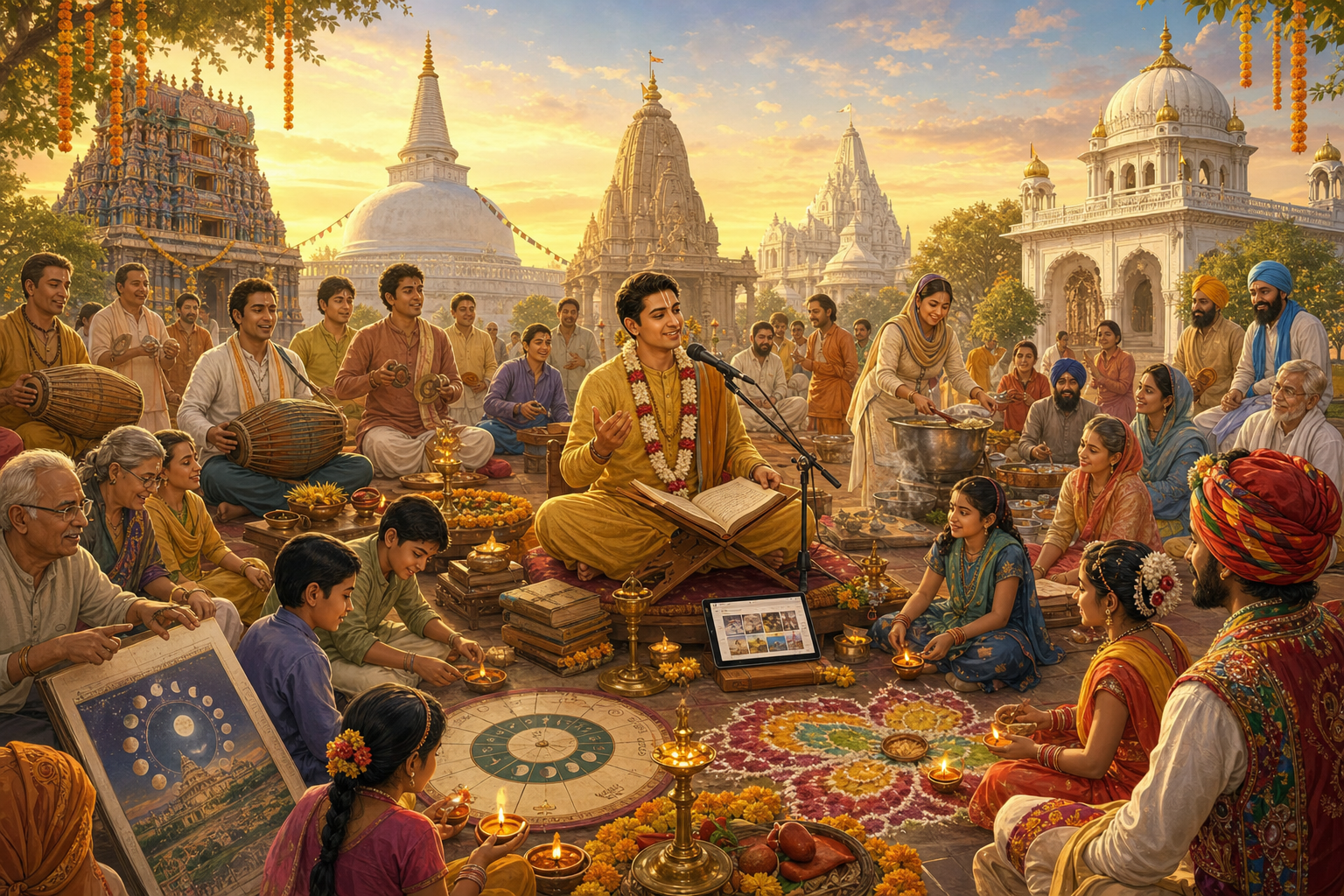
In the Loop, Education, Folk News, and Festivals presents an opportunity to examine how living traditions transmit knowledge outside the boundaries of formal classrooms. With only a thumbnail and title available from the source record, the most responsible approach is to develop the theme carefully rather than invent details from an inaccessible video or webpage. The title itself points toward a meaningful cultural framework: education as lived practice, folk news as community memory, festivals as public pedagogy, and Aniruddha Dasa as a devotional voice associated with the broader world of Hindu spirituality and cultural communication.
Education in dharmic civilization has never been limited to institutional instruction. Long before modern schooling systems became dominant, learning happened through guru-shishya parampara, temple culture, seasonal observances, pilgrimage routes, oral storytelling, music, ritual, family practice, village gatherings, and public festivals. A child watching elders prepare for Diwali, a young volunteer serving prasadam during Ratha Yatra, a family listening to Ramayana narration, or a community gathering for kirtan is not merely participating in an event. Each is entering a living classroom where memory, ethics, aesthetics, and spiritual orientation are transmitted together.
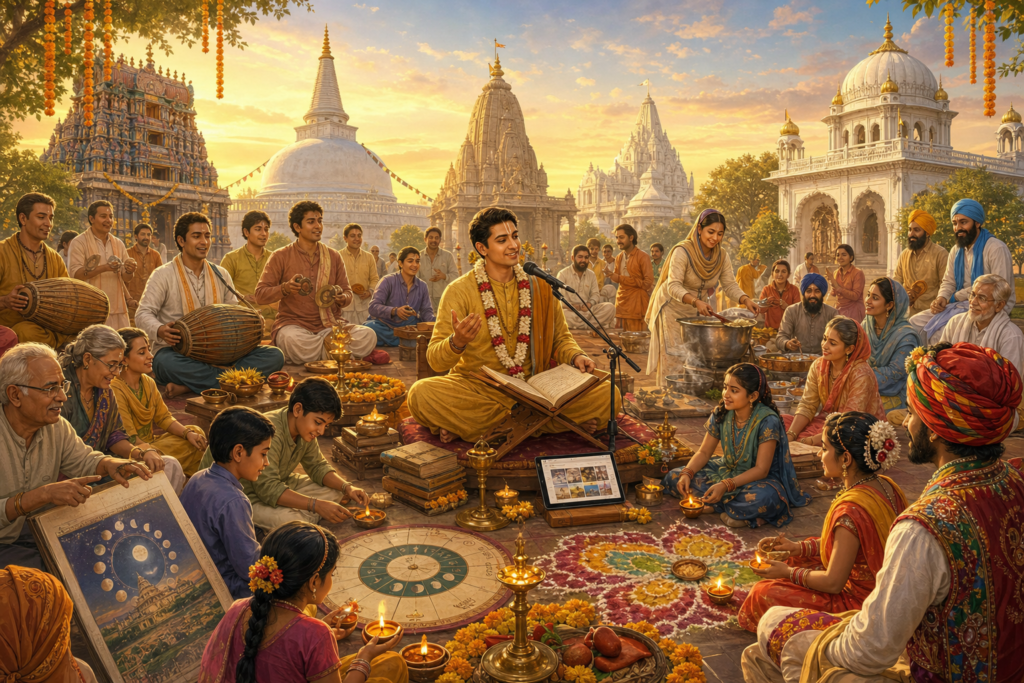
This wider understanding of education is especially important in the present age, when knowledge is often reduced to information and information is often consumed without context. Folk traditions resist that reduction. They teach through rhythm, repetition, symbol, emotion, and shared participation. A festival does not simply tell people that light overcomes darkness; it asks them to light lamps, clean homes, remember ancestors, share food, visit temples, reconcile with neighbors, and feel the meaning of renewal in the body. This is why Hindu festivals, Buddhist observances, Jain rituals, and Sikh gurpurabs continue to educate across generations even when formal instruction fails to communicate civilizational depth.
Folk news, in this context, can be understood as the flow of community knowledge that travels through local networks. It includes announcements of temple festivals, village fairs, spiritual gatherings, cultural performances, devotional music programs, pilgrimage updates, local acts of seva, and stories of artisans, priests, monks, granthis, teachers, dancers, singers, and householders who preserve tradition through ordinary work. Unlike commercial news, which often privileges conflict and spectacle, folk news gives attention to continuity. It records what communities actually do to keep meaning alive.
The educational value of such folk news is profound. When a community learns that a classical dance recital is connected to the Nāṭyaśāstra, that a temple procession follows an old sacred geography, that a village shrine preserves ecological memory, or that a festival calendar aligns human life with lunar and solar rhythms, news becomes more than an update. It becomes cultural literacy. It teaches people to recognize patterns that might otherwise be lost under the pressure of urban speed, digital distraction, and historical amnesia.
Festivals are among the most sophisticated educational systems in Indian civilization. They combine astronomy, agriculture, theology, aesthetics, ethics, social organization, economics, ecology, and emotional renewal. Makara Sankranti marks solar transition and harvest gratitude. Holi dramatizes social release, devotion, and seasonal change. Navaratri honors Shakti through discipline, music, fasting, worship, and community celebration. Diwali brings together Rama, Krishna, Lakshmi, Mahavira, Guru Hargobind Sahib, regional memory, household renewal, and the shared symbolism of light. Ratha Yatra makes divine movement visible in public space and reminds communities that darshan is not restricted to the inner sanctum alone.
This shared civilizational ecology also supports unity among dharmic traditions. Hinduism, Buddhism, Jainism, and Sikhism are distinct traditions with their own scriptures, philosophies, disciplines, lineages, and institutions. Yet they have long conversed through concepts such as dharma, karma, compassion, tapas, seva, ahimsa, meditation, renunciation, devotion, ethical action, and liberation. Public culture becomes healthier when these traditions are studied with respect for their differences and appreciation for their shared civilizational vocabulary.
For Hindu communities, festivals often serve as reminders of divine presence within daily life. The rhythm of puja, vrata, bhajan, kirtan, pilgrimage, and temple darshan transforms time into sacred time. For Buddhist communities, observances such as Vesak and meditation-centered gatherings preserve memory of the Buddha, the Dharma, and the Sangha while emphasizing mindfulness, compassion, and liberation from suffering. For Jain communities, Paryushan, Mahavir Jayanti, Pratikraman, and practices of restraint teach ahimsa, aparigraha, self-discipline, and purification of conduct. For Sikh communities, gurpurabs, Nagar Kirtan, langar, kirtan, and seva express devotion to the Guru, equality before the Divine, and responsibility toward society.
When viewed academically, these traditions show that festivals are not decorative additions to religion. They are methods of social formation. They organize memory, train emotion, shape moral imagination, and create networks of trust. A person who participates in langar learns equality through service. A child who observes elders performing Lakshmi Puja learns reverence, gratitude, and household responsibility. A Jain family observing forgiveness rituals learns that ethics must be practiced in relationships, not merely admired in scripture. A Buddhist practitioner entering a meditation retreat learns that inner discipline is a public good because calmer minds create more compassionate communities.
The phrase “in the loop” is useful because it suggests participation rather than passive observation. To be in the loop of culture is to remain connected to the rhythms, responsibilities, and stories that sustain a community. Modern individuals often experience tradition as fragmented content: a short video, a festival greeting, a forwarded image, or a simplified explanation. The challenge is to move from fragmented awareness to integrated understanding. Folk news and festival education can help bridge that gap when presented with accuracy, humility, and depth.
There is also a technical dimension to this subject. Festival calendars depend on complex systems of time reckoning, including tithi, nakshatra, masa, paksha, sankranti, lunar phases, solar transitions, regional calendars, and local temple traditions. These systems show the intellectual sophistication of Indian astronomy and ritual sciences. A date is not merely a date; it is located within a cosmological grammar. Understanding why Vaikunta Ekadashi, Guru Purnima, Chaitra Navratri, Akshaya Tritiya, or Kartika Purnima falls when it does requires attention to astronomy, regional custom, textual tradition, and lived practice.
Similarly, folk performance traditions carry layered knowledge. Yakshagana, Kathakali, Chhau, Bhuta Kola, Theyyam, Pandavani, Lavani, Garba, Bhangra, Odissi, Bharatanatyam, Kuchipudi, Sattriya, and countless local forms are not merely entertainment. They preserve narrative memory, regional language, theology, costume traditions, musical systems, martial movement, agricultural symbolism, and community identity. They educate through embodied form. The body becomes a text, the stage becomes a classroom, and the audience becomes a participant in cultural remembrance.
Devotional figures such as Aniruddha Dasa, when situated in this broader landscape, represent a recognizable pattern in contemporary dharmic communication: the teacher, presenter, kirtaniya, storyteller, or community educator who helps audiences reconnect with inherited knowledge. Such figures often operate between traditional authority and modern media. They translate concepts, narrate events, conduct discussions, and keep communities informed about festivals, education, and spiritual culture. The value of such work depends on fidelity to tradition, care in language, and the ability to unite rather than fragment dharmic communities.
A factual academic tone is especially necessary in this space because cultural content can easily become exaggerated, polemical, or sentimental. Accuracy matters. It is not enough to say that a festival is ancient; one must ask how it is attested, how it changed across regions, what texts or oral traditions support it, and how communities understand it today. It is not enough to praise folk culture; one must also document the artisans, performers, temple workers, scholars, women, elders, and volunteers who sustain it. Serious cultural writing should preserve devotion without abandoning discipline.
At the same time, cultural education should not become cold or detached. Festivals survive because they speak to human longing. People return to them because they remember the fragrance of incense in a childhood home, the sound of bells before dawn, the warmth of food served after worship, the discipline of fasting, the joy of singing together, the sight of lamps reflected in water, or the quiet dignity of elders explaining why a ritual matters. These experiences are not secondary to knowledge. They are part of how knowledge becomes durable.
Modern education systems can learn from this model. A curriculum that includes Hindu culture, Buddhist philosophy, Jain ethics, Sikh history, Indian classical arts, Sanskrit and regional literature, temple architecture, oral traditions, and festival calendars would not merely add “heritage content.” It would restore a more holistic understanding of knowledge. Students would learn that mathematics, astronomy, ecology, music, architecture, literature, philosophy, ritual, and ethics were historically intertwined. Such education builds rootedness without requiring hostility toward modernity.
The unity of dharmic traditions requires this balanced approach. Unity does not mean erasing differences. It means recognizing that differences can coexist within a larger culture of mutual reverence. Hindu bhakti, Buddhist mindfulness, Jain ahimsa, and Sikh seva each offer distinctive pathways of refinement. When these are presented respectfully, they strengthen one another by reminding society that spiritual life is not a single narrow method but a vast field of disciplined practice, ethical responsibility, and inner transformation.
Folk news can also counter cultural invisibility. Many important events in temples, monasteries, gurudwaras, Jain derasars, village shrines, Sanskrit schools, community kitchens, and local cultural centers receive little attention from mainstream media. Yet these spaces often do the quiet work of social cohesion. They feed people, teach children, support elders, preserve language, maintain calendars, sponsor music, keep manuscripts, organize pilgrimages, and provide moral continuity. Recording their work is not nostalgia; it is documentation of civil society in action.
Digital platforms have made this documentation easier but also more fragile. A video can reach thousands, but it can also disappear into algorithmic noise. A festival clip can inspire curiosity, but without explanation it may remain superficial. The future of dharmic education therefore depends on combining accessibility with depth. Short-form media can introduce a topic, but long-form essays, lectures, annotated calendars, translations, oral history projects, and community archives are needed to preserve understanding.
There is a practical model available here. Every festival report can include the date, region, tradition, principal deity or teacher, associated scripture or oral narrative, ritual practices, food customs, music, ecological context, ethical theme, and contemporary relevance. Every folk news item can identify the community, the institution, the people involved, and the cultural knowledge being preserved. Every educational program can connect practice with meaning. This approach turns content into a reliable resource rather than a passing update.
Such work is especially valuable for the diaspora. Hindu, Buddhist, Jain, and Sikh families living outside India often face the challenge of transmitting tradition across language gaps, school schedules, secular environments, and fragmented community structures. Festivals become anchor points. A child who may not yet read Sanskrit, Pali, Prakrit, Gurmukhi, Tamil, Telugu, Bengali, Gujarati, Kannada, Malayalam, Marathi, Hindi, or Odia can still learn through songs, food, stories, seva, and visual symbols. Over time, these experiences can lead to deeper study.
The deeper lesson is that culture remains alive when it is practiced, explained, and shared. Education gives structure. Folk news gives visibility. Festivals give rhythm. Spiritual insight gives purpose. Together, they form a loop of continuity in which each generation receives, interprets, and transmits. When this loop is broken, tradition becomes either museum material or identity slogan. When it is maintained with care, tradition becomes a living source of wisdom for family, community, and society.
Therefore, the theme suggested by In The Loop, Education, Folk News, Festivals – Aniruddha Dasa deserves serious attention. It points toward a model of cultural communication that is devotional without being careless, academic without being lifeless, and rooted without being exclusionary. In an age of distraction, such a model can help communities rediscover the educational power of festivals, the dignity of folk traditions, and the shared dharmic values that connect Hinduism, Buddhism, Jainism, and Sikhism across time.
Inspired by this post on Dandavats.



Leave a Reply
You must be logged in to post a comment.