
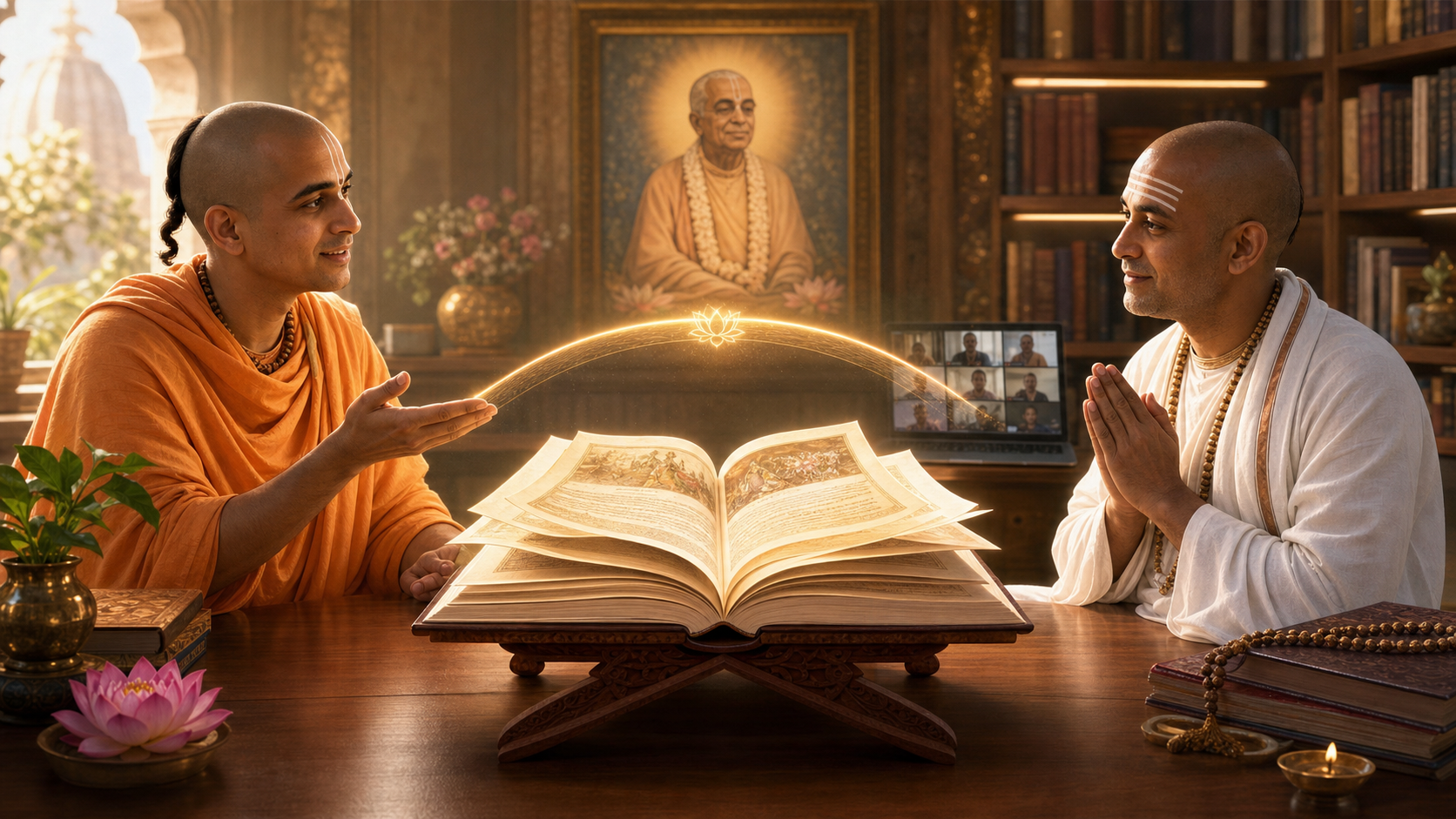
A striking appreciation for Srila Prabhupada and his Bhagavad-gita As It Is emerges from a simple yet revealing encounter: a monk from the Swaminarayana tradition in Gujarat sought guidance in studying the text. The request was significant not merely because it came from another Vaishnava sampradaya, but because it reflected a wider dharmic principle: sincere seekers often recognize spiritual substance across institutional boundaries when a scripture is presented with fidelity, clarity, and practical relevance.
The monk explained that his own tradition revered the study of the Bhagavad-gita. He referred to siksha-patri, described as a manual of good instructions, in which the importance of studying Bhagavad-gita is emphasized for sincere aspirants. Hearing repeatedly that ISKCON’s Bhagavad-gita As It Is offered a particularly clear and authoritative presentation, he approached devotees for assistance. In that moment, a familiar pattern in Hindu spiritual life became visible: learning is strengthened when traditions meet through humility rather than rivalry.
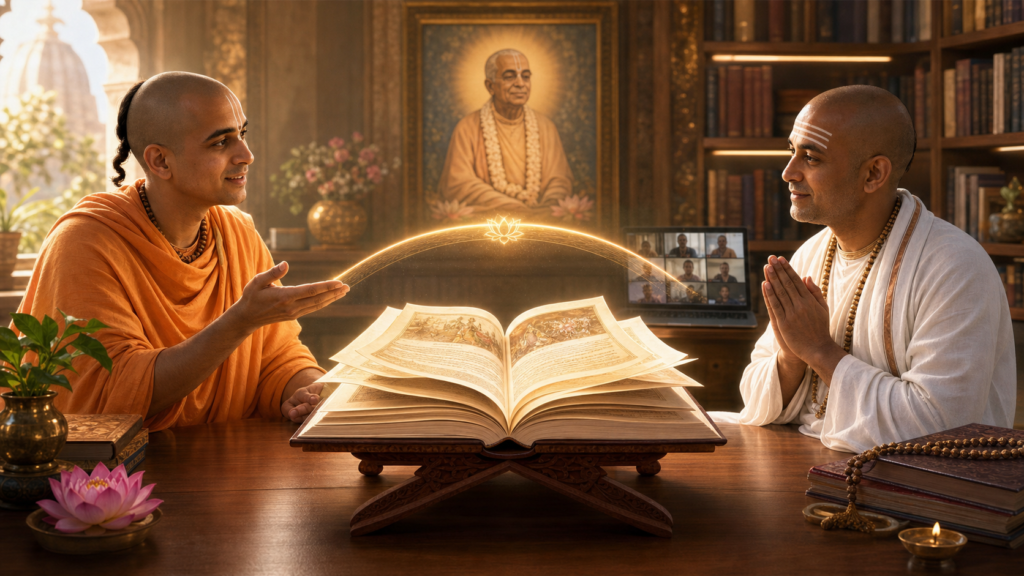
The context of the exchange was an online Bhagavad-gita study program. After joining the course and attending a lesson, the monk asked a question that was both simple and deeply perceptive: “How many books Srila Prabhupada has written? Has he written anything apart from Bhagavad-gita?” Such a question points to one of the most remarkable aspects of Srila Prabhupada’s public mission: his literary contribution was not a secondary activity beside preaching; it was central to his service, pedagogy, and global transmission of Vedic knowledge.
The tutor explained that Srila Prabhupada had made an extraordinary contribution to Vedic literature in English. Along with Bhagavad-gita As It Is, he produced extensive translations, commentaries, and summary studies of key Gaudiya Vaishnava scriptures, including major volumes of Srimad-bhagavatam and Caitanya-caritamrita. He also composed many other books, essays, letters, lectures, and instructional works that continue to shape the study of Krishna consciousness, bhakti, Vedanta, and practical devotional life across the world.
The monk’s response was one of astonishment. He wondered whether Srila Prabhupada had personally authored these works or relied on hired writers. The question was reasonable. Even a trained academic, professional editor, or full-time literary figure would find such a body of work difficult to produce. Srila Prabhupada’s writings were not fiction, casual reflections, or loosely inspired essays. They were scriptural translations and purports rooted in a living parampara, carrying philosophical precision, Sanskrit terminology, devotional theology, and ethical instruction for daily life.
The tutor clarified that the essential authorship was Srila Prabhupada’s own. Assistants helped by recording dictation, typing manuscripts, editing, printing, distributing, and organizing publication work, but the translation, commentary, theological emphasis, and instructional force came from Srila Prabhupada personally. This distinction matters because it shows the collaborative infrastructure of a global mission without reducing the central spiritual labor behind the texts. The books were not institutional products in the ordinary sense; they were the disciplined expression of a teacher carrying forward his guru’s instruction.
The Swaminarayana monk then remarked with wonder that such a contribution seemed humanly impossible and that Srila Prabhupada must have been a great personality. That observation carries more than admiration. It recognizes tapasya, scriptural mastery, discipline, and grace as visible qualities in a life dedicated to transmitting dharma. Within Hindu traditions, a guru is not measured only by eloquence or personal charisma, but by the capacity to make shastra intelligible, transformative, and applicable without diluting its essential meaning.
The emotional force of this moment lies in its inter-sampradaya respect. A monk from the Swaminarayana tradition did not approach the study of Bhagavad-gita As It Is as an outsider evaluating a competing institution. He approached as a seeker honoring Bhagavad-gita and recognizing the value of a serious commentary. Such exchanges strengthen dharmic unity because they remind Hindu society that reverence for shastra, guru, sadhana, and moral discipline can create bridges among diverse lineages.
A few weeks later, the monk wrote a letter appreciating Srila Prabhupada and Bhagavad-gita As It Is. He observed that in an age when countless books are published, only a few leave a substantial impact on readers. He placed Srimad Bhagavad-gita As It Is among those rare works. His appreciation focused on the book’s ability to explain deep and subtle truths in simple language, supported by relatable examples and analogies. This is one reason the text has remained influential among students, householders, monks, scholars, and devotional practitioners.
The monk also noted the force of Srila Prabhupada’s purports. He described them as bold teachings that pierce the heart, reach deeper layers of consciousness, and expose internal weaknesses such as lust, anger, and greed. In academic terms, this points to the ethical and psychological dimension of the commentary. Bhagavad-gita As It Is does not present spirituality as vague consolation. It repeatedly asks the reader to examine desire, ego, attachment, duty, devotion, and the nature of the self with seriousness.
This practical quality is especially important for the modern age. Many readers approach the Bhagavad-gita while struggling with anxiety, moral confusion, ambition, family responsibilities, professional pressure, and questions about identity. Srila Prabhupada’s presentation speaks directly to such concerns by connecting metaphysical truths with lived conduct. Concepts such as atman, karma, yoga, bhakti, guru, and surrender are not left as abstractions; they are related to food, work, speech, association, worship, discipline, and consciousness.
The letter further praised Srila Prabhupada’s tireless effort, noting his sleepless nights and full days spent rendering complex scriptures into accessible commentaries. This image is central to understanding his legacy. His work was performed in the later decades of his life, after he traveled from India to the West and founded ISKCON in 1966. The literary output that followed helped establish a global platform for the study of Bhagavad-gita, Srimad-bhagavatam, Caitanya-caritamrita, devotional practice, kirtan, prasadam, temple worship, and community-based Krishna bhakti.
From a technical literary perspective, Bhagavad-gita As It Is functions on several levels at once. It provides the Sanskrit verse, transliteration, word-for-word meanings, translation, and purport. This structure allows different kinds of readers to engage according to capacity. A beginner may read the translation and purport for meaning. A student of Sanskrit may examine the original terms. A practitioner may meditate on the devotional application. A researcher may study how Gaudiya Vaishnava Vedanta interprets the dialogue between Krishna and Arjuna.
The phrase “As It Is” is also theologically significant. It signals Srila Prabhupada’s intention to present the Bhagavad-gita through the disciplic succession rather than as a merely symbolic, secular, nationalist, psychological, or speculative text. This does not mean the work lacks philosophical depth; rather, its depth is anchored in devotion to Krishna as the Supreme Personality of Godhead. For readers within the bhakti tradition, this fidelity is precisely what gives the commentary its force.
At the same time, the episode invites a broader and constructive reflection for Hindu society. Dharmic traditions have always contained diversity: Vaishnava, Shaiva, Shakta, Smarta, Vedantic, Tantric, yogic, folk, temple-centered, monastic, and household-based streams have coexisted with different emphases. Mutual appreciation does not require erasing these distinctions. It requires recognizing sincerity, scriptural discipline, and spiritual fruits wherever they are found. The monk’s appreciation for Srila Prabhupada shows how such recognition can occur naturally.
Srila Prabhupada’s legacy is therefore not limited to one institution’s internal history. His books became a major channel through which Vedic literature reached global audiences in the twentieth century and beyond. For many readers outside India, Bhagavad-gita As It Is was their first encounter with Sanskrit scripture, Krishna, bhakti-yoga, prasadam, mantra meditation, and the philosophical vocabulary of Sanatana Dharma. For many readers within India, it renewed respect for a text they had heard about since childhood but had not studied systematically.
The appreciation from the Swaminarayana monk is powerful because it validates this contribution from a place of devotional seriousness. It recognizes that the true measure of a spiritual book is not only circulation, reputation, or institutional identity, but transformation. Does it clarify the mind? Does it challenge lower tendencies? Does it deepen reverence for Bhagavan? Does it encourage disciplined living? Does it inspire service? By these standards, the monk found Srila Prabhupada’s work deeply beneficial.
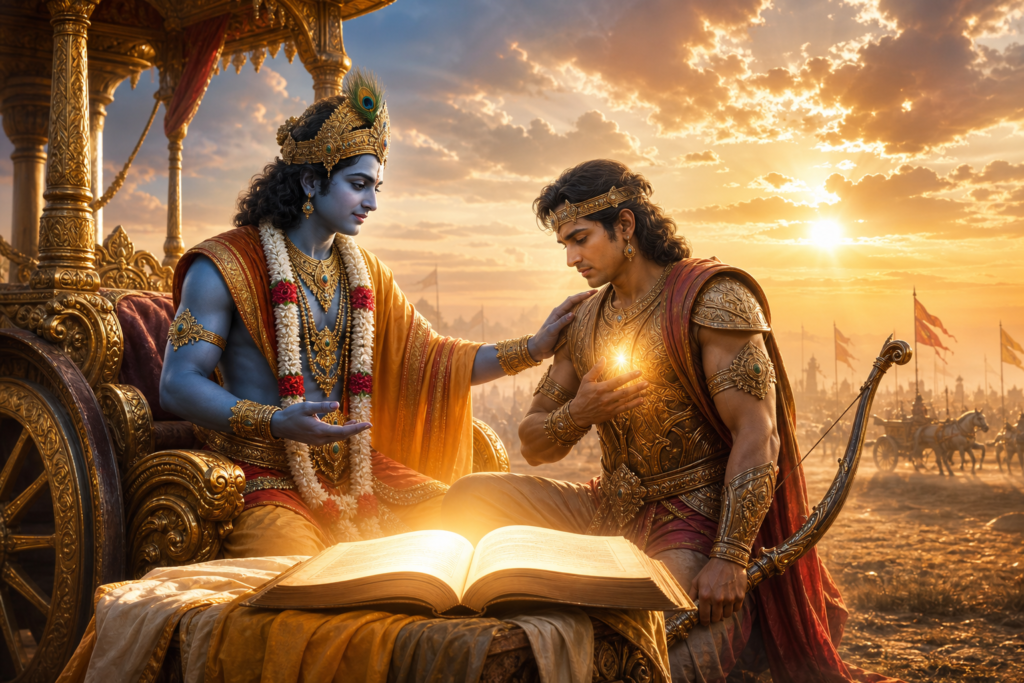
Such stories deserve to be remembered because they show how spiritual literature can become a meeting ground. The Bhagavad-gita itself is a dialogue born on a battlefield of crisis, duty, grief, and moral uncertainty. When studied through a sincere commentary, it can draw seekers from different communities into shared reflection on dharma, self-realization, devotion, and the purpose of human life. This is not sectarian narrowing; it is the strengthening of a common civilizational inheritance through serious study.
Srila Prabhupada’s Bhagavad-gita As It Is continues to inspire because it combines fidelity to shastra with an urgent concern for modern humanity. Its language is direct, its purports are uncompromising, and its purpose is practical spiritual transformation. The monk’s tribute captures this enduring significance: a sincere guru’s words, when rooted in purity, discipline, and parampara, can cross boundaries and awaken respect even among those formed in different but related dharmic lineages.
In that sense, this appreciation is not merely a compliment to one book or one teacher. It is a reminder of what Hindu spiritual culture can become when humility, study, reverence, and unity guide the search for truth. Srila Prabhupada’s work stands as a major contribution to Vedic literature, and the response of a fellow dharmic seeker affirms that genuine spiritual authority is recognized not by assertion, but by the clarity, discipline, and transformation it brings into human life.
Inspired by this post on Dandavats.




Leave a Reply
You must be logged in to post a comment.