
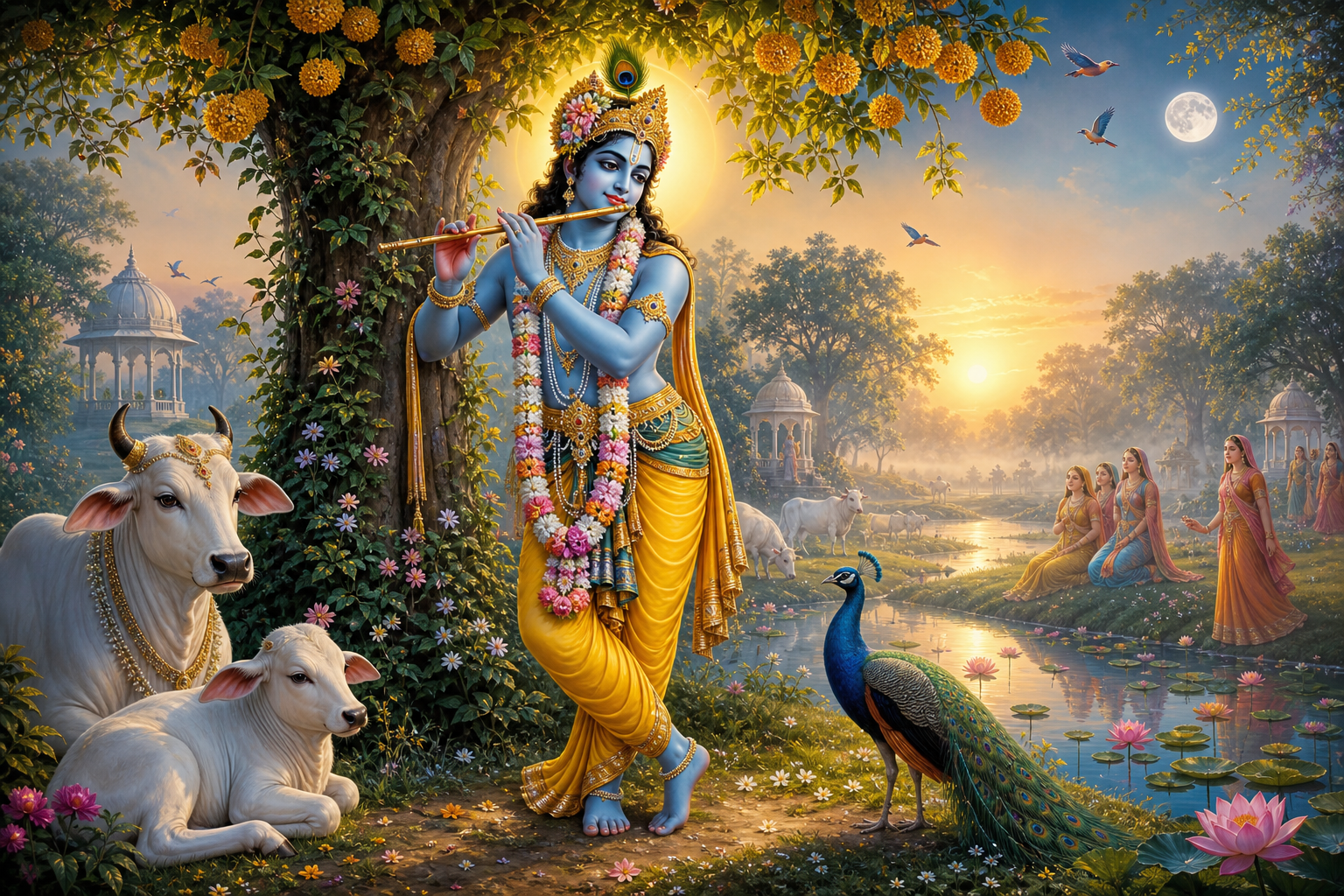
Madana Gopala is one of the most refined and emotionally resonant forms of Bhagavan Krishna. In this sacred image, Krishna appears not merely as a pastoral deity of Vrindavan, but as the supreme flute-bearer whose beauty, music, compassion, and playful sovereignty transform ordinary desire into devotion. The name brings together two powerful ideas: Gopala, the protector of cows and nourisher of beings, and Madana, a term associated with Kamadeva, the principle of attraction, longing, and love. The form therefore presents Krishna as the one who does not merely inspire love, but purifies and redirects it toward the divine.
In Vaishnava understanding, Madana Gopala is closely related to the devotional meanings of Venugopala, Madana Mohana, and Govinda. Venugopala emphasizes Krishna as the flute-playing cowherd; Madana Mohana emphasizes Krishna as the enchanter even of Kamadeva; Govinda emphasizes Krishna as the protector, guide, and delight of cows, the earth, and the senses. Madana Gopala stands at the meeting point of these meanings. The image is tender, graceful, and aesthetically captivating, yet its theological purpose is profound: it teaches that beauty is not separate from truth when it is rooted in dharma and bhakti.
The iconography of Madana Gopala is usually centered on Krishna in a youthful form, standing in an elegant posture while holding the flute. This posture is often described through the language of tribhanga, the graceful threefold bend of the body at the neck, waist, and knee. The body is not rigid like a ruler or warrior in command; it is fluid, musical, and relational. The curve of the form suggests rhythm, compassion, and intimacy. In temple art and devotional painting, this posture allows the image to communicate movement even when the murti is still.
The flute is the central emblem of Madana Gopala. Unlike a weapon, royal insignia, or scriptural manuscript, the flute is hollow, simple, and receptive. Its symbolism is deeply technical in devotional theology: the individual soul becomes an instrument only when ego, pride, and possessiveness are emptied. The breath of Krishna passing through the flute becomes the sound of divine will. For devotees, this image often carries an immediate emotional meaning. The call of the flute is not coercive; it invites. It does not command through fear; it awakens remembrance through love.
The association with Madana should not be misunderstood as ordinary sensuality. In the sacred vocabulary of Krishna bhakti, human longing becomes a starting point for spiritual refinement. Desire, when unexamined, binds the mind to restlessness. Desire, when illumined by devotion, becomes prema, the self-offering love celebrated in the Krishna tradition. Madana Gopala therefore represents the transformation of kama into bhakti. This is one of the most subtle achievements of Krishna iconography: it does not deny the emotional life of human beings, but sanctifies it through divine orientation.
Krishna’s dark-blue or rain-cloud complexion is another essential feature. Traditional descriptions compare this color to a monsoon cloud, suggesting fertility, relief, mystery, and nourishment. The cloud holds water for the earth; Krishna holds grace for beings. The blue-black radiance also conveys transcendence. It resists complete visual capture, reminding the devotee that the divine form is accessible to love but never exhausted by description. In Madana Gopala, this color deepens the contrast between visible beauty and immeasurable divinity.
The peacock feather, often placed in Krishna’s crown, adds another layer of meaning. The peacock is associated with beauty, rain, dance, and celebration. Its many-colored eye-like pattern has been read as a symbol of cosmic awareness, while its natural brilliance softens the royal authority of the crown. Krishna as Madana Gopala is not a distant monarch sitting beyond the reach of the heart. He is crowned, but he is also approachable. He is supreme, yet he stands among forests, cows, companions, and music.
The yellow garment, commonly called pitambara, is equally significant. Yellow is associated with auspiciousness, earth, vitality, and sacred radiance. When placed against Krishna’s dark form, the garment creates a visual theology of union: transcendence and immanence, mystery and manifestation, sky-like depth and earth-like warmth. The ornaments, garlands, anklets, armlets, and necklaces are not merely decorative additions. They express the fullness of divine beauty as understood in Hindu art and temple worship.
The vanamala, or forest garland, is especially important in the pastoral iconography of Krishna. It connects Madana Gopala to Vrindavan, where nature is not a passive background but a participant in devotion. Trees, flowers, rivers, birds, cows, and the dust of the cowherd paths are all drawn into the sacred world of Krishna. This ecological dimension is often overlooked in modern readings of iconography. Madana Gopala’s beauty is not urban, imperial, or detached from living landscapes; it is woven into a dharmic vision of harmony between the divine, the human, and the natural world.
Cows near Madana Gopala are not incidental symbols. As Gopala, Krishna is the protector of cows, but the meaning extends beyond animal care alone. The cow represents nourishment, patience, abundance, and the non-violent economy of care that is central to many Hindu traditions. In the presence of Madana Gopala, the cow becomes a theological witness: divine love protects the vulnerable and sustains the community. The image therefore joins beauty with responsibility.
Radha and the gopis, when present in the iconographic setting, deepen the emotional and theological field of the image. They represent the soul’s response to Krishna’s call. Their longing is not presented as social disorder but as a symbol of complete spiritual absorption. In many Vaishnava traditions, Radha is the highest embodiment of devotion, the one whose love reveals Krishna most fully. When Madana Gopala is contemplated with Radha, the form becomes an icon of reciprocal divinity: Krishna attracts the devotee, and devotion reveals Krishna.
The rasa tradition provides an important interpretive key. Rasa does not mean emotion in a casual sense; it refers to refined aesthetic experience, spiritually tasted and contemplated. The form of Madana Gopala belongs especially to madhurya, the mode of sweetness. Madhurya does not erase majesty; rather, it allows divine majesty to become intimate. This explains why Krishna can be worshipped as the supreme reality and loved as a child, friend, beloved, and cowherd. The iconography permits theology to become emotionally accessible without losing philosophical depth.
Scriptural foundations for this form are found across the Krishna-centered devotional imagination, especially in the Bhagavata Purana and later Vaishnava traditions. The Bhagavata Purana presents Krishna’s flute, Vrindavan pastimes, cowherd identity, and power of attraction as central to the mystery of divine play. Later devotional literature, temple practice, music, poetry, and painting expand these themes into a rich iconographic vocabulary. Madana Gopala is therefore not a random artistic invention; the form grows from a long continuity of scripture, worship, aesthetics, and lived devotion.
From a technical iconographic perspective, the hands of Madana Gopala are often arranged to hold the flute near the lips. The legs may be crossed or gently bent, with one foot bearing the weight and the other relaxed in lyrical balance. The face is serene rather than severe. The eyes are elongated and compassionate, suggesting that the deity sees the devotee with both intimacy and omniscience. The smile is subtle, not theatrical. It is the smile of one who knows the hidden ache of beings and answers it through grace.
The surrounding elements vary by region, lineage, and artistic medium. In some murtis, Madana Gopala appears alone as the flute-bearing Krishna. In others, he appears with Radha, with cows, with gopas and gopis, or beneath a kadamba tree. In paintings, the Yamuna, moonlight, lotus ponds, and flowering groves may be included. These additions are not merely scenic details. They create a sacred geography in which Vrindavan becomes the inner landscape of devotion.
Theologically, Madana Gopala resolves an important tension. Spiritual traditions often warn against attachment, yet human beings are naturally emotional, relational, and beauty-seeking. The form does not ask devotees to become emotionally barren. Instead, it teaches discernment. Attraction becomes destructive when it is ruled by ego; attraction becomes liberating when it turns toward the divine. This is why Krishna can be linked with Madana while also surpassing Madana. The power of love is acknowledged, disciplined, and lifted into sacred awareness.
This transformation has practical spiritual significance. A devotee standing before Madana Gopala may bring longing, grief, attachment, confusion, gratitude, or joy. The image receives all these movements of the heart and redirects them toward steadiness. The flute suggests listening; the posture suggests grace; the smile suggests acceptance; the pastoral setting suggests belonging. Such iconography functions as visual theology, but also as a disciplined emotional education.
Madana Gopala also illuminates the wider unity of Dharmic traditions. Hindu, Buddhist, Jain, and Sikh traditions differ in metaphysics, ritual structures, and theological language, yet they share a serious concern with desire, discipline, compassion, and liberation from ego-centered living. In the Krishna tradition, desire is transfigured through loving devotion. In other Dharmic traditions, it may be restrained through wisdom, ethical discipline, meditation, seva, or non-attachment. These paths need not be placed in opposition. Madana Gopala offers one luminous Hindu expression of a broader Dharmic insight: the inner life must be refined, not abandoned to impulse.
The form is also important for understanding Hindu aesthetics. Beauty in this tradition is not treated as superficial ornament. Sacred beauty is a means of knowledge. The carefully proportioned body, the musical gesture, the ornaments, the colors, the natural setting, and the emotional mood all work together to train perception. The devotee learns to see the world as charged with divine presence. In this sense, Madana Gopala is not only an object of worship but a method of contemplation.
Temple worship further expands the meaning of the form. Darshan is not merely looking at an image; it is a reciprocal encounter in which the devotee sees and is seen. Offerings of flowers, lamps, incense, food, and music are not symbolic gestures alone. They enact the relationship between the human community and the deity. In the worship of Madana Gopala, music and fragrance take on particular importance because they resonate with the form’s core themes of sweetness, attraction, and divine intimacy.
Music is especially inseparable from this iconography. The flute represents sound before it becomes doctrine, experience before it becomes argument. Many devotees understand Krishna’s flute as the call of the divine within conscience, memory, and longing. It is heard differently by each soul, yet its source is one. This makes the form deeply inclusive within the bhakti framework. Madana Gopala does not erase individuality; he harmonizes it through devotion.
In artistic history, Krishna’s flute-bearing form has inspired sculpture, miniature painting, temple murals, devotional songs, classical dance, and domestic worship. Bharatanatyam, Odissi, Kathak, Kuchipudi, and other Indian classical traditions have repeatedly returned to Krishna’s tribhanga posture, flute gesture, and rasa-filled presence. The reason is clear: the form contains narrative, philosophy, emotion, and rhythm in a single visual grammar. Madana Gopala is therefore not only a religious image but a civilizational motif within Indian culture.
The phrase divine love can easily become sentimental if detached from discipline. Madana Gopala prevents that reduction. His love is not indulgence; it is transformative. His beauty is not vanity; it is revelation. His music is not entertainment; it is an invitation to awaken. His pastoral tenderness is not weakness; it is the strength of protection without domination. The icon therefore speaks to both the heart and the intellect.
For contemporary readers, this form remains relevant because modern life often separates desire from responsibility, beauty from sanctity, and emotion from wisdom. Madana Gopala offers a different model. Love becomes sacred when it is purified by self-giving. Beauty becomes meaningful when it leads beyond self-absorption. Relationship becomes spiritual when it reveals the divine presence in another being. These insights make the iconography more than an inherited artistic convention; they make it a living resource for ethical and spiritual reflection.
The enduring power of Madana Gopala lies in this integration. He is the cowherd and the cosmic Lord, the flute-player and the teacher of inner transformation, the beloved of Vrindavan and the supreme attractor of consciousness. His form gathers sound, color, posture, nature, devotion, and philosophy into one complete vision. To contemplate Madana Gopala is to encounter Krishna as divine beauty made approachable, divine love made visible, and cosmic grace made intimate.
Inspired by this post on Hindu Blog.






Leave a Reply
You must be logged in to post a comment.