
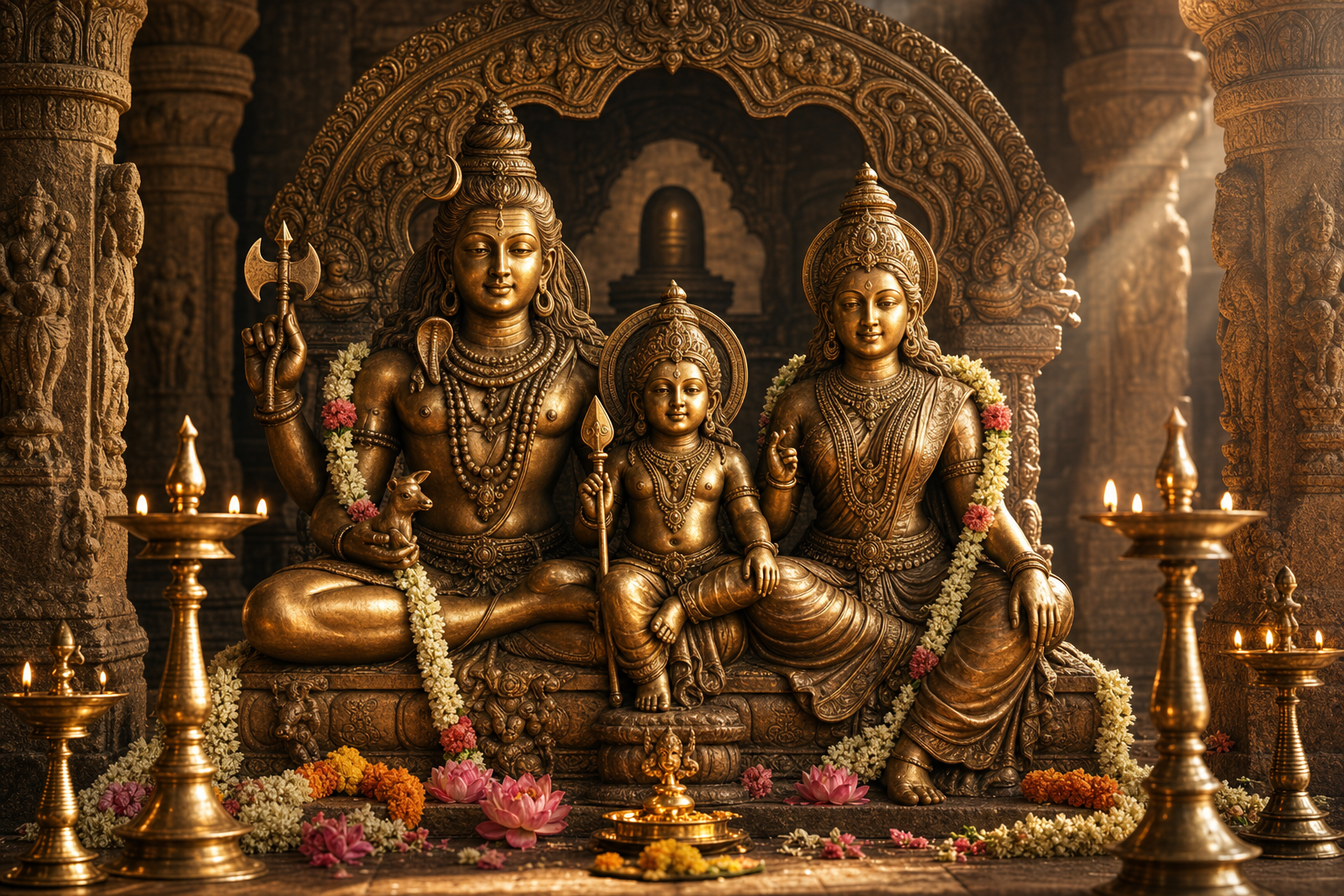
The Somaskanda Murti occupies a special place in the visual and theological imagination of South Indian Hindu temple culture. Among the many forms of Lord Shiva preserved in stone, bronze, ritual memory, and sacred architecture, this image is remarkable because it does not present Shiva as an isolated ascetic, cosmic dancer, fierce destroyer, or abstract linga alone. Instead, it presents him as Shiva seated with Uma, also known as Parvati, and their son Skanda, also known as Kumara, Muruga, Subrahmanya, or Kartikeya. The name itself expresses the theology of the form: Sa, meaning “with,” Uma, the divine mother, and Skanda, the divine child. The image is therefore not merely a family portrait; it is a carefully composed statement about grace, power, continuity, devotion, and the sacred wholeness of household life.
In South Indian temples, especially those shaped by Pallava and Chola artistic traditions, Somaskanda became one of the most meaningful forms through which Shaiva philosophy could be seen rather than only explained. The murti communicates several layers at once. It speaks to the devotee emotionally as an image of divine intimacy. It speaks to the ritualist as a temple icon associated with worship, procession, and festival life. It speaks to the art historian as a marker of Pallava innovation and Chola refinement. It speaks to the philosopher as a visual grammar of Shiva and Shakti, consciousness and energy, stillness and manifestation, transcendence and embodied love.
The historical development of Somaskanda is closely associated with the Pallava period in Tamil Nadu, particularly between the seventh and eighth centuries CE. Pallava temples at Kanchipuram, Mamallapuram, and related sites preserve some of the most important early examples of this form. In the Kailasanathar Temple at Kanchipuram, one of the great early structural temples of South India, Somaskanda panels appear in repeated and deliberate ways. At the Shore Temple of Mamallapuram, a monument associated with early Dravidian stone architecture and later recognized within the UNESCO-listed Group of Monuments at Mahabalipuram, Somaskanda reliefs are found on the rear walls of Shiva sanctums. This placement is not accidental. It suggests that the form carried deep ritual and theological significance in the Pallava sacred imagination.
The iconographic arrangement is usually stable but never artistically lifeless. Shiva is seated, often in a composed posture that conveys both royal dignity and yogic inwardness. Uma sits beside him, graceful and self-possessed, not as a secondary ornament but as the indispensable presence of Shakti. Between them appears Skanda, the child who completes the composition and transforms the image from a dyad into a sacred family. In many early representations, Skanda may be shown as a child standing or dancing between the parents, sometimes with a sense of animated joy that softens the majesty of the divine couple. The result is an image in which cosmic authority is brought close to human emotional understanding.
From a technical iconographic perspective, Shiva in Somaskanda is often shown with four arms. The upper hands may hold attributes such as the axe and deer, both of which carry established Shaiva meanings. The axe suggests the cutting away of bondage, ignorance, and limitation. The deer, restless and delicate, is often read as a sign of the mind brought under divine mastery. The lower hands may appear in gestures of assurance, composure, or symbolic expression. Uma is usually represented with two arms, seated in calm proximity to Shiva, while Skanda occupies the central space between them. The central placement of the child is crucial because it makes the image a theology of relationship rather than a mere grouping of figures.
The Somaskanda form also reveals the distinctive Tamil religious environment in which Muruga worship, Shaiva devotion, temple ritual, and royal patronage interacted. Muruga was never a marginal figure in Tamil cultural memory. He was celebrated in ancient Tamil literature as a youthful, radiant, martial, and deeply beloved deity. When the Pallava sacred world expressed Shiva, Uma, and Skanda together, it created a visual synthesis that honored both Sanskritic Shaiva theology and Tamil devotional inheritance. This is one reason Somaskanda is so important: it demonstrates how Hindu traditions often grow through integration, not erasure. Local devotion and pan-Indian theology are brought into harmony within a single sacred image.
The murti’s symbolism rests on the inseparability of Shiva and Shakti. Shiva without Shakti is pure consciousness, silent, still, and transcendent. Shakti without Shiva is dynamic energy, creative movement, and manifesting power. In Somaskanda, Uma is not simply “beside” Shiva in a domestic sense; she is the principle through which divine consciousness becomes accessible as compassion, fertility, beauty, protection, and embodied grace. Skanda, placed between them, becomes the living fruit of this union. He represents divine power born from harmony, disciplined energy, protection of dharma, and the continuity of sacred knowledge across generations.
For this reason, Somaskanda may be read as one of the most balanced visual teachings in Shaiva iconography. Shiva’s ascetic dimension is present, but it does not deny the household. Uma’s maternal and regal dignity is present, but it does not reduce her to domesticity. Skanda’s youthful energy is present, but it is held within the order of dharma. The murti therefore presents a vision in which renunciation and relationship are not enemies. The highest truth can be realized in meditation, temple worship, family duty, disciplined action, and loving participation in the world.
This teaching has lasting relevance because many modern readers assume that spirituality requires withdrawal from ordinary life. Somaskanda quietly challenges that assumption. It shows that sacred life is not limited to forests, caves, monasteries, or philosophical abstraction. The divine can also be contemplated through the tenderness of parent and child, the dignity of partnership, the responsibility of lineage, and the daily discipline of sustaining a household. In this sense, the murti gives visual form to a deeply Indian understanding: dharma is not merely an idea but a lived order that includes knowledge, duty, affection, restraint, worship, and social continuity.
The placement of Somaskanda panels in Pallava temples deepens this meaning. In several early temples, the panel appears on the rear wall of the sanctum, behind or near the principal Shiva linga. This relationship between the linga and the Somaskanda relief is theologically rich. The linga points toward Shiva as the aniconic, infinite, unbounded principle: the mark of the formless divine. The Somaskanda panel gives that same reality a relational and devotional form. Together, they create a complete contemplative movement: from the abstract to the personal, from the infinite to the intimate, from metaphysical truth to embodied grace.
The Pallava contribution to Somaskanda is especially important because Pallava art helped shape the future of South Indian temple architecture. Their experiments in rock-cut shrines, monolithic forms, and structural temples created models that later dynasties developed with extraordinary sophistication. Under the Cholas, bronze casting reached a high point, and the Somaskanda theme continued in metal icons used in ritual and procession. Chola bronzes are not static museum objects in their original context; they are living ritual forms meant to receive worship, be adorned, carried, sung to, and encountered by devotees during temple festivals. A Somaskanda bronze therefore extends the theology of the stone panel into public sacred life.
The Chola period also refined the emotional and aesthetic vocabulary of divine form. Chola bronzes are celebrated for their supple modeling, balanced posture, rhythmic movement, and luminous presence. When applied to Somaskanda, this artistic refinement makes the sacred family feel both transcendent and near. Shiva remains majestic, Uma remains serene, and Skanda carries the charm of divine childhood. The bronze medium adds another layer of meaning because it allows the deity to move from the sanctum into the streets, from the inner temple to the wider community. Through procession, the divine family becomes visible to all, reinforcing the temple as a shared cultural and spiritual center.
Somaskanda is also connected with the Thyagaraja tradition of Tiruvarur, where Shiva as Thyagaraja is associated with profound ritual, music, and devotional imagination. While Somaskanda and Thyagaraja are not identical in every theological context, the connection shows how a single iconographic form can be interpreted through different regional traditions. In Tiruvarur, the sacred presence of Shiva is woven into temple procession, music, dance, and the memory of the Tamil Shaiva saints. The form becomes not only an image to be studied but a living node of bhakti, ritual continuity, and community identity.
The theological beauty of Somaskanda lies in its refusal to separate power from tenderness. Skanda is a warrior deity, the commander of divine forces, and the one who defeats destructive forces in many sacred narratives. Yet in this murti, he is first seen as the child of Shiva and Uma. This is not a contradiction. It suggests that true strength is born from rootedness, discipline, love, and divine order. Power without dharma becomes disorder; power nurtured by wisdom becomes protection. In this way, Somaskanda offers a subtle teaching on leadership, courage, and responsibility.
The image also offers a constructive model for understanding unity among dharmic traditions. Hinduism, Buddhism, Jainism, and Sikhism differ in theology, metaphysics, ritual forms, and historical development, yet they share deep civilizational concerns: discipline, ethical refinement, liberation from ignorance, reverence for truth, and the transformation of the human being. Somaskanda belongs specifically to Shaiva Hindu tradition, but its visual teaching of harmony, restraint, compassion, and sacred responsibility can be appreciated across dharmic frameworks. It does not demand uniformity; it demonstrates ordered plurality. Shiva, Uma, and Skanda remain distinct, yet their unity is complete.
This principle of unity without sameness is one of the great strengths of Indian sacred art. A temple may contain Shiva, Vishnu, Devi, Ganesha, Skanda, Surya, local guardian deities, saints, river goddesses, and narrative panels from the Puranas and Itihasas. The purpose is not confusion but layered belonging. Somaskanda reflects this same worldview at a smaller scale. The family is one, but each figure retains identity. The composition is balanced, but not flattened. The devotee is invited to contemplate relationship as a sacred order rather than as a loss of individuality.
In iconographic study, posture and spacing matter as much as attributes. Shiva’s centered calm communicates sovereignty over the senses and the mind. Uma’s poised presence communicates grace, fertility, wisdom, and the sustaining dimension of Shakti. Skanda’s central position communicates generative continuity. The empty spaces between the figures are also meaningful because they allow the viewer to perceive relationship rather than crowding. The sculptor’s task was not merely to carve bodies but to carve theological balance into stone. Successful Somaskanda images create stillness without stiffness and intimacy without sentimentality.
The murti should also be understood within the broader category of Hindu sculpture as sacred technology. A temple image is not simply decorative art. It is shaped according to inherited principles of proportion, gesture, placement, and ritual suitability. Its beauty is not separate from its function. The form educates the eye, disciplines the mind, and prepares the heart for darshan. In Somaskanda, darshan becomes especially tender because the devotee encounters the divine not as distant abstraction but as a family whose stillness radiates protection and belonging.
Modern heritage discussions have added another dimension to the study of Somaskanda. Many South Indian bronzes, including images connected with Shiva, Uma, Skanda, and other temple deities, have been removed from their original ritual environments over the last several centuries through collecting, colonial movement, illegal trade, or inadequate provenance practices. Recent repatriation efforts involving Tamil Nadu bronzes show that sacred images are not merely portable works of art. They belong to communities, temples, lineages, and ritual histories. A Somaskanda image removed from its temple loses more than location; it loses the sound of bells, the scent of lamps, the rhythm of festivals, and the community of devotees who understand it as a living presence.
At the same time, careful academic study and responsible museum practice can help recover context when objects have been displaced. Documentation, provenance research, inscriptional study, stylistic comparison, and collaboration with source communities all matter. Somaskanda therefore belongs not only to theology and aesthetics but also to ethical heritage preservation. To study the murti seriously is to respect its ritual origin, regional identity, and continuing sacred value. The image is not exhausted by art history, but art history can help illuminate its journey.
The emotional force of Somaskanda comes from its accessibility. Even without technical training, a visitor can stand before the image and recognize a grammar of care. The father is still, the mother is graceful, the child is central, and the whole composition breathes order. For those who know Shaiva philosophy, the image opens into metaphysics. For those who know Tamil Muruga devotion, it opens into cultural memory. For those who know temple ritual, it opens into worship. For those who simply see a family, it opens into tenderness. This ability to speak at many levels is the mark of great sacred art.
Somaskanda also helps correct a common misunderstanding about Hindu iconography. The many forms of the divine are not random multiplication. Each form reveals a specific insight into reality. Nataraja reveals cosmic rhythm. Dakshinamurthy reveals silent teaching. Lingodbhava reveals the infinite pillar of light beyond comprehension. Ardhanarishvara reveals the unity of masculine and feminine principles. Somaskanda reveals divine relationship, lineage, and the sanctification of embodied life. Together, these forms create a vast philosophical vocabulary in visual language.
The sacred family of Shiva, Uma, and Skanda therefore deserves attention not only as a beautiful sculptural motif but as a complete theological teaching. It shows that the divine is beyond form and yet graciously enters form. It shows that power is highest when joined with wisdom. It shows that family, when ordered by dharma, can become a field of spiritual growth. It shows that regional devotion and pan-Indian philosophy can enrich one another. It shows that temple art is not silent stone but a disciplined language of revelation.
In the end, the Somaskanda Murti endures because it resolves tensions that human beings still feel: solitude and relationship, transcendence and tenderness, authority and love, tradition and renewal. Its message is not limited to the past. In an age often marked by fragmentation, the image offers a vision of centered harmony. Shiva sits in stillness, Uma radiates sustaining grace, and Skanda stands as the promise of protected continuity. The sacred family becomes a form of divine teaching, carved in stone, cast in bronze, carried in procession, and preserved in the living memory of South Indian temples.
Inspired by this post on Hindu Blog.




Leave a Reply
You must be logged in to post a comment.