
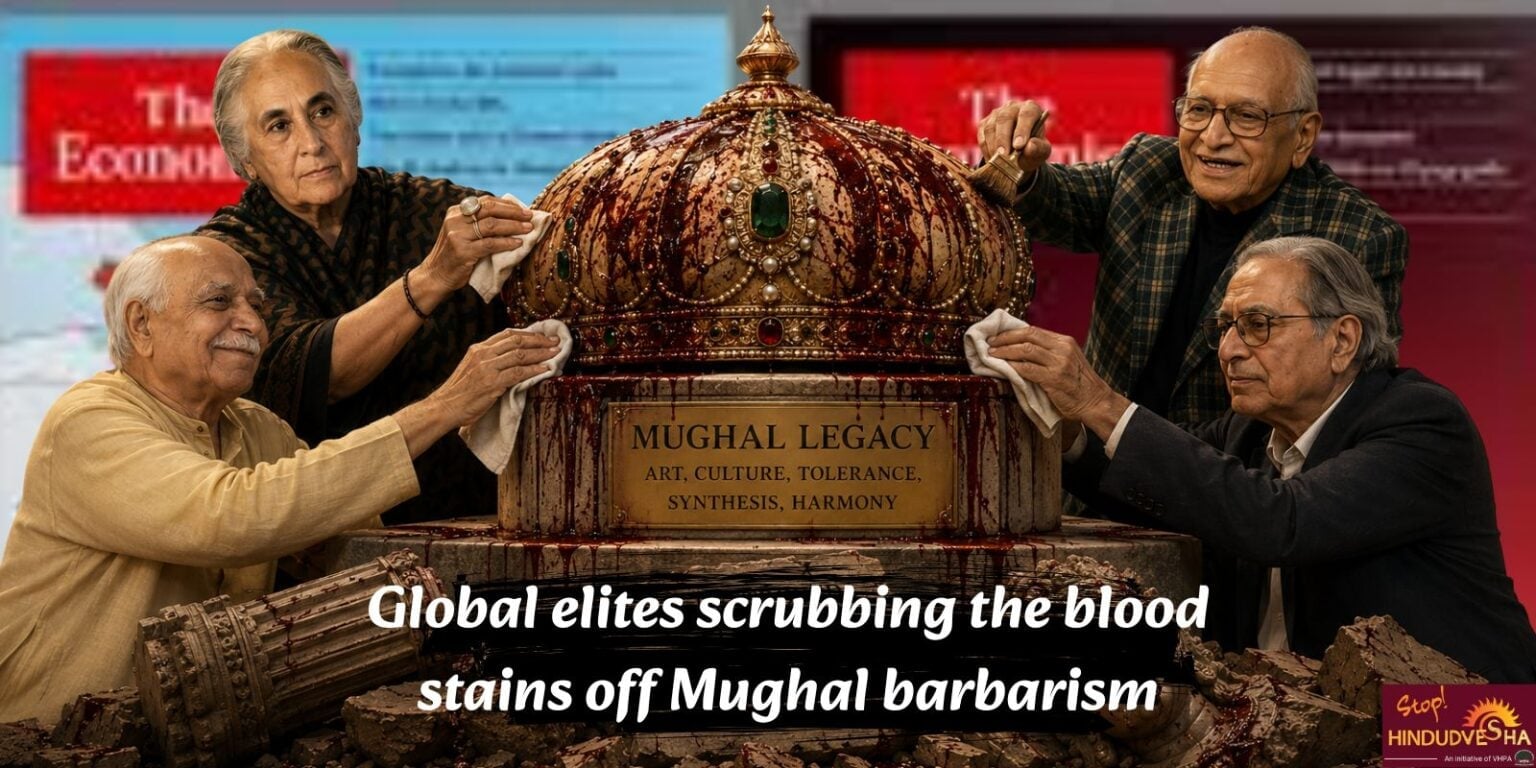
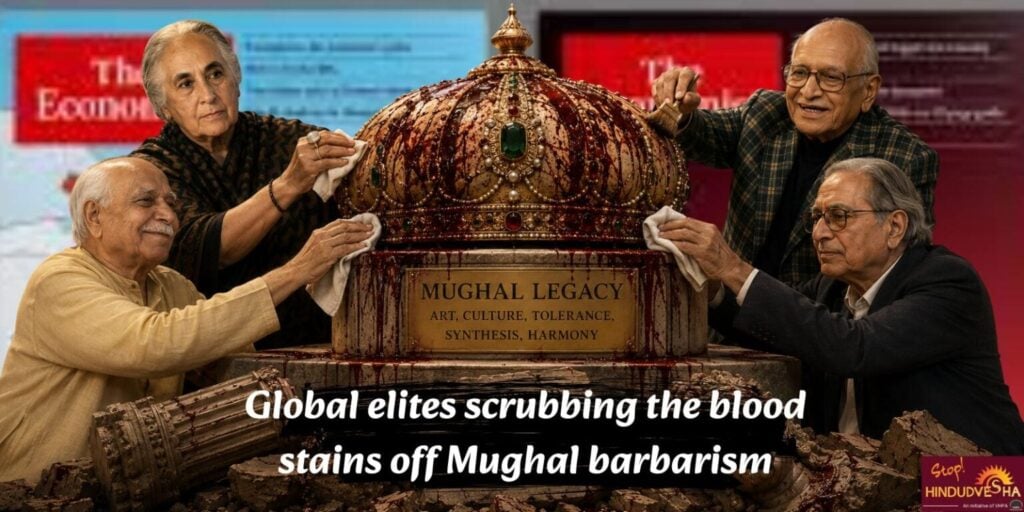
The debate over The Economist’s treatment of the Mughal legacy is not merely a dispute about medieval kings, monuments, or textbook chapters. It reflects a larger contest over Bharat’s historical memory, civilizational self-understanding, and the power of global media institutions to decide which parts of Indian history deserve sympathy and which parts must remain uncomfortable footnotes. When influential publications lament India’s supposed neglect of the Mughal Empire while giving limited attention to temple destruction, religious coercion, political violence, and civilizational disruption, the result is not balanced history. It becomes a selective moral framework in which imperial aesthetics are foregrounded while the suffering of conquered communities is pushed aside.
This issue matters because history is not an abstract archive for ordinary families. For many Indians, it is encountered through childhood textbooks, school excursions, public monuments, films, television serials, museum labels, and the inherited memory of temples, pilgrimage routes, sacred geography, and community trauma. A child who repeatedly sees Mughal courts presented as the height of refinement while Hindu, Buddhist, Jain, and Sikh civilizational institutions are treated as peripheral may absorb a distorted picture of Bharat. Such a child may come to believe that India’s deepest cultural achievements began with its conquerors rather than with its own ancient philosophical, artistic, scientific, and spiritual traditions.
The recurring celebration of Mughal rule in elite commentary often rests on a narrow cultural lens. Architecture, cuisine, courtly painting, language, music, textiles, and administrative systems are invoked as evidence of greatness. These themes are not irrelevant; no serious historical assessment should deny that imperial courts produced material culture, patronized artists, and shaped aspects of public life. The problem begins when these contributions are treated as moral absolution. A palace, manuscript, garden, or mausoleum cannot erase the documented realities of conquest, coercion, heavy taxation, iconoclasm, sectarian policy, and the political subordination of indigenous traditions.
The phrase “Ganga-Jamuni Tehzeeb” is often used to describe a composite culture that emerged in parts of north India under centuries of interaction. At its best, the phrase can acknowledge shared artistic forms, linguistic exchange, and everyday coexistence among communities. Yet it becomes intellectually dishonest when used as a veil over asymmetrical power. Cultural exchange under imperial domination cannot be understood in the same way as exchange among equal communities. A society may absorb influences from rulers, traders, migrants, saints, poets, and artisans, but the presence of hybrid cultural forms does not cancel the record of political violence or religious humiliation imposed by sections of the ruling elite.
The Mughal Empire must therefore be studied with a full historical vocabulary. Babur’s conquests, Akbar’s experiments in statecraft and religious policy, Jahangir’s court culture, Shah Jahan’s monumental architecture, and Aurangzeb’s long reign all require careful differentiation. Academic seriousness does not require crude simplification. At the same time, academic seriousness also cannot permit romantic simplification. Aurangzeb’s temple destructions, reimposition of jizya, conflicts with Hindu rulers, actions against Sikh Gurus, and wider record of religiously inflected imperial policy cannot be dismissed as minor details because they disturb a polished narrative of refinement.
Temple destruction in medieval India is a particularly sensitive subject because temples were not only places of worship. They were civilizational institutions: centers of learning, music, dance, land management, community gathering, charity, sacred memory, and local sovereignty. To attack a temple was often to attack a community’s political dignity and metaphysical world. The same holds, in different contexts, for monasteries, gurudwaras, Jain temples, pilgrimage centers, and sacred libraries. A Dharmic reading of history must therefore recognize that violence against one tradition’s sacred institution weakens the civilizational fabric shared by all Dharmic traditions.
This broader Dharmic perspective is essential. The objective is not to cultivate hostility toward present-day communities, nor to reduce Indian Muslims to the deeds of medieval rulers. Such collective blame would be ethically wrong and historically careless. The proper distinction is between people and political regimes, between living neighbors and imperial structures, between faith as practiced by ordinary families and state power as exercised by conquerors. Bharat’s civilizational renewal becomes healthier when it combines historical clarity with social responsibility.
The criticism of Mughal nostalgia is strongest when it avoids reactionary exaggeration and focuses on evidence, proportion, and intellectual fairness. The question is not whether every Mughal ruler was identical, whether every imperial policy was uniformly oppressive, or whether every cultural product from the period should be rejected. The question is whether modern media and academic institutions have presented the Mughal period with the same moral scrutiny they would apply to European colonialism, slavery, apartheid, or other imperial formations. Too often, the answer appears to be no.
The Economist’s reported concern that India failed to commemorate the quincentenary of Mughal rule reveals this asymmetry. Few societies are expected to celebrate the anniversaries of their conquerors with gratitude. Nations may study empires that ruled them, preserve monuments responsibly, and maintain archives without converting conquest into a festival of admiration. India has every right to examine the Mughal period critically, just as postcolonial societies examine the British Empire, indigenous peoples examine settler colonialism, and formerly occupied nations examine foreign domination.
What unsettles sections of the global commentariat is not the destruction of history, but the redistribution of historical attention. For decades, Indian public memory gave disproportionate visibility to Delhi Sultanate and Mughal narratives while treating many Hindu kingdoms, Buddhist universities, Jain intellectual networks, Sikh resistance, tribal movements, regional polities, maritime trade systems, and ancient knowledge traditions as secondary. The renewed interest in Cholas, Guptas, Vijayanagara, Marathas, Ahilyabai Holkar, Maharana Pratap, Guru Gobind Singh, Nalanda, Somnath, Kashi, Mathura, and countless regional histories is not erasure. It is correction.
Modern Indian historiography has long carried the burden of colonial categories and postcolonial ideological filters. British scholarship often framed India as a civilization awaiting order from outside powers. Later Marxist and elite secular frameworks frequently emphasized class, empire, and syncretism while downplaying sacred geography, civilizational continuity, and religious persecution. This does not mean all such scholarship is worthless; many historians produced valuable archival work. It does mean that the assumptions guiding historical interpretation deserve scrutiny, especially when those assumptions consistently minimize Hindu civilizational agency.
The discomfort around textbook revision must be understood in this context. When NCERT and other institutions revisit the presentation of medieval India, the question should not be framed as whether Mughals are being “erased.” The more serious question is whether students are being given a fuller account of Indian history. A balanced curriculum should explain administrative structures, cultural production, military campaigns, religious policy, resistance movements, temple destruction, regional kingdoms, social life, economic change, and the experience of ordinary communities. Selective glorification is poor education; so is selective demonization. The remedy is intellectual completeness.
Ram Janmabhoomi is central to this debate because it shows how historical memory can survive even when formal institutions dismiss it. For generations, the site remained a point of civilizational pain, legal contestation, archaeological inquiry, and devotional continuity. The eventual judicial resolution was not simply a political event; it marked the return of a sacred memory to public legitimacy. Global commentary that treats the issue only through the lens of majoritarian politics misses the deeper relationship between memory, worship, evidence, and historical injury.
Similar tensions surround Kashi-Gyanvapi, Mathura-Shahi Idgah, Sambhal, and other contested sites. These debates require legal discipline, archaeological care, and social restraint. They also require honesty. A civilization cannot be asked to forget visible signs of historical rupture simply because memory makes elites uncomfortable. Reconciliation is possible only when truth is not treated as provocation. Suppressed memory does not create harmony; it creates resentment beneath polite language.
The phrase “Hindu nationalism” is often used in global media as a warning label rather than an analytical category. This usage frequently collapses diverse Hindu concerns into a single political caricature. Concerns about temple destruction, Hinduphobia, textbook bias, civilizational recovery, demographic insecurity, or unequal secularism are often presented as inherently extremist. Such framing prevents serious engagement with Hindu experience. It also makes it difficult to distinguish between legitimate civilizational self-respect and irresponsible rhetoric, a distinction that any mature public debate must preserve.
A more responsible framework would treat Hindu, Buddhist, Jain, and Sikh historical concerns as valid subjects of study rather than as symptoms of political danger. Dharmic traditions have preserved profound philosophies of pluralism, self-discipline, non-violence, righteous resistance, debate, renunciation, devotion, and social duty. Their civilizational institutions endured invasions, iconoclasm, colonialism, missionary pressure, and modern ideological hostility. To recover this history is not to reject pluralism. It is to ground pluralism in truth rather than amnesia.
The academic sanitization of Mughal violence has also shaped popular culture. Films, period dramas, travel writing, coffee-table books, culinary nostalgia, and heritage walks often create a sensory romance around imperial courts. Viewers are invited to admire costumes, architecture, poetry, etiquette, and cuisine, while the conquered appear as abstractions. This produces an emotional imbalance. The empire is given beauty, personality, and sophistication; its victims are given silence. A historically literate culture must be capable of admiring craftsmanship without surrendering moral judgment.
The same principle applies to monuments. Preserving Mughal-era structures does not require celebrating Mughal imperialism. A mature civilization can conserve buildings, study inscriptions, maintain archaeological sites, and welcome tourists while clearly explaining the political and religious contexts in which those structures emerged. Heritage preservation should not become heritage worship. Public history must distinguish between conservation and glorification.
The charge that India is “writing Mughals out of history” often ignores the scale of earlier imbalance. Indian children learned far more about a handful of sultans and emperors than about numerous regional Hindu kingdoms, Sikh struggles, Jain intellectual traditions, Buddhist institutions, tribal resistance, women rulers, temple economies, and local systems of self-governance. Restoring these neglected histories may feel like displacement to those accustomed to Mughal centrality. In reality, it makes Indian history more representative of India.
There is also a geopolitical dimension. Western media institutions often approach Bharat through familiar templates: caste crisis, religious nationalism, minority anxiety, democratic decline, and majoritarian danger. Some of these themes can be legitimate when handled with evidence and balance. However, when they become the default lens through which every Indian development is interpreted, they produce intellectual laziness. India’s civilizational resurgence is then treated not as a complex postcolonial recovery, but as a threat to liberal order.
This selective anxiety is striking. European nations are allowed to recover pre-Christian heritage, protect churches, debate Islamic conquest, critique Ottoman rule, reassess colonial guilt, and preserve national memory. Indigenous communities across the world are encouraged to reclaim sacred sites and ancestral narratives. Yet when Hindus speak of temple restoration, civilizational trauma, or historical distortion, the language of alarm appears quickly. Such double standards deepen the perception that Hindu concerns are uniquely delegitimized in elite discourse.
None of this requires hostility toward cultural synthesis. India has always absorbed, transformed, debated, and reinterpreted influences. Sanskrit, Prakrit, Pali, Tamil, Persian, Arabic, Braj, Awadhi, Urdu, and many other languages have interacted across centuries. Music, food, dress, architecture, and literature bear marks of layered contact. But synthesis must not be confused with submission. A confident civilization can acknowledge exchange while refusing to romanticize domination.
The path forward should be neither denial nor revenge, but truthful reconstruction. Historical research must examine primary sources, inscriptions, chronicles, archaeological evidence, regional memory, temple records, Persian court histories, vernacular literature, colonial archives, and modern scholarship with discipline. Public debate must become more precise. Words such as “syncretism,” “tolerance,” “invasion,” “empire,” “resistance,” “Hinduphobia,” and “nationalism” should be defined carefully rather than used as ideological weapons.
Bharat’s civilizational reawakening is strongest when it is anchored in Dharma. That means truth without hatred, memory without collective blame, pride without arrogance, and scholarship without cowardice. It means recognizing the pain caused by Islamic imperial regimes while maintaining dignity toward present-day citizens of all faiths. It means honoring Hindu temples, Buddhist learning centers, Jain wisdom, Sikh sacrifice, and indigenous traditions as part of a shared civilizational inheritance.
The controversy around Mughal nostalgia ultimately raises a simple question: who has the authority to narrate Bharat’s past? For too long, that authority rested disproportionately with colonial scholars, ideological historians, metropolitan elites, and global media institutions that often viewed Hindu civilizational memory with suspicion. A more balanced future requires Indians to reclaim that authority with evidence, intellectual seriousness, and moral steadiness. The Mughal period should be studied, not sanctified. Its monuments should be preserved, not used to silence memory. Its cultural products should be contextualized, not converted into proof that conquest was benevolent.
A civilization that forgets its wounds becomes vulnerable to manipulation. A civilization that remembers only wounds becomes trapped by bitterness. Bharat needs neither amnesia nor rage. It needs a historically honest, Dharmic, and intellectually rigorous account of its past. Such an account can acknowledge complexity while refusing whitewash, preserve social harmony while rejecting distortion, and give future generations the confidence to inherit India’s history without shame.
Inspired by this post on Hindu Post.



Leave a Reply
You must be logged in to post a comment.