
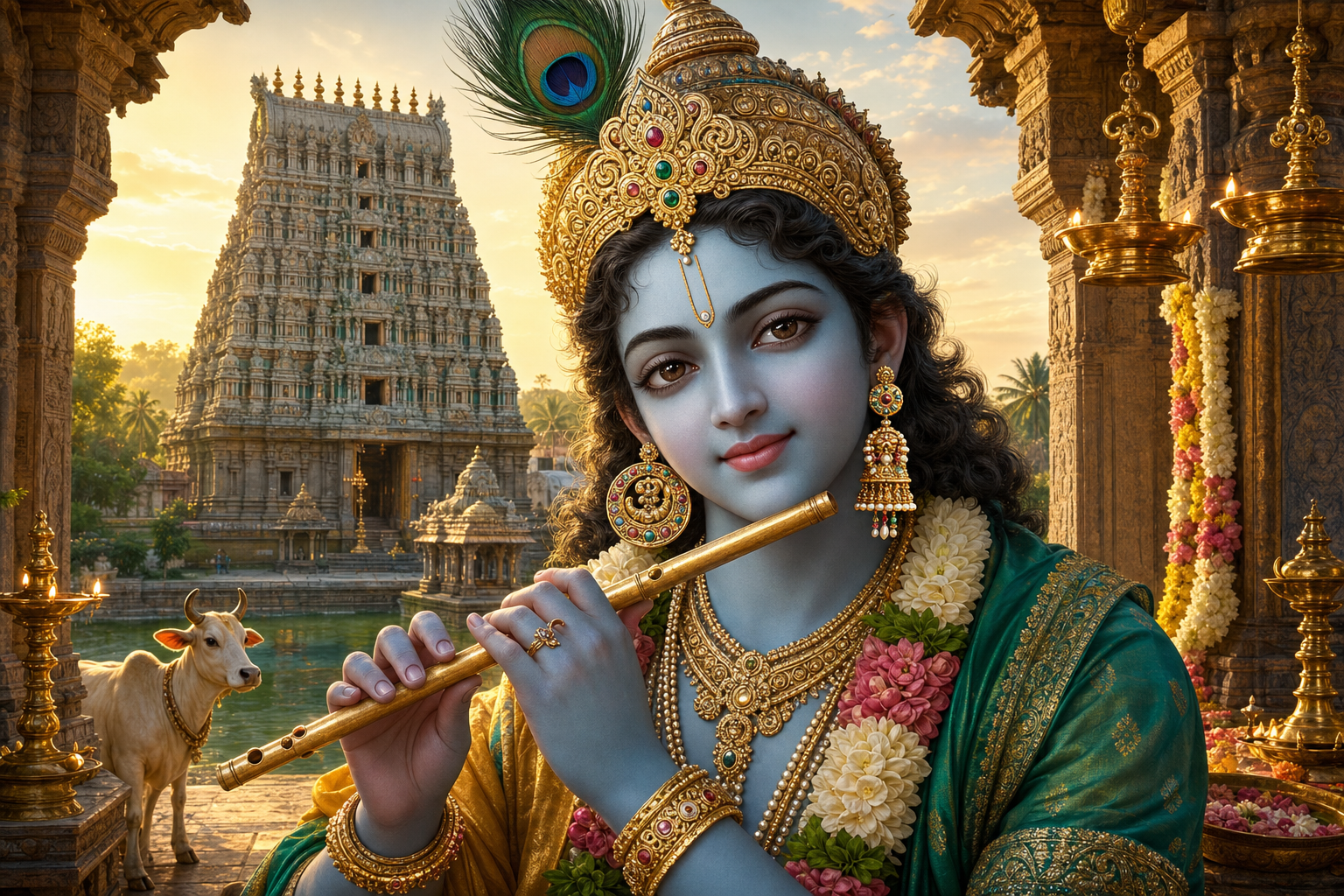
Mannargudi’s Rajagopalaswamy Temple occupies a distinctive place in the sacred geography of Tamil Nadu, not only because of its architectural scale and liturgical wealth, but also because of the intimate Krishna traditions preserved in its worship. The town lies in the fertile Cauvery delta, a region where agriculture, temple culture, music, ritual, and literary memory have shaped public life for centuries. At the heart of Mannargudi stands Sri Vidhya Rajagopalaswamy Temple, a major Vaishnava shrine dedicated to Krishna as Rajagopala, the royal cowherd-lord whose form joins majesty with affectionate accessibility.
The local tradition remembered through the story of Krishna’s two different earrings is especially valuable because it does not present divinity as distant abstraction. It presents Krishna as living, responsive, playful, and emotionally near. In the language of bhakti, such details matter. A crown, a flute, a butter pot, a garment, a glance, or even a pair of mismatched earrings can become a theological statement. The image teaches that the divine is not encountered only through symmetry and grandeur, but also through the tender irregularities that make devotion feel personal.
The popular explanation behind the mismatched earrings at Mannargudi is simple in outline and profound in meaning. Krishna, it is said, hurried in response to devotion and appeared without the slow ceremonial perfection expected of a royal deity. In that affectionate haste, he wore two different ear ornaments. The point of the story is not that the deity is careless. Its deeper suggestion is that divine compassion moves faster than formal correctness. In the devotional imagination of Mannargudi, Krishna’s eagerness to meet the devotee becomes visible in the smallest ornament on his sacred form.
This legend belongs to a larger Hindu way of seeing temple icons. A murti is not treated merely as a sculpture or symbolic reminder. In temple practice, the deity is awakened, bathed, dressed, adorned, offered food, praised through mantra and song, taken in procession, and placed before the community as a living center of relationship. Alankaram, or sacred adornment, is therefore not decorative excess. It is a disciplined liturgical language. The differing earrings of Rajagopala become part of that language, expressing urgency, intimacy, and the affectionate playfulness associated with Sri Krishna.
Mannargudi itself strengthens this interpretation. The temple is traditionally celebrated as Dakshina Dwaraka, the Southern Dwaraka, and also connected with the sacred landscape of Champakaranya Kshetram. Such names place the shrine within the broader Krishna tradition that stretches from Mathura and Vrindavan to Dwaraka, from Sanskrit puranic imagination to Tamil devotional culture. Yet Mannargudi is not a mere regional echo of North Indian Krishna worship. It has its own ritual grammar, local memories, festival forms, and emotional texture.
The deity worshipped here as Rajagopalaswamy or Sri Vidhya Rajagopalan expresses a layered form of Krishna. He is Gopala, the protector of cows and beloved of pastoral communities. He is Rajagopala, the royal form whose sovereignty does not erase his village intimacy. He is connected with Rukmini and Satyabhama in the temple’s visual and ritual tradition, yet the emotional atmosphere of the shrine continually returns to the playful Krishna of bhakti memory. The mismatched earrings are best understood within this combination of kingship and sweetness.
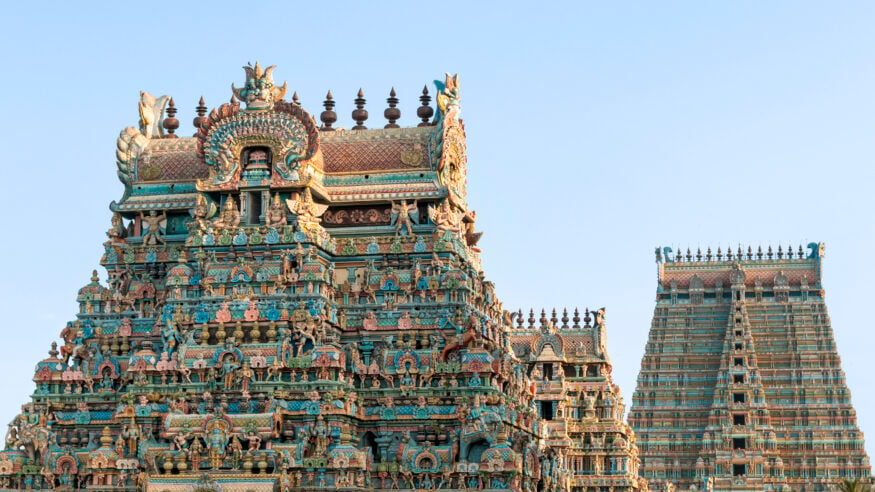
Historically, the Rajagopalaswamy Temple is associated with the Chola period and later expansions under subsequent South Indian dynasties, including the Nayaks of Thanjavur. The temple complex is known for its extensive prakaras, gopurams, mandapams, shrines, tanks, and festival routes. Its sacred tank, Haridra Nadhi, is among the most renowned temple tanks in Tamil Nadu. These features show that Mannargudi is not a small isolated shrine built around a single charming story. It is a major South Indian temple institution where architecture, ritual economy, royal patronage, and community devotion have converged over generations.
Yet the power of the earring legend lies precisely in its contrast with this vastness. A large temple can sometimes overwhelm the visitor with scale: walls, towers, corridors, processions, lamps, bells, and crowds. The story of the two earrings draws attention back to the face of Krishna and to a specific detail that can be held in the mind. It makes the monumental intimate. A devotee may not fully understand every inscription or ritual sequence, but the image of Krishna arriving in loving haste remains immediately accessible.
In the study of Hindu temples, such details should not be dismissed as folklore in the shallow sense of the word. Oral traditions often preserve the emotional theology of a place. Inscriptions may record land grants, lamps, festivals, donors, kings, and administrative arrangements. Agamic manuals may prescribe ritual procedures. Literary sources may praise the deity in refined poetic language. Local stories, however, explain how devotees feel the deity. They reveal the lived relationship between community and shrine. Mannargudi’s mismatched earrings belong to this field of living memory.
Theologically, Krishna’s haste recalls a repeated pattern in Hindu sacred narratives: the divine responds to bhakti with immediacy. In the Bhagavata tradition, Krishna is not only the teacher of cosmic truth but also the friend, child, beloved, cowherd, charioteer, and protector. His greatness is not reduced by closeness. Rather, his closeness reveals a deeper greatness. The Mannargudi legend follows this logic. A perfectly arranged ornament would show ceremonial completeness; two different earrings show relational urgency.
This is why the story carries emotional force for devotees. Human life often approaches the divine in states of incompleteness. People come to temples with unanswered questions, grief, gratitude, illness, family burdens, hopes for children, anxieties about livelihood, and the quiet need to be seen. The deity who appears with mismatched earrings becomes a compassionate mirror: perfection is not always the precondition for encounter. Devotion may begin in disorder, and grace may arrive before everything is neatly arranged.
At the same time, the story should be read with cultural care. It does not diminish the importance of ritual precision in Vaishnava worship. Temples such as Rajagopalaswamy Temple maintain elaborate traditions of puja, alankaram, naivedyam, recitation, procession, and festival observance. The legend works because it stands within that disciplined world, not outside it. A single playful exception becomes meaningful only when the ordinary standard is reverent care. Krishna’s mismatched earrings are therefore not a rejection of order, but a reminder that love is the heart of order.
The visual culture of Krishna worship often depends on this balance. Krishna is adorned as a king, but remembered as a child who stole butter. He is praised as Bhagavan, yet loved as the cowherd of Vrindavan. He speaks the Bhagavad Gita on the battlefield, yet plays the flute in pastoral beauty. Mannargudi’s Rajagopala embodies this same paradox. The temple’s grandeur speaks of sovereignty; the two earrings speak of nearness. Together they form a complete devotional image.
The association of Mannargudi with the Cauvery delta also adds cultural depth. The delta has long supported temple-centered settlements where agrarian life and sacred life were intertwined. Water, land, grain, cattle, music, and ritual formed a shared civilizational environment. Krishna as Gopala fits naturally into this world. The protector of cows and beloved of pastoral communities becomes the deity of a fertile landscape, where prosperity is understood not merely as wealth, but as harmony between land, community, and dharma.
The temple’s festivals further reveal the living character of the shrine. Panguni Brahmotsavam, Garuda Sevai, chariot processions, float festivals, and other annual observances make the deity visible beyond the sanctum. In processional worship, Krishna moves through the streets and the town itself becomes an extended temple. This movement is central to South Indian temple culture. The deity does not remain confined to the inner sanctum; he enters public space, receives collective devotion, and binds the community through shared rhythm, sound, and sight.
Within such a ritual world, ornamentation is never random. Earrings frame the face. They move attention toward the eyes, smile, and expression of the deity. In many Indian aesthetic traditions, the face of the divine image is the central point of darshan. The devotee sees and is seen. The asymmetry of the earrings therefore becomes more than a curiosity. It subtly interrupts expectation, inviting the devotee to look more closely and ask why this form is so distinctive.
That question opens the door to teaching. Hindu sacred art often educates through distinctive marks: Shiva’s crescent moon, Vishnu’s conch and discus, Ganesha’s broken tusk, Durga’s weapons, Hanuman’s folded hands, or Krishna’s flute. Each feature carries a story, and each story carries a philosophy. Mannargudi’s two earrings function in the same manner. They invite reflection on divine accessibility, the responsiveness of Krishna, and the affectionate freedom of bhakti.
The phrase “divine playfulness” is especially appropriate here. In Sanskritic and bhakti traditions, lila refers to the divine play through which the sacred becomes manifest in the world. Lila is not frivolity. It is the overflowing freedom of the divine, expressed in forms that instruct, delight, and transform. Krishna’s lila often breaks rigid expectations while deepening dharma. The mismatched earrings of Mannargudi can be read as a small but memorable lila preserved through temple memory.
Such a reading also supports unity among dharmic traditions. Hinduism, Buddhism, Jainism, and Sikhism each preserve, in different ways, a sensitivity to inner transformation, disciplined practice, ethical life, and the limits of ego. In the Krishna bhakti setting, the earring legend emphasizes humility before the sacred and the primacy of devotion over external perfection. This does not erase doctrinal differences among dharmic paths. Rather, it shows how a single temple story can encourage tenderness, self-reflection, and reverence across communities rooted in dharma.
The academic value of the story also lies in how it connects material culture with lived religion. A temple ornament is a material object. It may be made of metal, gem, or crafted design. But once placed on the deity within ritual context, it participates in a web of meaning. The object becomes part of memory, theology, aesthetics, and public identity. Mannargudi’s earrings show how a seemingly small visual feature can carry a community’s understanding of Krishna’s character.
The story also resists a purely museum-like view of temples. A museum object is usually fixed, labeled, and interpreted from a distance. A temple murti is encountered through sound, fragrance, movement, offering, seasonal change, and repeated presence. The same deity may appear in different alankarams across the year, each revealing another devotional mood. The mismatched earrings belong to this living world of darshan, where meaning is renewed through worship rather than frozen in a display case.
For visitors, the lesson is practical. Mannargudi should not be approached only as an architectural monument, though its architecture deserves serious attention. It should also be approached as a sacred text in stone, bronze, water, procession, and memory. The walls, tanks, mandapams, shrines, and ornaments together form a layered composition. The devotee or student who slows down before Rajagopala’s form may discover that the temple teaches through detail as much as through scale.
The narrative of Krishna’s haste can also be interpreted psychologically. Human beings often associate worthiness with flawless preparation. They delay prayer, reflection, apology, or moral correction until life appears orderly enough. The Mannargudi tradition quietly challenges that assumption. If Krishna can be remembered as coming in loving haste, the devotee too may approach without excessive self-consciousness. The temple’s message is not casualness, but trust: sincere turning toward the divine has value even when life feels unfinished.
This is one reason Krishna stories remain enduring across generations. They communicate philosophy without losing emotional warmth. The Bhagavad Gita presents Krishna as the profound teacher of action, knowledge, devotion, and surrender. Temple legends present the same Krishna in forms that children, elders, scholars, artists, musicians, and ordinary householders can love. The two earrings at Mannargudi belong to this broad educational tradition. They translate theology into a visual memory that can be carried home.
Mannargudi’s Rajagopalaswamy Temple also demonstrates the strength of Tamil Vaishnava culture. The temple is part of a landscape shaped by Alwar devotion, Sri Vaishnava theology, Sanskrit and Tamil liturgy, royal patronage, and local ritual continuity. Its identity cannot be reduced to a single legend, however charming. The legend must be placed within a larger heritage of temple service, sacred music, recitation, festival organization, and hereditary knowledge preserved by many communities over time.
At the same time, such legends help protect heritage from becoming abstract. When a temple is described only through measurements, dates, dynasties, and architectural categories, its living pulse can be missed. When it is described only through miracle stories, its historical depth can be missed. A balanced account should hold both together. Rajagopalaswamy Temple is historically important, architecturally significant, ritually active, and emotionally beloved. The story of the two earrings is one luminous point within that larger whole.
The symbolism of asymmetry is particularly striking. Sacred art often uses symmetry to indicate order, balance, and cosmic harmony. Here, a departure from symmetry creates another kind of harmony: the harmony of relationship. Krishna’s mismatched earrings do not disturb the devotional experience; they deepen it. They suggest that the divine personality is not mechanical. Krishna is not an impersonal principle dressed in jewels. He is remembered as one who acts, responds, plays, and loves.
This affectionate theology has shaped the emotional grammar of Krishna bhakti across India. In many traditions, devotees do not merely worship Krishna from a distance; they feed him, wake him, put him to sleep, sing to him, complain to him, celebrate him, and sometimes even tease him through poetry and song. Mannargudi’s legend fits this world naturally. A devotee can look at the two earrings and smile, not because reverence has disappeared, but because reverence has become intimate.
The temple’s location in Tamil Nadu also reminds us that Krishna devotion is not culturally uniform. The Krishna of Mannargudi is related to the Krishna of Mathura, Vrindavan, Dwaraka, Udupi, Guruvayur, Nathdwara, Puri, and countless village shrines, but each place gives him a local voice. This diversity is not fragmentation. It is one of the strengths of Hindu civilization. A shared sacred figure takes many regional forms while retaining recognizable theological continuity.
Such diversity is central to dharmic heritage. It allows temples, languages, sects, and sampradayas to flourish without demanding absolute sameness. The story of Mannargudi’s earrings subtly supports this principle. Even in the deity’s adornment, difference can be meaningful. The two earrings are not treated as a defect to be corrected, but as a sign to be understood. In a broader cultural sense, this becomes a gentle reminder that unity need not require uniformity.
For heritage preservation, this point is important. Protecting a temple means more than conserving walls and sculptures. It also means preserving oral traditions, festival knowledge, ritual vocabulary, songs, local explanations, and the memories of devotees. Once these are lost, the physical structure remains but much of its interpretive life fades. The Mannargudi earring legend is therefore part of intangible cultural heritage. It deserves careful retelling in a form that respects both faith and historical understanding.
A responsible retelling should also avoid exaggeration. The story is best presented as a cherished sthala tradition, a local devotional explanation attached to the form of Rajagopala. Its value does not depend on forcing it into the category of modern historical proof. Sacred traditions often work through layered truth: historical, ritual, symbolic, emotional, and theological. The mismatched earrings communicate symbolic and devotional truth with unusual clarity.
In this sense, Mannargudi offers a model for reading Hindu temples more deeply. Every shrine contains visible and invisible layers. The visible layer includes architecture, iconography, sculpture, ornament, and festival movement. The invisible layer includes memory, vow, longing, gratitude, inherited songs, and the quiet trust of generations. Rajagopalaswamy Temple brings these layers together, and the story of Krishna’s earrings gives visitors a memorable key to that inner world.
The enduring charm of the legend lies in its restraint. It does not require a dramatic cosmic battle or a complex philosophical argument. It turns on a tiny detail: two different earrings. Yet through that detail, the temple communicates a large idea. Krishna is royal, but not remote. Krishna is divine, but not indifferent. Krishna is adorned, but not imprisoned by ornament. Krishna responds to love, and in that response, even asymmetry becomes beautiful.
Ultimately, the mismatched earrings of Mannargudi’s Rajagopalaswamy Temple invite a more attentive form of darshan. They ask the visitor to notice what might otherwise be overlooked. They show how Hindu temple traditions encode theology in visual details and how bhakti transforms ornament into insight. In the sacred world of Mannargudi, Krishna’s hurried adornment is not an imperfection. It is a sign of divine nearness, a reminder that devotion is met with grace, and a powerful expression of the living cultural heritage of Tamil Nadu.
Inspired by this post on Hindu Blog.




Leave a Reply
You must be logged in to post a comment.