
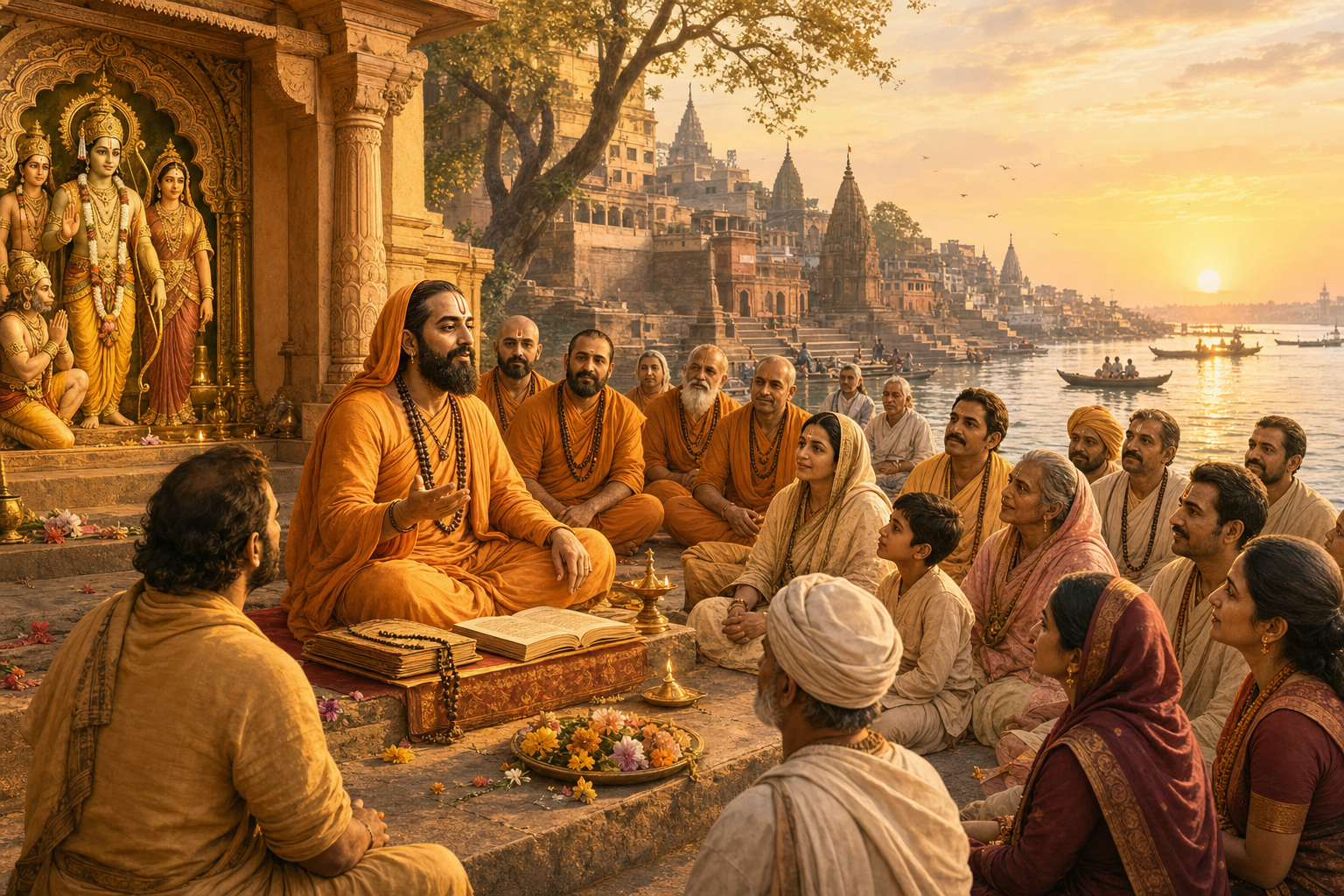
The Ramanandis occupy a major place in the religious, cultural, and social history of Hinduism. As one of the most influential Vaishnava orders, the Ramanandi Sampradaya is associated with the devotional legacy of Ramananda, a medieval North Indian saint whose teachings helped shape the Bhakti movement across the Gangetic plains. The tradition is centered on devotion to Rama, Sita, Lakshmana, Hanuman, and Vishnu, yet its significance extends beyond ritual worship. It represents a powerful historical current in which devotion, renunciation, vernacular spirituality, social inclusion, and disciplined monastic life converged.
In the broader landscape of Hindu spiritual traditions, the Ramanandis demonstrate how a sampradaya can preserve inherited theology while also speaking to the emotional and ethical needs of ordinary people. Their path is not only a matter of metaphysical doctrine; it is also a lived culture of bhakti, seva, pilgrimage, public recitation, temple service, ascetic discipline, and devotional remembrance. This is why the Ramanandi tradition continues to matter in discussions of Hindu philosophy, Hindu sects in India, Vaishnava Saints, and the social history of the Bhakti Tradition.
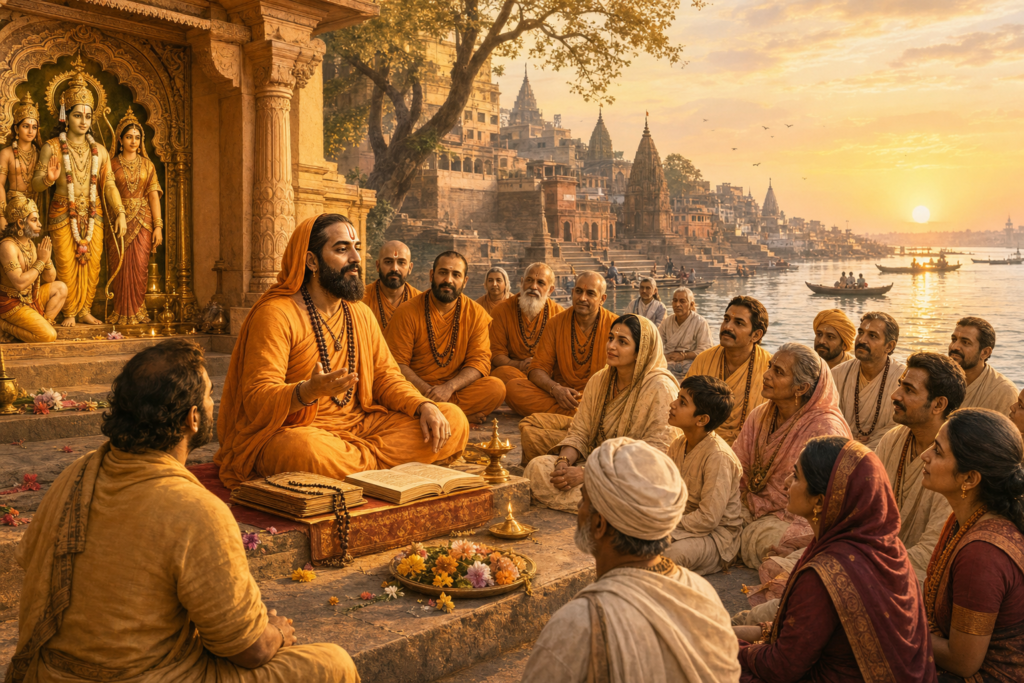
The name Ramanandi comes from Ramananda, who is traditionally remembered as a 14th-century Vaishnava teacher active in North India, especially in the sacred geography of Varanasi and the wider Gangetic region. Historical details about Ramananda are complex, because the sources include hagiographies, later sectarian memory, devotional compositions, and modern scholarly reconstruction. Even so, the received tradition consistently presents him as a spiritual teacher who made devotion to Rama more accessible to people beyond the narrow boundaries of scholastic Sanskrit learning.
Ramananda’s importance lies partly in the way he is remembered as a bridge figure. The tradition associates him with the philosophical influence of Ramanujacharya and Vishishtadvaita Vedanta, while also locating him in the North Indian devotional world of sants, bhajans, pilgrimage, and direct God-centered practice. This dual identity helps explain why the Ramanandi Sampradaya developed both a theological structure and a popular devotional appeal. It could speak to renunciants and householders, scholars and singers, temple communities and wandering ascetics.
At the heart of Ramanandi spirituality is Rama-bhakti. Rama is not treated merely as a heroic figure from the Ramayana, but as the supreme object of loving devotion, ethical reflection, and spiritual surrender. Sita is revered inseparably from Rama, and Hanuman holds a central place as the model of perfect service, humility, courage, and unwavering remembrance. This devotional pattern gives the tradition a deeply relational character. Spiritual life is understood not as abstract speculation alone, but as a disciplined relationship of love, trust, and surrender.
The Ramanandi tradition also preserves a strong sense of dharma. Rama’s life, as interpreted through the Ramayana, Ramcharitmanas, Adhyatma Ramayana, and related devotional literature, becomes a lens through which questions of duty, moral restraint, kingship, family responsibility, truthfulness, compassion, and spiritual discipline are examined. For devotees, the figure of Rama brings together personal piety and public ethics. The result is a tradition in which worship is not separated from conduct.
One of the most frequently emphasized features of the Ramanandi Sampradaya is its inclusive devotional spirit. Ramananda is traditionally associated with disciples from different social backgrounds, including figures such as Kabir, Ravidas, Dhanna, Pipa, Sena, and others. Modern scholars continue to debate the exact historical details of these lineages, yet the tradition’s memory is meaningful in itself. It shows how the Ramanandis came to stand for a form of bhakti in which access to divine grace was not limited by birth, status, occupation, gender, or social rank.
This inclusive impulse aligns closely with the wider purpose of Dharmic unity. The Ramanandi legacy is most constructive when understood as part of the larger family of Hindu, Buddhist, Jain, and Sikh civilizational traditions that value spiritual discipline, ethical living, inner transformation, and reverence for realized teachers. The presence of devotional poetry connected with Ramananda’s wider circle in Sikh scripture, and the respect shown to bhakti saints across communities, illustrates how Indian spiritual culture often crosses formal boundaries without dissolving its distinct traditions.
Ramanandi history also reveals the importance of language. Ramananda is remembered for supporting spiritual expression in the vernacular, making devotion available to people who did not have access to elite Sanskrit learning. This shift was not a rejection of Sanskrit or classical knowledge; rather, it was an expansion of religious communication. The sacred could be sung, remembered, debated, and experienced in the language of daily life. This is one reason the Bhakti movement became such a transformative force in medieval India.
The philosophical background of the Ramanandis is commonly linked with Vishishtadvaita, the qualified non-dualism associated with Ramanujacharya. In this framework, the Supreme is personal, gracious, and accessible, while the individual soul remains dependent on divine reality. The world is not dismissed as meaningless illusion; it is part of a divine order in which devotion, ethics, and surrender have real value. This philosophical orientation gave Ramanandi devotion a strong theological foundation while preserving emotional immediacy.
At the same time, Ramanandi spirituality cannot be reduced to one philosophical formula. The North Indian bhakti environment included both saguna and nirguna devotional currents: devotion to God with attributes and reflection on the divine beyond all attributes. Ramananda’s remembered legacy sits near this meeting point. For some devotees, Rama is worshiped with form, name, image, temple ritual, and narrative beauty. For others, the divine name becomes a doorway into the formless presence of the Supreme. This flexibility helped the tradition speak to many temperaments.
The discipline of the Ramanandi ascetics, often called Bairagis or Vairagis, is another defining feature of the sampradaya. Renunciation here is not understood as withdrawal born of despair, but as a disciplined reordering of life around spiritual purpose. The ascetic ideal values simplicity, restraint, meditation, mantra, pilgrimage, scriptural remembrance, and devotion to Rama. Such a life can appear severe from the outside, yet within the tradition it is treated as a path toward freedom from ego, attachment, and distraction.
The Ramanandi monastic world became especially significant in North India. Ramanandi ascetics were associated with monasteries, temples, akharas, pilgrimage networks, and public religious institutions. Their presence at major pilgrimage centers and Kumbh gatherings made them visible actors in Hindu religious life. The ascetic wing of the Ramanandi Sampradaya is often described as one of the largest Vaishnava monastic orders in India, and possibly among the largest Hindu renunciant communities overall.
Historically, some Ramanandi ascetic groups also developed martial roles, especially in periods when trade routes, pilgrimage routes, and sacred institutions required protection. The Naga and warrior-ascetic traditions should be understood within the political and social conditions of their time rather than through simplistic stereotypes. They show that renunciation in Indian history did not always mean passivity. In certain contexts, ascetics were also organizers, defenders, landholders, teachers, and protectors of pilgrimage networks.
Ayodhya holds special importance in the Ramanandi imagination. As the sacred city of Rama, it naturally became a major center for Rama-bhakti, temple worship, ascetic residence, and pilgrimage. Ramanandi mahants and institutions have long played a role in the religious life of Ayodhya, including at important temples associated with Rama and Hanuman. The devotional geography of Ayodhya makes the Ramanandi tradition concrete: theology becomes landscape, memory becomes pilgrimage, and bhakti becomes daily practice.
Varanasi is also important in the tradition’s historical memory. Ramananda is often associated with this sacred city, and Varanasi’s atmosphere of learning, renunciation, debate, and devotional practice shaped many Bhakti-era currents. In such cities, spiritual traditions did not develop in isolation. Shaiva, Vaishnava, Shakta, Nath, Sant, Jain, Buddhist, and later Sikh currents interacted through shared spaces, debates, songs, pilgrimage routes, and ethical concerns. The Ramanandi Sampradaya belongs to this plural and dynamic world.
The literary world of the Ramanandis is broad. Texts such as the Ramayana, Ramcharitmanas, Bhaktamal, Vinaya Patrika, Hanuman Chalisa, and other Rama-centered works became central to devotional education and community formation. Bhaktamal, traditionally associated with Nabhadas, became especially important because it preserved the memory of saints and devotees across devotional lineages. Such works did more than tell stories; they created a moral map of what devotion should look like in human life.
Tulsidas deserves special attention in any discussion of Ramanandi influence, although scholars differ on how exclusively he should be classified within the sampradaya. His Ramcharitmanas reshaped the devotional life of North India by presenting the Rama narrative in Awadhi with poetic brilliance, theological depth, and emotional accessibility. The text helped make Rama-bhakti a household presence, not only a temple or monastic practice. Through recitation, performance, and reflection, the Ramcharitmanas became a shared cultural scripture for millions.
The Ramanandi relationship with caste is historically important and requires careful wording. It would be inaccurate to claim that every Ramanandi institution at every moment fully dissolved social hierarchy. Like all large traditions, the sampradaya developed within the social realities of its time. Yet the tradition’s memory of Ramananda’s disciples, its vernacular devotional emphasis, and its repeated stress on divine grace gave it a powerful anti-exclusivist impulse. In bhakti, the sincerity of devotion could outweigh social status.
This point remains relevant today. Many people encounter religion through social identity first, and only later through inner practice. The Ramanandi tradition offers a corrective by placing devotion, humility, remembrance, and ethical conduct at the center. The devotee is not asked merely to inherit a label, but to transform the heart. That makes the tradition emotionally resonant even for modern readers who may not belong to a monastery or a formal Vaishnava lineage.
The figure of Hanuman is especially important for understanding this emotional resonance. In Ramanandi and wider Rama-bhakti culture, Hanuman represents strength without arrogance, service without self-display, learning without pride, and courage without cruelty. His devotion to Rama is active, disciplined, and practical. For householders, students, workers, and spiritual aspirants, Hanuman becomes a model of how inner devotion can be expressed through outer responsibility.
Ramanandi practice usually emphasizes the divine name, especially the name of Rama. Nama-japa, bhajan, kirtan, scriptural recitation, pilgrimage, temple service, and guru-disciple transmission all serve as vehicles of remembrance. The name is not treated as ordinary sound. In bhakti theology, the divine name carries presence, grace, and transformative power. Repetition of the name disciplines the mind, softens the heart, and redirects attention toward the sacred.
The guru also holds a central place. The Ramanandi Sampradaya, like many Hindu spiritual traditions, understands knowledge as something transmitted through living relationship. A guru does not merely provide information; the guru initiates, corrects, interprets, and embodies a disciplined way of life. This does not eliminate the need for discernment. Rather, it places responsibility on both teacher and disciple to preserve humility, integrity, and fidelity to dharma.
Modern interest in the Ramanandis often focuses on their scale and visibility, but their deeper influence lies in their ability to connect philosophy with daily devotion. They show that Hindu philosophy is not only a subject for academic debate. It is sung in temples, carried in pilgrimage, remembered in family rituals, embodied by ascetics, and interpreted through stories of Rama, Sita, Lakshmana, and Hanuman. This integration of thought and practice is one of the strengths of Hindu spirituality.
The Ramanandi tradition also has a diaspora dimension. Vaishnava devotional forms associated with Rama worship traveled with Indian communities to places such as the Caribbean, Fiji, Mauritius, South Africa, the United Kingdom, Canada, and the United States. In diaspora settings, Rama-bhakti often became a way of preserving language, family memory, festival culture, ethical identity, and spiritual continuity. The tradition therefore belongs not only to medieval India, but also to modern global Hindu life.
From a Dharmic unity perspective, the Ramanandi Sampradaya offers an important lesson: strong rootedness need not produce hostility toward other paths. A devotee can be deeply committed to Rama while respecting Shiva, Devi, Krishna, the wisdom of Jain tirthankaras, the compassion-centered teachings of Buddhism, and the guru-centered devotion of Sikh tradition. This is not a flattening of differences. It is a mature recognition that Dharmic traditions have often grown through dialogue, shared ethics, and mutual reverence.
The Ramanandis also challenge a common modern misunderstanding: that tradition and reform are always opposites. Ramananda’s remembered legacy suggests a different model. Reform can emerge from within tradition when devotion becomes deeper than social vanity, when language becomes accessible, when the divine name reaches ordinary people, and when spiritual dignity is extended beyond inherited privilege. This is reform through bhakti, not reform through deracination.
Academically, caution is necessary. The historical Ramananda is partly hidden behind layers of reverence, sectarian development, and devotional memory. Some claims about exact discipleship, dates, and institutional continuity remain debated. Yet this does not diminish the significance of the Ramanandi Sampradaya. Historical traditions are not only built by documented events; they are also shaped by remembered ideals, ritual continuity, institutional life, and the moral imagination of communities.
The Ramanandis are therefore best understood through several lenses at once. Theologically, they are a Rama-centered Vaishnava tradition. Historically, they are a major North Indian bhakti and ascetic order. Socially, they are linked with devotional accessibility and broad participation. Culturally, they helped sustain the public world of Ramayana recitation, pilgrimage, bhajan, temple worship, and saintly memory. Spiritually, they emphasize surrender, remembrance, renunciation, and divine grace.
The continuing relevance of the Ramanandis lies in the balance they represent. They preserve devotion without reducing religion to sentiment. They honor renunciation without rejecting society. They value scripture without making sacred knowledge inaccessible. They maintain a Vaishnava identity while participating in the wider fabric of Sanatana Dharma. In this balance, the tradition offers a compelling model for contemporary Hindu life.
For modern readers, the Ramanandi Sampradaya invites reflection on what spiritual belonging should mean. It suggests that a tradition becomes powerful not merely by counting followers, but by forming character. Devotion to Rama becomes meaningful when it produces humility, courage, service, truthfulness, compassion, and steadiness. The true measure of bhakti is not noise or display, but the transformation of the person who practices it.
In Hinduism’s vast spiritual tapestry, the Ramanandis remain a vital thread. Their history connects medieval Bhakti, Vaishnava philosophy, Ramayana devotion, ascetic institutions, social inclusion, and global Hindu continuity. Their message is both ancient and timely: the divine is approached through love, discipline, remembrance, and grace; and the path of devotion is strongest when it deepens unity rather than division.
Sources consulted for historical and contextual accuracy include general scholarly summaries and reference material on the Ramanandi Sampradaya, Ramananda, Vaishnavism, and Hanuman Garhi, including https://en.wikipedia.org/wiki/Ramanandi_Sampradaya, https://en.wikipedia.org/wiki/Ramananda, https://en.wikipedia.org/wiki/Vaishnavism, and https://en.wikipedia.org/wiki/Hanuman_Garhi_Temple.
Inspired by this post on Hindu Blog.




Leave a Reply
You must be logged in to post a comment.