
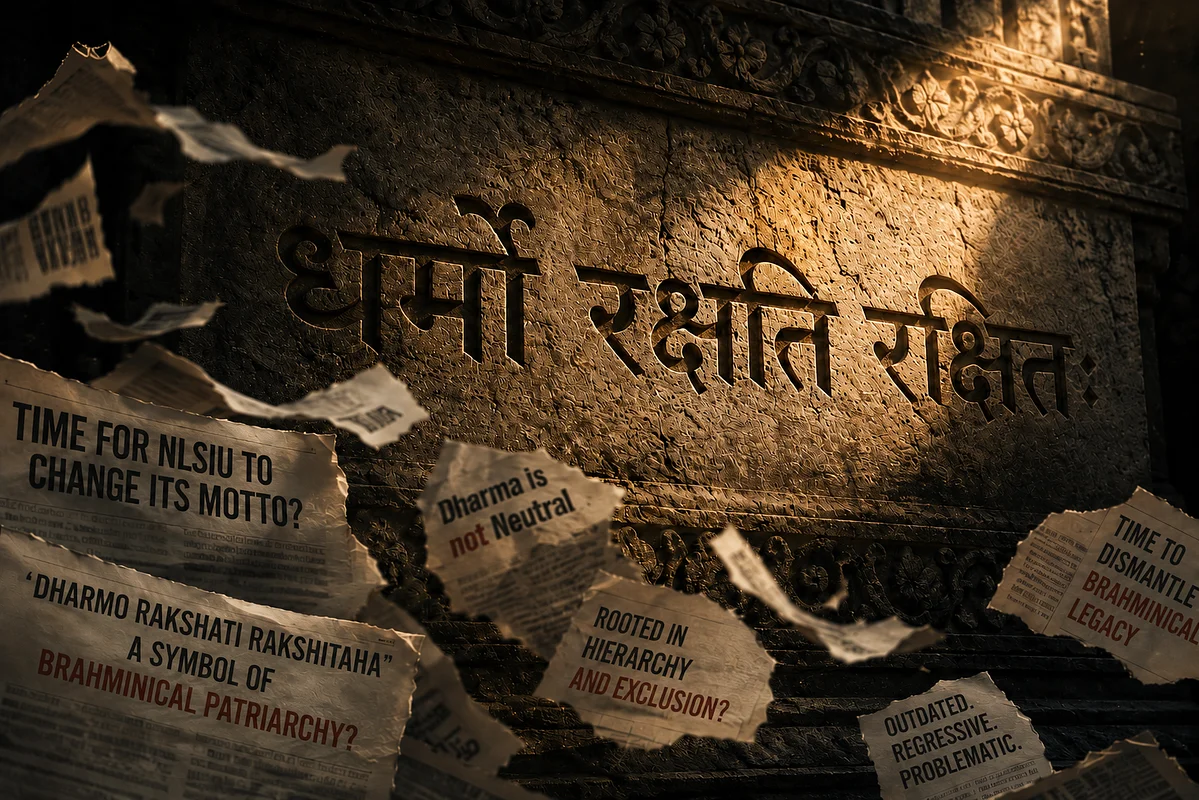
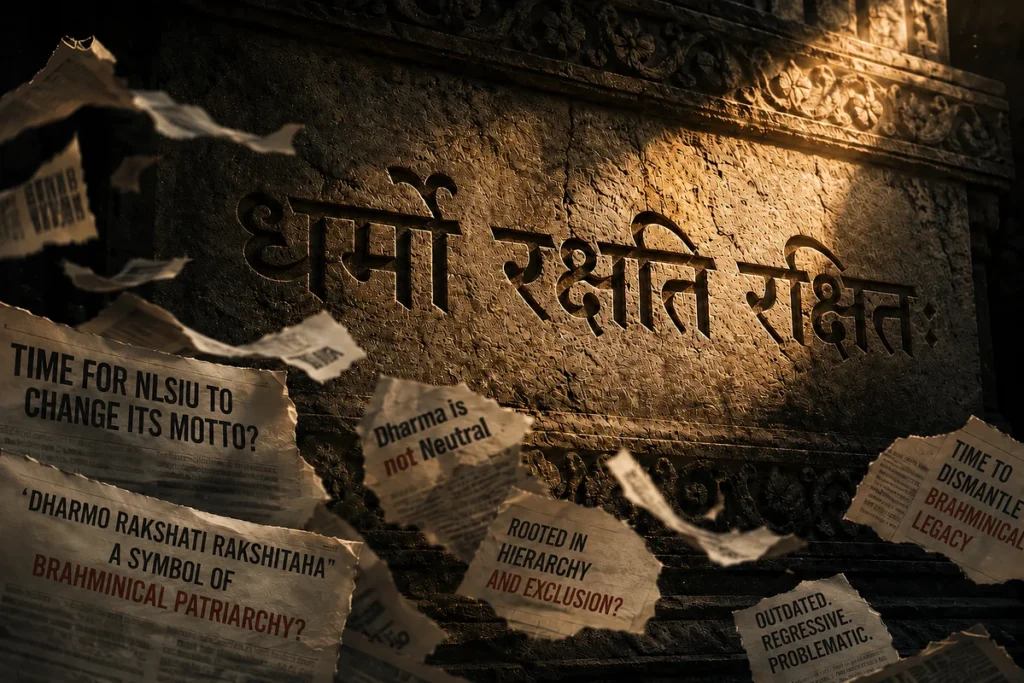
The debate over NLSIU’s motto, “Dharma Rakshati Rakshataha” or more commonly rendered as “Dharmo Rakshati Rakshitah,” requires intellectual seriousness, moral restraint, and a fuller understanding of Dharma than contemporary polemics often allow. The phrase is frequently translated as “Dharma protects those who protect it,” but even that translation only gestures toward a much wider civilizational idea. Dharma is not merely a slogan, nor is it reducible to a single text, caste category, political formation, or modern ideological dispute. It has carried meanings related to justice, order, duty, ethics, responsibility, social harmony, self-restraint, and the moral architecture of life across Hindu Dharma and wider Dharmic traditions.
The controversy arose after Sumit Baudh’s article in The Wire argued that the tragic Twisha Sharma case made it necessary to reconsider whether a leading law school should retain a motto allegedly drawn from “Brahminical patriarchy.” That framing is forceful, but it moves too quickly from a criminal allegation to a civilizational indictment. A careful response must begin by separating three things that should not be collapsed into one another: the human tragedy of a young woman’s death, the legal accountability owed through due process, and the meaning of Dharma as a concept in Indian philosophy, jurisprudence, and public life.
The reported facts surrounding Twisha Sharma’s death are deeply distressing. Public accounts have referred to allegations of dowry harassment, domestic abuse, a forced abortion, psychological torment, and desperate communications to her family. Such claims, if established through the legal process, demand firm accountability. They also raise difficult questions about contemporary social pressures, marriage, parental expectations, stigma around separation, and the isolation women may face when trapped between domestic violence and family honour. Any discussion that begins from this case has a moral obligation to keep the victim’s suffering at the centre rather than treating the tragedy as a convenient symbol for an unrelated ideological argument.
That is where the critique of the NLSIU motto becomes problematic. The appearance of the accused, reportedly an NLSIU alumnus, in clothing associated with his alma mater may create public discomfort, but it does not logically establish that the institution’s Sanskrit motto enabled the alleged crime. Nor does it show that Dharma, as a philosophical and ethical concept, is responsible for violence, patriarchy, dowry abuse, or the failures of family and society. Legal education can and should be criticized when it fails to cultivate ethical responsibility, but such criticism must be based on institutional evidence rather than symbolic association.
The deeper flaw lies in reducing Dharma to Manusmṛti, Manusmṛti to Brahmanism, and Brahmanism to an unchanging structure of domination. This chain of equivalences may be rhetorically useful, but it is historically and philosophically weak. Dharma has been debated across Mīmāṃsā, Vedānta, Nyāya, Dharmaśāstra, Itihāsa, Purāṇa, Buddhist ethics, Jain thought, Sikh teachings, and regional traditions of law and conduct. Across these traditions, Dharma is not a static command but a field of reflection about what sustains life, restrains power, protects the vulnerable, and orders human conduct toward responsibility.
The Mahabharata alone complicates any simplistic reading. It presents Dharma as subtle, difficult, contextual, and often agonizing. Yudhishtira’s dilemmas, Bhishma’s counsel, Vidura-niti, and the repeated phrase “Yato Dharmastato Jayah” show that Dharma is not merely rule-following or social conformity. It is a demanding inquiry into justice, truth, restraint, compassion, and consequences. In the epic imagination, Dharma is tested precisely when institutions fail, families fracture, and power becomes morally dangerous. That makes it especially relevant to legal education, not obsolete.
Similarly, in Buddhist traditions, Dhamma refers to truth, teaching, order, and the path that reduces suffering. In Jainism, ethical life is shaped by ahimsa, aparigraha, anekantavada, and disciplined responsibility toward all living beings. Sikh thought emphasizes hukam, seva, justice, courage, and the defence of the oppressed. These traditions do not use identical vocabularies, yet they share a concern with moral order, self-discipline, compassion, and social duty. A blog committed to unity among Dharmic traditions must therefore resist attempts to turn Dharma into a narrow sectarian or caste-coded caricature.
There is also a jurisprudential reason to take the motto seriously. Law schools do not merely train technicians who memorize statutes and precedents. They shape future advocates, judges, scholars, administrators, and public leaders. A motto such as “Dharma protects those who protect it” can be read as a reminder that law without ethics becomes procedure without conscience. It suggests that justice is not self-executing; it must be protected by disciplined human beings who respect truth, fairness, due process, and the dignity of persons.
This does not mean that Sanskrit phrases should be immune from scrutiny. Institutions must be willing to explain their symbols, especially in plural societies. If students or citizens ask what Dharma means in a constitutional law school, the answer cannot be vague nostalgia. It must be rigorous. Dharma in a modern legal institution should be articulated as ethical responsibility, constitutional morality, protection of the vulnerable, fidelity to truth, and restraint in the use of power. Such an interpretation strengthens both Indian intellectual heritage and modern legal education.

The danger lies not in questioning a motto but in flattening it. A serious critique would ask whether NLSIU teaches legal ethics deeply enough, whether alumni internalize public responsibility, whether gender justice is meaningfully embedded in legal education, and whether institutions respond adequately to domestic violence and dowry-related abuse. These are difficult and necessary questions. They become weaker, not stronger, when they are converted into a broad denunciation of Dharma based on a selective reading of Manusmṛti and a tragic criminal case still requiring legal adjudication.
Public discourse also needs empathy. When a young woman dies under disturbing circumstances, the first response should be grief, concern for truth, and commitment to justice. The case should lead society to examine how families handle distress calls, how communities treat women who seek help, how divorce is stigmatized, and how legal mechanisms can become more accessible before abuse escalates. These concerns are immediate, human, and urgent. They do not require the erasure of Dharma; in fact, they demand a more truthful application of Dharma as protection, responsibility, and moral courage.
In this sense, the NLSIU motto can be read not as a relic of hierarchy but as an ethical challenge to every law student. If Dharma protects those who protect it, then a lawyer who manipulates procedure, a family that ignores suffering, a society that normalizes dowry pressure, and an institution that fails to teach moral responsibility are all failing Dharma. The phrase becomes a standard of accountability rather than a shield for complacency. Its power lies in the fact that it can be turned toward self-critique.
The appropriate response to misuse of Dharma is not abandonment but clarification. Dharma must be distinguished from social abuse committed in its name, just as law must be distinguished from injustice committed through legal language. No serious scholar would discard constitutionalism because constitutional rhetoric is sometimes misused. By the same logic, Dharma should not be discarded because polemicists identify it with one text, one historical layer, or one political reading.
A balanced academic approach therefore recognizes two truths at once. First, India’s social realities include gender violence, dowry-related cruelty, family pressure, and institutional failures that require urgent reform. Second, Dharma as a civilizational idea contains ethical resources for confronting precisely these failures. It is not an escape from justice; properly understood, it is a demand for justice. It asks whether conduct sustains life, protects dignity, restrains harm, and upholds truth.
NLSIU’s motto should therefore not be treated as an embarrassment to be discarded in haste. It should be taught, debated, translated, and ethically renewed. A leading law school can use it to connect Indian jurisprudential memory with constitutional values, gender justice, and professional responsibility. That would be a more constructive path than symbolic rejection. The task is not to empty institutions of civilizational language, but to ensure that such language is interpreted with intellectual honesty and moral seriousness.
The wider lesson is clear. Tragedies should not be instrumentalized to discredit entire traditions, and sacred or philosophical terms should not be protected from all critique. Between these two errors lies a more mature public discourse: one that mourns victims, demands accountability, studies texts carefully, rejects social abuse, and preserves the ethical depth of Dharmic civilization. “Dharma Rakshati Rakshataha” remains meaningful only when Dharma is actively protected through justice, compassion, truth, and responsibility. That is the standard by which individuals, families, legal institutions, and society itself must be judged.
Inspired by this post on Hindu Post.







Leave a Reply
You must be logged in to post a comment.