
What does it mean to be truly healthy? The question appears simple, yet its answer has never belonged only to hospitals, laboratories, fitness routines, or diet charts. Across cultures and centuries, health has been understood as a layered condition in which the body, mind, senses, social life, environment, and inner orientation all participate. This wider understanding is especially visible when Ayurvedic wisdom is read beside modern global health philosophy.
The striking point is not that ancient and modern systems use the same vocabulary. They do not. Ayurveda speaks of dosha, agni, dhatu, mala, atma, indriya, and manas. Modern public health speaks of physical, mental, and social well-being. Yet both frameworks challenge the same narrow assumption: that health is merely the absence of diagnosable disease.
Modern medicine has made extraordinary contributions through measurable markers. Blood pressure, fasting glucose, lipid profiles, inflammatory markers, imaging reports, organ function tests, and diagnostic screening can save lives. These tools detect disease early, guide treatment, and make medical care more precise. No serious discussion of health should dismiss them. The problem begins only when measurable markers are treated as the whole story rather than one important part of it.
Many people recognize this gap from ordinary experience. A person may receive normal laboratory results yet feel exhausted, anxious, lonely, unmotivated, inflamed, sleepless, or emotionally dull. Another person may be managing a chronic condition yet remain mentally steady, socially connected, spiritually anchored, and deeply purposeful. These examples reveal why health cannot be reduced to pathology reports alone.
The World Health Organization made this point powerfully in 1948 when it defined health as “complete physical, mental and social well-being” and not merely freedom from disease or infirmity. The most important phrase is “not merely.” It signals that disease-centred medicine, though indispensable, is incomplete if it ignores the lived quality of human life.
This definition was radical for its time because it expanded the field of health beyond the clinic. It made mental balance, emotional resilience, social belonging, and functional well-being part of the conversation. In public health terms, this helped shift attention toward prevention, social conditions, community life, nutrition, sanitation, work stress, family structures, and mental health.
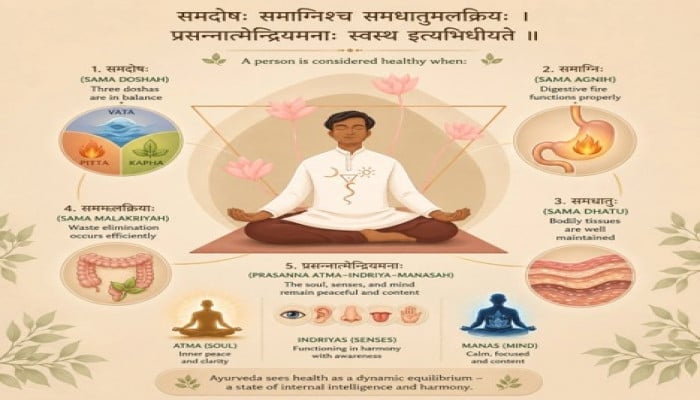
Ayurveda had already articulated a similarly integrated view in the classical Sanskrit tradition. The Sushruta Samhita expresses health through a compact and profound verse:
समदोषः समाग्निश्च समधातुमलक्रियः ।
प्रसन्नात्मेन्द्रियमनाः स्वस्थ इत्यभिधीयते ॥
This verse describes a healthy person as one whose doshas are balanced, whose agni functions properly, whose bodily tissues are well maintained, whose eliminatory processes are orderly, and whose atma, senses, and mind are peaceful and content. It is a remarkably sophisticated model because it includes physiology, metabolism, tissue nourishment, elimination, sensory regulation, mental clarity, and spiritual well-being in one definition.
The Sanskrit term swastha is central to this understanding. It is often translated as “healthy,” but its deeper meaning is “established in oneself.” This is not a poetic excess. It is a diagnostic principle. A person is not fully well if the body functions but the mind is agitated, the senses are overstimulated, digestion is disturbed, sleep is fragmented, and life feels disconnected from meaning.
Ayurveda’s first pillar is sama dosha, the balanced state of Vata, Pitta, and Kapha. These doshas are not single anatomical substances. They are functional principles that describe patterns of movement, transformation, structure, lubrication, heat, stability, and biological regulation. Vata governs motion and communication, Pitta governs transformation and metabolism, and Kapha governs cohesion, nourishment, and stability.
In practical terms, Vata imbalance may appear as irregular appetite, bloating, constipation, anxiety, restlessness, variable energy, dry skin, and disturbed sleep. Pitta imbalance may appear as acidity, irritability, inflammation, excess heat, sharp hunger, skin eruptions, and impatience. Kapha imbalance may appear as heaviness, lethargy, slow digestion, congestion, fluid retention, attachment, and metabolic sluggishness.
The value of this framework is observational. It trains attention toward patterns rather than isolated symptoms. A person is not seen merely as a stomach problem, a sleep problem, a mood problem, or a skin problem. The person is seen as an interconnected organism whose daily routine, food, climate, emotional life, work rhythm, sleep, and sensory habits all influence balance.
The second pillar is sama agni, balanced digestive and metabolic fire. In Ayurveda, agni is not limited to the physical act of digesting food. It refers to the body’s capacity to transform food into nourishment, sensory experience into understanding, and daily life into vitality. Strong agni supports energy, immunity, clarity, enthusiasm, and resilience.
When agni is weak or disturbed, food may be eaten but not properly assimilated. The result can be heaviness, gas, acidity, irregular bowels, fatigue after meals, cravings, brain fog, poor immunity, and emotional dullness. This idea has contemporary relevance because modern research increasingly recognizes the connections among digestion, the gut-brain axis, the microbiome, immune regulation, inflammation, and mood.
The gut-brain axis is especially important for understanding why Ayurvedic medicine gives digestion such a central role. The gut communicates with the nervous system, immune system, endocrine system, and microbial ecosystem. Disturbances in digestion can influence mood, cognition, sleep, inflammatory status, and stress response. Ayurveda described these connections in its own language long before modern microbiome science developed its current vocabulary.
The third pillar is sama dhatu, the balanced nourishment of bodily tissues. Classical Ayurveda identifies seven dhatus: rasa, rakta, mamsa, meda, asthi, majja, and shukra. These are often associated with plasma or nutritive fluid, blood, muscle, fat, bone, marrow or nervous tissue, and reproductive essence. The technical details vary across interpretive traditions, but the underlying principle is clear: health requires proper nourishment at every level of the body.
This principle offers a useful corrective to modern extremes. A person may eat enough calories but remain undernourished in quality. Another may follow an aggressive diet that produces short-term weight loss while weakening sleep, hormones, digestion, emotional steadiness, or long-term vitality. True nourishment is not merely intake; it is digestion, absorption, tissue formation, strength, repair, and balanced energy.

The fourth pillar is sama mala kriya, orderly elimination of wastes. Ayurveda pays close attention to bowel movement, urination, sweating, and other eliminatory processes because the body must not only receive and transform but also release. Retention, stagnation, and poor elimination can disturb comfort, metabolism, skin, energy, appetite, and mental clarity.
Modern health culture often speaks more easily about food than elimination, yet elimination is a major sign of systemic function. Regularity, ease, and appropriate quantity indicate that digestion, hydration, movement, nervous system tone, and diet are working together. In this sense, Ayurveda encourages a practical and unsentimental attentiveness to the body’s daily intelligence.
The fifth pillar is prasanna atma, indriya, manas: a peaceful inner self, clear senses, and balanced mind. This is the most philosophically expansive part of the Ayurvedic definition. Health is not complete when metabolism alone is corrected. The senses must be regulated, the mind must be steady, and the inner life must be aligned with clarity, contentment, and purpose.
This point is deeply relevant in the present age. Many illnesses are worsened by chronic stress, overstimulation, poor sleep, social isolation, compulsive screen use, sedentary routines, processed food, emotional suppression, and loss of meaningful community. A technically advanced society can still produce people who are metabolically strained, mentally overloaded, and spiritually restless.
Ayurveda’s emphasis on the senses is particularly perceptive. What one sees, hears, touches, tastes, smells, and repeatedly consumes through attention shapes the nervous system. Sensory overload is not neutral. Constant noise, conflict, comparison, speed, and distraction can disturb digestion, sleep, mood, and decision-making. Health therefore requires not only better food but also better inputs for the mind and senses.
This does not mean that Ayurveda should be treated as a substitute for modern medical care. Acute infections, trauma, cancer, cardiovascular emergencies, endocrine disorders, surgical conditions, and many chronic diseases require evidence-based diagnosis and treatment. A mature view does not place Ayurveda and modern medicine in competition. It recognizes that different systems can address different dimensions of human well-being.
Modern medicine is strongest in emergency care, diagnostics, surgery, pharmacology, infectious disease management, and measurable disease control. Ayurveda is especially valuable as a philosophy of prevention, daily routine, digestion, lifestyle, constitutional awareness, seasonal adaptation, mind-body harmony, and long-term balance. Integrative medicine becomes meaningful when each system is used with intellectual honesty and proper scope.
The unity of Dharmic traditions also enriches this discussion. Hindu, Buddhist, Jain, and Sikh traditions each emphasize discipline, ethical living, moderation, compassion, self-awareness, service, and inner refinement. Their vocabularies differ, but their shared civilizational insight is that human flourishing is not merely biological survival. It includes conduct, consciousness, restraint, relationship, and responsibility.
Yoga contributes the language of balance, breath, posture, concentration, and self-mastery. Buddhist traditions emphasize mindfulness, suffering, impermanence, and the training of attention. Jain thought highlights ahimsa, aparigraha, restraint, and the moral consequences of consumption. Sikh teachings bring the importance of seva, remembrance, dignity of labour, community, and truthful living. Together, these traditions broaden health into a dharmic ecology of body, mind, ethics, and society.
This broader approach matters because health is never purely private. A person’s well-being is shaped by family rhythms, food systems, social trust, clean air, work culture, education, economic stability, community support, and moral atmosphere. The WHO’s inclusion of social well-being and Ayurveda’s inclusion of mind, senses, and inner self both point toward the same conclusion: the individual cannot be separated from the environment in which life is lived.
From a practical standpoint, true health can be approached through several disciplined habits. Regular sleep protects hormonal rhythm, mood, immunity, and cognition. Fresh, digestible, seasonal food supports agni. Daily movement maintains circulation, strength, mobility, and metabolic health. Breath awareness and meditation calm the nervous system. Meaningful relationships protect emotional resilience. Ethical living reduces inner conflict. Spiritual practice gives direction to life beyond consumption and performance.
Such practices are not glamorous, but they are powerful because they act repeatedly on the foundations of well-being. A person does not become healthy through occasional intensity alone. Health is shaped by what is repeated: the food eaten most days, the sleep pattern followed most nights, the thoughts entertained most often, the relationships maintained, the work rhythm endured, and the values lived under pressure.
Ayurveda also encourages humility before individuality. The same food, exercise, climate, or routine does not affect every person identically. Constitution, age, season, geography, digestive strength, occupation, emotional state, and disease condition all matter. This is why personalized observation is central to traditional medicine. Health advice becomes more intelligent when it is adapted to the person rather than imposed as a universal trend.
At the same time, personalization must not become an excuse for rejecting evidence. Responsible health practice requires discernment. Claims should be examined, treatments should be evaluated, and serious symptoms should be medically assessed. The most useful path is not blind traditionalism or blind modernism, but a careful synthesis grounded in experience, evidence, ethics, and respect for human complexity.
True health, then, is not a single number, a fashionable diet, a perfect body, or a disease-free report. It is a dynamic state of balance in which digestion, tissues, elimination, immunity, sleep, mood, senses, relationships, purpose, and consciousness move toward harmony. It is physical, mental, social, ethical, and spiritual at once.
This is why the convergence between Ayurveda and modern global health philosophy is so significant. One arose from ancient clinical observation and spiritual inquiry; the other emerged from modern public health policy. Both insist that a human being is more than a mechanical body. Both warn against defining wellness too narrowly. Both invite a more complete understanding of life.
To be truly healthy is to be established in oneself while remaining responsibly connected to the world. It is to have a body capable of vitality, a mind capable of clarity, senses capable of restraint, relationships capable of warmth, and an inner life capable of peace. In that vision, health becomes not merely a medical condition, but a disciplined, relational, and deeply human way of being.
Inspired by this post on Hindu Post.









Leave a Reply
You must be logged in to post a comment.