
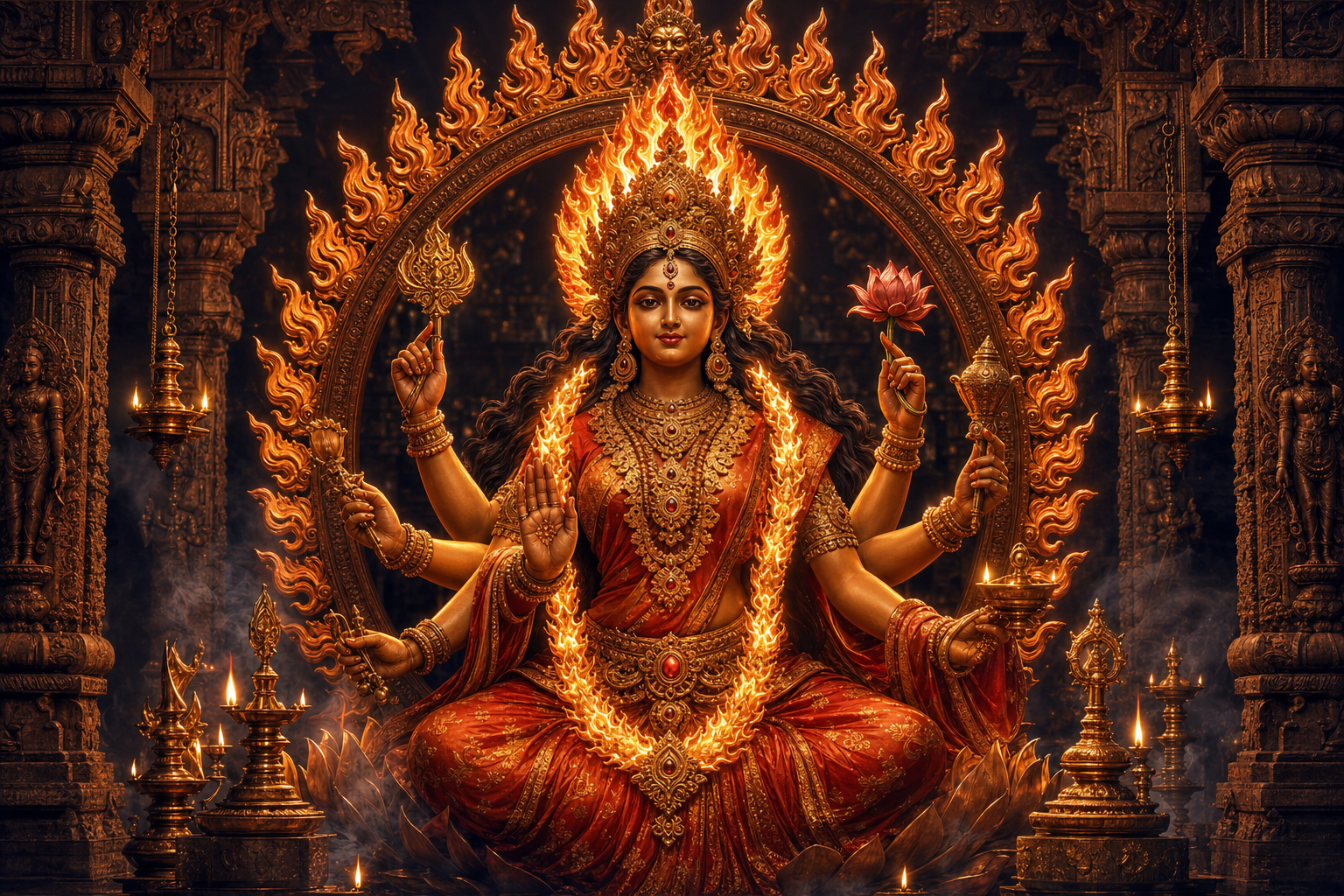
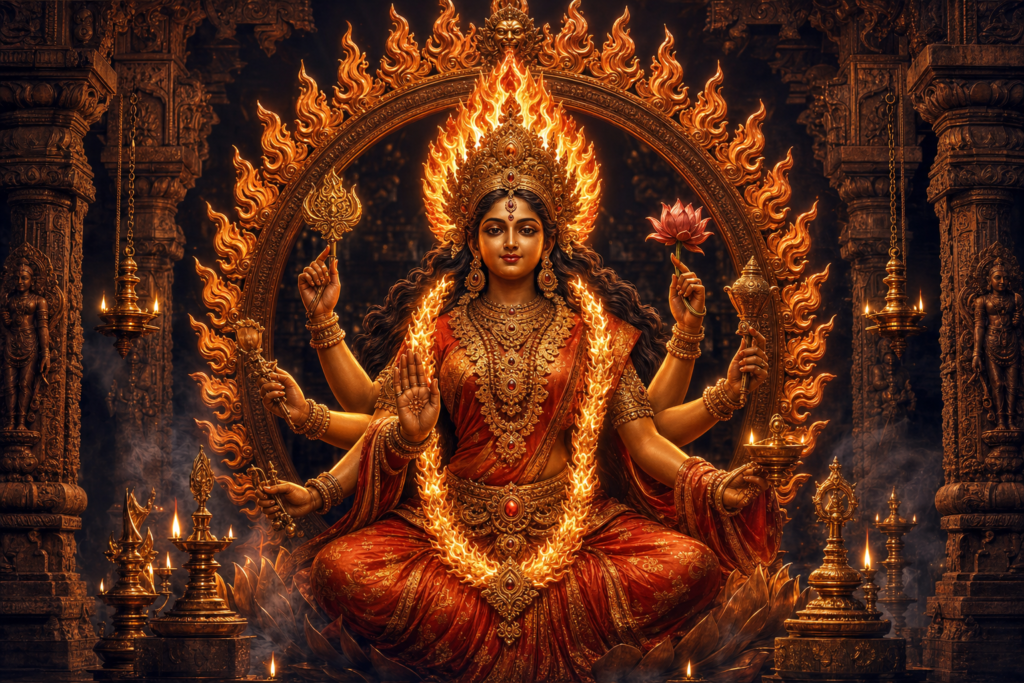
Jwalamalini Devi stands among the most striking sacred forms associated with the radiant power of Devi Shakti. Her name itself offers the first key to understanding her theological and artistic significance: Jwala means flame, while Malini means one who is garlanded. Jwalamalini is therefore understood as the flame-garlanded Goddess, a divine presence encircled by fire, brilliance, protection, purification, and transformative force.
In the study of Hindu Goddess traditions and Hindu Sculptures, Jwalamalini occupies a distinctive place because her form is not merely ornamental. The flames around her are not decorative embellishments added for visual intensity. They function as a theological language. Fire, in the dharmic imagination, reveals, purifies, consumes impurity, marks sacred presence, and transforms one state into another. When Jwalamalini is shown wearing or radiating fire, the iconography indicates a Devi whose grace is fierce, luminous, and protective.
The fierce forms of the Goddess in Hindu tradition are often misunderstood when viewed only through external appearance. A flame-crowned deity, a weapon-bearing hand, a wide-eyed face, or a blazing halo may appear terrifying at first glance. Yet in the inner grammar of Shakti worship, such forms are not expressions of cruelty. They are visual declarations that divine compassion is not always soft. Sometimes compassion arrives as a force that burns confusion, dissolves fear, cuts through ego, and protects the vulnerable from forces that disturb dharma.
Jwalamalini Devi is therefore best understood as a sacred image of fierce grace. The phrase may seem paradoxical, but it captures a central truth of Devi iconography. The motherly aspect of Shakti is not limited to nourishment and tenderness. The mother also guards, warns, disciplines, and defends. In this sense, Jwalamalini represents a form of divine motherhood in which fire becomes an act of protection rather than destruction for its own sake.
The symbolic importance of fire is deeply rooted in Vedic, Puranic, Tantric, and temple traditions. Agni is the carrier of offerings, the witness of vows, the purifier of ritual space, and the subtle bridge between the human and divine worlds. A deity surrounded by flame invokes this ancient sacred vocabulary. Jwalamalini Devi’s fire suggests tapas, inner heat, spiritual intensity, disciplined practice, and the power by which the aspirant is refined.
Her iconography also belongs to a broader Indic tradition in which radiance signals divinity. Halos, aureoles, flaming arches, and luminous crowns are common across Hindu, Buddhist, and Jain sacred art. This shared visual language helps reveal the unity of dharmic traditions. Fire is not treated only as a physical element; it becomes a symbol of consciousness, awakening, discipline, and liberation. Jwalamalini Devi, when studied through this wider framework, becomes part of a civilizational vocabulary rather than a narrow sectarian image.
In Hindu Shakti traditions, fierce Goddess forms such as Durga, Kali, Chamunda, Bhairavi, Pratyangira, and other protective manifestations are frequently represented with heightened visual energy. Their forms can include multiple arms, weapons, dynamic posture, intense facial expression, and surrounding flames. These features are not random. Each element communicates a specific theological idea. The multiple arms indicate divine capacity beyond human limitation. The weapons indicate the destruction of adharma and inner obstacles. The flames indicate purification and spiritual force.
Jwalamalini’s flame-garland is especially meaningful because a garland usually marks honor, beauty, celebration, and consecration. In ordinary ritual practice, a garland made of flowers is offered to a deity as an act of devotion. In Jwalamalini’s case, the garland is made of fire. This reversal transforms the gentle act of adornment into a profound metaphysical statement. She is not simply decorated by devotees; she is adorned by the very energy of transformation.
The flame-crowned form also suggests sovereignty. A crown identifies authority, while fire identifies sacred power. When these two symbols converge, the Goddess is presented as one whose authority is luminous and absolute. She does not need borrowed power. She is Shakti itself, the animating principle behind movement, protection, knowledge, and spiritual awakening.
From the perspective of Hindu Sculptures, the form of Jwalamalini invites close visual reading. The sculptor’s task is not only to create beauty but to render theology in stone, metal, wood, or painted form. A flame motif may appear around the head, behind the body, along the outer aureole, or as a garland-like pattern encircling the deity. The treatment of these flames can vary by region, period, material, and artistic school, but the underlying idea remains consistent: the deity is surrounded by an energy that purifies and protects.
In many sacred images, flames are carved with rhythmic precision. Their repeated curves create movement even in still material. This is one of the great achievements of Indian temple art: immobile stone is made to suggest movement, heat, sound, and divine presence. A viewer standing before such an image may feel that the form is not static. The flames seem to rise, the halo seems to pulse, and the deity appears to inhabit a realm beyond ordinary time.
The emotional force of Jwalamalini’s image is therefore inseparable from its technical artistry. Her iconography does not ask the devotee or scholar to choose between devotion and analysis. It invites both. The sacred form can be approached through rasa, through bhakti, through art history, through theology, through ritual studies, and through the lived memory of communities that preserve such traditions.
Jwalamalini also has significance beyond a single devotional framework. In Jain tradition, Jvalamalini is known as a powerful protective yakshi associated especially with the Digambara Jain tradition and with the wider world of Jain ritual culture. This presence of a flame-garlanded sacred feminine figure in Jain contexts is important because it shows how Indic traditions often share symbols while interpreting them through their own philosophical commitments. Rather than weakening any tradition, this shared symbolism enriches the study of dharmic heritage.
Such overlap must be approached with care. Hindu Shakti theology and Jain devotional or ritual frameworks are not identical. Their metaphysical foundations, ritual aims, and doctrinal structures differ in important ways. Yet both traditions participate in a larger Indic visual world where fire, radiance, protective divinity, discipline, and spiritual power carry deep meaning. Studying Jwalamalini through this lens supports a more respectful understanding of Hinduism, Jainism, Buddhism, and Sikhism as distinct yet civilizationally connected dharmic traditions.
The iconographic study of Jwalamalini Devi also reveals why fierce feminine forms are central to Hindu spirituality. These forms teach that spiritual life is not merely a search for comfort. It is also a process of confrontation. One confronts ignorance, attachment, fear, injustice, pride, anger, and spiritual laziness. The flame-garlanded Goddess becomes a sacred mirror: she reveals that transformation requires heat, discipline, and courage.
This is why Jwalamalini’s fire should not be reduced to anger. In dharmic symbolism, fire is often the medium through which offerings are carried upward, impurities are removed, and vows become sacred. A flame can destroy, but it can also illumine. It can burn a forest, but it can also cook food, light a temple, mark a yajna, and guide a pilgrim in darkness. Jwalamalini embodies this double power of fire: intense enough to dissolve negativity, compassionate enough to become guidance.
The Goddess’s fierce form also speaks to the psychology of devotion. Devotees do not always approach the divine from a place of peace. Many come with fear, grief, anger, confusion, or the memory of hardship. A gentle image may soothe the heart, but a fierce image can give strength. Jwalamalini’s blazing presence suggests that the sacred feminine does not withdraw from difficulty. She enters the field of struggle and transforms it.
In this sense, her iconography has a relatable human dimension. Fire is experienced in daily life as both danger and necessity. It warms, cooks, lights, cauterizes, and consecrates. It demands respect. The same is true of spiritual power. Jwalamalini Devi’s imagery reminds the devotee that divine energy is not a passive idea. It is a force that must be approached with humility, discipline, and reverence.
Her form also carries a subtle teaching about boundaries. The fiery aura around a deity can be read as a sacred perimeter. It marks the presence of the divine and separates the sanctified from the profane. In temple worship, boundaries are essential: the garbhagriha, the threshold, the pradakshina path, the mandapa, and the outer prakara all create graded movement toward sacred presence. Jwalamalini’s flames function as an iconographic boundary that both protects and reveals.
Multiple arms, when present in depictions of fierce Devi forms, should be interpreted as a symbolic grammar rather than as anatomical fantasy. Indian sacred art frequently uses multiplicity to express transcendence. A deity with many arms can act in many directions at once. Each hand may hold an ayudha, display a mudra, or communicate a power. In the case of Jwalamalini, such features would be read through the larger language of Shakti: protection, destruction of obstacles, bestowal of courage, and illumination of the path.
The crown, the flame, the gaze, the posture, and the surrounding radiance all work together. No single feature should be isolated from the whole. A fierce face without theological context becomes merely frightening. A weapon without dharmic context becomes merely violent. A flame without ritual context becomes merely decorative. Jwalamalini Devi’s sacred form becomes meaningful only when these elements are read together as a disciplined visual theology.
The study of Jwalamalini also encourages a more careful understanding of Hindu Goddess worship. Devi is not one-dimensional. She is Lakshmi as auspicious abundance, Saraswati as knowledge, Parvati as mountain-born strength, Durga as the warrior mother, Kali as time and liberation, and countless regional and Tantric forms as localized embodiments of cosmic power. Jwalamalini belongs to this vast spectrum of Devi Shakti, where the sacred feminine is both intimate and cosmic.
Regional traditions often preserve forms of the Goddess that are not widely known in mainstream devotional discourse. Such forms may appear in local temples, oral narratives, ritual manuals, sculptures, family traditions, and sectarian lineages. Jwalamalini’s importance lies partly in reminding scholars and devotees that Hinduism is not limited to the most popularly circulated images. Its richness includes subtle, fierce, esoteric, and regionally rooted manifestations that deserve serious attention.
In temple and sculptural settings, the viewer’s experience of a deity like Jwalamalini is shaped by more than the image alone. Light from lamps, fragrance from incense, sound from bells and mantras, the movement of devotees, and the rhythm of ritual all contribute to perception. A flame-garlanded Goddess seen in dim temple light can appear dramatically alive. The icon is not merely observed; it is encountered.
This encounter is central to the Indian understanding of murti. A sacred image is not treated as an inert object once ritually consecrated. It becomes a focus of darshan, a meeting point between devotee and deity. Jwalamalini’s blazing form, in this context, does not function only as art. It becomes a living center of reverence, meditation, protection, and spiritual instruction.
For art historians, Jwalamalini’s iconography offers a valuable case study in how symbolic intensity is created. Flame motifs can be stylized as sharp tongues, curling bands, serrated borders, or rhythmic petals of energy. These forms are closely related to the prabhavali seen around many South Indian bronzes and temple icons, especially in images where cosmic energy is central. The visual principle is clear: divinity radiates beyond the body.
For practitioners, the same flames may be understood inwardly. The outer fire of the Goddess corresponds to the inner fire of sadhana. The aspirant must burn away distraction, cultivate clarity, and sustain discipline. Jwalamalini’s form therefore becomes an icon of inner purification. Her flames are not only around her; they are also a reminder of the tapas required within the devotee.
This inward reading is consistent with broader Hindu philosophy. The Bhagavad Gita, Upanishadic reflection, Yogic practice, and Tantric symbolism all use imagery of light and fire to describe knowledge, awareness, sacrifice, and transformation. Darkness is not always evil, but it often represents ignorance or unawareness. Fire, by contrast, reveals what is hidden. Jwalamalini’s flame-garland can therefore be interpreted as the radiance of knowledge that surrounds awakened power.
Her fierce grace also has ethical significance. A society that values only gentleness may fail to defend dharma when it is threatened. A society that values only force may lose compassion. The image of Jwalamalini holds these principles together. She represents strength that is sanctified, power that is disciplined, and intensity that is aligned with protection rather than domination.
This balance is especially important in contemporary discussions of Hindu identity and dharmic heritage. Sacred images must not be flattened into stereotypes of exoticism, violence, or superstition. Nor should they be reduced to aesthetic objects detached from living communities. Jwalamalini Devi demands a more mature reading: one that respects theology, ritual, iconography, history, and lived devotion.
The unity of dharmic traditions is strengthened when such images are studied with nuance. Hindu, Buddhist, Jain, and Sikh traditions have distinct doctrines and practices, yet they share civilizational concerns with liberation, discipline, ethical life, sacred sound, reverence for teachers, and the transformation of consciousness. Jwalamalini’s flame symbolism can be appreciated within this wider dharmic atmosphere without erasing the particularity of any tradition.
In the end, Jwalamalini Devi is not merely a Goddess wearing fire. She is a profound symbol of sacred intensity. Her flames express purification, her garland expresses consecrated beauty, her fierce presence expresses protection, and her association with Shakti expresses the living power of the divine feminine. To decode her form is to enter a deeper conversation about Hindu iconography, Devi worship, temple art, and the spiritual grammar of fire.
Jwalamalini’s image remains powerful because it addresses a permanent human need: the need for light in confusion, courage in fear, protection in vulnerability, and transformation in times of inner struggle. Her flame-crowned form teaches that the divine does not merely comfort the world. It also illumines it, purifies it, and gives it strength.
Inspired by this post on Hindu Blog.




Leave a Reply
You must be logged in to post a comment.