

Śrīmad-Bhāgavatam 4.8.53 stands at a precise and emotionally charged point in the story of Dhruva Mahārāja. A young prince, wounded by rejection and stirred by a longing for dignity, has left the palace for the forest. Nārada Muni meets him there, not to flatter his pain, but to redirect it. The verse belongs to that moment when personal hurt begins to become disciplined devotion, and when ambition is slowly refined into bhakti.
The Sanskrit verse reads: japaś ca paramo guhyaḥ śrūyatāṁ me nṛpātmaja yaṁ sapta-rātraṁ prapaṭhan pumān paśyati khecarān. Its central teaching is that Nārada will now disclose a deeply confidential mantra connected with the practice of meditation. If chanted with care and discipline for seven nights, this mantra is said to give the practitioner vision of elevated beings who move through the sky.
At first glance, the reference to seeing khecarān, or sky-traveling beings, can sound remote from ordinary life. Yet the verse is not merely an invitation to fascination with yogic powers. In the broader context of Śrīmad-Bhāgavatam, it is a lesson about the potency of purified sound, the necessity of guidance, and the disciplined transformation of consciousness through japa. The miraculous imagery is secondary to the spiritual architecture that makes such transformation possible.
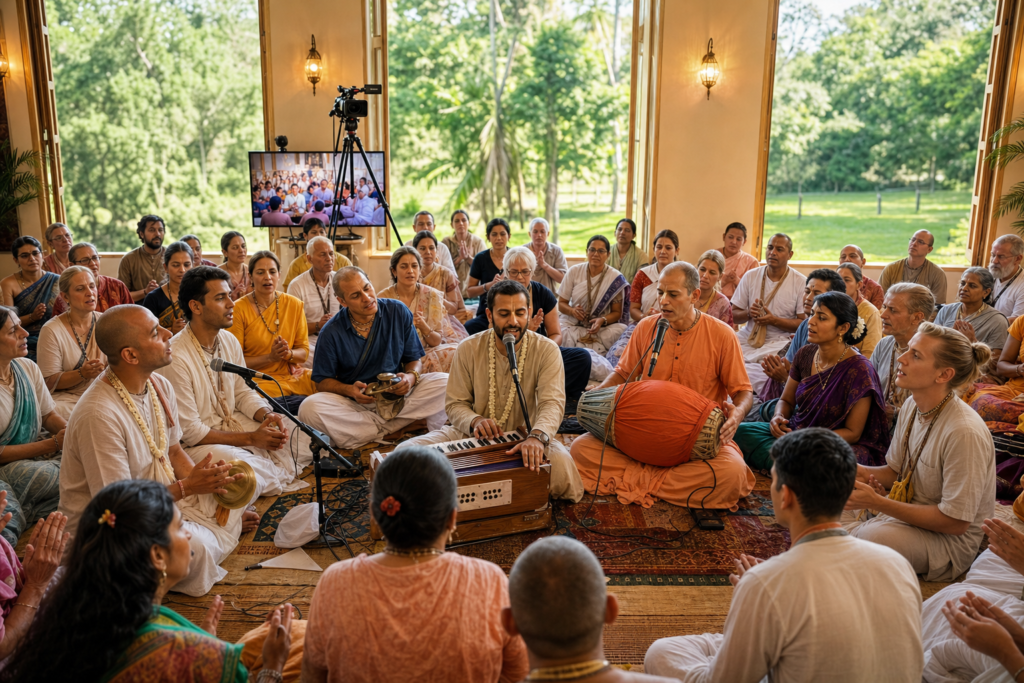
The word japa is technically important. It refers to the repeated recitation or murmuring of a mantra, often with careful attention to sound, breath, intention, and remembrance. In Vaiṣṇava practice, japa is not treated as a mechanical exercise. It is a way of placing the mind before the Divine again and again, until scattered thought begins to settle into devotional attention. The practice disciplines speech, hearing, memory, and desire at the same time.
The phrase paramo guhyaḥ, meaning supremely confidential, requires careful interpretation. Confidentiality here does not imply elitism or a desire to hide sacred knowledge from sincere seekers. Rather, it points to the principle that mantra is fully alive when received, understood, and practiced within a responsible lineage. A sacred formula may be printed in a book or heard in public, but its deepest force is awakened through śraddhā, discipline, and sambandha, a living connection with guru, śāstra, and sādhana.
This is why Nārada Muni is indispensable in the narrative. Dhruva does not invent a spiritual method out of emotional intensity. He receives instruction. The guru does not erase Dhruva’s personality, nor does he deny the reality of Dhruva’s pain. Instead, Nārada gives that pain a sacred direction. The child who entered the forest seeking a kingdom is gradually trained to seek the presence of Lord Viṣṇu.
In the sequence of verses, Śrīmad-Bhāgavatam 4.8.53 follows a description of meditating on the auspicious form of the Lord. This order matters. The text does not separate mantra from contemplation. Sound and form support one another. The practitioner hears the mantra, remembers the Lord, and allows the mind to become steady through disciplined repetition. In this sense, japa meditation is not emptying the mind into blankness; it is orienting the mind toward a sacred object of love.
The next verse, Śrīmad-Bhāgavatam 4.8.54, identifies the celebrated dvādaśākṣara-mantra: oṁ namo bhagavate vāsudevāya. In the story, this mantra becomes the center of Dhruva’s practice. It is a concise theological statement and a devotional act: obeisance is offered to Bhagavān Vāsudeva, the Supreme Lord. Its brevity is part of its power. It can be carried by memory, repeated with attention, and installed in daily life as a rhythm of surrender.
Technically, the verse brings together mantra, meditation, guru-paramparā, and yogic attainment. These are not isolated themes. Mantra provides the sonic form of practice. Meditation gives the mind a stable focus. Paramparā protects the meaning and method from distortion. Yogic attainment indicates the possible refinement of consciousness when practice is undertaken with seriousness. The Bhāgavatam’s concern, however, is not the display of powers but the purification of desire.
The mention of seven nights should also be read with theological sensitivity. It does not reduce spiritual life to a quick technique or guaranteed formula. In sacred literature, time periods often mark intensity, completeness, and disciplined observance. Dhruva’s later practice is severe, focused, and extraordinary. The verse therefore highlights the potency of properly received mantra, while the narrative as a whole reminds readers that sincerity, austerity, and divine grace cannot be bypassed.
The reference to beings from Siddhaloka introduces the classical idea of siddhis, or yogic perfections. Traditional lists include capacities such as becoming extremely small, becoming very light, expanding greatly, obtaining what is desired, and exercising extraordinary command over material conditions. These ideas belong to the cosmology and yoga psychology of the Purāṇic world. Yet the Bhāgavatam consistently subordinates siddhis to bhakti, because powers can still leave the heart unpurified if devotion is absent.
This point is spiritually practical. A person may seek meditation for calmness, chanting for emotional relief, study for intellectual mastery, or ritual for cultural belonging. All of these may have value, but Śrīmad-Bhāgavatam presses deeper. It asks whether practice is softening pride, purifying intention, and awakening service. Dhruva’s greatness is not that he gains access to extraordinary experience; it is that he eventually recognizes the higher worth of devotion over worldly reward.
The verse also speaks to the modern condition with surprising force. Contemporary life trains the mind to fragment itself across notifications, anxieties, ambitions, and constant comparison. Japa reverses that training. It asks the practitioner to return to one sacred sound, one remembered presence, one disciplined act of hearing. Even when the mind wanders, the practice quietly teaches humility: attention must be offered again, not merely assumed.
Many practitioners recognize this struggle intimately. The beads may be in the hand, yet the mind may be in unfinished work, family conflict, social comparison, or old grief. The value of japa is not lost in that struggle. The return itself becomes part of the sādhana. Each sincere return to the mantra is a small act of reordering the inner life, placing the Divine above the noise of impulse and memory.
For this reason, the instruction to hear is as important as the instruction to chant. In many bhakti traditions, the practitioner is advised not merely to pronounce the holy name but to listen to it. Hearing anchors the mind. It prevents chanting from becoming a background activity. The sound is not treated as a tool to manipulate reality, but as sacred presence approached through reverence and receptivity.
Theologically, this understanding protects japa from two distortions. The first is superstition, in which mantra is treated as a magical instrument detached from character and devotion. The second is reductionism, in which mantra is viewed only as a psychological calming device. The Bhāgavatam offers a richer account. Mantra is sound, meaning, relationship, discipline, grace, and revelation held together in practice.
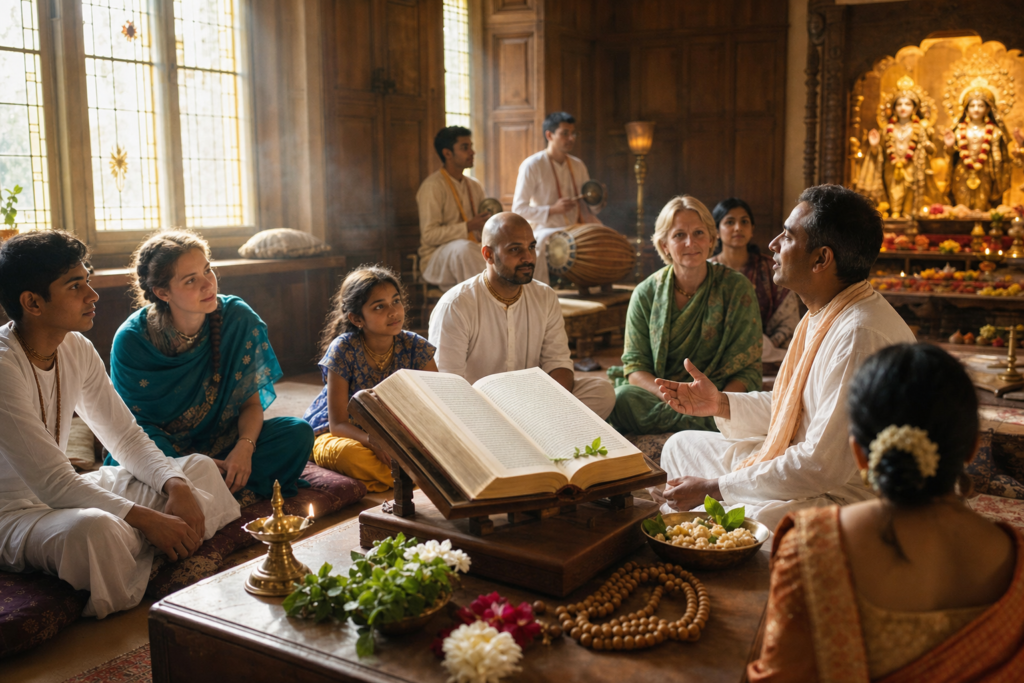
The role of guru in this passage is equally central. Nārada Muni does not merely provide information; he initiates a transformation. In the guru-śiṣya tradition, knowledge is not treated as data alone. It is transmitted with responsibility, tested through practice, and embodied through conduct. Dhruva’s receptivity is therefore as important as Nārada’s instruction. A mantra received without humility may remain external, while a mantra received with surrender can reorganize the entire personality.
This has implications for broader Dharmic unity. Hindu, Buddhist, Jain, and Sikh traditions differ in theology, metaphysics, ritual language, and ultimate doctrinal goals. Yet all preserve disciplined practices of repetition, remembrance, ethical restraint, and inward refinement. Nāma-smaraṇa, mantra-japa, dhyāna, sāmāyika, and simran are not identical practices, but they reflect a shared civilizational insight: the human mind is trainable, sound can sanctify attention, and spiritual life requires repeated practice.
Such unity does not require erasing difference. A Vaiṣṇava reading of Śrīmad-Bhāgavatam 4.8.53 will naturally center Bhagavān Vāsudeva, Nārada Muni, and bhakti. A respectful Dharmic approach can honor that specificity while recognizing resonances with other paths of disciplined remembrance. The healthiest form of inter-Dharmic solidarity is not vague sameness, but informed respect rooted in clarity, humility, and shared ethical aspiration.
Dhruva’s story is especially powerful because it begins with a wound. He is not introduced as a detached sage but as a child hurt by humiliation. This makes the narrative psychologically realistic. Spiritual life often begins not in serenity but in disturbance. A person seeks justice, recognition, healing, or stability. The Bhāgavatam does not mock that beginning. It shows how, under guidance, even mixed motivation can become purified devotion.
This is one of the compassionate dimensions of bhakti. It does not demand that the seeker arrive already purified. Dhruva comes with anger and longing. Nārada gives him a path. The mantra does not merely intensify Dhruva’s desire; it educates it. Through disciplined remembrance of the Lord, the heart learns to want differently. What begins as a search for status becomes a search for divine presence.
In academic terms, the passage integrates soteriology, ritual practice, and sacred psychology. Soteriologically, it points toward liberation through devotion. Ritually, it emphasizes mantra received through proper authority and practiced with discipline. Psychologically, it shows how concentrated sound and form reshape consciousness. The Bhāgavatam does not separate these dimensions; it presents them as mutually reinforcing aspects of the path.
The verse also clarifies the relationship between effort and grace. Dhruva must practice. He must chant, meditate, restrain himself, and follow instruction. Yet the revelation of the Lord is never reduced to human effort alone. In bhakti, disciplined practice prepares the heart, but divine self-disclosure remains grace. This balance protects the practitioner from both laziness and arrogance.
There is a subtle warning here for modern spiritual culture. Techniques are often marketed as quick pathways to power, manifestation, or exceptional experience. Śrīmad-Bhāgavatam 4.8.53 may mention extraordinary vision, but its placement within Dhruva’s narrative resists shallow sensationalism. The real question is not what the practitioner can see after chanting, but what kind of person the practitioner becomes through chanting.
When japa is practiced rightly, it can cultivate steadiness, humility, reverence, and moral seriousness. It can interrupt reactive patterns and create space between impulse and action. It can bring inherited sacred language into the intimate field of daily life. A mantra repeated in the morning, during travel, in grief, or before difficult decisions becomes part of an inner discipline that links ordinary time to sacred memory.
For devotees of Lord Krishna, the practice of chanting is inseparable from relationship. Krishna consciousness is not merely belief in a doctrine; it is the cultivation of remembrance, service, and love. The mantra is therefore not an object of analysis alone. It is a path of encounter. Academic study can clarify its structure and context, but practice reveals why generations of devotees have treated sacred sound as spiritually transformative.
Bhakti Anugraha Janardana Swami’s lecture title, centered on SB 4.8.53, points toward this enduring theme: the confidential force of japa is not hidden because it is unavailable, but because it must be approached properly. Sacred sound asks for more than curiosity. It asks for discipline, humility, lineage, and a heart willing to be changed.
The lasting relevance of Śrīmad-Bhāgavatam 4.8.53 lies in its union of tenderness and rigor. A wounded child is not abandoned to his pain. A sage offers him a mantra. The forest becomes a place of practice. The mind becomes an altar. The sound becomes a guide. Through this movement, the Bhāgavatam teaches that bhakti can transform injury into aspiration, aspiration into discipline, and discipline into grace-filled realization.
Inspired by this post on Dandavats.







Leave a Reply
You must be logged in to post a comment.