
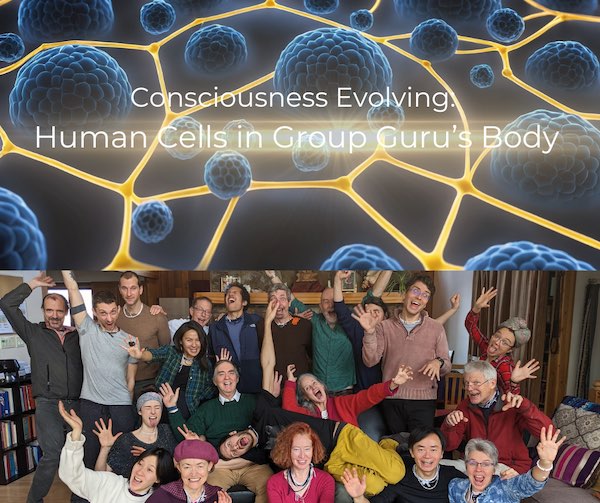
Consciousness, evolution, and the search for a unified future
Humanity appears to be living through a period in which fragmentation and integration are unfolding at the same time. Public life often seems divided by anxiety, ecological pressure, technological disruption, political conflict, and a widening crisis of trust. At the same time, there are visible signs of a more global, planetary, and interdependent awareness taking shape. This is not merely a sentimental hope. It reflects a recurring pattern in the history of life: separate units can, under certain conditions, learn to cooperate so deeply that a new level of organization becomes possible.
The central insight is simple but demanding. Human beings may be evolving toward forms of community in which individuality is not erased, but reorganized into a more conscious whole. Cells do not lose their cellular nature when they contribute to a liver, lung, nervous system, or immune system. Their identity becomes meaningful through participation in a larger organism. A comparable possibility stands before human society: persons, families, institutions, and spiritual communities may become more capable of acting like conscious cells within a larger body of life.
This idea must be handled carefully. Biological evolution is not a straight ladder marching toward a predetermined spiritual conclusion. Many lineages remain simple, many become specialized, and many disappear. Yet the study of major evolutionary transitions shows a repeated pattern: molecules form replicating systems, cells form more complex cells, single-celled organisms form multicellular bodies, and individuals form social structures. Cooperation, differentiation, and shared regulation have repeatedly allowed life to become more complex. The spiritual question is whether human consciousness can participate in this pattern knowingly, ethically, and responsibly.
From LUCA to human society: complexity through cooperation
The scientific story begins with common ancestry. The Last Universal Common Ancestor, often called LUCA, refers to the ancestral cellular population from which known bacteria, archaea, and eukaryotes descend. Estimates vary, but contemporary research commonly places LUCA deep in Earth history, roughly between 3.5 and 4.2 billion years ago. A useful technical summary of LUCA research can be found in work such as PLOS Genetics on the last universal common ancestor. The important point is not a single exact date, but the shared biological inheritance of all known life.
From early microbial life, evolution generated increasing forms of organization. Bacteria and archaea diversified. Eukaryotic cells emerged with internal compartments. Multicellularity appeared in several lineages. Plants, fungi, animals, nervous systems, and eventually self-reflective human beings arose through long processes of mutation, selection, symbiosis, cooperation, and environmental constraint. This history does not prove that consciousness must evolve in one particular way, but it does show that life has often solved survival problems by creating larger, more integrated forms.

The human body is one of the clearest illustrations of this principle. A body is not a pile of independent cells. It is a coordinated society of specialized cells, tissues, organs, chemical signals, feedback loops, immune responses, and nervous system integration. A liver cell does not exist merely for itself; it serves the function of the liver, and the liver serves the whole body. A neuron does not become less real because it participates in a nervous system. Its meaning expands through relationship.
Human beings face an analogous challenge at the level of culture and consciousness. Modernity has intensified individuality, mobility, choice, and self-expression. These are not errors; they are real achievements. Yet isolated individuality cannot solve problems that are planetary in scale. Climate change, biodiversity loss, artificial intelligence, public health, economic instability, religious conflict, and social fragmentation require coordinated intelligence. In this sense, social evolution demands not the abolition of the person, but the maturation of the person into a responsible participant in a larger whole.
Dharmic traditions and the grammar of interdependence
Dharmic traditions offer a particularly rich language for this emerging consciousness. Hinduism speaks of dharma, lokasangraha, seva, karma yoga, and the wider order that sustains life. Buddhism emphasizes interdependence, compassion, awareness, and the end of clinging to a rigid ego. Jainism develops a profound ethic of ahimsa, many-sided truth through Anekantavada, and disciplined responsibility toward all living beings. Sikhism gives powerful expression to seva, sangat, humility, remembrance, and alignment with Hukam. These traditions differ in doctrine and practice, yet they converge in a civilizational intuition: the individual is not complete in isolation.
This convergence is crucial for unity among Hindu, Buddhist, Jain, and Sikh communities. Unity does not require sameness. In fact, Dharmic unity is strongest when it honors diversity without dissolving difference. A body is healthy precisely because its organs are not identical. The heart, lungs, liver, skin, and brain perform different functions, but their cooperation allows the whole organism to live. In the same way, Dharmic traditions can retain their distinctive lineages, scriptures, teachers, disciplines, and philosophies while contributing to a shared civilizational ethic of compassion, wisdom, restraint, courage, and responsibility.
This perspective also helps address a common anxiety. Many people fear that collective consciousness means conformity, loss of freedom, or surrender to institutional control. A more careful reading suggests the opposite. Mature integration preserves differentiation. The liver does not become the lung; the lung does not become the nervous system. Each serves the whole through its own nature. Similarly, a human being need not become less personal, less creative, or less free in order to serve a larger moral and spiritual order. Freedom becomes deeper when it is guided by dharma rather than by compulsive self-assertion.

The ego, the cell, and the larger body of Mind
The metaphor of human beings as conscious cells in a larger body of Mind is powerful because it speaks to both humility and dignity. It humbles the ego by showing that no individual controls the entire process. It dignifies the individual by showing that every life has a function within a wider field. A cell may be small, but its health matters. A damaged cell can affect a tissue; a healthy cell can support the organism. Likewise, a person shaped by awareness, compassion, and ethical discipline can influence family, community, workplace, temple, vihara, gurudwara, monastery, school, and nation.
Human consciousness differs from ordinary cellular life because it can reflect on its own participation. A liver cell does not appear to contemplate the meaning of liver function. Human beings can contemplate duty, identity, mortality, suffering, liberation, God, Brahman, Buddha-nature, Jiva, Atman, Shunya, Hukam, and the moral order of life. This reflective capacity makes responsibility more intense. Human beings can resist interdependence, exploit it, misunderstand it, or consciously serve it.
Much suffering arises when the ego imagines itself to be absolutely separate. This does not mean that personal boundaries, self-respect, or individual rights are unimportant. They are essential. But a life built only around private preference becomes unstable. The person begins to experience the world as threat, competition, comparison, or possession. Dharmic philosophy repeatedly challenges this contracted identity. Whether through meditation, japa, seva, study, mindfulness, devotion, ethical vows, or disciplined action, the practitioner is invited to discover a wider field of belonging.
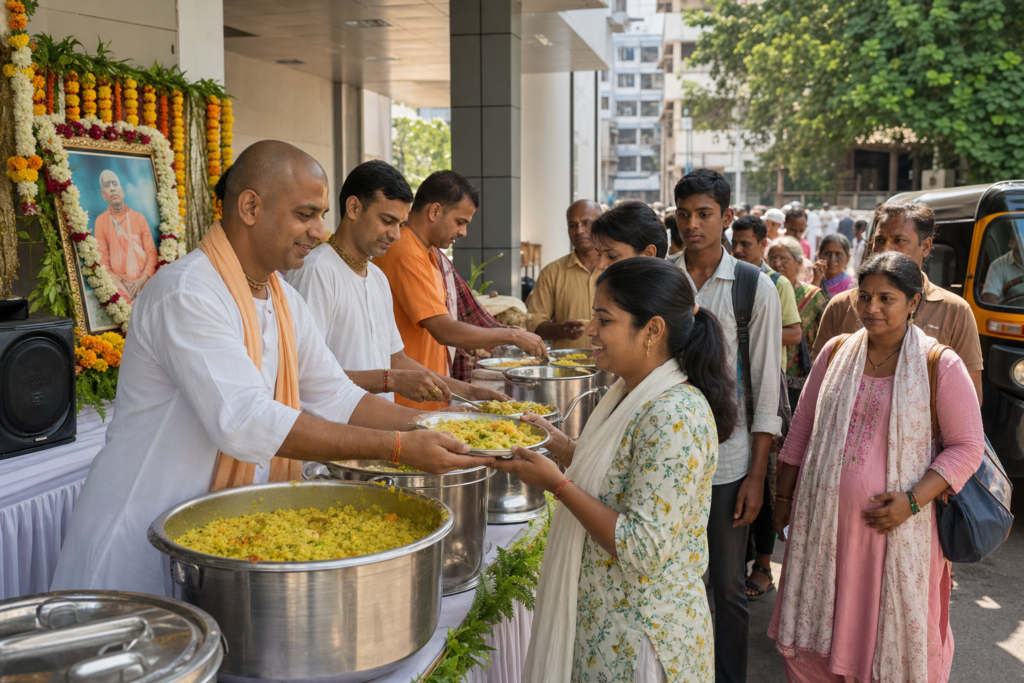
For many practitioners, this shift is not abstract. It is felt in ordinary experience: caring for an elder, sharing food in community kitchens, sitting in meditation with others, offering seva without recognition, restraining harmful speech, or choosing patience in conflict. These moments reveal that consciousness evolves not only through grand theories, but through small acts of alignment. The larger body of Mind is not elsewhere. It becomes visible when individuals act with awareness within relationship.
Include and transcend: a practical model of growth
A useful philosophical formula for this process is to include and transcend. New levels of organization do not simply destroy earlier levels; they incorporate them into broader forms. A multicellular organism includes cells but transcends single-cell isolation. A mature society includes families, local communities, religious traditions, and individual freedoms, but also requires wider responsibility. A Dharmic civilization includes ritual, philosophy, devotion, meditation, service, art, ecology, law, and education, but must also respond to contemporary realities such as artificial intelligence, biotechnology, digital life, and planetary ecological crisis.
This principle prevents two common mistakes. The first mistake is nostalgia: the belief that the past can be recovered unchanged. The second mistake is rootless futurism: the belief that new technology or social theory can replace inherited wisdom. A living tradition must include and transcend. It must preserve what is life-giving, examine what has become mechanical, and develop new capacities for new conditions. This is especially important for Dharmic traditions, which have historically shown remarkable adaptability across geography, language, philosophy, ritual, and social form.
The emergence of artificial intelligence makes this question urgent. Technology can intensify fragmentation through distraction, surveillance, manipulation, and speed. It can also support education, translation, medical research, ecological modeling, and cross-cultural learning. The determining factor is not technology alone, but consciousness. A tool used by an egoic mind magnifies egoic patterns. A tool governed by dharma can support knowledge, responsibility, and service. Therefore, the evolution of consciousness must accompany technological development.
Ecological crisis and planetary responsibility
The ecological dimension cannot be avoided. Humanity lives inside Earth systems, not above them. The current biodiversity crisis is severe. The IPBES Global Assessment on Biodiversity and Ecosystem Services warned that human activity has placed around one million species at risk of extinction. Climate instability, habitat destruction, pollution, overexploitation, and invasive species are not merely environmental issues; they are signs of a disordered relationship between consciousness and the living world.
Earth history has seen catastrophic extinction events before. The Permian-Triassic extinction, often called the Great Dying, eliminated a vast proportion of marine species and many terrestrial vertebrates. Such events remind humanity that life is resilient, but not sentimental. Evolution continues, but particular species, cultures, and ecosystems can vanish. A spiritually serious view does not use evolution as an excuse for passivity. It recognizes that responsibility is part of participation.

Dharmic traditions have resources for ecological responsibility. Ahimsa broadens moral concern beyond human convenience. Seva turns care into action. Aparigraha challenges compulsive consumption. The sacred geography of rivers, mountains, forests, pilgrimage routes, temples, and tirthas teaches that place is not merely resource. The idea of Vasudhaiva Kutumbakam, often translated as the world as one family, becomes meaningful only when it includes soil, water, air, animals, plants, ancestors, descendants, and unseen forms of life.
Conflict as part of growth, not proof of failure
The movement toward unity is not smooth. Growth often produces conflict because different parts of a system mature at different rates. Individuals, communities, institutions, and nations carry different histories, wounds, fears, and aspirations. Some cling to rigid separation. Others rush toward shallow unity without honoring real difference. Some resist change because it threatens identity. Others embrace change without sufficient wisdom. These tensions are not proof that integration is impossible; they are the field in which integration must be practiced.
A body also knows conflict. Immune responses, inflammation, healing, cell death, repair, and adaptation are part of biological life. The question is whether conflict serves restoration or destruction. Human conflict becomes destructive when driven by hatred, humiliation, domination, or denial of dignity. It becomes evolutionary when guided by truthfulness, accountability, compassion, courage, and willingness to learn. Dharmic traditions do not demand naive harmony. They ask for disciplined harmony rooted in dharma.
This distinction matters for inter-Dharmic unity. Hindu, Buddhist, Jain, and Sikh communities need not erase theological differences in order to stand together. They can disagree with intellectual honesty while recognizing shared ethical concerns: protection of sacred traditions, preservation of knowledge, cultivation of youth, defense of religious freedom, care for the vulnerable, ecological responsibility, and the formation of communities that can withstand fragmentation. Unity becomes mature when it can hold difference without hostility.
Duty, responsibility, and the freedom of participation
The language of duty can feel heavy in an age shaped by personal choice. Yet duty, properly understood, is not a denial of freedom. It is freedom disciplined by meaning. A person who belongs to nothing is not necessarily free; such a person may simply be unanchored. Dharma gives action a context. Responsibility gives individuality a direction. Service gives talent a purpose. Community gives practice a field of testing.
In the metaphor of the larger body, each person has a function. Some teach, some protect, some heal, some organize, some study, some serve quietly, some create art, some preserve ritual, some build institutions, some raise children, some care for elders, and some hold contemplative space. No single function exhausts the whole. The health of the whole depends on the integrity of each part and the cooperation among parts.
This understanding also softens the burden of control. No individual controls the entire song of history. No community, however sincere, sees the whole pattern. Human beings participate in a process much older and larger than themselves. This can be frightening to the ego, but liberating to the deeper intelligence. The task is not to control evolution, but to participate in it with awareness. The task is not to become the whole body, but to become a healthier cell within it.
What conscious community requires
A conscious community cannot be built on sentiment alone. It requires practices, structures, and disciplines. It needs shared study, ethical norms, conflict resolution, intergenerational transmission, transparent leadership, care for vulnerable members, and a culture that values both contemplation and action. Without structure, community becomes fragile. Without compassion, structure becomes rigid. Without wisdom, compassion becomes confused. Without courage, wisdom remains private.
Dharmic communities are especially well placed to develop this model because they inherit centuries of reflection on mind, conduct, liberation, discipline, and social obligation. Yoga, meditation, satsang, sangha, sangat, vrata, dana, seva, scriptural study, pilgrimage, festival, and ritual all train the person to move beyond isolated selfhood. Their deeper function is not merely cultural continuity, though that is important. Their deeper function is the formation of consciousness capable of relationship, restraint, insight, and service.
Such communities also help young people meet despair with grounded hope. Many young people see ecological damage, social conflict, loneliness, and institutional failure. Optimism without evidence feels hollow. But a long view of evolution and dharma offers something sturdier than optimism. It shows that life has repeatedly generated new forms under pressure, and that human beings can consciously choose practices that support integration rather than fragmentation.
The future of humanity as conscious cooperation
The future of humanity may depend on whether intelligence becomes more cooperative than competitive. Competition has a place in evolution, economics, politics, and personal excellence. But competition without integration becomes self-destructive. Cells that refuse the regulation of the body do not become liberated; they become pathological. Societies that celebrate ego without duty risk similar disorder. Conscious cooperation is therefore not weakness. It is a higher-order strength.
The emerging body of Mind should not be imagined as a single centralized institution or ideology. It is better understood as a field of awakened relationships: between persons, traditions, species, technologies, ancestors, descendants, and the Earth itself. In Dharmic language, it is a movement from avidya toward vidya, from clinging toward service, from fragmentation toward dharma, from unconscious habit toward awareness.
The practical conclusion is direct. Human beings remain individuals, but individuality matures through participation. Communities remain distinct, but distinction becomes meaningful through cooperation. Traditions remain rooted, but roots nourish branches that must grow. The next stage of consciousness will not be created by abstraction alone. It will be formed through daily ethical practice, disciplined attention, compassionate action, ecological responsibility, and unity among Dharmic traditions without erasing their plurality.
Life is evolving. The question is whether human consciousness will evolve with enough humility, intelligence, and compassion to serve the larger body that is already forming.
Inspired by this post on Planet Dharma.


Leave a Reply
You must be logged in to post a comment.