
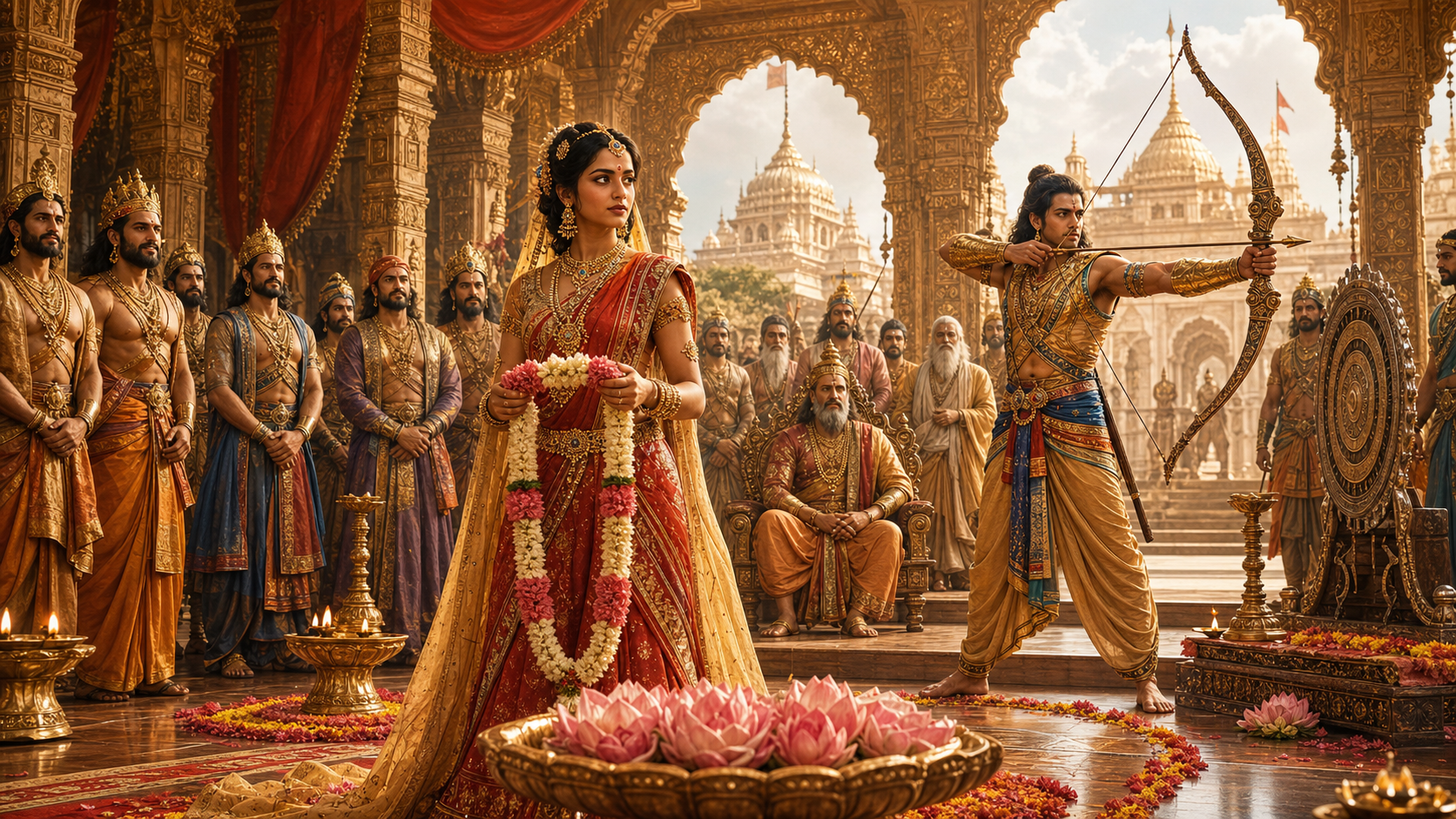
Swayamvara and Viryashulka are two closely related but distinct ideas found in the social, literary, and political imagination of ancient India. Both are associated with marriage, royal households, heroic reputation, and the public selection of a suitable husband, yet they should not be treated as identical customs. Swayamvara emphasizes the bride’s act of choosing, while Viryashulka emphasizes the heroic condition that a suitor must satisfy before he becomes eligible for marriage.
The difference matters because these terms reveal how ancient Indian society understood marriage not merely as a private arrangement, but as an institution linked with dharma, lineage, social responsibility, political alliance, personal worth, and public honor. In epic and Puranic narratives, marriage often becomes a stage on which ethical character, skill, restraint, courage, and destiny are tested. This is why the stories of Sita, Draupadi, Damayanti, Savitri, and other women continue to invite serious reflection in discussions of Hindu traditions, Indian epics, and ancient customs.
The word Swayamvara is generally understood as self-choice. It combines the idea of swayam, meaning self, with vara, meaning bridegroom or chosen person. In practice, a Swayamvara was a formal assembly in which a princess or eligible woman selected her husband from among invited suitors. Such assemblies were especially associated with royal and Kshatriya circles, where marriage carried political and military implications in addition to personal and familial meaning.
In its ideal form, Swayamvara gave visible agency to the woman. She did not merely become the object of negotiation between families; she appeared in a public setting and made a choice from among candidates. This does not mean that every Swayamvara was modern individual freedom in the contemporary sense. The ceremony was shaped by family expectations, dynastic interests, caste and social codes, and the political realities of the time. Still, compared with many arranged marriage models, it preserved a striking recognition of female choice within a structured social framework.
Viryashulka, by contrast, is built around the idea of valor as the qualifying condition for marriage. The term joins vīrya, meaning strength, heroism, prowess, or valor, with śulka, often translated as fee, price, condition, or consideration. In this context, it should not be reduced to a crude commercial bride-price. Viryashulka indicates that the bride’s hand is granted only to the person who proves extraordinary ability, usually through a test of arms, strength, archery, endurance, or heroic competence.
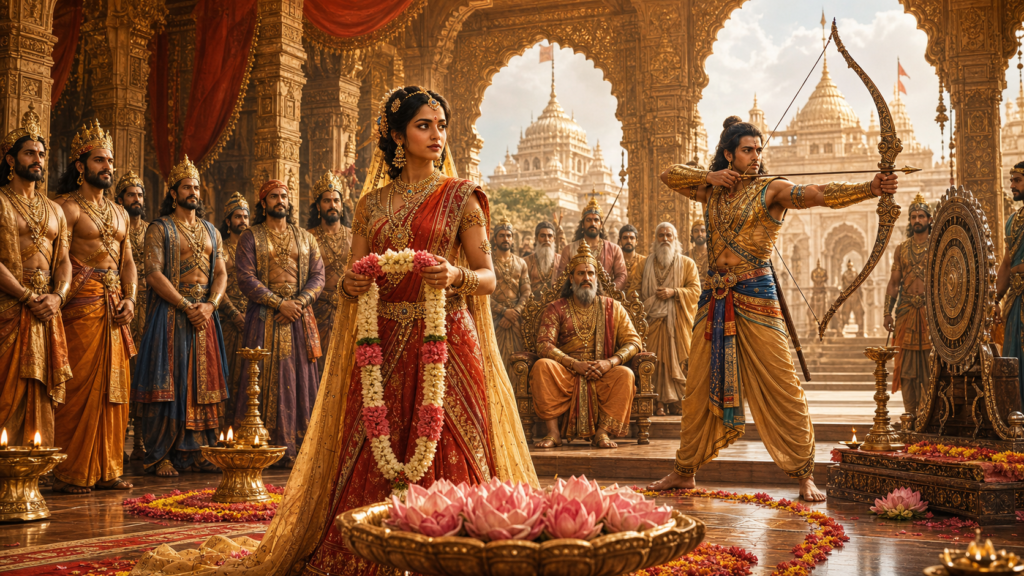
The most famous example is the marriage of Sita in the Ramayana tradition. King Janaka sets the lifting and stringing of Shiva’s bow as the condition for Sita’s marriage. Rama alone succeeds, and the feat establishes him not merely as a powerful prince but as a person of divine destiny, discipline, and rightful stature. In this case, the marriage is commonly described through the logic of Viryashulka because valor becomes the decisive condition.
Draupadi’s marriage in the Mahabharata is often discussed as a Swayamvara, yet it also contains a Viryashulka-like test. The suitors gather in a royal assembly, and the challenge requires extraordinary archery skill. Arjuna, disguised as a Brahmin, succeeds in the test and wins Draupadi’s hand. This example shows why the two concepts can overlap: a ceremony may be called a Swayamvara because it is a bride-selection assembly, while the eligibility mechanism may resemble Viryashulka because it depends on a feat of prowess.
The essential distinction, therefore, lies in the center of gravity. Swayamvara is bride-centered in its formal definition because the decisive act is selection. Viryashulka is condition-centered because the decisive act is the fulfillment of a heroic test. A Swayamvara asks, whom does the bride choose? Viryashulka asks, who has proven worthy through valor? In many epic narratives, the two questions appear together, creating a layered institution rather than a simple category.
It is also important to distinguish Viryashulka from the Asura form of marriage described in Dharmashastra discussions, where wealth is given to the bride’s family in a manner resembling purchase. Viryashulka is not primarily about money. Its moral logic is tied to ability, courage, and public merit. The suitor does not buy the bride; he demonstrates worthiness before society, elders, and the royal court.
In Dharmashastra literature, marriage is often discussed through classifications such as Brahma, Daiva, Arsha, Prajapatya, Asura, Gandharva, Rakshasa, and Paishacha. Swayamvara does not always appear neatly as one of these eight formal categories because it functions more as a royal selection custom than as a separate doctrinal marriage type. It may contain elements associated with Gandharva marriage when personal choice is emphasized, or with Kshatriya codes when martial tests and royal assemblies dominate.
The social setting of Swayamvara is significant. It was generally not a casual gathering. Kings, princes, warriors, sages, and political allies could be present. The event displayed wealth, diplomatic relationships, military power, and cultural refinement. For a royal house, the marriage of a princess could affect alliances, succession, regional stability, and prestige. Thus, personal choice and statecraft often moved together.
Viryashulka reflects the Kshatriya ideal that power must be tested and visible. In an age where rulers were expected to protect society, uphold order, and defend dharma, physical courage and martial skill were not decorative qualities. They were markers of public responsibility. A prince who could not demonstrate discipline, strength, and competence might be politically unsuitable, regardless of birth.
At the same time, the epics do not glorify brute strength alone. Rama’s breaking of the bow is inseparable from humility, obedience, restraint, and dharmic character. Arjuna’s skill is inseparable from training, focus, and self-control. Nala’s selection by Damayanti is not based on a weapon-test but on character, love, reputation, and destiny. These narratives repeatedly suggest that true worthiness combines ability with virtue.
Damayanti’s Swayamvara in the Mahabharata offers a useful contrast. The gods themselves attend the assembly, yet Damayanti chooses Nala. Her discernment becomes the central force of the episode. There is no major martial contest like the bow of Sita or the archery test of Draupadi. The example shows Swayamvara in its more choice-centered form, where recognition, commitment, and inner conviction matter deeply.
Savitri’s story provides another related but different model of female agency. She chooses Satyavan after personal search and reflection, even when warned of his short lifespan. Although this is not usually presented as a formal Swayamvara assembly, it belongs to the broader civilizational memory of women exercising judgment within dharmic frameworks. Her story transforms marriage into a field of loyalty, courage, spiritual intelligence, and moral endurance.
From a historical perspective, these customs should be read carefully. Epic literature preserves ideals, memories, social debates, and symbolic patterns; it is not always a direct administrative record of everyday practice. Swayamvara and Viryashulka were likely associated with elite and royal circles rather than ordinary households. Their presence in literature, however, indicates that ancient Indian culture could imagine marriage as a public test of both personal consent and social worth.
The emotional appeal of these narratives remains strong because they address questions that are still familiar. What makes a person worthy of marriage? Should family, society, and individual preference be balanced? Is strength enough without character? Is choice meaningful without responsibility? Ancient Indian stories answer these questions through narrative rather than abstract theory, which is why they continue to feel alive across generations.
In contemporary discussions, Swayamvara is sometimes romanticized as complete freedom and Viryashulka is sometimes misunderstood as patriarchal competition. Both readings are too simple. Swayamvara did preserve a space for selection, but it operated within social boundaries. Viryashulka did demand heroic achievement, but in its best form it pointed toward responsibility and excellence rather than mere dominance. A balanced interpretation recognizes both agency and structure.
These customs also show the diversity within Hindu culture and broader Dharmic traditions. Indian civilization did not develop a single mechanical model of marriage. Different regions, communities, texts, and historical periods preserved different forms of union, consent, alliance, ritual, and social duty. This diversity should be approached with intellectual humility, especially when comparing Hindu, Buddhist, Jain, and Sikh civilizational values around family, ethics, restraint, and responsibility.
The concept of dharma is central to understanding both practices. Marriage was not viewed only as personal desire or social contract. It was also connected to duty, lineage, household life, ritual obligation, ethical companionship, and the maintenance of social order. In this setting, a spouse was not merely chosen for attraction or status; the ideal spouse was expected to be capable of sustaining shared responsibilities.
Swayamvara therefore highlights discernment. The bride’s garland, choice, or public preference becomes a symbol of judgment. Viryashulka highlights qualification. The heroic test becomes a symbol of demonstrated capacity. Together, they reveal a sophisticated tension in ancient Indian marriage customs: the right to choose and the need to be worthy of being chosen.
For modern readers, the most meaningful lesson is not to imitate ancient ceremonies literally, but to understand the values they dramatized. Swayamvara reminds society that consent, discernment, and personal preference cannot be dismissed. Viryashulka reminds society that marriage requires preparedness, discipline, courage, and responsibility. When read together, they offer a richer view of Indian traditions than either concept can provide alone.
The difference between Swayamvara and Viryashulka can finally be stated with clarity: Swayamvara is a mode of choosing a husband, while Viryashulka is a condition of winning eligibility through valor. One centers the act of selection; the other centers the test of worthiness. In the great Indian epics, these customs sometimes merge, but their meanings remain distinct and valuable for understanding ancient India, Hindu traditions, marriage customs, and the enduring moral imagination of dharmic society.
Inspired by this post on Hindu Blog.

Leave a Reply
You must be logged in to post a comment.