
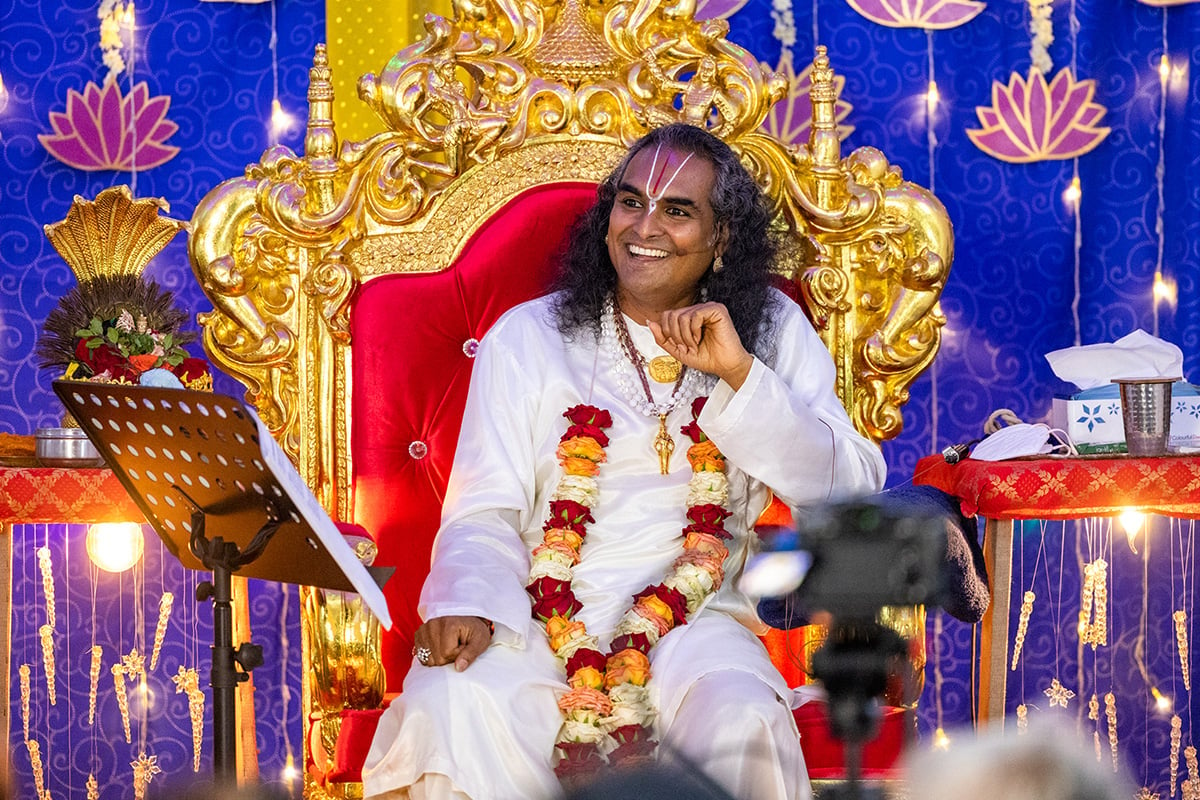
The central question is not merely whether Paramahamsa Vishwananda is a guru, but how the guru principle is recognised within a serious dharmic life. In many Hindu spiritual traditions, the meeting between a seeker and a master is not treated as a casual preference, a personality attraction, or an intellectual conclusion formed after comparing public teachings. It is understood as a subtle convergence of longing, readiness, grace, discipline, and recognition. The original reflection on Paramahamsa Vishwananda places this question inside the language of bhakti, where the heart is not sentimental weakness but an instrument of spiritual discernment.
The teaching attributed to Paramahamsa Vishwananda begins with an important distinction: outside satisfaction may be easy, but spirituality concerns inner satisfaction. This distinction is technically significant in Hindu philosophy because external satisfaction depends on changing conditions, while inner contentment points toward steadiness of consciousness. The human being may accumulate success, approval, information, and experiences, yet still remain unsettled. In that condition, the search for a guru is not an escape from responsibility; it becomes a search for guidance capable of reorienting the whole life toward God-realisation, self-knowledge, and love.
When seekers ask how a master is recognised, Paramahamsa Vishwananda is described as asking, “What do you feel?” rather than “What do you think?” This does not reject reason. Rather, it recognises that the mind often produces arguments, doubts, fantasies, projections, and anxieties at the same time. In contrast, the heart, when purified through humility and sincerity, may register a deeper form of recognition. In bhakti traditions, such recognition is not simply emotional excitement; it is a quiet interior certainty that one has encountered a path demanding transformation rather than entertainment.
This emphasis on feeling should be interpreted carefully. A dharmic approach does not encourage blind dependence on charisma or passive obedience to any religious figure. It asks for discernment, steadiness, ethical clarity, and observation of the fruits of the teaching. The feeling spoken of in the original teaching is not impulsive attraction. It is the settled awareness that arises when a seeker feels inwardly called toward discipline, devotion, surrender, and a life of greater truthfulness. Such recognition may be tender, but it is also demanding.
The difference between a guru and a satguru is therefore central. The Sanskrit word guru can refer broadly to a teacher, guide, remover of darkness, or one who carries spiritual weight. In lived Hindu practice, there may be many gurus: teachers of scripture, mantra, music, ritual, yoga, ethics, philosophy, and meditation. A satguru, however, is understood in devotional traditions as one who leads the disciple toward the highest truth, not merely toward skill, culture, or intellectual refinement. The satguru is associated with liberating knowledge, transformative grace, and the awakening of direct relationship with the Divine.
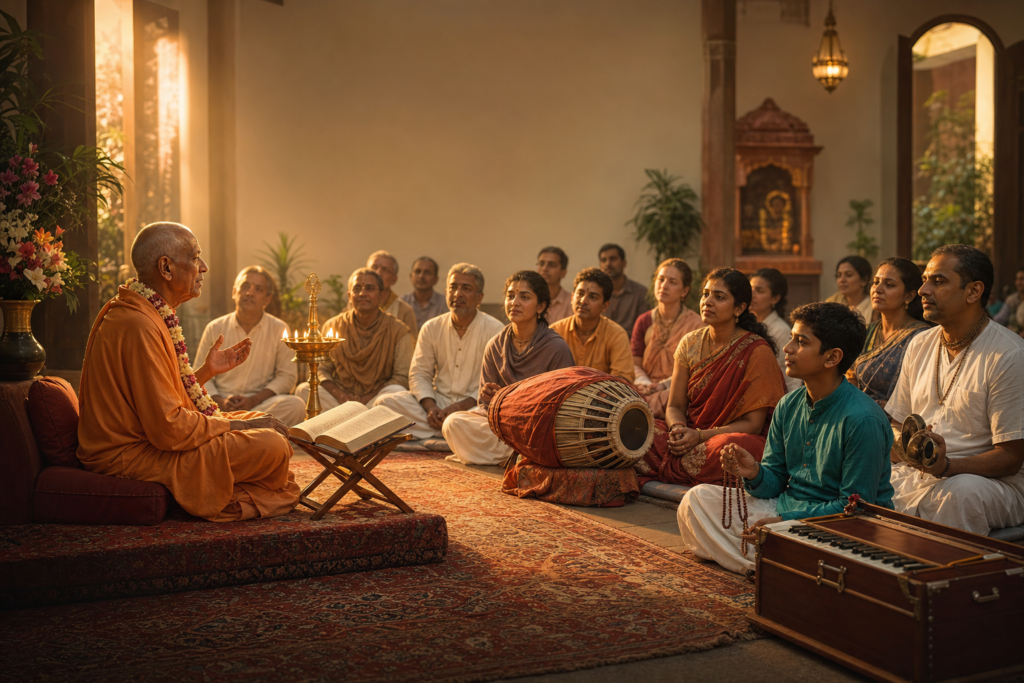
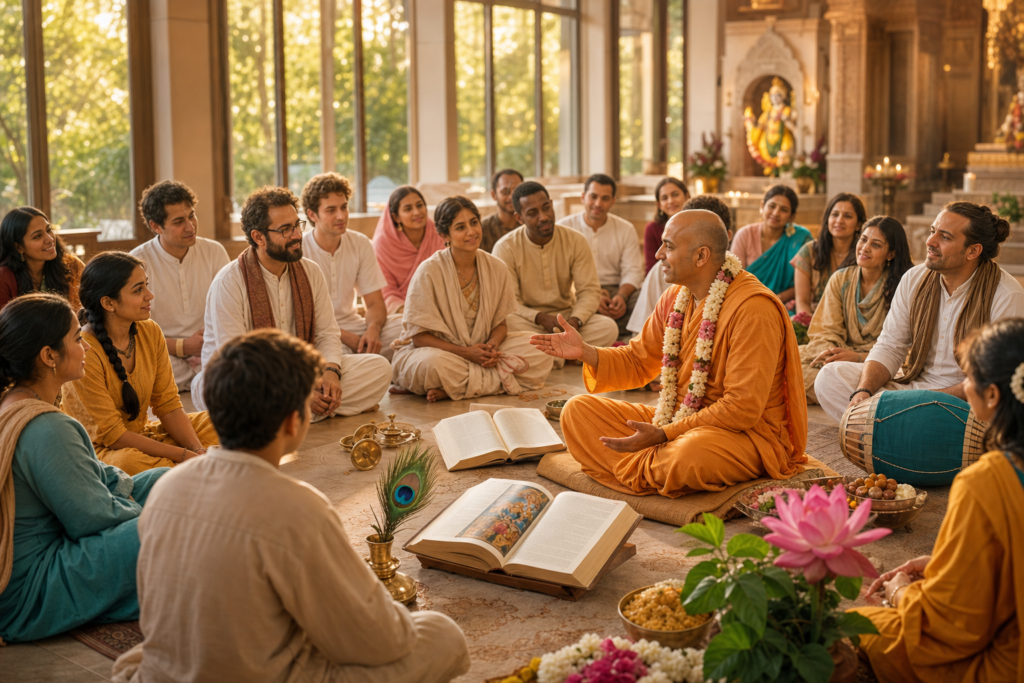
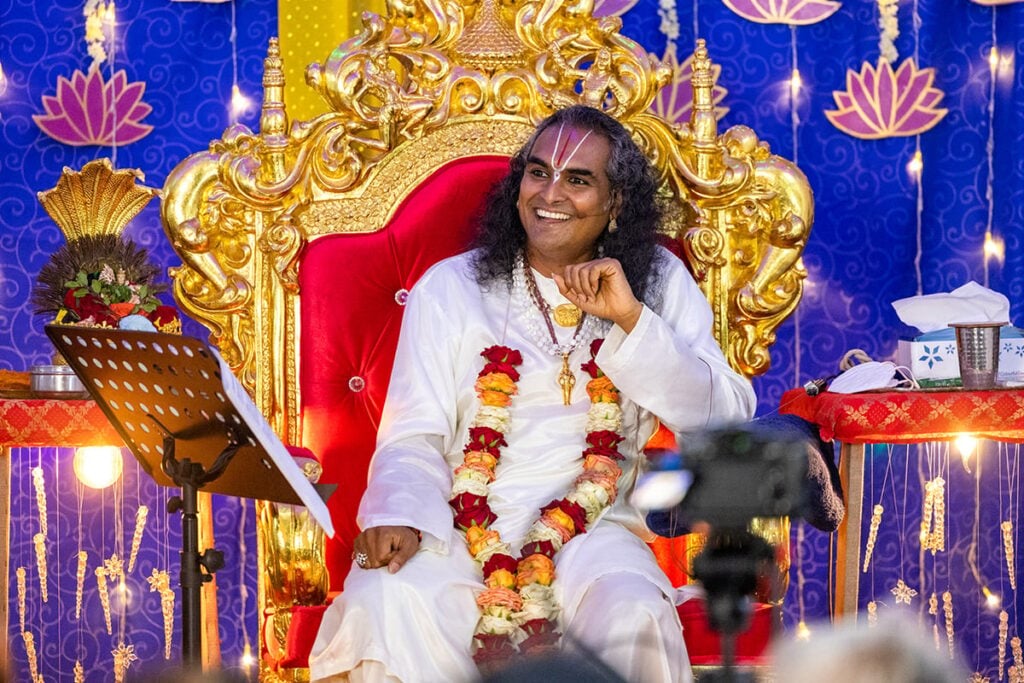
Within the Bhakti Marga tradition, Paramahamsa Vishwananda is revered by devotees as a satguru whose mission is connected with opening the heart to Divine Love. This claim belongs to the devotional self-understanding of that community and should be read as a theological statement rather than a neutral historical measurement. Academically, it shows how contemporary Hindu movements continue older guru-shishya patterns: the teacher is not only a lecturer, the disciple is not only a listener, and spiritual knowledge is not reduced to information. The relationship is meant to reshape perception, conduct, aspiration, and identity.
The Bhagavad Gita provides an important framework for this kind of discussion. The text repeatedly links dharma, devotion, self-mastery, surrender, and divine manifestation. The often-cited teaching that the Divine manifests whenever dharma declines is not merely a dramatic religious claim; it expresses a metaphysical pattern in which grace responds to human disorder. For bhaktas, the guru becomes one way through which that grace becomes concrete, personal, and practical. The guru is not approached as a replacement for God, but as a living channel through which the seeker learns how to love, serve, remember, and realise God.
This is why the original question, “Is Paramahamsa Vishwananda your guru?” cannot be answered only by admiration from a distance. Admiration may enjoy the image of a spiritual master, but discipleship tests the whole person. It asks whether one is prepared to be instructed, corrected, refined, and made more honest. It asks whether spiritual longing is stronger than the ego’s preference for comfort. It asks whether love is merely an inspiring word or a discipline capable of transforming speech, conduct, relationships, priorities, and the hidden patterns of the mind.
Modern spirituality often turns yoga, meditation, mantra, and devotion into lifestyle accessories. These practices can certainly reduce stress and improve well-being, but traditional dharmic systems give them a deeper aim. Yoga is not only relaxation. Meditation is not only focus. Bhakti is not only emotion. Guru-bhakti is not personality worship when properly understood. These are methods of reordering the human being around truth, humility, remembrance, and love. In that context, a true guru is recognised not by spectacle, but by the seriousness of the transformation demanded and enabled.
The technical language of bhakti helps clarify this transformation. A bhakta is a lover of the Lord, one who places the Divine at the centre of life. This does not require withdrawal from daily responsibilities; rather, it requires that work, family, speech, study, worship, and service become aligned with remembrance. The life of a bhakta is therefore not anti-intellectual or anti-worldly. It is integrative. It brings emotion, thought, body, community, and moral action into a single orientation. The guru assists by making this orientation visible and livable.
Paramahamsa Vishwananda’s teaching on Divine Love, or Prema, is especially important in this discussion. Love is often confused with approval, attachment, emotional intensity, or psychological comfort. In bhakti, Divine Love is more radical. It exposes the desire to control, the fear of surrender, and the ego’s need to remain central. When Prema awakens, the seeker may experience both sweetness and difficulty. The sweetness lies in intimacy with the Divine; the difficulty lies in the collapse of familiar self-protective patterns. This is why a guru’s grace may feel compassionate and challenging at the same time.
The original teaching also warns against passivity. Even if a master is believed to be filled with grace, the disciple cannot reduce the path to waiting for miracles. Dharmic traditions consistently join grace with effort. Sadhana, seva, japa, study, ethical restraint, humility, and devotion are the means through which the seeker becomes receptive. This balance protects the path from spiritual consumerism. The question is not simply, “What can the guru give?” It is also, “What must be purified so that the gift can be received responsibly?”
Recognition of a guru also requires attention to doubt. Doubt is not always a defect; it can prevent naivety and compel deeper inquiry. However, uncontrolled doubt can become a habit of avoidance. The mind may demand certainty while refusing transformation. A mature seeker examines both the teacher and the self. Is the attraction rooted in longing for God, or in the desire for belonging? Is resistance rooted in healthy discernment, or in fear of surrender? Such questions make the guru-shishya relationship more serious, not less.
This approach also supports unity among dharmic traditions. Hinduism, Buddhism, Jainism, and Sikhism each preserve distinctive understandings of teachers, lineage, discipline, liberation, and inner awakening. They do not need to be flattened into sameness to be honoured together. The dharmic family of traditions broadly recognises that the human being requires guidance, practice, ethical refinement, and liberation from ignorance, ego, or bondage. The guru principle in Hindu bhakti can therefore be appreciated alongside the Buddhist kalyana-mitra, the Jain acharya, and the Sikh reverence for Guru as the light of wisdom preserved in the Guru Granth Sahib.
Such comparison deepens rather than weakens bhakti. It shows that reverence for a spiritual guide is not a narrow sectarian habit, but part of a larger Indic understanding of transmission. Knowledge is not merely downloaded; it is embodied, tested, protected, and lived. A scripture may declare truth, but a realised or deeply disciplined guide demonstrates how truth reshapes life. This is why dharmic traditions give importance to lineage, practice, humility before wisdom, and the purification of intention.
In the case of Paramahamsa Vishwananda, the central theme is the movement from outer searching to inner recognition. A seeker may first be drawn by darshan, kirtan, Atma Kriya Yoga, scripture commentary, community, or the language of Divine Love. Yet the decisive question remains inward: does this encounter awaken sincerity, humility, devotion, and willingness to live differently? If it only produces fascination, the relationship may remain superficial. If it awakens disciplined love for God, it may become the beginning of discipleship.
The heart, in this framework, is not opposed to knowledge. It is the place where knowledge becomes existential. A person may know many doctrines about atman, maya, dharma, karma, bhakti, and moksha, yet still live from anxiety and ego. The guru’s function is to make truth unavoidable. The disciple begins to see that spirituality is not a topic, but a way of being. This is why inner satisfaction matters: it signals a shift from collecting spiritual ideas to entering a path of transformation.
To ask whether Paramahamsa Vishwananda is one’s guru, then, is to ask whether his presence and teachings draw the seeker toward God-realisation, disciplined bhakti, humility, and Divine Love. The answer cannot be manufactured by argument or borrowed from another devotee’s experience. It must be discerned through sincere practice, ethical clarity, prayerful reflection, and the quiet intelligence of the heart. In the dharmic view, when the search is genuine, guidance appears in the form most suited to the soul’s growth.
The most balanced conclusion is neither careless acceptance nor dismissive skepticism. The guru-shishya relationship is too sacred for haste and too transformative for cynicism. A seeker who feels drawn to Paramahamsa Vishwananda may approach the path with reverence, study, discernment, and sincere practice. If the encounter deepens love for God, strengthens dharma, softens ego, and increases compassion toward all beings, then the question has begun to answer itself in the only place where such recognition can finally occur: the heart.
Inspired by this post on Bhakti marga blog.




Leave a Reply
You must be logged in to post a comment.