
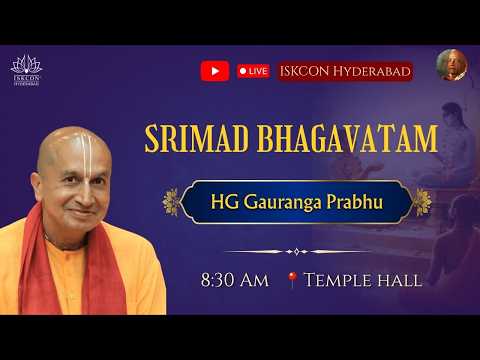
The Srimad Bhagavatam class on SB 5.24.03 at ISKCON Abids Hyderabad brings attention to a compact but deeply layered passage in the Fifth Canto. The verse belongs to the chapter traditionally known as “The Subterranean Heavenly Planets,” a section that presents a sacred cosmology where astronomy, theology, ethics, and devotional symbolism are woven together. The immediate subject is the encounter of Rāhu with the sun and moon, the protective intervention of Lord Viṣṇu through the Sudarśana cakra, and the phenomenon understood in the text as an eclipse.
At first glance, SB 5.24.03 may appear to be a mythological description of a celestial event. Yet within the Bhagavata Purana, such passages are rarely limited to physical description alone. They also function as meditations on order, protection, fear, divine agency, and the limits of material power. The text teaches through cosmological imagery, inviting the listener to see the universe not as a random mechanism but as a morally and spiritually meaningful field governed by dharma.
The central figure in the verse is Rāhu, a being associated in Hindu sacred literature with eclipses, disruption, and the karmic consequences of deception. In the narrative framework, Rāhu approaches the sun and moon, but the Supreme Lord engages the Sudarśana cakra to protect them. The Sudarśana cakra is not presented merely as a weapon in a mechanical sense. It is described as beloved, luminous, and intimately connected with divine will. Its effulgence becomes unbearable to Rāhu, who withdraws after a limited interval. This temporary disturbance is identified with what people commonly call an eclipse.
The theological significance is profound. The sun and moon represent order, rhythm, illumination, and the continuity of cosmic life. Their protection by Lord Viṣṇu indicates that dharma is not abandoned even when forces of obscuration appear powerful. In devotional reading, an eclipse is therefore not only a celestial alignment but also a reminder that darkness has duration, boundary, and consequence. It may interrupt vision, but it does not possess ultimate authority.
This insight is especially relevant for spiritual practice. Many people encounter moments when clarity is temporarily covered by anxiety, pride, confusion, grief, or fatigue. The symbolism of Rāhu becomes relatable because it reflects the human experience of being overshadowed. The Bhagavata response is not despair but remembrance. Just as the sun and moon remain protected, the inner aspiration toward truth remains recoverable when one returns to sādhana, scripture, humility, and the company of sincere practitioners.
The Sudarśana cakra also deserves careful attention. The Sanskrit term “Sudarśana” can be understood as auspicious vision or purified seeing. This makes the imagery more than martial. Divine protection is not only the removal of an external threat; it is also the restoration of right perception. In a life shaped by dharma, protection often comes as clarity: the ability to distinguish permanent from temporary, truth from appearance, and service from self-centered ambition.
For students of Hindu scriptures, this verse is a useful example of how Purāṇic cosmology operates. It speaks in a sacred language that is symbolic, theological, ritual, and metaphysical. Its aim is not limited to satisfying curiosity about the mechanics of the sky. It trains consciousness to perceive the cosmos as connected with Bhagavān, karma, devotion, and moral accountability. The verse therefore belongs to a larger intellectual tradition in which cosmology and spiritual psychology are not sharply separated.
In an academic reading, it is important to avoid flattening the text into either literalism or dismissal. The Bhagavata Purana has its own categories, aims, and modes of explanation. It belongs to a sacred knowledge system where narrative, ritual memory, metaphysical teaching, and devotional practice reinforce one another. A respectful interpretation allows the traditional meaning to stand while also recognizing that different disciplines use different methods for describing reality.
The class title places the discussion in the living context of ISKCON, the Hare Krishna movement, and the continuing study of Srimad Bhagavatham in temple communities. Such classes perform an important function: they transform scripture from a stored text into a heard and contemplated teaching. The Bhagavata tradition is deeply oral. Listening, questioning, reflection, and application are not secondary activities; they are central to how sacred knowledge becomes part of daily life.
HG Gauranga Prabhu’s class, by focusing on SB 5.24.03, belongs to this long-standing practice of scriptural exposition. A single verse becomes a doorway into multiple themes: Viṣṇu as protector, the role of Sudarśana, the symbolism of Rāhu, the nature of eclipses in Purāṇic thought, and the devotional necessity of taking shelter. The value of such a class lies not only in explanation but in training the listener to approach scripture with seriousness, patience, and reverence.
The passage also supports a wider dharmic understanding. Hinduism, Buddhism, Jainism, and Sikhism differ in theology, metaphysics, and practice, yet each tradition recognizes the need to overcome ignorance, discipline the mind, and align life with a higher moral order. In the Bhagavata framework, Rāhu’s obscuration can be read as a powerful image of avidyā, the covering of wisdom. The response is not hatred toward another path but purification of vision and commitment to truth.
This is where the verse becomes especially meaningful for contemporary readers. Modern life often produces its own eclipses: distraction, digital noise, ideological anger, spiritual superficiality, and the reduction of religion to identity alone. SB 5.24.03 gently redirects attention toward divine guardianship and disciplined perception. It suggests that light is not destroyed when it is hidden; it must be awaited, protected, and rediscovered through practice.
The devotional lesson is therefore practical. When the mind is disturbed, one can remember that the disturbance is not the self. When clarity is covered, one can return to mantra, śravaṇa, kīrtana, study, seva, and ethical conduct. When fear rises, one can take shelter in the principle represented by Sudarśana: purified vision guided by the Divine. This is not escapism. It is a disciplined way of interpreting experience through dharma.
The verse also affirms that protection does not always mean the absence of disturbance. The eclipse still occurs. Rāhu still approaches. The sun and moon still appear covered for a time. Yet the disturbance is limited, and the protective order remains active. This is a mature spiritual teaching. Dharma does not promise a life without tests; it reveals how to understand tests without losing faith, balance, or responsibility.
For readers engaged in the study of Hindu philosophy, SB 5.24.03 offers a valuable model of integrated interpretation. The verse may be studied as Purāṇic cosmology, devotional theology, symbolic psychology, ritual memory, and ethical instruction. Each level enriches the other. The result is not a narrow reading but a comprehensive appreciation of how Srimad Bhagavatham communicates spiritual wisdom through layered narrative forms.
In the end, the class on SB 5.24.03 invites reflection on a simple but enduring truth: obscuration is temporary, but divine order is not. Rāhu may cover the light for a moment, yet the sun and moon continue their course. In the same way, confusion may cover the heart, but sincere practice can restore direction. The message remains deeply relevant for anyone seeking steadiness, humility, and spiritual clarity in a world where the visible and the invisible constantly interact.
Inspired by this post on Dandavats.









Leave a Reply
You must be logged in to post a comment.