
Krishna’s life, as preserved in the Mahabharata, the Bhagavad Gita, the Harivamsa, and the Bhagavata Purana, presents a sustained challenge to the human fascination with profession, title, royal rank, and social prestige. He is introduced not through the security of a palace but through the vulnerability of a prison cell in Mathura, born to Vasudeva and Devaki under the shadow of Kamsa’s tyranny. This beginning is philosophically significant: the one revered as Bhagavan enters history without public honor, without ceremonial protection, and without the visible signs by which society usually recognizes greatness.
By lineage, Krishna belongs to the Yadava clan and stands close to power from birth. Yet his early journey moves away from royal entitlement and into the intimate world of Gokul and Vrindavan, where he is raised by Nanda and Yashoda among cowherds, cattle, forests, music, friendship, and community life. The contrast is deliberate. A prince grows up as a gopa, and the sacred narrative refuses to measure him by courtly status alone. The childhood of Krishna therefore becomes a profound reflection on Hindu philosophy: dignity is not created by rank; it is revealed by conduct, love, courage, wisdom, and service.
The social imagination often assumes that a higher profession, a royal title, or a recognized public position automatically indicates inner worth. Krishna’s journey questions this assumption at every stage. In Vrindavan, he is not diminished by rural life; rather, the pastoral world becomes a field of divine intimacy. His flute, his friendships with the gopas, his care for cows, his playful protection of the community, and his lifting of Govardhana are not secondary episodes before the “real” political life begins. They disclose a dharmic principle: service to life, protection of community, and alignment with truth are greater than ornamental authority.
The episode of Govardhana is especially important for understanding Krishna’s critique of status-conscious religiosity. When the people of Vraja prepare a ritual offering rooted in inherited expectation, Krishna redirects attention toward the immediate ecological and social world that sustains them: the mountain, the cattle, the land, and the labor of the community. The teaching is not a rejection of sacred life but a purification of intention. Dharma is not meant to become a display of prestige; it is meant to cultivate gratitude, responsibility, and right relationship with the visible and invisible sources of nourishment.
When Krishna later returns to Mathura and Kamsa is defeated, the expected political pattern would be simple: the victorious hero claims the throne. Yet the tradition presents Krishna restoring Ugrasena rather than enthroning himself as king of Mathura. This decision is often overlooked, but it is central to the theme of inner sovereignty. Krishna possesses the power to rule, yet he does not need the symbol of rule to validate his authority. The distinction between possessing power and being possessed by power becomes one of the most relevant lessons of his life.
In Dvaraka, Krishna becomes a statesman, strategist, diplomat, householder, protector, and guide. These roles are substantial, but none of them imprisons his identity. He is not reducible to a profession. He can engage in politics without being consumed by political vanity, participate in war strategy without glorifying violence, and guide rulers without needing to wear their crowns. This flexible participation in the world reflects the Bhagavad Gita’s wider teaching on Karma Yoga: action is necessary, but attachment to the ego of action is bondage.
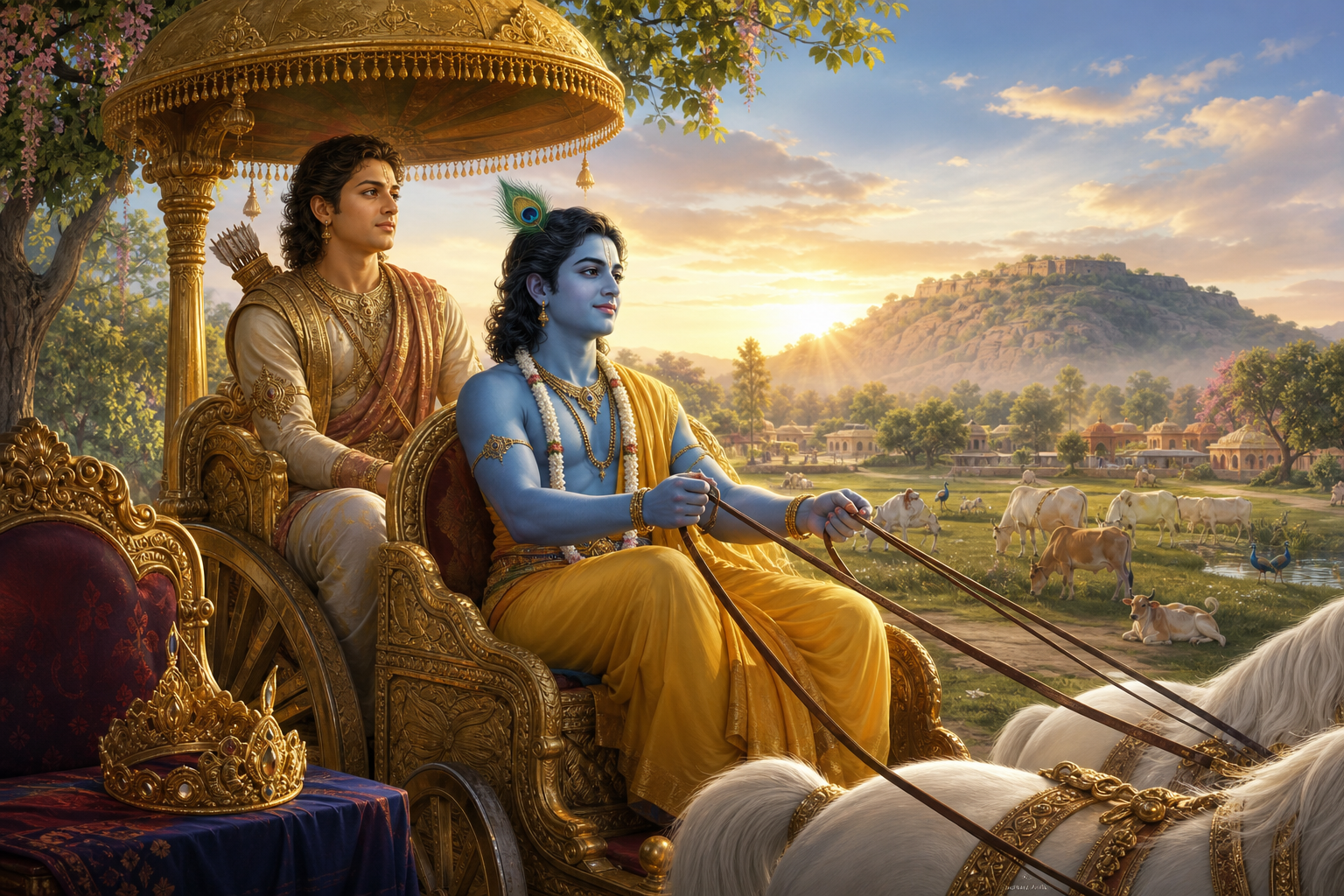
The Kurukshetra war brings this lesson into its sharpest form. Krishna does not enter the battlefield as a crowned monarch demanding tribute. He becomes Arjuna’s charioteer. In ordinary social terms, the charioteer occupies a functional position of service. In the Mahabharata’s spiritual architecture, that position becomes the seat from which the Bhagavad Gita is delivered. The chariot, not the throne, becomes the classroom of dharma. The reins in Krishna’s hands symbolize not subordination but mastery over direction, timing, restraint, and purpose.
This choice has lasting philosophical power. Krishna offers his vast Narayani Sena to one side and his own unarmed presence to the other. Duryodhana chooses military strength; Arjuna chooses Krishna. The contrast is not merely between two wartime options but between two ways of understanding value. One mind sees force, numbers, and visible assets as the highest advantage. The other recognizes guidance, wisdom, and divine presence as the deeper strength. In this moment, Krishna’s role as charioteer exposes the limitations of external status and the superiority of inner alignment.
The Bhagavad Gita repeatedly refuses to glorify social vanity. It does not teach escapism from duty, nor does it flatten all distinctions of responsibility. Instead, it teaches that profession and function must be governed by svadharma, self-discipline, clarity, and freedom from possessiveness. A person’s work becomes sacred when performed as an offering, without the fever of egoistic claim. Krishna’s instruction to Arjuna is therefore not simply a battlefield command; it is a complete psychology of action in which the worth of a role depends on consciousness, not applause.
Krishna’s teaching on nishkama karma is particularly relevant in societies where identity is often built around occupation, income, public recognition, caste pride, institutional title, or political affiliation. The Gita does not ask human beings to abandon excellence. It asks them to abandon vanity. It does not deny the importance of skill, responsibility, and leadership. It warns that these become spiritually dangerous when they harden into arrogance. A doctor, teacher, ruler, farmer, artisan, soldier, monk, parent, administrator, or laborer can participate in dharma when work is purified by responsibility and compassion.
The life of Krishna therefore gives a nuanced account of equality. It is not a denial that people perform different duties in social life. It is a denial that external function determines ultimate worth. In Dharmic traditions, the deepest identity of the being is not exhausted by social description. Hindu Vedanta speaks of the atman; Buddhist traditions analyze the instability of ego and attachment; Jain dharma emphasizes restraint, aparigraha, and purification of the soul; Sikh teachings honor seva, humility, and remembrance of the Divine. Across these traditions, spiritual dignity is not measured by title but by truthfulness, discipline, compassion, and liberation from ego.
Krishna’s humility must not be misunderstood as weakness. He is gentle in Vrindavan, decisive in Mathura, strategic in Dvaraka, and uncompromising in Kurukshetra when dharma is at stake. His refusal to be defined by status does not make him passive. Rather, it gives him freedom to act according to necessity. A person attached to title fears losing face; a person rooted in dharma can accept honor, obscurity, service, conflict, or sacrifice as the situation demands. Krishna demonstrates this freedom with remarkable consistency.
This is why Krishna can be simultaneously playful and grave, intimate and cosmic, pastoral and political, personal and universal. The same Krishna who steals butter also instructs Arjuna on the immortality of the self. The same Krishna who dances in Vrindavan also negotiates peace in the Kuru court. The same Krishna who is loved as a friend becomes the revealer of the Vishvarupa. These contrasts are not contradictions. They show that divine fullness cannot be confined within a single profession, social identity, or institutional category.
For modern readers, this teaching carries immediate relevance. Much of contemporary life encourages people to introduce themselves by their job, measure their success by visibility, and compare their worth with the achievements of others. The emotional burden of such comparison is severe. Krishna’s journey offers another model: one may perform one’s work with precision, accept responsibility with seriousness, and still refuse to let status become the center of the self. This insight is not sentimental; it is psychologically practical and spiritually rigorous.
The charioteer image is especially powerful for personal reflection. In daily life, many people occupy roles that appear ordinary: caring for family, supporting colleagues, teaching children, maintaining institutions, serving communities, or quietly protecting others from harm. Krishna’s presence as Arjuna’s sarathi elevates such service. It suggests that the person who guides, steadies, listens, and helps another act rightly may be participating in a form of dharma deeper than public recognition can capture.
Krishna also teaches that leadership without attachment is superior to leadership intoxicated by rank. In the Mahabharata, many figures possess titles: kings, princes, commanders, elders, and teachers. Yet title does not guarantee wisdom. Dhritarashtra is a king but remains bound by attachment. Duryodhana is a prince but is ruled by envy. Bhishma is revered but constrained by vows and political loyalty. Arjuna, though a warrior of extraordinary skill, collapses in moral confusion. Krishna, standing outside the hunger for the throne, becomes the one who can see the field clearly.
This clarity is the heart of Krishna’s spiritual leadership. He does not flatter Arjuna’s despair, nor does he reduce the crisis to a simple matter of ambition. He teaches discernment between the eternal and the temporary, duty and attachment, compassion and weakness, renunciation and avoidance. Such teaching remains relevant because human beings still confuse emotional intensity with moral truth and social approval with righteousness. Krishna’s counsel restores proportion: action must arise from dharma, not from fear, pride, or the desire to appear noble.
The vanity of profession and rank is therefore not a rejection of worldly responsibility. Krishna does not ask Arjuna to abandon the battlefield and seek private purity while injustice triumphs. Nor does he ask rulers to neglect governance or householders to despise ordinary life. His teaching is more demanding: one must act fully in the world while remaining inwardly free from the intoxication of role. This is the difficult balance of Karma Yoga, and Krishna’s own life becomes its most vivid commentary.
In the wider framework of Sanatana Dharma, Krishna’s example also protects spiritual life from elitism. Sacredness is not limited to the scholar, the ascetic, the king, or the ritual specialist. It appears in the cowherd settlement, the battlefield, the court, the family, the forest, the marketplace, and the heart of the seeker. This inclusive vision supports unity among Dharmic traditions by affirming that different paths, disciplines, and temperaments can participate in the pursuit of truth when guided by humility and ethical clarity.
Krishna’s refusal to be trapped by social identity also helps reinterpret success. Success is not merely the acquisition of command. It is the ability to act rightly without becoming inwardly enslaved by the result. The Gita’s famous teaching on action and fruits has often been reduced to a motivational slogan, but its original meaning is far more profound. It trains the mind to work without possessiveness, to serve without self-advertisement, and to accept outcomes without spiritual collapse.
Such a teaching is not easy. The ego enjoys titles because they appear to make the self solid. Profession, rank, wealth, lineage, educational credentials, and institutional authority can become armor against insecurity. Krishna’s life quietly dismantles that armor. He shows that the most powerful being in the narrative can choose simplicity, service, diplomacy, friendship, and apparent subordination without losing majesty. The truly great do not need constant confirmation of greatness.
At the same time, Krishna does not romanticize poverty, disorder, or social irresponsibility. He establishes Dvaraka, protects his people, participates in political decision-making, and recognizes the importance of stable institutions. His critique is not against organization or duty; it is against egoistic identification with them. This distinction matters. A society cannot function without roles, but a society becomes spiritually unhealthy when roles become instruments of contempt, domination, or self-worship.
The enduring relevance of Krishna lies in this integration. He does not stand outside life as a distant moralist. He enters its complexity: birth under oppression, childhood displacement, community care, conflict with tyranny, statecraft, family life, friendship, diplomacy, war, grief, and instruction. Through all these, he remains unattached to the vanity of position. His authority comes from dharma, wisdom, and divine presence, not from the decorations of office.
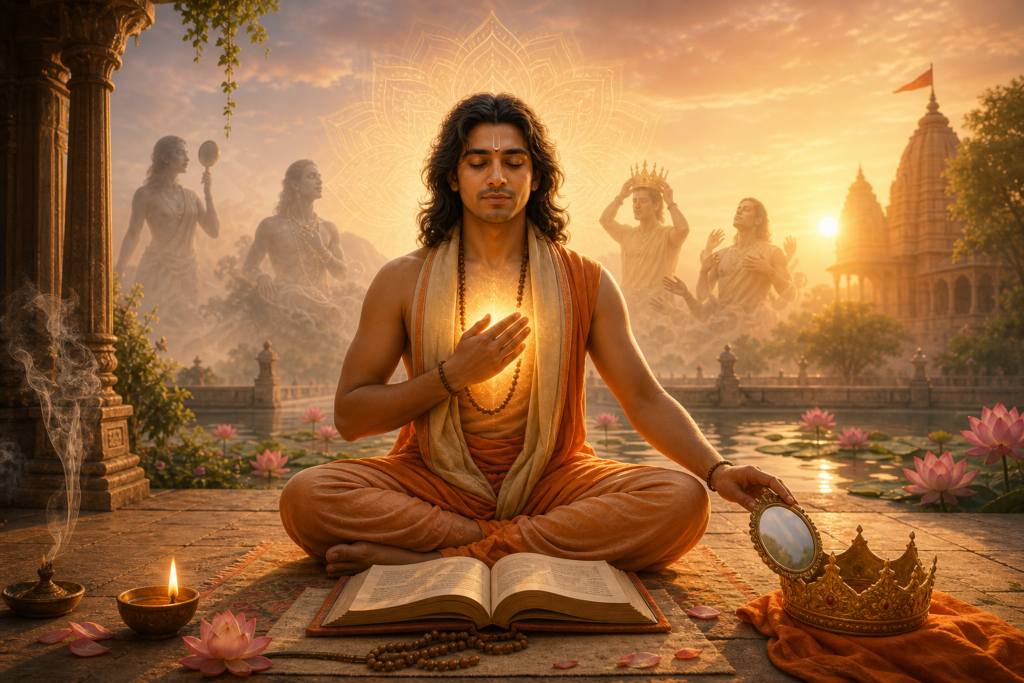
Therefore, the journey of Bhagavan Krishna on earth can be read as a sustained meditation on inner freedom. The prince becomes a cowherd; the statesman becomes a charioteer; the guide of kings refuses to be reduced to kingship. The lesson is not that titles are useless, but that they are temporary tools. When used in the service of dharma, they can benefit the world. When used to inflate the ego, they become obstacles to wisdom.
Krishna’s life ultimately invites a revaluation of human worth. The measure of a person is not the chair occupied, the rank announced, or the profession displayed. It is the quality of consciousness brought to action. It is the courage to protect dharma, the humility to serve, the intelligence to discern, the steadiness to act without attachment, and the love that binds community without possessiveness. In this sense, Krishna remains not only the charioteer of Arjuna but also the enduring guide for anyone seeking dignity beyond profession and freedom beyond social status.
Inspired by this post on Hindu Blog.







Leave a Reply
You must be logged in to post a comment.