
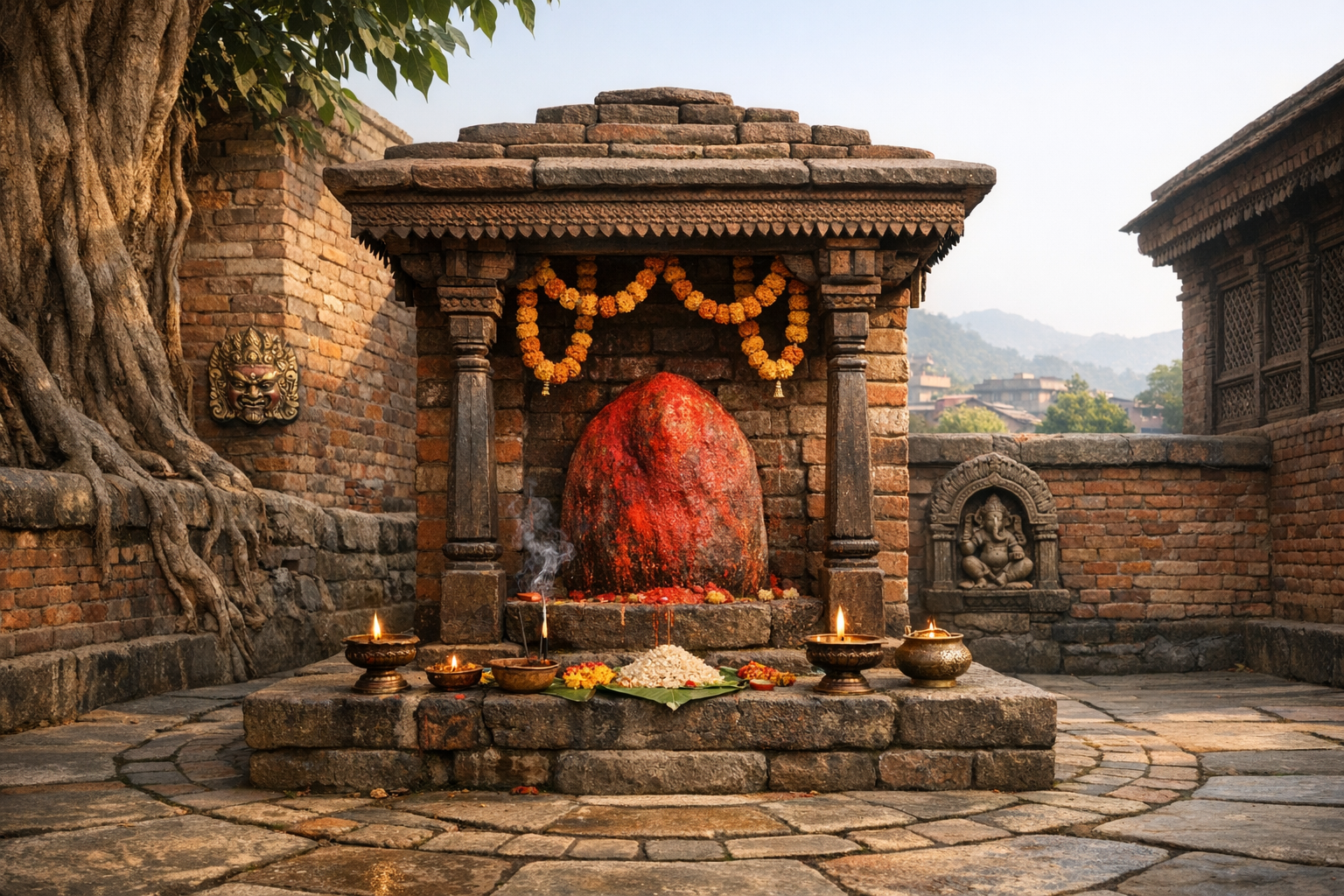
Across the Kathmandu Valley, Shakta worship endures in a distinctive Newar form known as Ajima Dhyo, an ancient, living tradition in which the protective, maternal presence of the divine feminine is embedded into streets, courtyards, crossroads, and thresholds. Long before brick sanctuaries rose, open-air altars and aniconic stones marked spaces where this power was invited, honored, and trusted to guard communities. The result is a cityscape where devotional practice and urban life are inseparable, and where Shakta–Tantric ideals remain thoroughly local, relational, and continuous.
Etymologically, Ajimā (Nepal Bhasa: आजिमा) means “grandmother,” while Dyo (also rendered Dyaḥ) denotes “deity.” Ajima Dhyo, therefore, names a class of goddess-guardians whose relationship to households and neighborhoods is at once intimate and protective. In theological terms, many Ajima are identifiable with the Aṣṭamātṛkā (the Eight Mothers—Brahmāyani/Brahmani, Māheśvarī, Kaumārī, Vaiṣṇavī, Vārāhī, Aindrī/Indrani, Cāmuṇḍā, and Mahālakṣmī) and with Navadurga forms, aligning the Newar sacred landscape with wider Shakta cosmologies of South Asia while preserving a distinct Newar vocabulary, ritual grammar, and aesthetics.
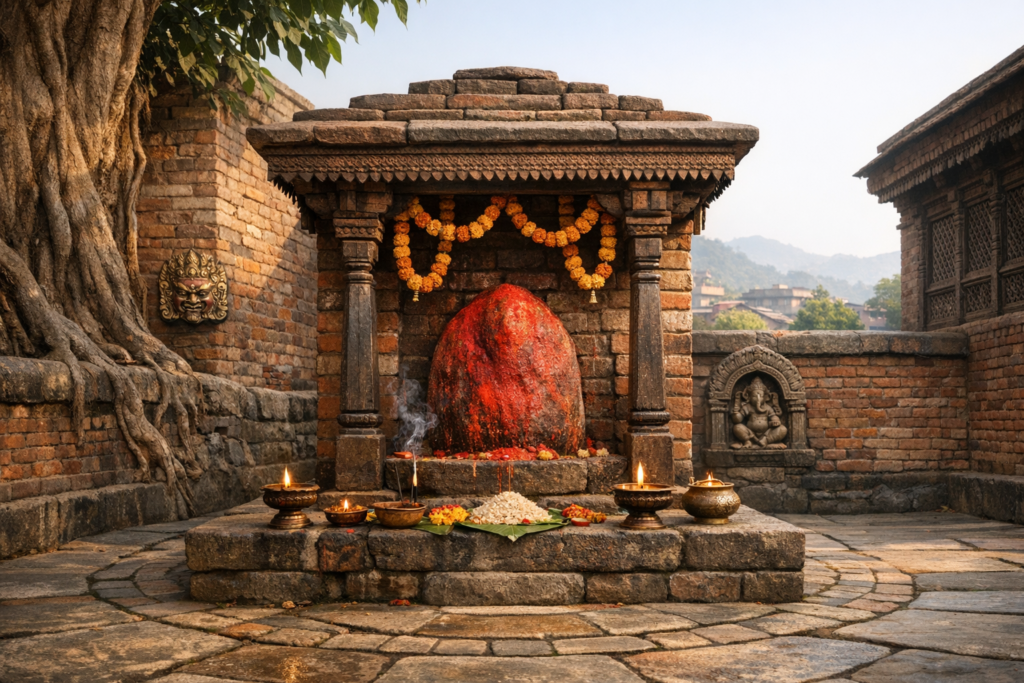
Sacred geography in the Valley is mapped as a protective mandala: Ajima shrines occupy liminal sites—gates, perimeters, crossroads, water sources—demarcating a ritual boundary for the city and its wards. Within agglomerated courtyards, neighborhood gods (dyo) and lineage deities (often kept at open-air stone altars) anchor social memory. The material forms vary: some Ajima are represented as vermilion-smeared stones; others as metal or stone icons in dyo-chhen (god-houses). Bhairava and Gaṇeśa are frequently associated guardians, signaling a triadic grammar of protection, removal of obstacles, and fierce boundary-keeping.
The ritual life of Ajima Dhyo is distinctly Tantric in method and communal in ethos. Daily and seasonal observances revolve around mantra, mudrā, and nyāsa, with offerings that classically include flowers, lamps, rice, incense, and, in certain Shakta contexts, consecrated liquor—elements long embedded in Newar ritual culture. Substitutional practices are also well attested, with households or guthis (socio-religious trusts) adopting non-violent analogues for formerly transgressive substances when community ethics or contemporary law so require. This adaptability exemplifies how living Tantrism negotiates continuity with conscientious reform.
Priesthood and ritual authority further demonstrate plural integration. Rajopādhyāya Brahmins officiate at key Shakta shrines such as Guhyeśvarī, while Newar Buddhist Vajrācāryas minister at Vajrayāna goddess temples and, in some neighborhoods, participate in shared civic rites. The result is not doctrinal collapse but a long-standing division of ritual labor that allows Hindu Shakta and Newar Buddhist Tantric worlds to remain distinct yet harmoniously interdependent—an enduring testament to dharmic pluralism in practice.
Festivals render Ajima’s presence palpably communal. During Mohani (the Newar observance of Navarātri within Daśain), households and guilds venerate the goddess through progressive empowerments culminating in khadga-pūjā (consecration of the sword) and bali offerings. Many communities today favor symbolic or vegetarian bali, or fruits such as gourds and coconuts, in alignment with evolving ethical concerns and ahimsa-oriented sensibilities found across Hinduism, Buddhism, Jainism, and Sikh thought. This shift illustrates how a living Shakta tradition remains faithful to form and meaning while refining means.
Ritual performance (pyākhan) further animates the Valley’s Shakta canvas. In Bhaktapur, the renowned Navadurga troupe embodies the goddess through masked theatre, dance, and itinerant blessings that weave protection into the civic calendar. These performances are maintained by guthis that steward costumes, music, and sacred dramaturgy, ensuring artistic excellence and ritual orthopraxy converge. Here, Ajima is not a remote abstraction but a moving center of the community’s moral and protective order.
At the scale of household and lineage, Ajima functions as Kula Devata in practice. Digu dya altars—often set at agricultural margins or neighborhood thresholds—receive offerings at life-cycle junctures such as naming, first-feeding, and marriage. In this intimate register, Ajima Dhyo fuses maternal care with juridical protection: blessings for fertility and health are inseparable from vows to uphold familial duty, neighborly reciprocity, and social memory.
Certain Valley shrines concentrate Shakta attention with regional significance. Guhyeśvarī Temple, adjacent to Paśupatināth, is revered as a Śakti Pīṭha and venerated by Shakta Hindus and Newar Buddhists alike. Bhadrakālī in central Kathmandu (long known in local parlance as Lumarhi Ajima) and Dakṣiṇkālī to the south exemplify fierce protective forms that stand at once beyond and within the Valley’s civic life. Pilgrims commonly pattern their circuits to include these sites together with key neighborhood Ajima and Matrikā pīṭhas, tracing a living map of power and protection.
Correspondences with Vajrayāna Buddhism are both theological and spatial. Vajrayoginī temples at Sankhu and the Pharping area, and Hariti (Hariti Ajima) at Swayambhū, demonstrate a shared grammar of maternal protection and Tantric method. In practice, many Newar Buddhists honor Ajima within the same civic and familial rhythms observed by their Hindu neighbors, while retaining distinctive Buddhist frames of meaning. These affinities do not conflate traditions; rather, they reflect a dharmic ecology in which multiple paths co-exist and mutually enrich the Valley’s sacred commons.
Iconographically, Ajima oscillates between saumya (benign) and raudra (fierce) rasas. Aniconic stones densely smeared with red sindūr speak to primordial presence and locality, while fully realized icons may display swords, tridents, skull-cups, or species-specific heads—such as Vārāhī’s boar visage—signifying powers of cutting delusion, guarding thresholds, and transmuting impurity. The semiotics of color, fragrance, and sound—vermilion, incense, drums, and shankha—compose an experiential theology that Newar devotees absorb from childhood.
Institutionally, the guthi system is decisive. Endowments fund lamps, music, offerings, and repairs; steward knowledge of calendrics; and transmit ritual roles across generations. Women’s participation—often central in daily offerings and festival preparations—aligns with Ajima’s maternal valence, while inter-household cooperation mirrors the goddess’s social work: to bind the neighborhood in shared discipline, mutual care, and vigilant protection.
Contemporary practice engages ethical and heritage questions with creativity. Urbanization pressures demand careful conservation of small roadside shrines and courtyards, even as communities negotiate traffic, tourism, and new building codes. Simultaneously, many have reinterpreted bali and other sensitive rites in ways that honor Shakta theology while foregrounding non-violence and environmental responsibility—an approach that resonates with shared dharmic values across Hinduism, Buddhism, Jainism, and Sikhism.
From a wider dharmic perspective, Ajima Dhyo invites constructive comparison: the maternal and protective paradigms of Śakti resonate with Buddhist Tārā and Hariti, with Jain yakṣiṇīs such as Ambikā and Padmāvatī, and with Sikh invocations of divine valor in compositions like the Chandi tradition within the Dasam corpus. While each tradition maintains its integrity, these parallels articulate a common civilizational intuition—the divine feminine as strength, wisdom, and compassionate protection—that fosters mutual respect and unity in diversity.
For students, pilgrims, and heritage stewards, several practical heuristics clarify the tradition’s living form: read the Valley as a mandala of protective nodes; attend to neighborhood Ajima along with major temples; observe festival calendars that braid household, guild, and civic rites; and approach photography and ritual spaces with explicit consent, removal of leather items where appropriate, and sensitivity to ongoing worship. Such attentiveness turns observation into participation and study into stewardship.
Ajima Dhyo thus stands as a precise example of how Shakta worship in Nepal is not only preserved but enacted daily through space, performance, and kinship. Its Tantric heart remains vibrant yet adaptive; its theological depth is mirrored in social ethics; and its plural interfaces with Hindu and Buddhist practice model a dharmic ecology that is both ancient and fully contemporary. In the Kathmandu Valley, the “grandmother” goddess continues to hold the city, household, and heart together.
Inspired by this post on Hindu Blog.










Leave a Reply
You must be logged in to post a comment.