
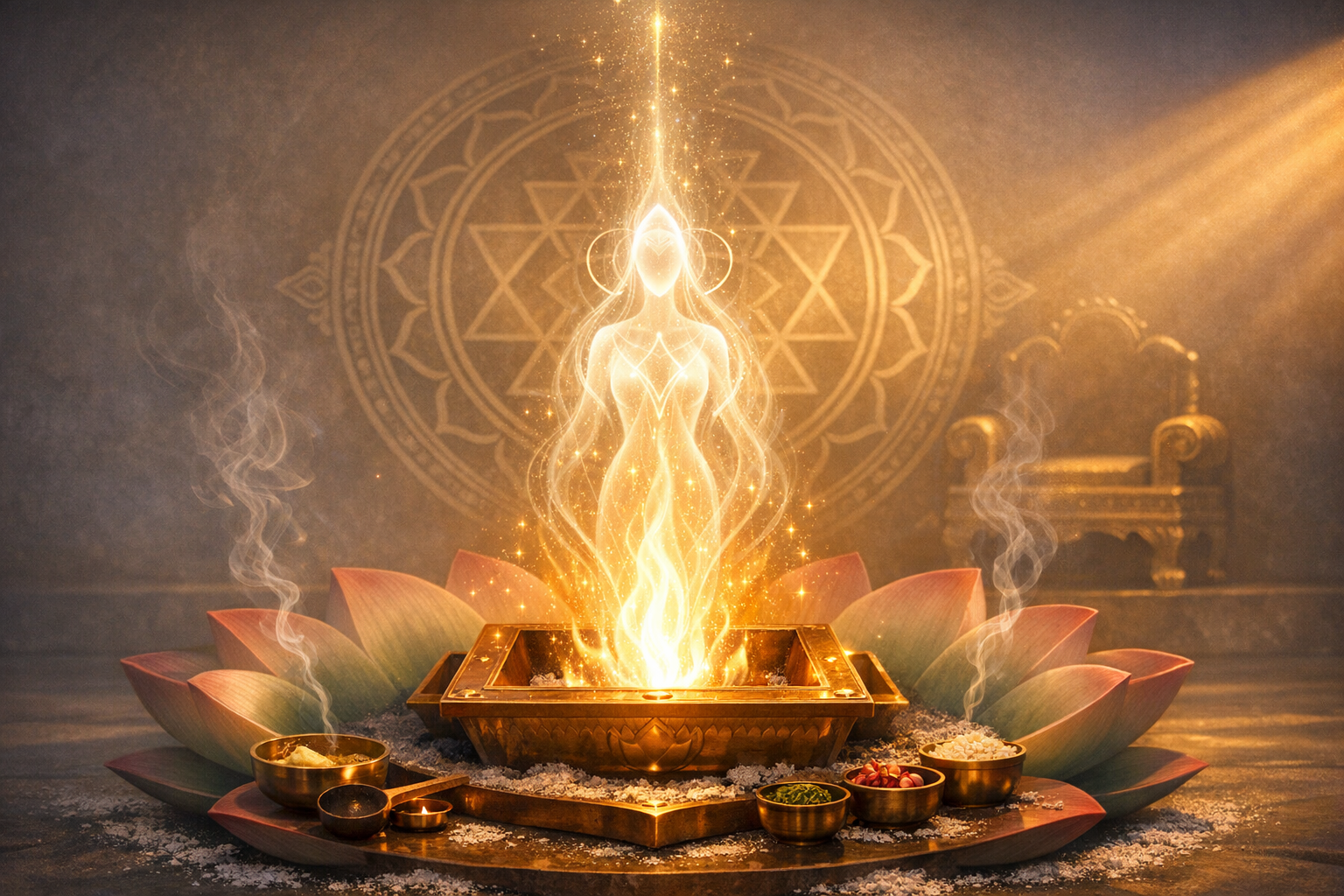
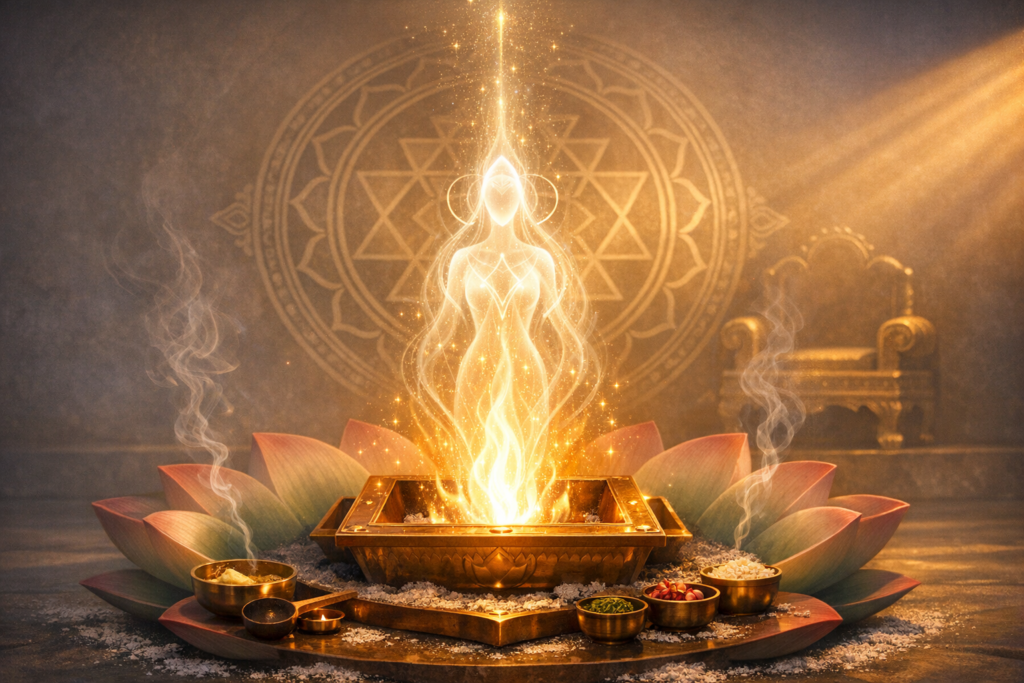
Within the Shakta tradition, the Lalita Sahasranama stands as a luminous intersection of Vedic revelation, Tantric praxis, and contemplative philosophy. Its opening cluster of epithets pivots around an arresting image—fire—through the name Chit – Agni – Kunda – Sambhuta (Chitagnikundasambhuta), signaling that the Goddess is recognized not merely through majesty or ornament, but through the very blaze of awakened awareness.
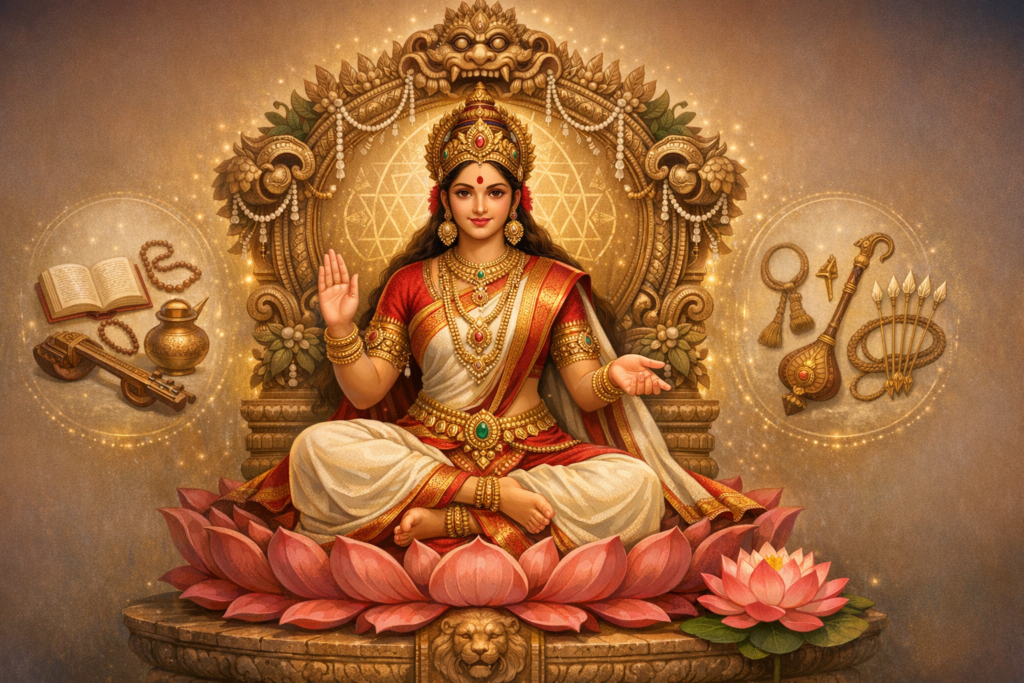
Textually, the commonly transmitted first names in the Lalita Sahasranama are “Sri Mata,” “Sri Maharajni,” and “Sri Mat Simhasaneshwari,” immediately followed by Chitagnikundasambhuta and then Devakarya Samudyata. In this way, the hymn’s very first verse anchors the Mother (Sri Mata) upon the throne of realization (Sri Mat Simhasaneshwari) and then makes a decisive turn to the metaphor of consciousness as fire, thereby establishing the hermeneutic key for all subsequent names.
Philologically, Chitagnikundasambhuta parses as: chit (consciousness), agni (fire), kunda (altar-pit), and sambhuta (arisen, born). The compound points to Devi as “She who arises from the altar-pit of consciousness-fire.” Many scholars transliterate the name as “Chidagnikunda Sambhuta”; the form “Chitagnikundasambhuta” retains the same semantic core. The grammar suggests a tatpurusha compound, with “chit-agni-kunda” functioning as the instrumental or ablative source from which the Divine manifests.
Hermeneutically, this appellation fuses two grand strands of Indian thought. From the Vedic horizon, Agni is the primordial mediator—messenger of the gods, bearer of offerings, and purifier of oblation and oblator alike. From the Vedantic insight, chit is the self-luminous principle that knows and reveals. When conjoined, “chid-agni” symbolizes the incandescence of awareness itself—the inner light that burns away obscuration (avidya) and reveals the indivisible fullness of reality.
This imagery resonates with Vedic and Upanishadic motifs. Rig Veda 1.1 exalts Agni as the priest and bridge; the Brihadaranyaka and Chandogya Upanishads explore the interiorization of sacrifice, pointing to a fire that no longer depends on wood but is fed by insight. The Mundaka Upanishad’s analogy—sparks arising from a blazing fire—aptly mirrors the transforming effulgence implied by Chitagnikundasambhuta: individuality shimmering forth from, and returning to, the one radiance.
Ritually, the kunda is the structured space of transformation. In Vedic and Smarta idioms, the homa or havan enacts a physics of transmutation: offerings pass through flame, become subtle, and are carried to their destination. In Srividya, this outer kunda mirrors an inner altar—the heart-lotus—where awareness itself serves as sacred fuel and fire. To contemplate Chitagnikundasambhuta is, thus, to recognize Devi as the luminous process by which the gross becomes subtle (sthula to sukshma) and the finite finds the perennial.
The phrase also invites a sober psychology of liberation. Fire consumes what is combustible; the “combustible” in the sadhaka is the habitual identification with the limited personality (ahamkara). In Shaiva-Shakta symbolism, the memory of this consumption is worn as vibhuti—sacred ash—reminding that when ego’s claims are offered into the fire of consciousness, what remains is clarity and equipoise. The “ashes of the self,” far from nihilism, signify the stabilization of presence after the dross is burned away.
Srividya practice amplifies this interiorization. The Sri Chakra, with its interpenetrating triangles, is read as a cosmogram of consciousness. Navavarana puja, moving through nine enclosures, can be mapped to progressive refinements of attention, intention, and identity. In this interpretive arc, Chitagnikundasambhuta serves as a doorway: the journey begins when the altar of the heart is recognized and the fire of insight is kindled with mantra, visualization, and ethical steadiness.
The outer homa retains profound pedagogic value. Standing before a havan kunda, a devotee observes how ghee, grains, and herbs—symbols of effort, habit, and latent tendencies—are gracefully transmuted. The crackle of flame and the fragrance of samagri teach, without words, that change is lawful, luminous, and benevolent when guided by dharma. The “outer” and “inner” fires are not rivals; they are complementary lenses on one transformative principle.
Yogic anatomy lends further clarity. The manipura chakra is classically associated with fire (agni-tattva), while the heart (anahata) is the aniconic altar where awareness expands without obstruction. The ascent of kundalini through sushumna nadi is often described as an ignition sequence, yet Srividya insists that the flame to be recognized is not merely bio-energetic (tejas) but ontological (chit). Chitagnikundasambhuta therefore orients practitioners away from sensationalism and toward abiding lucidity.
Ethically, the metaphor of fire affirms that transformation is rhythmic, not abrupt. In the gunas model, tamas (inertia) yields to rajas (activity), which in turn is refined into sattva (clarity). The “burning” of tamasic habits is inseparable from the cultivation of compassionate action and luminous understanding. By placing the image of fire at the start of the hymn’s semantic arc, the Sahasranama foregrounds responsibility: insight must express as benevolence.
Historically, the Lalita Sahasranama is preserved in the Brahmanda Purana (within the Lalitopakhyana), with a robust commentary tradition culminating in works such as Bhaskararaya’s Saubhagya-bhaskara (18th century). These sources consistently treat the opening verse as programmatic: the Mother enthroned, the fire of consciousness kindled, and the Goddess manifest “for the accomplishment of the divine task” (Devakarya Samudyata), indicating that realization and responsibility are twinned.
Traditional recital preserves the compact power of these names: “Sri Mata Sri Maharajni Sri Mat Simhasaneshwari | Chitagnikundasambhuta Devakarya Samudyata ||” This sequence aligns ontology (who She is), cosmology (how She abides), and soteriology (how She illumines and transforms), while providing the practitioner with a contemplative syllabus encoded in language and rhythm.
From a philosophical standpoint, the name resolves a potential paradox. If Devi is the boundless substratum, how can She be “born”? The Sahasranama answers by metaphor: “birth” names not an event in time but an epistemic dawning. When the heart recognizes its own luminosity, Devi is said to “arise” from the altar-pit of consciousness. This arising is not a movement from absence to presence; it is the unveiling of what always is.
Comparative resonances across Dharmic traditions deepen this understanding and underscore civilizational unity. In Buddhism, the transformation of the kleshas (afflictions) is repeatedly pictured as a burning away through insight; the imagery of tejo-dhātu and the “fire sermon” motifs serve analogous roles in turning delusion into clarity and compassion. The emphasis on direct seeing aligns with the “chid-agni” of the Sahasranama.
In Jainism, tapas—especially internal austerities—functions as a fire of purification, consuming karmic accretions and unveiling jñāna that is self-existent. The disciplined offering of passions into this ethical-gnostic fire parallels the inner homa of Srividya, where tendencies are refined until only awareness remains luminous and unentangled.
In Sikh tradition, the transformation of haumai (egoic self-centrism) through simran (remembrance) and seva (service) is frequently articulated as a melting or burning away of separative hardness in the warmth of the One Name. While the idioms differ, the arc is shared: remembrance kindles, service sustains, and the heart becomes the field where the fire of truth softens and renews.
These convergences matter. They show that the fire image is not sectarian but civilizational, inviting practitioners of Hinduism, Buddhism, Jainism, and Sikhism to recognize a shared grammar of inner alchemy. Chitagnikundasambhuta thus becomes a bridge-word in the Dharmic lexicon, honoring plurality while revealing unity in purpose: the ending of suffering through the illumination of awareness and the flowering of compassion.
For lived practice, a contemplative protocol can translate the name into experience:
1) Orientation: Sit with a gentle, elongated exhale. Intend clarity and benevolence. 2) Mantra: Recite the opening sequence softly, resting attention on “Chitagnikundasambhuta.” 3) Visualization: Sense the heart as a serene altar; the flame is calm, steady, and cool with knowing. 4) Offering: Place one habitual reactivity into the fire (impatience, fear), imagining its transmutation into discernment and warmth. 5) Integration: Contemplate a concrete act of seva to express the insight. 6) Stillness: Abide for a few breaths in uncluttered awareness.
Ritualists may also establish an outer homa, aligning each oblation with an inner intention. The correspondence between havan kunda and heart-altar educates the senses, disciplines attention, and renders philosophy tangible. Understood this way, ritual is not mere custom; it is embodied pedagogy, where Agni teaches by example.
Symbols that accompany this practice retain interpretive depth. Vibhuti (sacred ash) recalls what has been relinquished and what remains deathless. The Sri Chakra, approached through navavarana, traces the path by which awareness becomes intimate with itself. The Goddess, “arisen” from the inner altar, is simultaneously the altar, the fire, the offering, and the one who offers—nonduality expressed through a symphony of forms.
Theological precision helps prevent misreadings. Chitagnikundasambhuta does not imply that consciousness requires destruction to shine; rather, it indicates that when the conditions of confusion are relinquished, what is constant becomes evident. The “consumption” is of misidentification, not of the living world; the outcome is a more skillful, tender, and fearless participation in that world.
An Ayurvedic aside enriches the metaphor. Digestive fire (jatharagni) elaborates nourishment into vitality; mental fire (medhā) elaborates impressions into understanding. The chid-agni of the Sahasranama integrates these vistas: clarity in body, clarity in mind, and clarity in being form a single ecology, with Devi as its living intelligence (Shakti).
Scholarly tradition supports this integrative reading. Commentators emphasize that the initial epithets are programmatic rather than ornamental; they lay out ontology (who She is), epistemology (how She is known), and praxis (how knowing matures into ethical action). The image of the altar-pit is therefore not incidental; it is a master-key to the Sahasranama’s architecture.
Historically and philologically, variants like “Chidagnikunda” and “Chitagnikunda” coexist in manuscripts and recensions. What remains stable is the interpretive core: awareness as fire, heart as altar, and the Goddess as the luminous arising that both reveals and renews. This stability across expression attests to the robustness of the symbol.
Taken together, these strands suggest a practical, unifying ethic for contemporary life. When speech is offered into the fire of truthfulness, it becomes gentle and exact. When consumption is offered into the fire of restraint, it becomes sustainable. When opinion is offered into the fire of inquiry, it becomes wisdom. Chitagnikundasambhuta, contemplated sincerely, turns everyday acts into subtle offerings.
Thus the hymn’s opening movement is not only a theological proclamation but a call to transformation. It invites a turn—from distraction to attention, from compulsion to care, from division to shared purpose across Dharmic lineages. The altar-pit of consciousness is always already here; the flame is lit whenever clarity, compassion, and courage are allowed to act together.
In summary, the name Chitagnikundasambhuta is a condensed mandala: Devi as the fire of consciousness, the heart as altar, the world as worthy of luminous participation. Read this way, the Lalita Sahasranama becomes an operating manual for inner alchemy—Vedic in ancestry, Tantric in method, Vedantic in realization, and harmoniously resonant with the liberative aims of Buddhism, Jainism, and Sikhism.
Inspired by this post on Hindu Blog.






Leave a Reply
You must be logged in to post a comment.