
Within the vast spiritual imagination of the Bhagavata Purana, the brief yet arresting episode of Krishna defeating Sakatasura is a concentrated meditation on samsara, karma, and liberation. Far from a simple wonder of divine childhood, this lila is best read as a layered hermeneutic: a sacred narration that encodes a psychological map, an ethical prompt, and a soteriological teaching. Across Hindu spirituality and the wider dharmic family of Buddhism, Jainism, and Sikhism, the image of a wheel carries the shared intuition of cyclical becoming, bondage through habit and intention, and the possibility of release. The story of Krishna’s effortless kick, shattering an overloaded cart and the demon hidden within it, becomes an evocative symbol of how grace, clarity, and disciplined practice can interrupt the ceaseless momentum of the wheel of samsara.
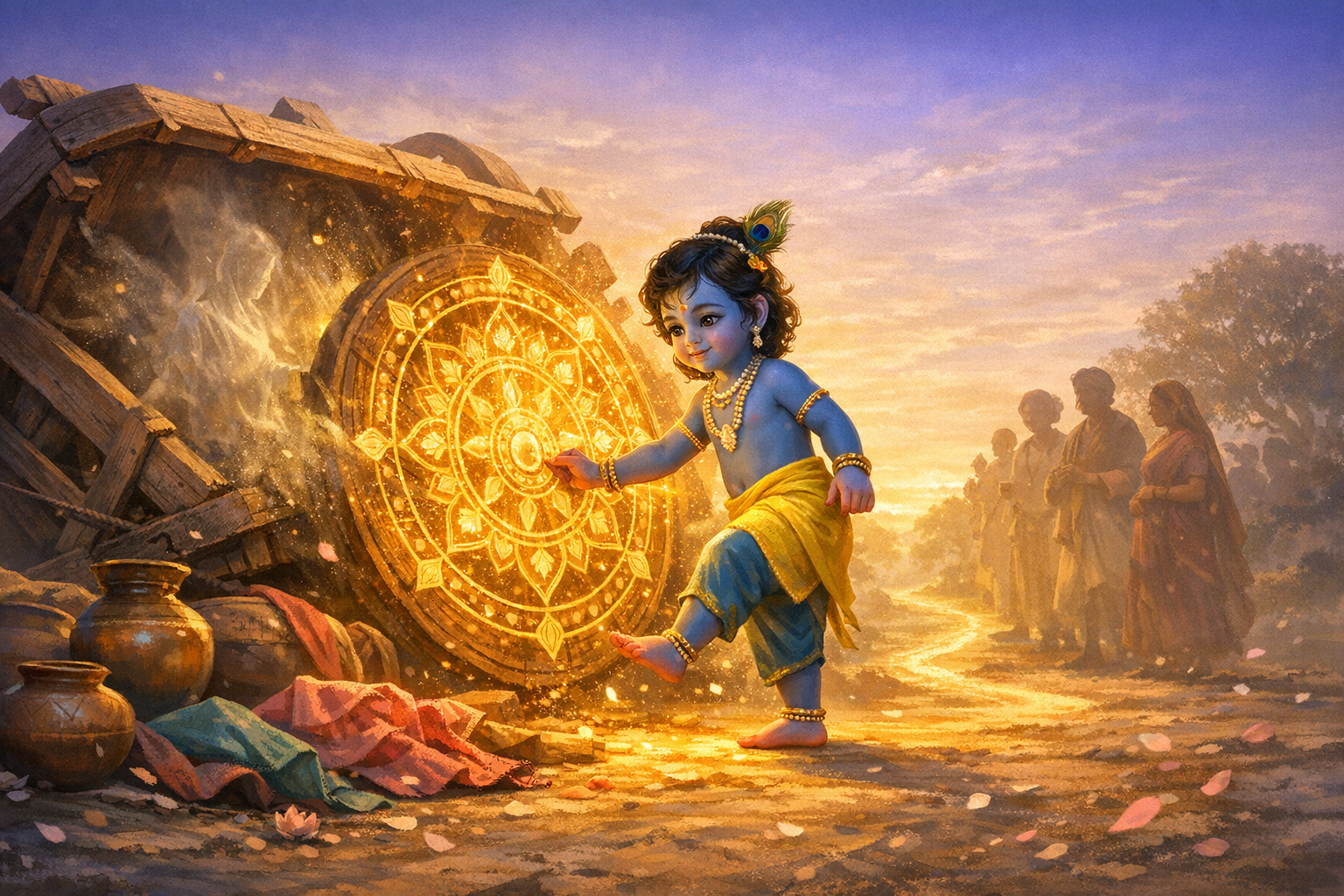
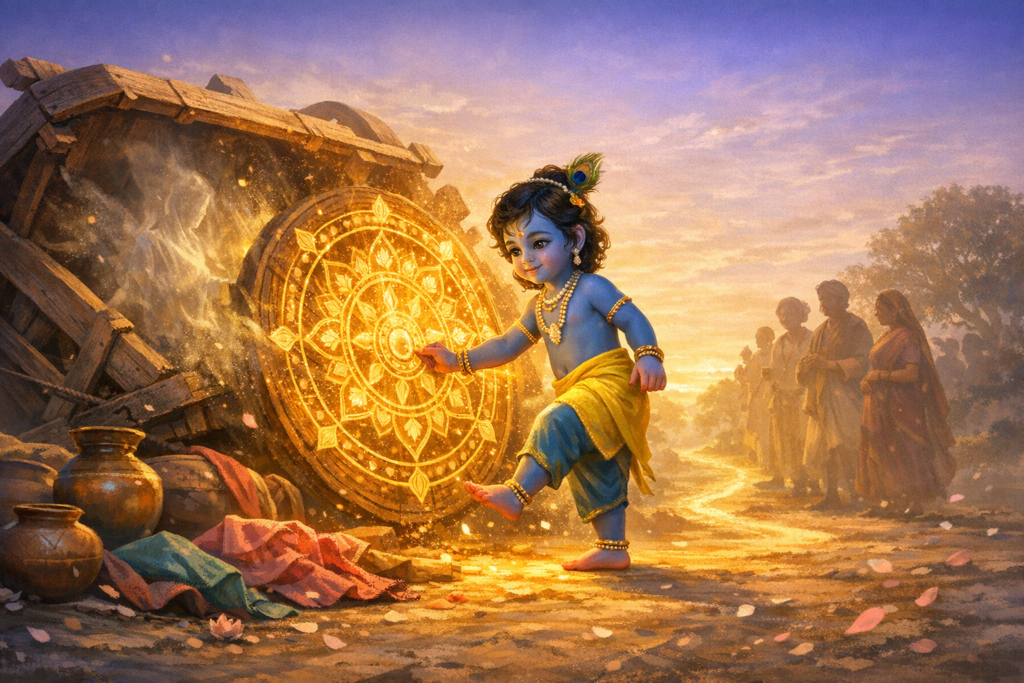
Purana narrations in Skandha 10 place the scene in Gokula during a communal festivity. Mother Yashoda and the Vraja women were briefly occupied while baby Krishna, lying beneath a cart used to store festival utensils and provisions, suddenly cried and stretched his tiny feet. With a playful yet world-transfiguring motion, he kicked the cart; it capsized with a crash; its contents scattered; and the demon Sakatasura, who had possessed the cart, was vanquished. The astonishment of the cowherds gives way to a recognition recurring throughout the Krishna-katha of Vraja: the childlike form discloses a power that protects, purifies, and teaches through lila rather than sermon.
Philologically, sakata denotes a cart, a mundane vehicle for bearing weight, while asura signals a being whose intention runs counter to cosmic harmony. Lila points to spontaneous divine play, where actions are at once effortless and purposive. In literary and ritual traditions across North India, this episode is remembered as shakata-bhanjana, the breaking of the cart, and often dramatized in ras-lila performances. Art historical depictions in the North Indian miniature schools render Bala-Krishna beneath the toppled cart and the stunned assembly around him, capturing the suddenness with which hidden weight is exposed and neutralized.
At the symbolic level, the cart becomes the wheel of samsara, a composite of body, senses, habits, and social momentum that carries forward through time. Its two wheels evoke cyclical time and karmic causality; its load evokes inherited tendencies and acquired attachments; its axle evokes the subtle convergence of intention and attention. The demon’s concealment within the cart is a striking image of unseen forces lodged inside everyday structures: conditioning that seems ordinary until a moment of grace dislodges it. When Krishna’s foot strikes, one sees not aggression but awakening; the hidden occupant is revealed and removed, and ordinary life is returned to safety and clarity.
Vedantic readings elaborate these motifs differently while converging in purpose. For Advaita, Sakatasura aligns with avidya, the primordial misunderstanding of self as separate, lodged in the vehicle of body and mind; the effortless kick is brahman’s self-revelation dispelling error. For Vishishtadvaita, the episode highlights the supremacy of prapatti, surrender to Vishnu’s grace, which alone can overturn burdens too complex for individual effort; yet the cart’s collapse also instructs in right conduct, since households and hearts must be lightened of unnecessary load. For Dvaita, a real conflict between the Lord and the demonic agent is stressed, underscoring the need to take firm refuge in Hari while adhering to dharma to avoid becoming a host for hostile influences. The doctrinal accents differ, but all three situate the narrative as soteriological pedagogy: grace and discipline together unbind the wheel’s compulsions.
Bhakti literature further reads the episode through the progression from faith to love. A well-known map in the Vaishnava tradition follows adau shraddha, sadhu-sanga, bhajana-kriya, anartha-nivritti, nishtha, ruchi, asakti, bhava, and finally prema. Shakata-bhanjana speaks most immediately to anartha-nivritti, the clearing out of impediments that clog devotion and distort perception. The cart’s sudden collapse and the demon’s exposure mirror the lived experience of aspirants who, upon taking shelter of Krishna and engaging in steady sadhana, find latent patterns of fear, pride, or craving abruptly surfacing and dissolving in the presence of remembrance and grace.
A psychological lens offers a complementary reading without diminishing the sacred. The cart is the architecture of conditioning; the demon is an entrenched narrative of lack or control; the load is cumulative emotional debris; and the infant’s kick is the spontaneous intelligence of awareness, prior to self-conscious effort, disrupting the closed loop of reactivity. Many recognize the moment in daily life when an unpremeditated act of simple attention, kindness, or truth unexpectedly liberates a situation that elaborate strategies could not. The story dignifies such moments as signs that the ground of being remains available beneath the habit-field, and that a direct touch of awareness can overturn massive inertia.
Dharmic common ground deepens the interpretation. In Buddhism, the bhavacakra presents a wheel powered by ignorance, craving, and aversion, with dependent origination binding beings to repeated becoming. The cart is easily read as the wheel itself, and the kick becomes the flash of insight and compassion that cuts the nidanas and halts propulsion. In Jain philosophy, bandha arises from the influx and binding of karmic particles to the soul through passions; saṃvara and nirjara are the twin disciplines of stopping influx and shedding old bonds. The cart’s load evokes karmic matter encrusted upon the jiva, while the kick evokes a decisive turn toward ahiṃsa, aparigraha, tapas, and samayika that lightens and finally liberates. Within Sikh tradition, haumai and maya veil the view of Hukam; simran on the divine Name, guidance of the Guru, and seva dissolve the knot of ego. The cart then becomes the architecture of haumai, and the sudden overturning a grace-infused remembrance where the Gurmukh walks free even amidst worldly duties. These convergences show not sectarian rivalry but a shared civilizational pedagogy about bondage and release.
Cosmologically the cart’s wheels may be read as kala, time’s unremitting rotation that carries being along, and as rita or dharma, the normative order that must be kept aligned. When order is usurped from within by forces of negation masquerading as utility, a crisis restores balance. Krishna’s lila functions as that restorative event: not an escape from the world but a purification of its vehicles. The story’s setting during a communal festival emphasizes that spiritual correction is not a retreat from social life; it arises right in the busy center of shared activity and returns the community to harmony.
Iconography strengthens these meanings. Bala-Krishna images often celebrate the paradox of limitless agency in a playful infant form. The upraised foot alludes to both effortless potency and the primacy of foundation; in yogic anatomy, the base of the body is where weight accumulates and stability is learned. The narrative thereby recommends not a flight to abstraction but a return to first principles: steadiness, clarity, and the courage to remove what no longer serves the journey. In devotional aesthetics, the sweetness of the child aligns with vatsalya rasa, demonstrating that tenderness itself can be a vehicle of transformative power.
Ritual and performance traditions keep this teaching close to lived experience. Janmashtami retellings highlight the episode to show how divine remembrance protects family and village. Ras-lila troupes in Vraja and beyond dramatize shakata-bhanjana to linger on the gasp of recognition when the demon is revealed. Domestic observances that tidy, simplify, and consecrate household space before festivals also resonate with the image of lightening the cart’s load. The lesson is not ascetic denial of life’s tools but a discerning use of them, refusing to let what is useful become a host for what is harmful.
A practical pathway unfolds naturally from the symbolism. In Hindu practice, regular japa of the Names of Krishna, attentive svadhyaya of texts such as the Bhagavata Purana and the Bhagavad Gita, regulated breath and posture to calm the mind, and seva that turns capacities outward help make space for grace. In Buddhist cultivation, the disciplined arc of sila, samadhi, and prajna breaks the wheel’s momentum, while loving-kindness and compassion transform habitual reactions into wholesome responses. In Jain discipline, ahiṃsa in thought, speech, and action, coupled with aparigraha and periodic pratikraman, steadily dislodges karmic encrustations. In Sikh living, daily simran, kirtan, and seva under the Guru’s guidance anchor one in Hukam amidst worldly roles. Each tradition offers complementary means, and their shared intention is unmistakable: make the vehicle light and transparent so that awakening can act through it.
Ethically, the story cautions against allowing social carts to carry concealed burdens. Institutions, communities, and even noble causes can unknowingly host patterns of domination and fear within structures meant to serve. The remedy is not cynicism but vigilant discernment and the courage to enact restorative correction. By anchoring correction in tenderness and clarity rather than rage, the episode models how dharmic action can be both firm and compassionate, protecting the vulnerable without perpetuating cycles of harm.
Krishna’s victory over Sakatasura also clarifies the reciprocal dance of grace and effort. The collapse of the cart is instantaneous; the shaping of a life that keeps carts light is gradual. Devotional traditions therefore hold together two commitments: steady sadhana that purifies intention and receptivity to moments of unearned blessing. When these align, what seemed immovable gives way with surprising ease, and the energy bound up in carrying weights is released for creative service, study, and contemplation.
For many households, the episode resonates with an intuitive relief familiar in everyday life. A room long cluttered is cleared, and breathing becomes easier. An unspoken grievance is finally named with care, and relationship becomes supple again. A fixed self-concept is questioned, and possibilities reappear. In each case, attention and kindness function like Krishna’s foot, dislodging what hid within the ordinary and restoring balance without theatrics. The sacred narration widens the meaning of such moments, suggesting they are not trivial housekeeping but signatures of a deeper liberation at work.
As a synthesis for seekers across dharmic paths, the teaching can be stated plainly. Lighten the cart by reducing unnecessary accumulation in possessions and opinions. Guard the vehicle from hidden passengers by cultivating mindfulness, ethical restraint, and truthful speech. Keep the wheels aligned with dharma by regular remembrance, study, and service. Rely on grace with humility, recognizing that decisive transformations often arrive unbidden to those who have prepared the ground. In this synthesis, doctrinal differences become complementary emphases in a single pedagogy of freedom.
In conclusion, Krishna’s shakata-bhanjana is a compact guide to liberation. It reveals that samsara’s wheel need not be feared when seen clearly, that karmic burdens can be shed without violence, and that playful tenderness can be a more effective force than anxious striving. Read alongside the bhavacakra of Buddhism, the bandha and moksha science of Jainism, and the hukam-centered freedom of Sikhism, it affirms a civilizational vision where inner purification and compassionate action walk together. The path is practical, the symbol is memorable, and the promise is profound: when the cart is light and the heart is awake, even a gentle touch is enough to end an ancient captivity.
Inspired by this post on Hindu Blog.







Leave a Reply
You must be logged in to post a comment.