
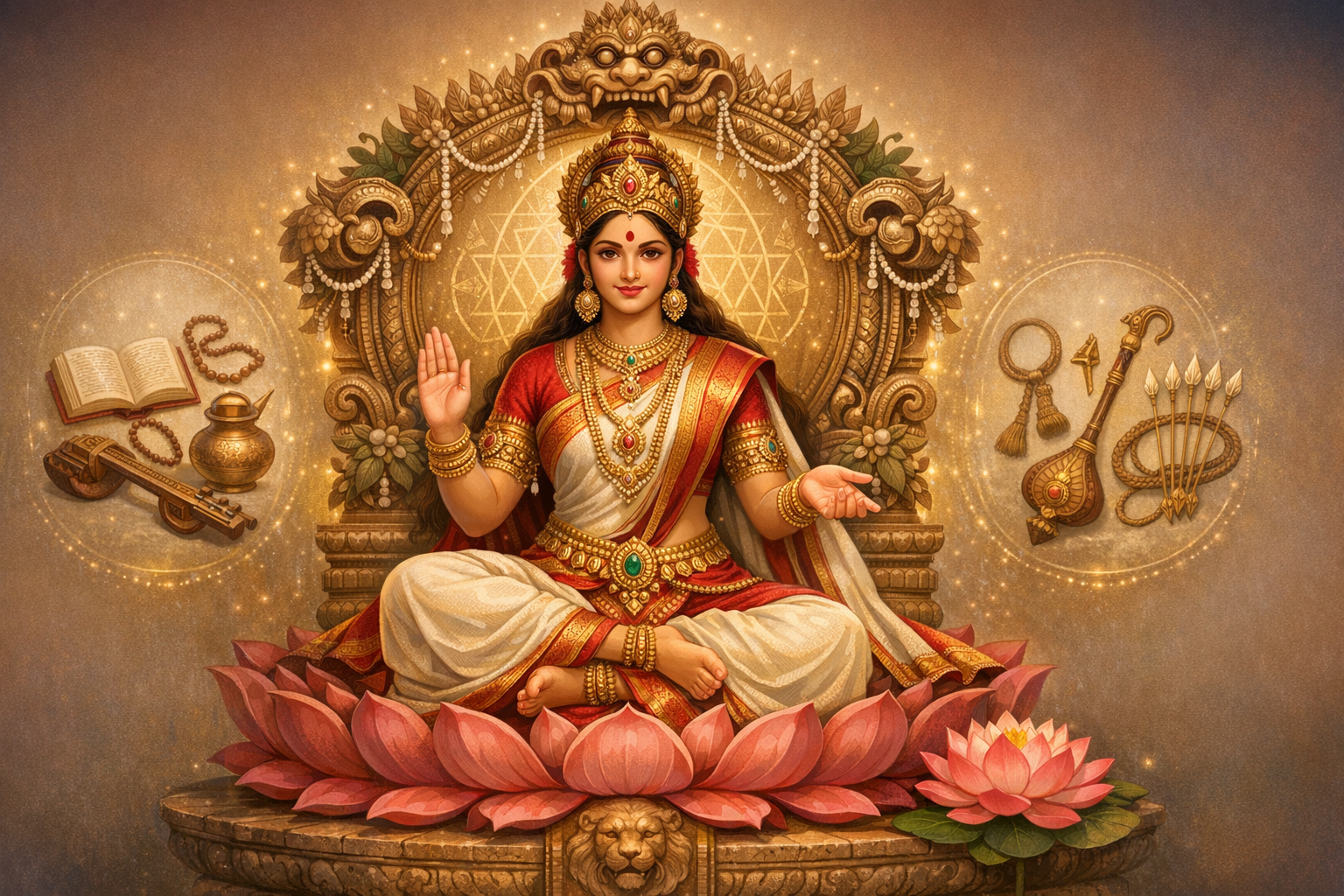
Lopamudra Devi: The Iconographic Splendor of a Shakta–Tantric Mother Goddess finds its place within the broader visual theology of Hindu Sculptures, where every mudra, attribute, ornament, and posture functions as a condensed scripture. In Shakta–Tantric praxis, the murti is not merely art; it is a pedagogical diagram of metaphysics and ethics, shaping devotion through form, proportion, and ritual presence.
Textual memory identifies Lopamudra in the Rigveda as a celebrated rishikā associated with Sage Agastya, while regional Shakta traditions extend this memory into divine motherhood by venerating Lopamudra Devi as an embodiment of Devi Shakti. Because a standardized pan-Indian iconographic prescription is sparse, hereditary sthapati lineages and Agama–Tantra practitioners typically derive murti-lakshana from cognate Devi forms—especially Sarasvati (for vidyā) and Lalitā–Tripurasundarī/Rājarājeśvarī (for sovereign Shakti)—adapting details to local paramparā, Sthala-Purāṇa, and temple liturgy.
Two recurrent iconographic lineages therefore become visible in field practice. The first, Vidyā–Lopamudra, emphasizes knowledge transmission and Vedic learning; the second, Rājarājeśvarī–Lopamudra, foregrounds Shakta–Tantric sovereignty and auspicious power. Both are legitimate within Shakta hermeneutics and may coexist across regions, with sculptural workshops referencing Shilpa Shastra norms to balance aesthetics, theology, and ritual functionality.
Posture (āsana) encodes a primary theological cue. Padmāsana projects contemplative equipoise and is common where Lopamudra Devi is read as a vidyā–śakti. Lālitasana (royal ease with one leg pendant) communicates benign sovereignty central to Śrīvidyā contexts. Tribhaṅga (three bends) adds graceful dynamism, especially in Odisha and eastern idioms, aligning with aesthetic canons that celebrate śṛṅgāra refined by sattva.
Mudras serve as a universal dharmic vocabulary. Abhaya mudra (assurance of fearlessness) articulates the ethical core of Shakti—courage granted to seekers. Varada mudra (boon-bestowing) signals compassionate grace. These gestures resonate across Hindu, Buddhist, and Jain visual cultures and underscore a civilizational emphasis on compassion, wisdom, and fearlessness as shared virtues.
Attributes (āyudha/ābharaṇa) vary by lineage. In Vidyā–Lopamudra, a pustaka (book) affirms scriptural knowledge; an akṣamālā (rosary) signifies mantra–japa and disciplined study; a kamaṇḍalu implies rishi-ascetic discipline and purity. In some regional ateliers, a vīṇā appears as a cognate to Sarasvati’s iconography, harmonizing musical meter (chandas), knowledge (vidyā), and speech (vāk).
In Rājarājeśvarī–Lopamudra, Śrīvidyā cues may predominate: pāśa (noose) gathers and disciplines the senses; aṅkuśa (goad) steers consciousness toward liberation; a puṣpa-dhanuḥ (sugarcane bow) and pañca–śara (five flower-arrows) allegorize mind’s faculties refined by beauty and restraint. A full lotus (padma) often complements either lineage, emblematic of purity arising unsullied from the world.
Headgear and facial iconography follow Shilpa Shastra conventions. A kāraṇḍa–mukuṭa or kirīṭa–mukuṭa denotes regal sovereignty; gently arched brows and elongated eyes enable a compassionate dṛṣṭi suited to darśana. Some Tantric ateliers add a tri-netra (third eye) to mark trans-conceptual insight; others omit it in favor of serene sattva aligned with vidyā–śakti. A subtle tilaka or bindu often centers the forehead as a sign of awakened awareness.
Jewelry (ābharaṇa) is semiotic rather than ornamental excess. Ear ornaments (kuṇḍala), armlets (keyūra), bracelets (valaya/kaṅkaṇa), girdle (mekhalā), and anklets (nūpura) signify auspicious plenitude (śrī). Shakta variants may show a sarpa–yajñopavīta (serpentine sacred thread) or vastra–yajñopavīta, each encoding different layers of energy and discipline; both cohere with Agamic practice and do not contravene dharmic plurality.
Vastra design often shows a finely pleated sari with an uttariya (upper cloth), the drapery rendered to reveal the canonical lākṣaṇa of a Devi form—slender waist, proportionate torso, and poise. Color conventions in festive alankāra complement theology: raktavarṇa (crimson) evokes active Shakti in Śrīvidyā settings; śveta (white) supports sattvic vidyā modes; hari-ta (green) may highlight fertility and renewal during specific temple observances.
The aureole and backplate (prabhāvali) typically deploy a makara–toraṇa capped by a kīrti–mukha. Makaras disgorge ornate foliage and pearls, signaling the emanation of cosmic abundance from the maternal principle; the kīrtimukha devours egoic excess, protecting the sanctum. These motifs are staples of Hindu Iconography and sit comfortably within Tantrism without sectarian friction.
Pedestals reveal theological layering. A padma–pīṭha (lotus pedestal) asserts purity and transcendence; a yoni–pīṭha affirms cosmic source and is particularly resonant in Shakta–Tantric contexts; a kūrma–pīṭha (tortoise base) is used in select temples to stabilize and symbolize cosmic support. Vāhana imagery, when present, aligns with local tradition—simha (lion) for heroic śakti semantics, or no explicit vāhana in Sarasvati-adjacent readings—reflecting the freedom of Hindu Goddess iconography within Agamic bounds.
Yantra integration strengthens Tantric semantics. The Śrī–Yantra (Śrī–Cakra) may be installed behind or beneath the murti per sampradāya. Navāvaraṇa pūjā maps the seeker’s inward ascent through concentric enclosures, culminating in union with the bindu (ultimate point). The yantra is the geometric counterpart to the murti; together they realize a complete semiotic field, balancing form (rūpa) and diagram (rekhā).
Scriptural and technical authority for such work draws from Shilpa Shastra and Agama literature—texts like Mayamata, Mānasāra, Śilparatna, Kāmikāgama, and the Odisha–centric Śilpa Prakāśa. While none prescribes Lopamudra Devi as a pan-Indian canonical type, these treatises detail Devi–lakṣaṇa, proportions (pramāṇa), and ornament grammar that artisans adapt to local theology and temple usage.
Proportion (tāla–māna) provides the armature of meaning. Common Devi murtis range from aṣṭa–tāla to nava–tāla heights, each “tāla” derived from the face module. The body subdivides into calibrated angula measures, harmonizing head (śiras), torso (uras/udara), and limbs (bāhu/ūrū) so that aesthetics conveys sattva and śrī. This iconometry is not pedantry; it is visual dharma that renders metaphysics legible.
Materials and methods signal regional genius. Stone idols in Odisha (khandolite, laterite) and the Deccan (granite) follow chiseling and polishing sequences that accentuate supple drapery and luminous skin. Panchaloha casting (the five-metal alloy) and, in some regions, aṣṭa-dhātu (eight-metal) bronze employ lost-wax (madhucchiṣṭa) processes perfected in the Chola ateliers—yielding fluid silhouettes and enduring ritual durability for Hindu Sculptures.
Surface finishing attends to both devotion and longevity: fine chasing (nāga-rikhā), selective mercury gilding where sanctioned, and controlled patination support ritual visibility in oil-lamp light. Installation follows Agamic prescriptions, with aśṭa-bandhana (sacred resinous setting) securing the murti to the pīṭha, and orientation determined by temple geometry and local paramparā.
Ritual life completes iconography. Pran Pratishtha consecrates presence; daily śodasa–upacāra (sixteen offerings) nurtures a living relationship; alankāra cycles mark the liturgical calendar. Panchamrita Abhisheka, when observed, is balanced with conservation-aware practices in stone and bronze temples so that devotion and heritage stewardship reinforce each other rather than compete.
A practical reading of the idol benefits from a three-pass method. First, read the pīṭha and vāhana to grasp theological ground. Second, decode posture, mudra, and implements for ethical-metaphysical teaching. Third, attend to prabhāvali motifs, mukuṭa, and ornament to register sovereignty, protection, and auspicious plenitude. The result is a coherent darśana where form, doctrine, and feeling converge.
Cross-dharmic resonances underscore civilizational unity. Abhaya and varada mudras recur in Buddhist and Jain traditions; the lotus symbolizes unstained purity in all three. While Sikh tradition is fundamentally aniconic in worship, its emphasis on fearlessness (Nirbhau) and compassion (Nirvair) mirrors the ethical thrust of maternal Shakti. Such convergences reflect a shared Indic grammar of spiritual values without erasing distinct paths.
Regional idioms enrich the whole. Odisha’s Śilpa Prakāśa favors lyrical tribhaṅga and intricate jewelry; Bengal and Assam emphasize śākta vitality inspired by Kāmākhyā’s sacred geography; Tamil and Karnataka bronzes inherit Chola fluidity, making the form appear to breathe in lamplight. Each lineage preserves authenticity while participating in the wider Indic conversation on divine femininity.
From an art-historical vantage, stylistic markers help situate a murti: almond eyes with elongated corners, soft oval faces, and sash-like uttariya are typical of eastern ateliers; defined musculature and crisp pleat-edges signal southern workshops. Yet, these are accents on a shared score whose melody is unity-in-diversity—an enduring hallmark of Indian Culture and Temple Architecture.
Museum and temple settings both demand context-rich interpretation. In situ, devotees often describe a felt assurance when meeting the goddess’s gaze—an affect that iconographers actively build through mudra–dṛṣṭi design. In museums, clear labeling of lineage (Vidyā–Lopamudra or Rājarājeśvarī–Lopamudra), attributes, and ritual function transforms a static object into an intelligible Sacred Symbol.
Contemporary practice continues to evolve. Diaspora temples commission panchaloha idols that respect tāla–māna while accommodating safety codes; digital photogrammetry and 3D archives document masterworks for research and education; collaborative workshops between sthapatis and scholars ensure that living traditions remain both authentic and accessible.
In sum, Lopamudra Devi iconography integrates Vedic memory, Shakta–Tantric metaphysics, and Shilpa Shastra grammar into a coherent theological image. Whether approached through the lenses of Vidyā or Śrīvidyā, the murti teaches fearlessness (abhaya), generosity (varada), knowledge (vidyā), and disciplined compassion (dayā) as shared dharmic virtues. Read in this way, the idol becomes a bridge—honoring the unity of Hindu, Buddhist, Jain, and Sikh civilizational values while celebrating the distinctive radiance of the Hindu Goddess tradition.
Inspired by this post on Hindu Blog.






Leave a Reply
You must be logged in to post a comment.