Gurmat Sangeet stands as the living tradition of Sikh sacred music, where Shabad (revealed word) is rendered within the grammar of raag and taal to cultivate devotion, contemplation, and ethical action. A rigorous certification program in this domain strengthens continuity with the Guru Granth Sahib’s raag-based structure, refines musicianship, and preserves intangible heritage. It also situates Sikh music within the broader dharmic soundscape, fostering unity across Indic traditions while honoring the distinct theological core of Sikhi: the primacy of the Shabad-Guru.
At its heart, a Gurmat Sangeet certification program anchors learning to the canonical organization of the Guru Granth Sahib, which presents Bani under specific raags, along with the interpretive marker ਰਹਾਉ (rahāo) that guides thematic focus. The pedagogy emphasizes singing Shabads in their assigned raags, nurturing both musical integrity and spiritual fidelity. Learners often describe a quiet, transformative resonance when Asa-di-Var unfolds at dawn or when a deeply intoned Ramkali evokes introspection; such moments illustrate how raag is not ornament but meaning-bearing structure.
The curricular architecture typically rests on six pillars: Gurbani santhiya (accurate reading and pronunciation), raag-vidya (raga grammar and aesthetics), taal-vidya (rhythmic systems), shabad kirtan repertoire (liturgical forms and contexts), Sikh organology (traditional instruments and their technique), and performance practice (kirtan chauki design, stage decorum, and maryada). Each pillar is interdependent, ensuring that musical skill and theological understanding deepen together.
Textual foundations receive sustained attention. The Guru Granth Sahib’s raag taxonomyspanning thirty-one principal raags with variants and prescribed tunes for select vaar compositions (for example, the instruction to sing certain Vaars to specific dhunis such as tunde asraja di dhuni)is studied alongside practical exemplars from respected raagi paramparas. The function of ਰਹਾਉ (rahāo) as a thematic refrain is analyzed closely so that musical phrasing supports arth (meaning) and not merely melody.
Raag-vidya develops competency in aroha–avaroha, pakad (signature phrases), voice-leading, and the aesthetics of meend, andolan, and gamak as appropriate to dhrupad- and shabad-ang. While Gurmat Sangeet shares grammar with Hindustani classical music, its intent prioritizes clarity of Bani and collective singing over virtuosic display. Instruction therefore balances swara precision and raag chalan with the devotional clarity that Gurmat aesthetics demand.
Taal-vidya cultivates confident laya control across cycles such as Teentaal (16), Ektal (12), Rupak (7), and Jhaptal (10), as well as pakhawaj-derived thekas foundational to older kirtan styles. Students learn to internalize sam–khali relationships, tihai construction, and layakari without obscuring the sung text. Comparative study of jori–pakhawaj and tabla accompaniment helps align rhythmic color with the shabad’s mood and context.
Shabad kirtan repertoire is sequenced with liturgical sensitivity. Foundational learning often includes Asa-di-Var (dawn), Anand Sahib (celebratory and reflective), Sukhmani Sahib (contemplative), and evening forms aligned with Rehraas and Kirtan Sohila. Where manuscripts or oral traditions preserve prescribed tunes or meters, those lineages are studied respectfully, encouraging historically aware performance without rigidity that erases community practice.
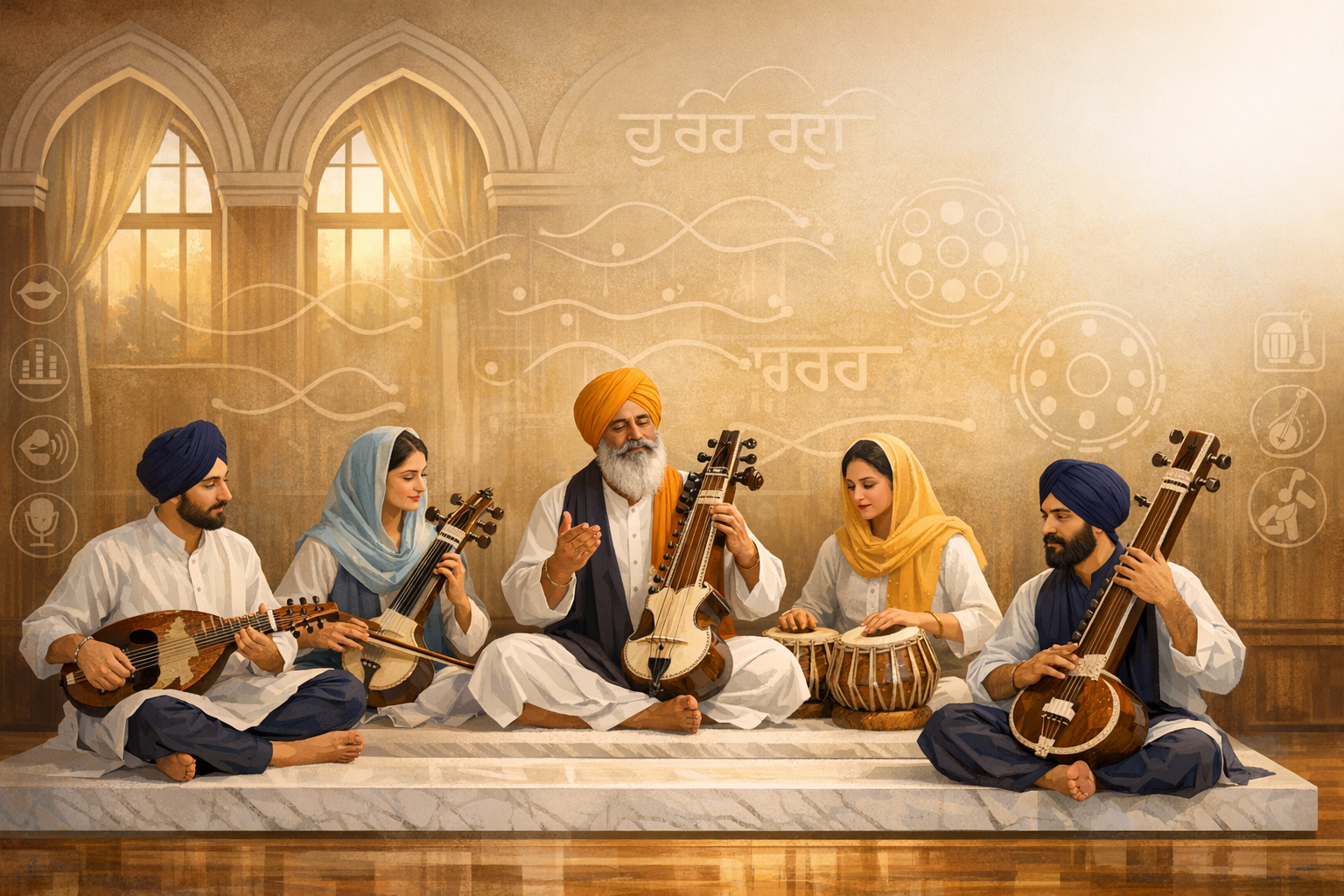
Organology focuses on instruments integral to Sikh history and aesthetics: rabab (associated with Bhai Mardana), saranda (linked to Guru Arjan’s milieu), taus (traditionally associated with Guru Hargobind), dilruba (attributed to Guru Gobind Singh), along with jori–pakhawaj and tabla. Students learn posture, bowing or plucking technique, tonal production, and tuning to a stable drone (tanpura or shruti box), ensuring that timbre supports the raag’s emotive architecture.
Gurbani santhiya and phonetics form a technical spine for the program. Precision with sihari, bihari, aunkar, dulankar, laavā̃, and related orthographic signals is essential so that pronunciation serves meaning. Instruction covers the multilingual range of Gurbani (including Punjabi, Sant Bhasha, Braj, Persian, and Sanskrit vocabulary), with attention to vishraam (pausal) conventions that align phrasing to arth. This prevents musical stretching from fracturing semantic clarity.
Liturgical design and samay (time-of-day) considerations are studied to align kirtan chaukis with congregational needs and traditional aesthetics. The program prepares learners to plan dawn, midday, and evening repertoires with thematic coherence and appropriate raags, maintaining a living dialogue between historical practice and contemporary sangat realities.
Performance practice emphasizes maryada and congregational leadership: modest presentation, collective singability, accurate ardas-related transitions, and attentiveness to sangat participation. Learners practice pacing that invites sabad-vichar (reflection) rather than crowding the service with improvisation. This fosters a shared devotional space where musical choices are guided by gurmat ethos.
Assessment and certification rubrics combine musicianship and hermeneutics. Typical criteria include: intonation accuracy (within acceptable cent tolerances), raag grammar adherence, rhythmic steadiness, textual diction and prosody, articulation of ਰਹਾਉ (rahāo) as the thematic anchor, and demonstrated understanding of arth. Reflective componentssuch as a riyaz log and short exegetical notes on chosen shabadsencourage disciplined practice and thoughtful engagement with meaning.
A research element often complements performance proficiency. Examples include comparative studies of a single raag’s treatment across multiple shabads, analysis of dhuni-based vaar performance, or documentation of regional kirtan lineages and their pedagogies. Rather than imposing a single reading on historical markers (e.g., ghar numbers), the program encourages evidence-based inquiry that weighs textual, oral, and musicological sources with care.
In the spirit of dharmic unity, the program locates Gurmat Sangeet within the wider Indic conversation on sound and liberation. Shared frameworkssuch as the ethical role of music, the saptak (seven-note) system, and the contemplative power of droneare acknowledged across Hindu, Buddhist, and Jain devotional soundscapes, while maintaining the Sikh theological grounding in Shabad and the sovereignty of the Guru Granth Sahib. This comparative literacy nurtures mutual respect and interfaith understanding without flattening distinct traditions.
Pedagogically, guru–shishya learning is integrated with modern tools. Oral transmission remains centralthrough call-and-response, memorization of bandish-like settings of shabads, and attentive correctionwhile notations, recordings, and analytic handouts support retention. The aim is to form musicians who make independent, text-faithful decisions in live sangat contexts.
Digital archiving and documentation are treated as seva. Learners are trained to produce high-quality, metadata-rich recordings (raag, taal, ang, textual incipit, source lineage) so future generations can access accurate exemplars. Thoughtful curation of variants is encouraged to reflect the vibrancy of living tradition without erasing historical anchors.
Quality assurance is typically overseen by panels that include experienced raagis, musicologists, and scholars of Sikh liturgy. Recommended references may include reliable teekas for arth, documented kirtan lineages (e.g., Rababi traditions), and standard maryada guidelines, ensuring that certification aligns with both musical rigor and spiritual responsibility.
Pathways after certification span congregational seva (leading kirtan in gurdwaras), pedagogy (community classes and school programs), archival and research roles, and curation of kirtan chaukis for community events such as Nagar Kirtan. Many graduates report greater confidence in serving diverse sangatsadapting repertoire, tempo, and explanation to invite participation from elders, youth, and newcomers alike.
Emotionally and spiritually, participants frequently describe a deepened relationship with Bani: the stillness that arrives when a correctly intoned ਰਹਾਉ (rahāo) settles, the collective breath that synchronizes around a well-placed sam, and the sense of ethical clarity that follows a sabad rendered in its prescribed raag. These experiences are not incidental to certification; they are the telos of learning in a Gurmat framework where music is a disciplined path to awareness.
In sum, a Gurmat Sangeet certification program offers a comprehensive, text-faithful, and aesthetically rigorous pathway to mastering shabad kirtan. By uniting santhiya, raag-taal grammar, organology, performance practice, and research, it safeguards Sikh musical heritage while fostering unity and respectful dialogue within the broader dharmic family. The outcome is a musician–sevak able to honor tradition, serve the sangat, and carry Gurmat Sangeet forward with authenticity and grace.
Inspired by this post on SikhNet – News.