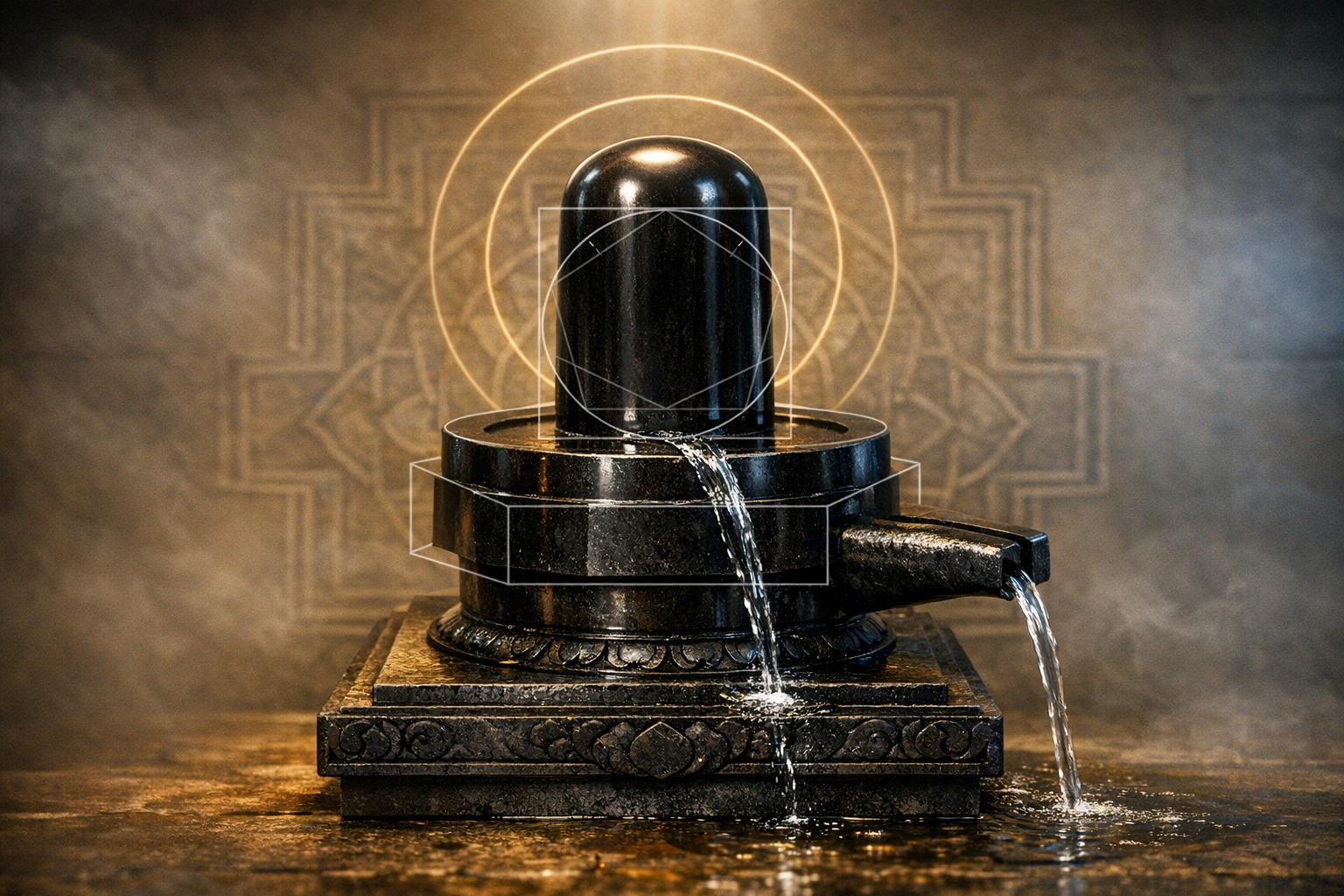
Samakanda Shivling denotes a meticulously proportioned mānuṣa liṅgaa manmade representation of Śivawhose three bhāgas (sections) of Brahmā, Viṣṇu, and Rudra are maintained in equal measure. This equal division embodies a deliberate theological choice: to present creation (sṛṣṭi), preservation (sthiti), and dissolution (saṁhāra) in perfect equilibrium. In temples and homes alike, the Samakanda configuration functions as a visual and ritual grammar of balance, inviting contemplative alignment with the Trimūrti’s integrated work in the cosmos and within the practitioner.
Classical Śilpa-Śāstra and Śaiva Āgama traditions systematize liṅga typologies by origin (svayambhū, daivika, ārṣa, mānuṣa), material, and proportion. The Samakanda Shivling belongs to the mānuṣa class, shaped according to prescriptive canons (lakṣaṇa) that seek not only aesthetic fidelity but also metaphysical exactness. Although lineages vary, canonical sources such as the Kāmīkāgama, Suprabhedāgama, Ajitāgama, and allied śilpa compendia provide convergent guidance on measurements, shapes, and installation protocols.
Iconographically, the liṅga’s vertical body is read in three stacked zones called bhāgas. The Brahmā-bhāga at the base is associated with the square (caturaśra), stability, and grounding; the Viṣṇu-bhāga in the middle is commonly articulated as eight-sided (aṣṭāśra), signifying ordered expansion; and the Rudra-bhāga at the summit is circular (vṛtta), signifying infinitude and unbounded presence. In most shrine settings, the Brahmā-bhāga remains embedded within the pīṭha (yoni-pīṭha/avudaiyār), the Viṣṇu-bhāga may be partially visible or faceted, and the Rudra-bhāga appears as the exposed cylindrical crown receiving abhiṣeka.
Samakanda (sama-kāṇḍa) specifically indicates that the three bhāgas are of equal height in the canonical measure. Practically, the visible vertical of the liṅga from the pīṭha’s top to the crown is divided into three equal partseach corresponding to Brahmā, Viṣṇu, and Rudra. While regional practice can nuance shapes and slight dimensional emphases, the governing principle remains the pursuit of exact equality, symbolizing non-hierarchical unity of the Trimūrti’s functions.
Measurement traditions rely on standardized units such as aṅgula and tāla. The total height (from the pīṭha’s upper plane) is apportioned so that each bhāga occupies one-third of that measure; diameter, curvature, and facet transitions are then resolved to meet the Agamic profile. Variations across schools reflect local canons and workshop lineages, yet the Samakanda designation is anchored in the one-third rule for each bhāga. This technical exactness ensures that the liṅga’s geometry and theology reinforce one another.
The liṅga is inseparable from its yoni-pīṭha, whose layout enables ritual hydraulics and cosmic orientation. The prāṇāḷa (soma-sūtra)the spout through which consecrated waters exittypically faces north or east in line with Āgamic prescriptions and the liṅga’s specific theological mood (saumya or ugra). In Samakanda installations, the even distribution of height across the three bhāgas works in tandem with pranāla orientation to encode equilibrium into every abhiṣeka cycle, ensuring that the sanctified flow symbolically touches creation, preservation, and dissolution in sequence.
Material choice follows another classical taxonomy: śilā-liṅga (stone) predominates in permanent temples for durability and ritual purity, while pañcaloha (five-metal), dāru (wood), rajata (silver), suvarṇa (gold), mṛnmayī (clay), and ratna (gem) variants appear in portable or special contexts. Each medium carries connotative guṇa-bheda in traditional discoursestone for steadfastness, metals for radiance and conductivity, and clay for the earth-principlewithout altering the core Samakanda equalization of the three bhāgas.
Ritually, the Samakanda Shivling excels in pedagogical clarity. During abhiṣeka, libations offered on the Rudra-bhāga course over the Viṣṇu-bhāga and eventually stabilize at the Brahmā-bhāga before exiting via the prāṇāḷa. This choreographed descent is read as grace moving from the unbounded (Rudra) through order (Viṣṇu) into grounded manifestation (Brahmā). Devotees frequently note that the visual cadence of the water itself conveys equanimity, making the Samakanda form especially resonant for collective worship and inner reflection.
Mantra and mudrā sequences for prāṇa-pratiṣṭhā and nitya-pūjā are structurally identical to those for other liṅga types, yet the Samakanda proportion subtly shapes meditative emphasis. Equalized bhāgas invite a balanced contemplation in japa and dhyāna, tempering the tendency to over-identify with any single cosmic function or psychological mode. Priests often underscore this by distributing offerings evenly across the shaft, reinforcing the sama-bhāva (equanimity) the icon encodes.
Theologically, Samakanda supports a non-polemical synthesis. Instead of privileging one aspect of the Trimūrti, it teaches that sṛṣṭi, sthiti, and saṁhāra are interdependent processes in a single living cosmos. This is consonant with the Śvetāśvatara Upaniṣad’s non-dual intuitions about the supreme Rudra as the all-pervasive ground, while remaining compatible with the Purāṇic imagination that differentiates functions to aid devotion and instruction.
Yogic literature adds another interpretive stratum: the three bhāgas are correlated with the tri-granthiBrahmā-granthi (stability at mūlādhāra), Viṣṇu-granthi (integration at anāhata), and Rudra-granthi (transcendence at ājñā). While mappings differ across Tantric and Haṭha traditions, the Samakanda’s architectural parity naturally complements practices that seek even development of body, prāṇa, and awareness along suṣumṇā-nāḍī. In this sense, the liṅga’s axis mirrors Meruthe axis mundialigning temple space with inner ascent.
In the language of temple architecture (Vāstu-Puruṣa-maṇḍala), the garbhagṛha functions as a calibrated void and the liṅga as its organizing axis. Samakanda proportions, by distributing height equally across square, octagonal, and circular principles, create a harmonic between geometry and metaphysics. The square roots the icon in cardinal stability, the octagon mediates between square and circle (earth and sky), and the circle consummates the ascent in wholenesseach contributing exactly one-third of the vertical narrative.
Comparative Agamic practice sometimes deploys intentional asymmetry to emphasize a single functiontraditions may speak of Brahmādhika, Viṣṇvādhika, or Rudrādhika variants where one bhāga is proportionally accentuated to cultivate a particular aspirational mood. Against this backdrop, Samakanda emerges as the baseline of equipoise. For communities seeking inclusive symbolism that does not over-privilege any function or temperament, the Samakanda is frequently preferred.
Identification in situ follows iconographic cues. If facets are visible, the octagonal transition around the shaft (Viṣṇu-bhāga) can often be felt or seen just below the fully cylindrical crown (Rudra-bhāga), while the square base (Brahmā-bhāga) is embedded within the pīṭha. Measurements are taken from the pīṭha’s upper surface to the crown, partitioning that visible height into three equal segments. Where surfaces are worn smooth by centuries of abhiṣeka, priests and śilpins rely on canonical memory and the liṅga’s installation records to affirm the Samakanda schema.
For home worship, Āgamic counsel recommends that permanent liṅgas be installed and consecrated under qualified guidance, since the yoni-pīṭha’s slope, prāṇāḷa direction, and mantric regimen are integral to orthopraxy. Devotees who seek balance in household life often choose the Samakanda proportion, aligning daily abhiṣeka with sama-bhāva. Even in simple routinesbilva-patra offering, pañcāmṛta abhiṣeka, and śānti-mantra recitationthe equalized form cultivates a steady, inclusive devotional mood.
Across the wider Indic field, the Samakanda Shivling’s triadic equilibrium resonates with recurrent civilizational patterns that prize harmony over hierarchy. While theological forms vary, an ethos of integration and inner balance is celebrated across dharmic traditions: Buddhism’s contemplative middle way, Jainism’s emphasis on samyag-darśana–jñāna–cāritra (the Ratnatraya), and Sikhism’s remembrance of the One with ethical living. Read in this ecumenical light, the Samakanda proportion becomes a shared cultural invitation to unity-in-diversity.
From a pedagogical perspective, the Samakanda liṅga is an elegant teaching tool. Children and newcomers readily grasp the meaning of three equal partsno single function dominates. Ritual specialists likewise appreciate how the form stabilizes community mood during festivals and Mahāśivarātri, moderating extremes and orienting collective devotion toward a centered, compassionate strength.
In textual hermeneutics, the Samakanda can be read as a concrete commentary on non-dual insights articulated in Upaniṣadic and Purāṇic strata: the many are not other than the One, and the One blossoms as the many without fragmentation. By giving each bhāga identical measure, the icon declares that differentiation serves realization rather than division. The result is a devotional object that is at once philosophically rigorous and emotionally accessible.
Scholars of art history often note how the Samakanda format illustrates a mature integration of śāstra (theory), prayoga (practice), and rasa (aesthetic mood). The structural equalization is not merely mathematical; it is a carefully tuned aesthetic that supports the soft orbit of lamp flame at ārati, the cadence of mantra, and the reflective gaze during sandhyā. In this sense, sacred geometry does practical spiritual work.
In contemporary discourse on cultural heritage and temple architecture, the Samakanda Shivling offers a clear example of how Indic design encodes ethical and spiritual values. It models balancesocially, psychologically, and cosmicallywithout erasing difference. That message remains timely for plural societies committed to harmony among Hindu, Buddhist, Jain, and Sikh communities.
In conclusion, the Samakanda Shivling is best understood as both precise sacred engineering and a luminous symbol of unity. Its equal Brahmā, Viṣṇu, and Rudra bhāgas translate grand metaphysics into tactile form, guiding ritual, education, and personal practice toward equilibrium. Whether encountered in the stillness of a garbhagṛha or the intimacy of a home altar, it quietly teaches that creation, preservation, and dissolution are perfectly synchronized movements of one compassionate reality.
Inspired by this post on Hindu Blog.