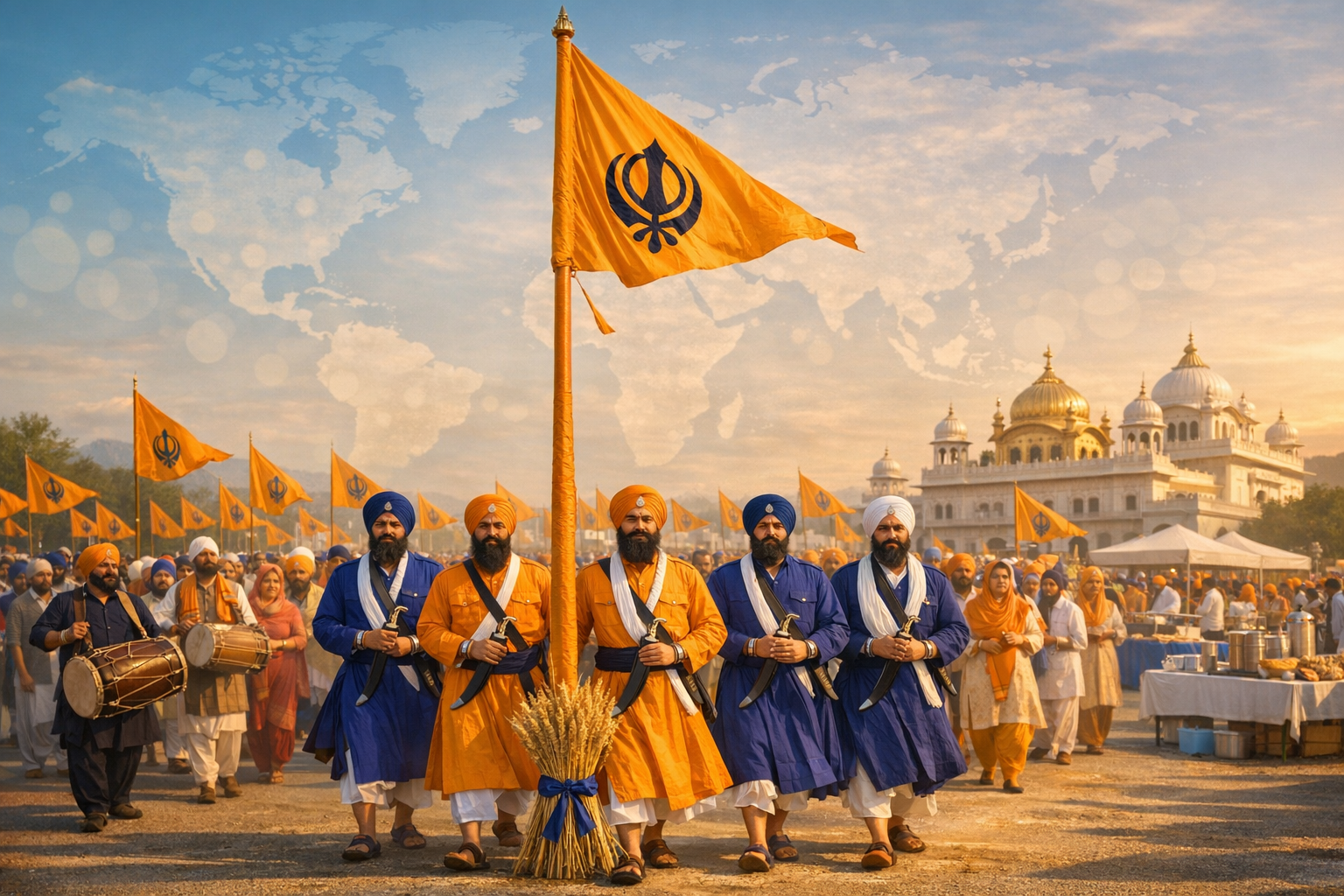
A massive gathering of Sikhs commemorated the historic 327th Baisakhi, marking Khalsa Sirjana Diwas and reaffirming the living legacy of Guru Gobind Singh’s 1699 proclamation at Anandpur Sahib. Across Punjab, India, and the global diaspora, gurdwaras and civic spaces resonated with kirtan, Ardas, and spirited processions, underscoring both spiritual devotion and community cohesion. The observances blended solemn liturgy with cultural vibrancy, reflecting Vaisakhi’s dual identity as a harvest festival and the Khalsa’s foundation day.
Historically, Baisakhi anchors one of the most consequential moments in Sikh history. In 1699 (1 Vaisakh), Guru Gobind Singh instituted the Khalsa at Anandpur Sahib, transforming the community into a disciplined fellowship committed to spiritual elevation and righteous defense. The institution of the Panj PyareBhai Daya Singh, Bhai Dharam Singh, Bhai Himmat Singh, Bhai Mohkam Singh, and Bhai Sahib Singhsymbolized radical equality, courage, and collective responsibility. The Khalsa identityembodied in the Five K’s (kesh, kangha, kara, kachera, kirpan)codified an ethical and disciplined way of life.
Calendrically, Baisakhi aligns with the onset of the solar month of Vaisakh and typically falls in mid-April in the Gregorian calendar. Its timingsituated in the agrarian cycle as rabi crops reach marketsadds socioeconomic resonance in Punjab and adjoining regions. While local practice may follow Nanakshahi or Bikrami reckonings, the commemoration unites Sikhs worldwide in a shared remembrance of Khalsa ideals and Sikh sovereignty of spirit.
Core religious observances during the 327th Baisakhi centered on Amrit Sanchar (Khande di Pahul). In this initiation ceremony, the Panj Pyare prepare Amrit with a double-edged khanda as the congregation recites five banis: Japji Sahib, Jaap Sahib, Tav-Prasad Savaiye, Chaupai Sahib, and Anand Sahib. Initiates embrace the Khalsa rehat (Rehat Maryada), pledging integrity, seva, discipline, and courage, culminating in the shared affirmation “Waheguru ji ka Khalsa, Waheguru ji ki Fateh.” These rites, held from village gurdwaras to Takhts, highlight continuity in doctrine and practice.
Congregational worship framed the day. Akhand Path and special kirtan diwan created a contemplative arc that culminated in collective Ardas and the Hukamnama, offering scriptural guidance for the community. At Harmandir Sahib (Golden Temple) and the Akal Takht in Amritsar, at Takht Sri Kesgarh Sahib in Anandpur Sahib, and at Takhts in Nanded, Patna, and Talwandi Sabo, the atmosphere combined devotional serenity with purposeful resolve. Global gurdwaras mirrored these patterns, often extending services and broadcasting proceedings to connect the diaspora.
The Nishan Sahibemblematic of sovereignty and servicereceived renewed attention through ceremonial seva. Many gurdwaras replaced the flag’s chola (cloth covering) and refurbished masts, ritually cleansing and rededicating the symbol under Ardas. The saffron hue flying against spring skies conveyed steadfastness and the Khalsa’s duty to uphold righteousness and protect the vulnerable.
Processions added a kinetic dimension to worship. Nagar Kirtanled by the Panj Pyarewove through city streets with shabad kirtan, children carrying saffron flags, and community volunteers maintaining decorum and cleanliness. Gatka demonstrations showcased disciplined mastery of Sikh martial arts, not as spectacle alone but as living pedagogy in self-restraint, readiness, and the ethical ethos of dharamyudh (righteous defense). Many participants described the day’s cadencemusic, motion, and meditationas a moving education in Sikh values.
Seva remained the social heartbeat of the commemorations. Langarvegetarian, free, and open to allserved as the community’s living charter of equality and hospitality. From small kitchens behind local gurdwaras to expansive tents near major shrines, volunteers organized cooking, water distribution, waste segregation, and meticulous hygiene. Blood-donation drives, health camps, and environmental stewardship initiatives often accompanied the festivities, reframing celebration as a platform for public good and resilience.
Geographies of observance underscored Sikh plural presence. In India, Baisakhi drew large congregations to Anandpur Sahib (Takht Sri Kesgarh Sahib), Amritsar (Akal Takht and Harmandir Sahib), Talwandi Sabo (Takht Sri Damdama Sahib), Patna (Takht Sri Patna Sahib), and Nanded (Takht Sri Hazur Sahib). Pilgrims and delegations also honored the historic shrine of Sri Panja Sahib in Hasan Abdal (Pakistan), reinforcing transboundary reverence. Internationally, major Baisakhi and Khalsa Day parades unfolded in North America, the United Kingdom, Southeast Asia, and Oceania, attesting to a vigorous and confident diaspora.
As an agrarian festival, Baisakhi retains deep regional texture. For farming families, it coincides with the culmination of a season’s labor and the beginning of procurement at mandis. In many districts, religious rites interlace with thanksgiving for a safe harvest and aspirations for water security, fair markets, and sustainable agriculture. The continuity of these agrarian linkages lends Baisakhi a pragmatic dimension, where devotion is inseparable from stewardship of land and livelihood.
Dharmic unity emerged as an explicit theme during the 327th Baisakhi. The month of Vaisakh is honored across Indic calendars, and while traditions vary in ritual emphasis and dating, shared values of compassion (karuna), truth (satya), service (seva), and the welfare of all (Sarbatt da Bhala) bind communities across Hinduism, Buddhism, Jainism, and Sikhism. In interfaith greetings and joint cultural programs, participants framed Baisakhi as both particular in its Sikh sacred history and resonant within the wider dharmic civilizational tapestry.
Logistics for such large gatherings reflected accumulated institutional experience. Crowd management combined volunteer marshals with local administration; hydration points and first-aid stations mitigated heat-related risk; traffic rerouting protected procession routes; and accessible facilities ensured participation by elders and persons with disabilities. Digital live-streams widened reach while reducing congestion, allowing those at a distancestudents, professionals, and overseas familiesto connect with ceremonies in real time.
For many families, Baisakhi carried a distinctive emotional cadence: children practicing simple boliyan and bhangra steps in school programs; elders narrating the origin of the Khalsa and the stories of the Panj Pyare; and multigenerational participation in langar dutiescutting vegetables, rolling rotis, and serving with humility. These intimate rituals of memoryperformed in kitchens, courtyards, and community hallsanimated the day’s academic and historical meanings with lived warmth.
Respectful participation remained a guiding norm. Visitors to gurdwaras covered heads, removed footwear, observed queue discipline, and received karah prashad with reverence. Volunteers emphasized cleanliness, mindful use of resources, and courtesy across languages and cultures. These simple etiquettes served as gateways to understanding Sikh spirituality, aligning everyday conduct with the day’s exalted themes of equality and service.
The 327th Baisakhi thus stood at the intersection of history, spirituality, culture, and public ethics. It reaffirmed the Khalsa’s timeless call to courage, integrity, and seva; it celebrated agrarian gratitude and urban solidarity; and it modeled a dharmic ethos that honors both diversity and unity. In renewing vows and revitalizing institutions, Sikh communities worldwide demonstrated how a festival can function as annual soulcraftbinding memory to mission, and devotion to the common good.
Inspired by this post on SikhNet – News.