When a republic collapses into tyranny, the rupture rarely concerns power alone; it is also a wound to memory, institutions, and the shared ethic of a people. In ancient Mathura, a key city of the Yadava confederacy in Ancient India, tradition remembers a civic order anchored in a council of eldersoften styled as the Sudharmawhose deliberations mediated authority, kinship, and sacred duty. The violent ascent of Kamsa, and his displacement of these older republican textures, offers a case study in how oligarchic-democratic polities could be unmade from within and how Dharma and Adharma contend in the realm of statecraft.
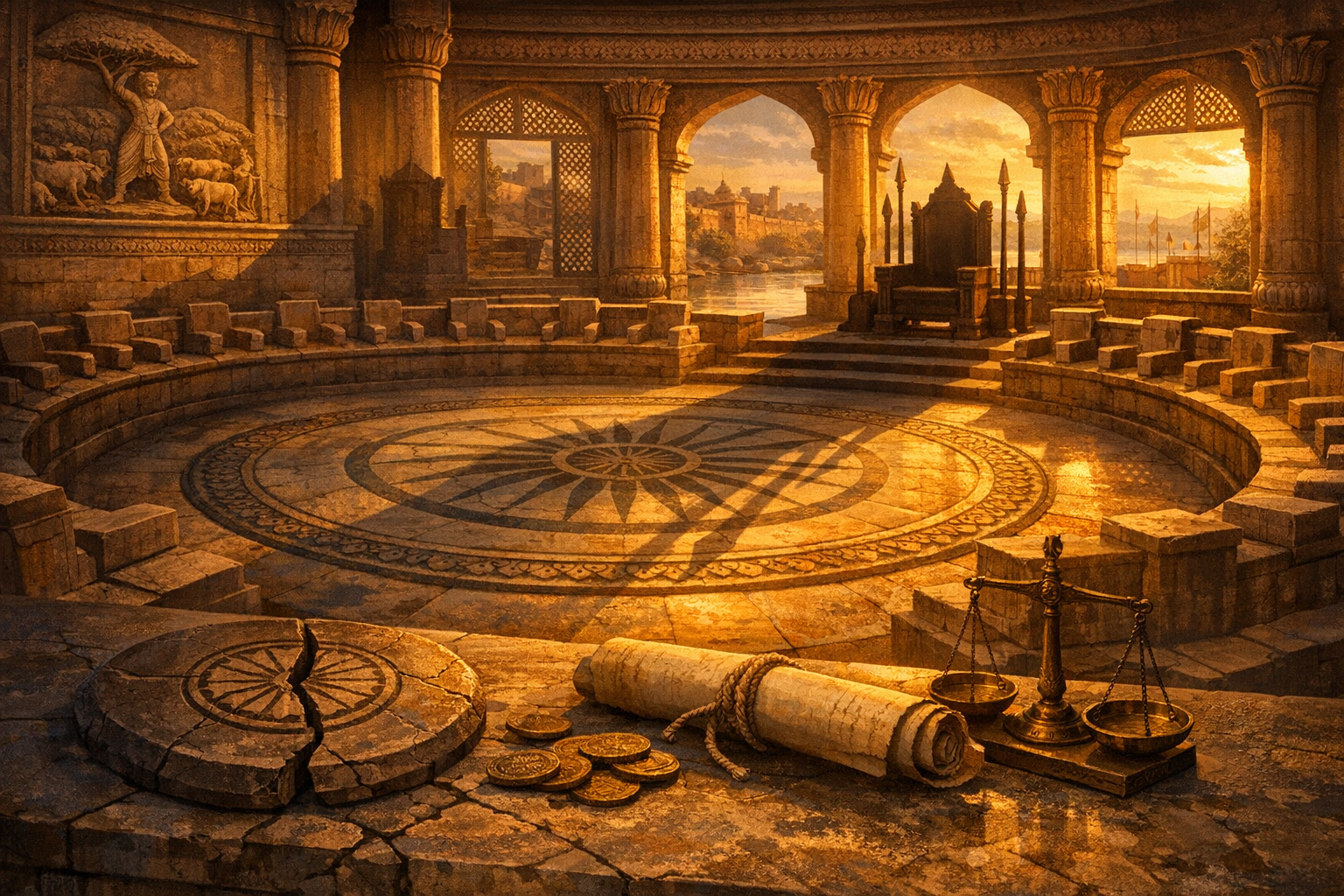
Mathura occupied a strategic position along the Yamuna corridor, integrating pastoral wealth, caravan trade, and ritual prestige. In such urban nodes, political forms were seldom monolithic. A hereditary ruler might preside, yet a councilcomposed of clan seniors, guild representatives, and ritual specialistsregularly checked and channeled royal prerogative. The Sudharma, remembered as a venerable assembly among the Yadavas, exemplifies this composite order where consent, counsel, and custom constrained absolutism.
The broader Indic landscape contained multiple variants of such mixed constitutions. Buddhist sources, particularly the Mahaparinibbana Sutta, praise the Vajji or Lichchhavi gana-sangha for meeting frequently, honoring elders, and acting in concordfeatures consistent with resilient republican governance. Jain literature likewise preserves memories of gana polities where deliberation and ascetic ethical norms intertwined. Against this civilizational backdrop, Mathura’s Sudharma fits a long continuum of participatory institutions within Ancient History.
Textual strands for Mathura’s political transformation come principally from the Bhagavata Purana, Vishnu Purana, and the Harivamsa, reinforced by the broader Mahabharata tradition. While these are sacred narratives rather than administrative charters, their consistent attention to assembly halls, clan federations like the Vrishnis and Andhakas, and conflicts over legitimacy offers valuable signals for political history. Archaeological horizons around Mathurabearing Northern Black Polished Ware, early coinage, and sculptural ateliersconfirm a milieu capable of sustaining complex governance.
Prior to Kamsa’s coup, Mathura’s rulership is associated with Ugrasena of the Bhoja line, yet that kingship did not overshadow collective deliberation. The Sudharma’s elders and allied clan councils formed a normative lattice, balancing martial authority with mercantile and pastoral interests. This equilibrium follows the Arthasastra’s logic in which councils, ministers, and guilds stabilize the realm and dilute the risk of capricious kingship.
Kamsa’s violent rise punctured this balance through a fusion of palace seizure, fear politics, and external alliance. Purana accounts concur that Kamsa, son of Ugrasena, usurped his father’s throne. The legendary triggeran oracle at his sister Devaki’s wedding foretelling that her eighth child would be his slayerprovides a psychological lens: a sovereign consumed by succession anxiety becomes prone to preemptive cruelty and constitutional vandalism.
Imprisonment of Devaki and Vasudeva, the killing of newborns, and the surveillance of dissidents were not only personal crimes but instruments of regime security. By striking at kinship sanctity and the rites surrounding childbirth, the usurper sent a signal to the city’s assemblies: sacred custom would not shield civic life from the appetite of central command. In republican terms, this was a direct assault on the social compacts that legitimized governance.
Central to Kamsa’s statecraft was alliance with the formidable Magadhan monarch Jarasandha. Tradition remembers that Jarasandha gave his daughters Asti and Prapti in marriage to Kamsa, a dynastic bond that translated into military patronage. With Magadha’s backing, Kamsa could overawe clan elders, marginalize the Sudharma’s moral veto, and convert the apparatus of Mathura into a garrisoned kingship.
Coercion radiated outward through proxies: wrestlers like Chanura and Mushtika, enforcers, and a network of agents tasked to preempt threatsmost famously, the repeated attempts to extinguish the prophesied child. Though couched in theodicy within the Bhagavata Purana, these episodes map cleanly onto a recognizable repertoire of authoritarian control, including targeted violence, intelligence gathering, and performative spectacles designed to terrify and enthrall.
Economically, Mathura’s prosperity derived from textiles, metalwork, and caravan traffic across the western Gangetic plain. Tyrannical rule rarely leaves commerce untouched. Increased exactions, unpredictable edicts, and the militarization of civic space likely dampened guild confidence and redirected wealth toward court consumption and war-making. In such conditions, republican institutionswhose legitimacy rests on predictable normsatrophy quickly.
To anchor this power, tyrants often seek ritual legitimation. Kamsa’s pageantry, public combats, and court rites functioned as a substitute sacrality to mask the erosion of custom and counsel. Yet dharmic literature draws a line between the sanctity of Rajadharmalawful, measured, and accountableand mere ritualized sovereignty. The Shanti Parva of the Mahabharata frames kingship as custodial: authority exists to protect subjects, uplift the weak, and maintain truth. By those canons, Kamsa’s regime exemplified Adharma.
At the social edge of Mathura’s polity, the cowherd commonsthe Gopas and Gopalaspreserved a parallel moral economy grounded in pastoral cycles and mutual defense. The celebrated Govardhana episode, in which Krishna persuades the cowherds to prioritize immediate ecological duty over a distant ritual to Indra, illuminates the ethical grammar of local self-governance. While not a formal constitutional act, the narrative affirms subsidiarity: communities thrive when decision-making aligns with lived realities.
Kautilya’s Arthasastra offers an incisive analytic frame here. It warns that a ruler who alienates counselors, guilds, and frontier communities invites revolt, foreign entanglement, or slow internal decay. In Mathura, the alliance with Magadha yielded short-term intimidation but magnified long-term insecurity, making the city hostage to external retaliation once the tyrant fell.
Comparative republican insights from Buddhist and Jain sources amplify the point. The Buddha’s counsel to the Vajjisto assemble often, respect elders, and protect women and shrinesreads like a charter for institutional resilience. Jain traditions, emphasizing Ahimsa and collective discipline, show how ethical restraints deepen civic durability. These dharmic streams converge on a shared warning: abandon counsel and compassion, and even a mighty city becomes brittle.
Public memory preserves Kamsa’s paranoia as a hallmark of breakdown. Fear of a foretold avenger metastasized into surveillance and incessant violence. Authoritarianism, by definition, externalizes inner insecurity; it outruns truth to smother imagined threats, and in doing so, it devours the very legitimacy it seeks to command.
In time, Krishna’s arrival in Mathura and the fateful arena combat with Chanura and Mushtika culminated in Kamsa’s death. The narrative significance extends beyond theodicy. It signals a reconstitution of moral order: Ugrasena was reinstated, and with him the possibility of resurrecting consultative governance. Victory in the arena thus doubles as a juridical momenttyranny is judged and found wanting before the city’s eyes.
Reprieve, however, was partial and fragile. Jarasandha’s fury unleashed repeated invasions against Mathura, pressing the Yadavas to rethink their urban footprint. Strategic relocation to Dvarakaa maritime fortress-cityfollowed. Tradition recalls the Sudharma assembly hall there with particular warmth, suggesting that institutional memory from Mathura’s civic life migrated and matured rather than vanished.
This relocation illustrates a larger pattern in Ancient India: republican and oligarchic forms adapted to geopolitical pressure, sometimes abandoning a vulnerable node to preserve the institutional seed elsewhere. Mobility, federation, and memory kept the lamp of counsel alive even when a single city succumbed to war or usurpation.
Political anthropology of early Historic India often contrasts the Janapada monarchies with the gana-sanghas. Yet Mathura’s story complicates simple binaries. The Yadava experience shows how a city could braid kingship with council and how that braid could be severed by a coup d’étatreplaced by a centralized rule only sustainable through external arms and perpetual fear.
Within the dharmic ecumene, the tale also resonates across traditions. Hindu, Buddhist, Jain, and Sikh reflections converge on the duties of leadership: to safeguard the vulnerable, to submit might to right, and to honor assembly and counsel. Sikh sarbat khalsa traditions, Buddhist sangha protocols, and Jain gana discipline echo the same civilizational grammardharma is social as much as personal.
Archaeology anchors the plausibility of these complex polities. Mathura’s early coinage, sculptural workshops, and trade networks point to civic institutions worthy of the Sudharma’s memory. While Puranic chronologies and modern academic periodization differ, both agree that the region sustained a density of life that required more than autocratic fiat to function well.
Methodologically, it is prudent to read the Puranas and the Harivamsa as repositories of political imagination and ethical pedagogy, not merely as chronicles. They articulate the difference between rule by fear and rule by dharma, between courts that seek ritualized awe and councils that embody civic consent. In this register, Kamsa’s regime is not only an episode; it is a recurring caution.
What then ended when Kamsa rose was not merely a king’s tenure but a civic equilibriumassemblies meeting in recognized halls, elders offering binding counsel, guilds negotiating taxes and norms, and ritual authority operating under the canopy of law. What returned after his fall was not an identical past but the memory and method to rebuild legitimacy through the Sudharma’s spirit.
The lessons speak crisply to modern governance. Institutionswhether panchayats, city councils, or corporate boardsderive strength from regular deliberation, transparency, and respect for ethical constraints. Authoritarian shortcuts can accelerate decisions but also accelerate decay, especially where economic vitality depends on trust and predictable norms.
From the perspective of Dharma and Adharma, the core question is enduring: does power serve the people’s flourishing and truth, or do the people serve power’s fear? The answer, in every age, is given not by declarations but by institutionsby how often they meet, how freely they speak, and how faithfully they protect those without power.
For readers across dharmic traditions, Mathura’s arc invites reflection on a shared inheritance of participatory governance. The Buddhist praise of federated concord, the Jain insistence on disciplined community life, the Hindu ideal of rajadharma, and the Sikh ethic of seva and collective counsel together define a common civilizational north. Unity emerges not from uniformity but from a mutual commitment to restrain power and lift truth.
In the final assessment, Kamsa’s coup did not merely crown a tyrant; it decrowned a city’s conscience. Yet the Sudharma’s memory enduresreappearing in Dvaraka’s famed assembly hall and, more importantly, in the living conviction that councils must outlast kings. Therein lies the price of lost dharma and the promise of its return: institutions can be broken, but they can also be rebuilt by resolve, remembrance, and shared duty.
The story concludes where many such stories begin: with communities choosing concord over fear. Mathura’s tragedy and Dvaraka’s reinvention together affirm that republican spirit in Ancient India was resilient, portable, and deeply dharmic. The fall to tyranny was real; the recovery through counsel was possible; and the warning remains urgent for every polity that would prefer a hall of deliberation to a throne of dread.
Inspired by this post on Hindu Blog.