Shyamasundar Das (Sam Speerstra) stands at a pivotal crossroads in the global story of Gaudiya Vaishnavism: the moment when sacred forms, songs, and processions stepped from the Indian subcontinent into the streets of the West. His watchword Chase the Rhino captured an audacious, disciplined method for translating devotion into public culture, turning improbable goals into living heritage.
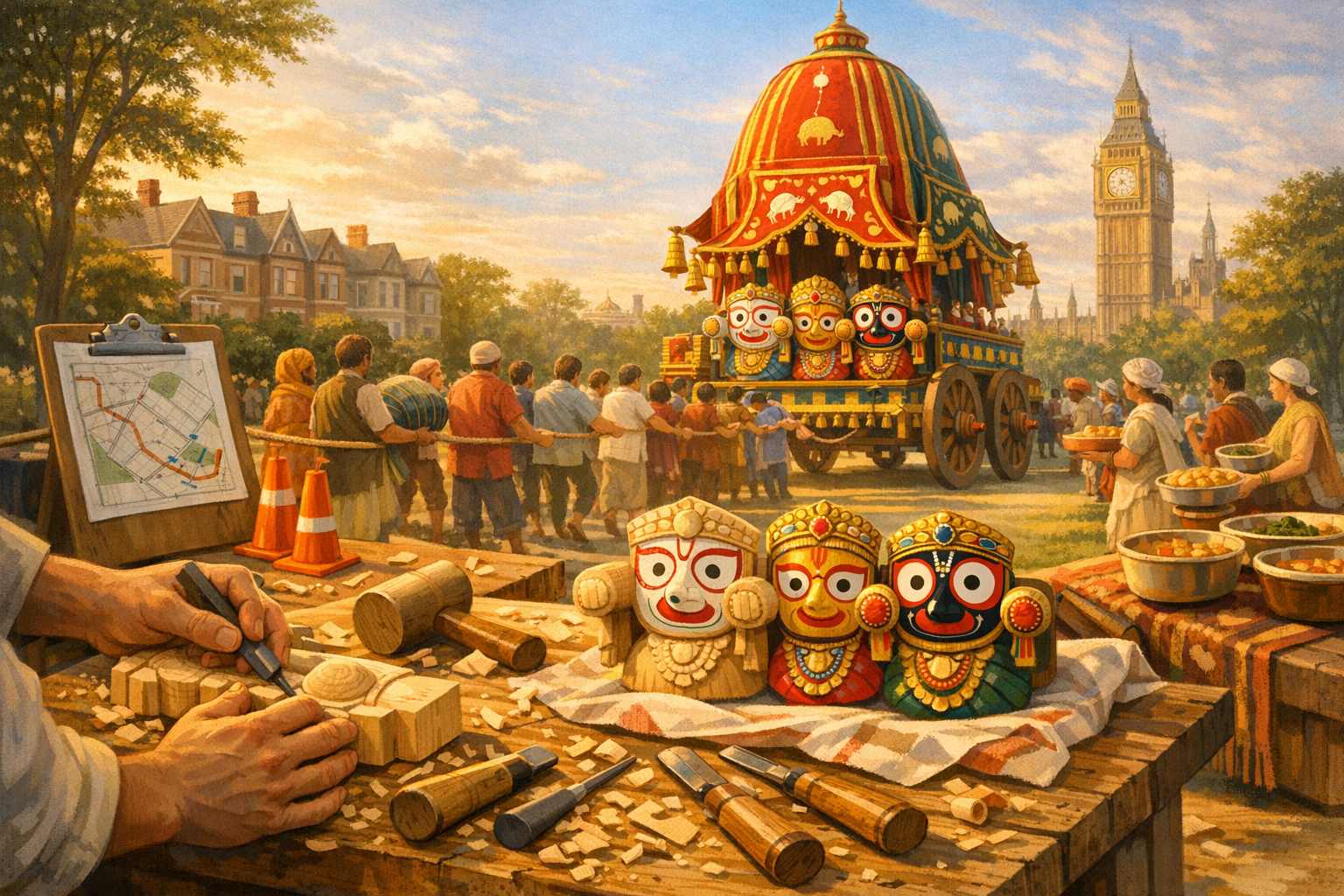
In January 1967 in San Francisco, he took initiation from Srila Prabhupada. Within months, he introduced Lord Jagganath to Western audiences by carving the first Deities and coordinating what became the first Rathayatra outside India. These acts were not experiments in spectacle; they were carefully reasoned applications of Gaudiya Vaishnava theology in new civic spaces and the genesis of what the Hare Krishna Movement would achieve internationally.
Understanding the significance of Jagannath–Baladeva–Subhadra helps explain the depth of that gesture. In the Jagannath tradition, the triad’s wooden forms are at once precise and welcoming: large eyes that behold all, simplified limbs that signify universal accessibility, and materials that insist on periodic renewal. Diaspora artisans followed that logic in miniature, selecting appropriate woods, honoring ritual protocols to the extent possible, and foregrounding community participation over ornament to preserve theological clarity.
San Francisco in the late 1960s offered both a challenge and an opening. Public permitting, route planning through park spaces, crowd safety, prasada distribution, and kirtan acoustics all had to be solved within municipal frameworks unfamiliar with Hindu processions. The resulting Rathayatra demonstrated that devotional processions could be both compliant with local regulations and faithful to scriptural intent a template later replicated in major cities around the world.
Shortly thereafter, London became the next proving ground. Working with a small team, Shyamasundar helped establish ISKCON’s presence in the United Kingdom, cultivated relationships in the broader cultural community, and supported recordings and public events that carried the Hare Krishna mantra onto mainstream airwaves. This London chapter did more than popularize a chant; it normalized public expressions of bhakti in a global city and laid the groundwork for enduring institutions linked to ISKCON (International Society for Krishna Consciousness).
The phrase Chase the Rhino later memorialized in his multi-volume recollections was not mere bravado. It represented a method: set a goal so demanding that it disciplines planning, invites collaboration, and yields value even in partial success. Read through the lens of project and event management, that method integrates stakeholder mapping (city officials, neighborhood groups, interfaith partners), risk assessment (weather, traffic, crowd flow), and message clarity (devotion without proselytization), ensuring that sacred intent and civic responsibility move in step.
Rathayatra’s expansion has proven especially generative for dharmic unity. The chariot festival’s open, processional form invites participation from Hindus of many sampradayas and from closely related traditions. Shared practices congregational chanting that resonates with Sikh kirtan, vegetarian prasada that honors Jain and Buddhist ahimsa, and the emphasis on seva and community care create a welcoming bridge while respecting distinct identities. The name Jagannath, Lord of the Universe, itself signals an ethic of inclusion at the heart of these gatherings.
Participants across continents consistently describe the same emotional arc: the timbre of mridanga and karatalas rising over city noise, the quiet dignity of the Deities on the ratha, and the spontaneous fellowship that forms around the sharing of prasada. Families in diaspora settings often report that these festivals help children link household practice to public life, strengthening identity without narrowing horizons and deepening a sense of belonging in plural urban contexts.
From a technical standpoint, four elements have proven decisive wherever Rathayatra has taken root: respectful iconography that follows Jagannath tradition; chariot engineering scaled to local rules and terrain; compliance-forward event logistics; and interfaith outreach that explains the festival’s ethos in accessible language. When paired with sustainability practices minimal single-use plastics, food-waste recovery, and public-transport incentives the festival models responsible citizenship alongside devotion.
Shyamasundar’s early work in San Francisco and London continues to inform these choices. The carving of Deities illustrated how diaspora communities can uphold core theological meanings through adaptive craftsmanship. The first Western Rathayatra showed how sacred movement through a city can be both aesthetically powerful and civically constructive. The London initiatives demonstrated how art, media, and scholarship can meet bhakti without dilution, magnifying both cultural literacy and spiritual access.
Equally important is memory. Narratives of those formative years serve today as a shared archive for Hindus, Buddhists, Jains, and Sikhs seeking modes of public presence that are confident yet compassionate. In that archive, the call to Chase the Rhino reads as an invitation to pursue the difficult good to attempt projects that dignify communities, promote interfaith understanding, and leave cities better than they were found.
The legacy is visible now in Rathayatras and kirtan gatherings across five continents, in research on diaspora ritual, and in friendships formed under the canopy of a moving ratha. Tracing that legacy back to Shyamasundar Das clarifies both a lineage of courage and a method of care: intense aspiration balanced by procedural rigor and a generous spirit. In that balance lies a living blueprint for unity in religious diversity and a durable contribution to the world’s cultural heritage.
Inspired by this post on Dandavats.