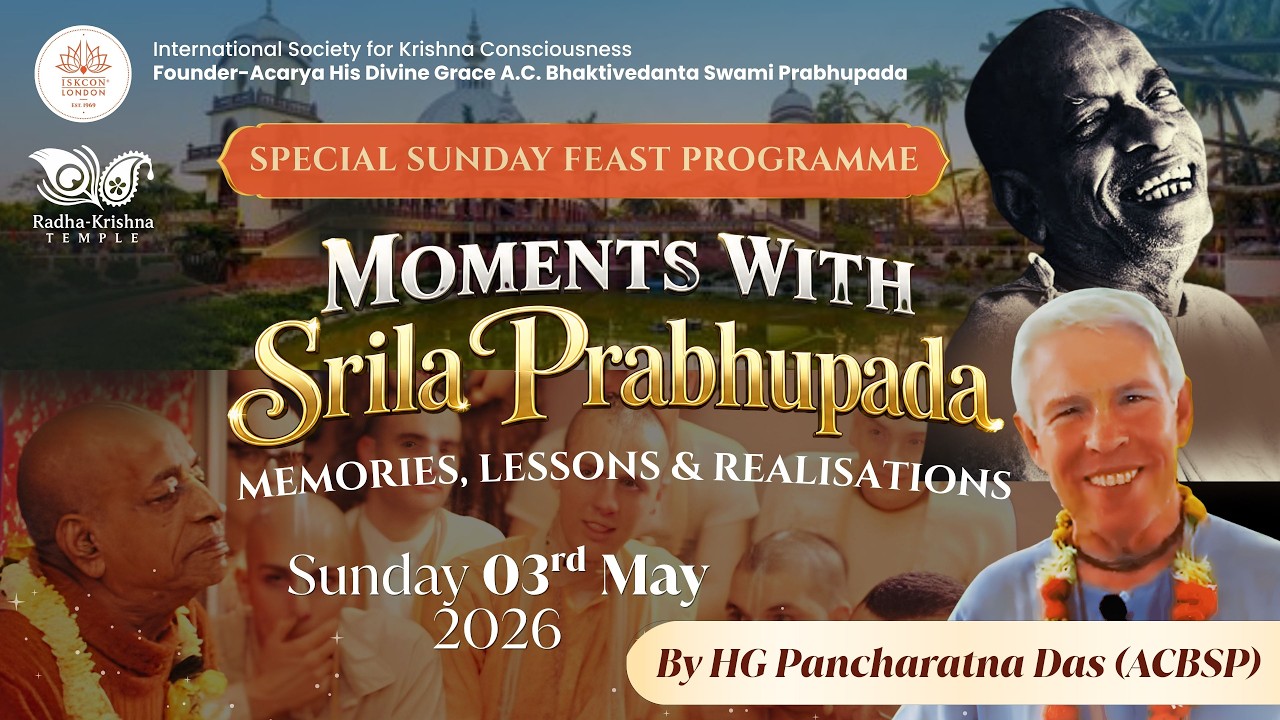
On 03 May 2026, the Sunday Feast talk titled “Moments with Srila Prabhupada” by HG Pancharatna Das offered a careful, experience-grounded exploration of how living memory animates the Bhakti Tradition within ISKCON (International Society for Krishna Consciousness). Through reflective anecdotes and disciplined analysis, the presentation illuminated how brief encounters—“moments”—with A.C. Bhaktivedanta Swami Srila Prabhupada function as powerful pedagogical touchstones, shaping devotional identity, deepening scriptural understanding, and sustaining institutional coherence across time and geography.
The talk positioned memory as a vital mode of transmission in Sanatana Dharma, where stories of acharyas serve not merely as biography but as living theology. Within Gaudiya Vaishnavism, recollection (smarana) of saints’ conduct and teachings is treated as a disciplined spiritual method that complements scripture (shastra) and association with saintly persons (sadhu-sanga). Framed in this way, “moments” become method: they consolidate doctrine into embodied practice and render philosophical principles accessible to diverse communities.
Srila Prabhupada’s global mission—rooted in Bhagavad-Gita and Srimad Bhagavatham—pioneered the modern sankirtana movement’s institutional form, cultivating a network of temples and communities that present bhakti-yoga as a coherent way of life. The talk underscored that Srila Prabhupada’s pedagogy combined rigorous fidelity to parampara (guru-shishya lineage) with pragmatic adaptability, enabling core teachings to be articulated clearly in contemporary contexts without diluting their philosophical integrity.
Central to this ecosystem is the ISKCON Sunday Feast, the weekly assembly that integrates kirtan, philosophical discourse, and prasadam. Historically conceived as a welcoming forum—often called a “Sunday Love Feast”—this gathering operates as a public pedagogy of devotion: it opens a participatory pathway to sravanam (hearing) and kirtanam (singing) while nurturing community bonds. HG Pancharatna Das emphasized that this format is both doctrinally faithful and socially inclusive, creating a repeatable, scalable model of spiritual outreach.
From a teaching-design perspective, the Sunday Feast embodies a triadic pedagogy—heart (kirtan), head (philosophical exposition), and hands (seva through prasadam and service). This multimodal engagement fosters comprehension, retention, and transformation. Participants do not merely receive information about Hindu spirituality; they inhabit a living tradition in which learning is co-created through song, dialogue, and sacred hospitality.
The presentation situated personal recollections of Srila Prabhupada within a broader hermeneutic: lila-katha (narratives of saintly lives) function as portals to both tattva (truth-claims) and bhava (devotional mood). When devotees recount Prabhupada’s decisions, instructions, and affective presence, they preserve doctrinal clarity and transmit the inner quality (rasa) of bhakti. Such memory work is not nostalgia; it is a disciplined practice that aligns with the nava-vidha-bhakti framework and concretizes scriptural ideals in lived situations.
Several themes recurred across the anecdotes curated in the talk: uncompromising commitment to shastra; clarity of instruction married to compassion; and a striking ability to discern what truly advances Krishna-bhakti at a given moment. These patterns, when taught through verified recollections, give future generations procedural wisdom—how to distribute books, organize kirtan, host the Sunday Feast, or resolve misunderstandings—without reducing bhakti to managerial checklists.
The leadership template emerging from these “moments” is distinctive: principle-centered yet context-sensitive. Srila Prabhupada modeled how adherence to parampara does not preclude innovation; rather, innovation is legitimate when it carries the weight of shastra and advances the purposes of guru and Krishna. This balance, the talk argued, is a signature feature of ISKCON’s resilience and growth in varied social and cultural terrains.
The guru-shishya relationship, an anchor of Hindu Dharma, was examined as both epistemic and relational. Knowledge flows through lineage not as mere data but as refined character—sattva cultivated through sadhana and service. “Moments with Srila Prabhupada” thus function as quality control for the transmission: they re-inscribe standards, manners, and moods appropriate to a Vaishnava instructor, ensuring that teaching remains faithful in tone as well as in content.
Kirtan was presented as a potent technology of the sacred—a collective practice that fuses theology, aesthetics, and community psychology. Contemporary research on group singing and rhythmic entrainment helps explain participants’ reported states of uplift, cohesion, and clarity. Yet the talk kept the emphasis devotional: nama-sankirtana is not primarily a technique but a revelation-centered practice that orients the mind and senses toward the Divine, translating philosophy into palpable experience.
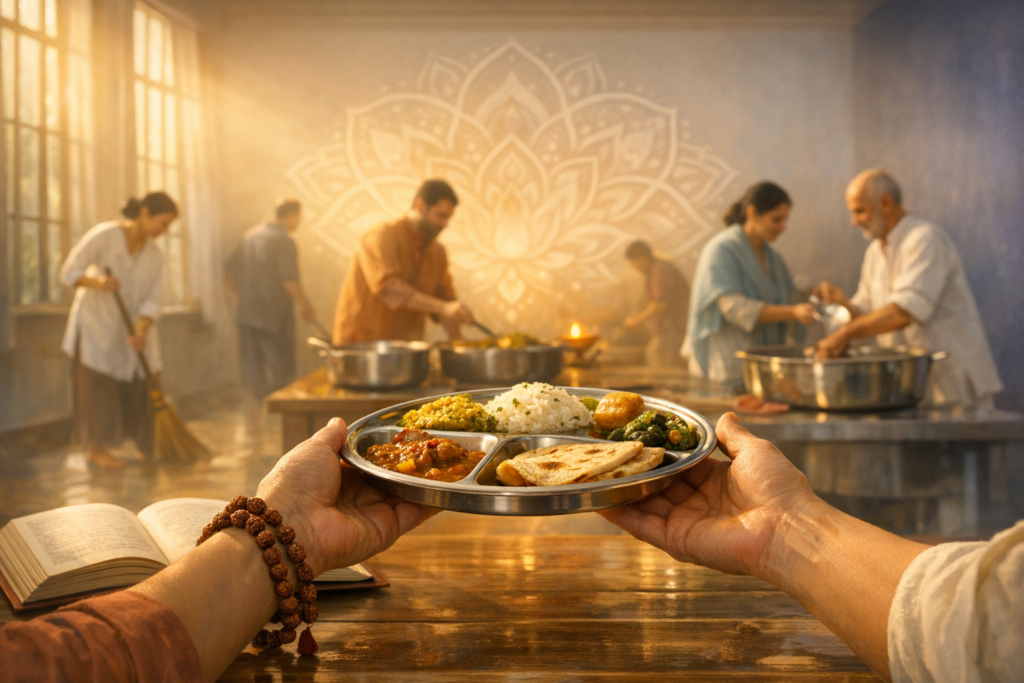
Prasadam distribution exemplifies sacred hospitality. Rooted in ahimsa and sanctification of food through offering, it democratizes access to sanctity and dissolves social barriers. The talk highlighted instructive parallels with Sikh langar and Jain commitments to non-violence in diet, demonstrating that ISKCON’s Sunday Feast is organically aligned with the broader dharmic family’s ethics of care, service, and equality.
In this spirit, the presentation explicitly advanced unity among dharmic traditions—Hinduism, Buddhism, Jainism, and Sikhism—without collapsing their distinctives. Shared commitments to compassion (karuna), non-harm (ahimsa), remembrance through chant or hymn (kirtan/nam-simran/buddha-vandana), and community service (seva/dana/langar) provide convergent pathways toward societal harmony. The Sunday Feast becomes a venue for interfaith friendship grounded in practice and mutual respect.
Theologically, the talk located ISKCON’s public outreach in scriptural mandates articulated in Bhagavad-Gita (devotional surrender and remembrance) and the Bhagavata tradition (sravanam-kirtanam as primary limbs of bhakti). By integrating shastra with lived exemplars, the pedagogy avoids two extremes: abstract philosophy divorced from conduct, and sentiment without doctrinal spine. The outcome is orthopraxy—right practice—anchored in orthodoxy—right understanding.
Institutionally, Srila Prabhupada’s approach—preserved through such recollections—foregrounds what might be termed a “culture of care”: clear instructions, time-tested routines of sadhana, and a compassionate space for gradual transformation. The Sunday Feast, when implemented with integrity, becomes a regular rhythm that sustains newcomers and experienced practitioners alike, bridging individual devotion and collective responsibility.
The talk also touched on communication and education strategies: simple language without simplism; consistent terminology rooted in shastra; and layered messaging that meets participants at different stages of curiosity and commitment. In diasporic contexts especially, this clarity safeguards identity while welcoming intercultural exchange, allowing ISKCON communities to serve as bridges between traditions, generations, and civic spaces.
Ethically, the Feast extends the principles of Hindu way of life—truthfulness, compassion, cleanliness, and self-discipline—into visible, repeatable action. Vegetarian prasadam reflects ahimsa; kirtan models shared joy without intoxication; discourse affirms inquiry without hostility. These practices create a psychologically safe container in which participants can explore profound questions and cultivate virtuous habits.
For community organizers, the presentation offered a practical framework: design for accessibility (clear signage and flow), intelligibility (concise talks anchored in Bhagavad-Gita and Srimad Bhagavatham), and relational warmth (welcoming teams and follow-up pathways for study and seva). Such attention to detail translates “moments” into systems—sustaining inspiration through predictable, high-quality weekly experiences.
Evaluation metrics were proposed in an academic spirit: retention (repeat attendance), engagement (participation in kirtan and Q&A), progression (enrollment in study circles or seva), and well-being markers (self-reported calm, purpose, and social connection). These indices, while secondary to devotion itself, help leaders steward resources wisely and uphold a high standard of care.
The talk further encouraged dialogical humility: listen across traditions for resonances and differences; articulate Vaishnava theology positively rather than polemically; and cultivate friendships that exemplify Vasudhaiva Kutumbakam—the world as one family. This aligns the Sunday Feast with broader social goals of harmony and mutual uplift across the dharmic spectrum.
As a repository of “moments,” the talk underscored several transferable practices drawn from Srila Prabhupada’s example: keep scripture central; pair clarity with kindness; prioritize chanting; honor prasadam as sacred hospitality; and build institutions that serve people, not the reverse. Each practice is simple enough to adopt immediately yet profound enough to sustain a lifetime of growth.
Ultimately, “Moments with Srila Prabhupada” affirmed that living memory is a shared inheritance and a disciplined responsibility. When curated responsibly, it guides communities away from myth-making and toward ethically grounded, shastra-informed devotion. In this way, the Sunday Feast is not an event to consume but a culture to cultivate—week after week, generation after generation.
By presenting vivid recollections through the steady lens of scripture and service, HG Pancharatna Das demonstrated how remembrance becomes roadmap. The result is a unifying vision in which devotion is experiential, education is relational, and unity among Hinduism, Buddhism, Jainism, and Sikhism is pursued through shared virtues rather than forced uniformity. Such unity, anchored in respect and practice, is both the heritage and the hope of the wider dharmic family.
Inspired by this post on Dandavats.