Across the vast narrative of the Ramayana, Atikaya stands as a figure of tragic valorimmensely gifted, formidable in battle, and yet overshadowed by the towering reputations of Ravana and Indrajit (Meghanada). His arc, compressed into a few crucial episodes in the Yuddha Kanda, raises enduring questions about lineage, recognition, and the ethical contours of dharma-yuddha. Reconstructing Atikaya’s story from Sanskrit and regional retellings illuminates how the epic preserves not only martial prowess but also the interior struggles of loyalty, belonging, and the search for approval within complex familial hierarchies.
Traditional accounts most commonly identify Atikaya as a son of Ravana. Some later recensions and regional narratives specify his mother as Dhanyamalini, who is in certain texts described as an attendant in the court of Mandodari. These strands underscore a symbolic tension: a warrior of supreme ability who may have stood outside the principal queenly lineage and who therefore becomes, in many readings, an emblem of the quest for validation within an exacting royal household. While textual attestations vary, this interpretive thread helps explain why Atikaya’s battlefield courage is often framed as a bid for paternal acknowledgment.
Even in the concise notices preserved in Yuddha Kanda, Atikaya’s education and endowments are emphasized. He is portrayed as an archer of rare mastery, conversant in the use and counteruse of astras (celestial weapons) and confident enough to challenge the foremost heroes of the vanara and human alliance. Later narrative traditionsespecially in vernacular retellingssometimes add that he received boons from Brahma and, in a few versions, protective armaments through tapas or divine favor. Though details differ across sources, the composite portrait is stable: Atikaya was not a peripheral combatant but an elite warrior who inspired apprehension even among seasoned fighters.
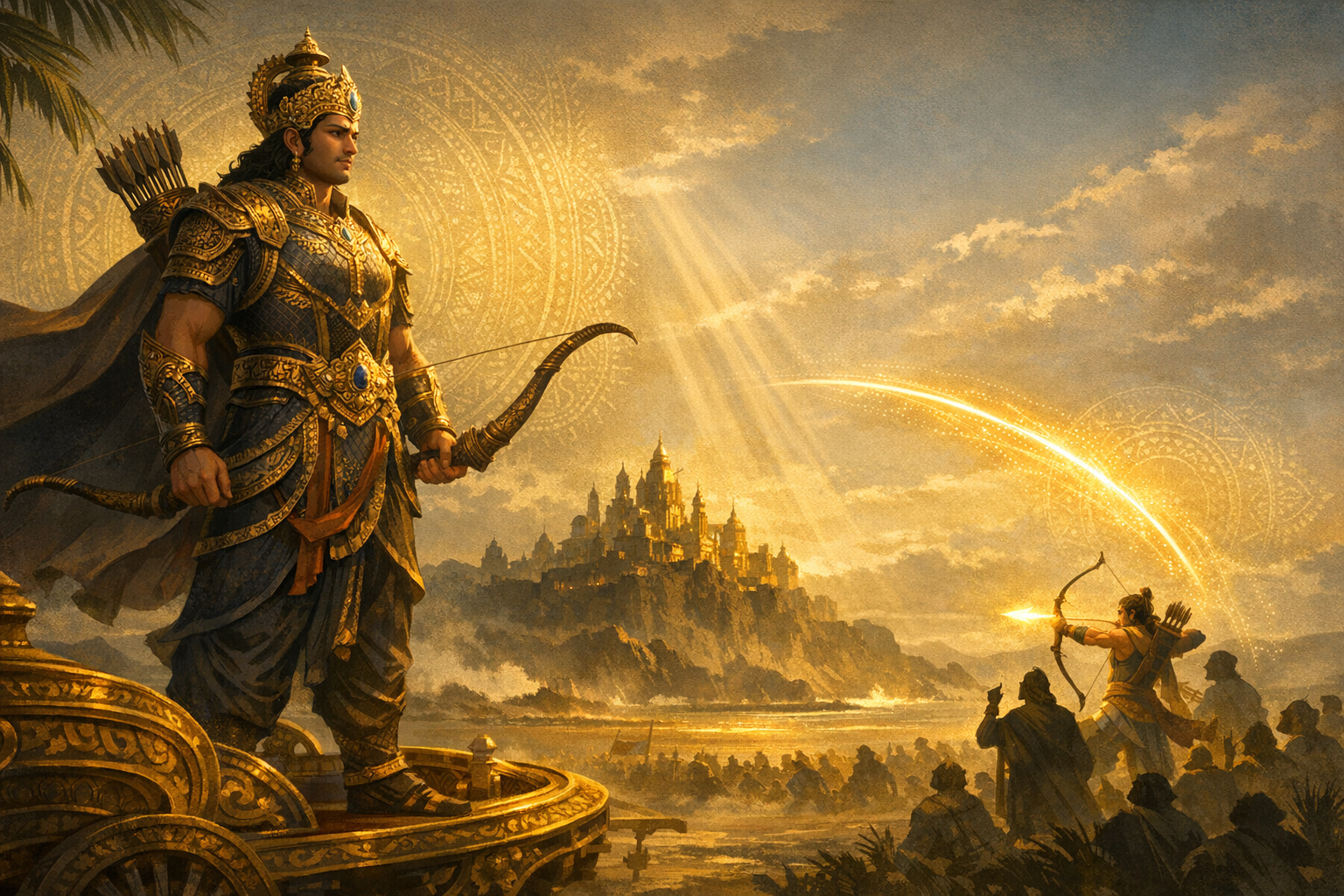
The Lanka war contextualizes his emergence. As the conflict intensifies in the Ramayana’s Yuddha Kanda, champions on both sides enter the field in waves. After the shattering entries of Kumbhakarna and Indrajit, Atikaya’s arrival reads as yet another elevation of stakes. His chariot gleams, his armor appears impenetrable, and his confidence is not bluster but the hard edge of an expert in astra-vidya. Several vanara commanders sustain losses confronting him, and the field grows tense as ordinary missiles prove ineffective against his defenses.
Valmiki’s narrative cadence is instructive: when ordinary valor meets supernormal protection, counsel replaces impulse. Vibhishanawhose steady guidance repeatedly unlocks the moral and tactical puzzles of the waradvises Lakshmana that Atikaya holds boons from Brahma and that conventional weapons will fail. The prescription is clear and precise: only a divinely empowered astra can meet this challenge. Lakshmana, trained and disciplined, invokes the Brahmastra with the proper mantras, acknowledging the weighty responsibility that attends such use in dharma-yuddha.
The duel between Atikaya and Lakshmana is both technical and thematic. Technically, it is a demonstration of astra-vidya: the reading, matching, and countering of missiles in a rapid sequence that tests concentration, mantra-shakti, and moral clarity. Thematically, it stages a confrontation between two disciplined embodiments of kshatra-dharma: one fighting to defend the cause of justice in a righteous war, the other channeling filial loyalty and royal duty toward a flawed sovereign. When the Brahmastra finally strikes, Atikaya falls not as a minor adversary, but as a great archer whose courage was never in doubt.
Atikaya’s end carries an unmistakable tone of tragedy. He is not mocked in defeat; the text accords him the respect reserved for warriors who die with their vows intact. The Ramayana’s ethical architecture does not erase the nobility of those who fight on the opposing side if they follow the codes of warfare. This calibrated presentationcondemning adharma while honoring kshatra excellenceexplains why Atikaya remains a figure of enduring interest to thoughtful readers across traditions.
Many modern interpreters view Atikaya through the lens of recognition. Readers who have navigated rigid hierarchies or pursued approval from exacting elders often find in his arc a poignant mirror. The battlefield becomes more than a site of victory or loss; it is reimagined as a stage on which love, worth, and belonging are tested. In this light, Atikaya’s martial audacity reads as a deeply human gesture: a bid to transform exceptional skill into enduring acceptance within a demanding court culture.
From the standpoint of epic studies, Atikaya exemplifies how the Ramayana combines political realism with spiritual ethics. The realism is apparent: lineage politics matter, patronage shapes esteem, and battlefield renown can recalibrate status. The spiritual ethic is equally central: valor without dharma becomes mere violence; dharma without compassion risks rigidity; and both together, rightly aligned, protect life and truth. Atikaya’s arc illuminates the consequences of aligning one’s devotion and skill to an unrighteous sovereign, no matter how reverent the filial intention.
In comparative dharmic perspective, Atikaya’s story resonates across Hindu, Buddhist, Jain, and Sikh sensibilities. Hindu readings emphasize kshatra-dharma moderated by viveka (discriminating wisdom), reminding that prowess must serve righteousness. Buddhist reflections might highlight the subtle forms of craving (taṇhā) for status or recognition that obscure clear seeing. Jain perspectivessteeped in ahiṃsā and aparigrahaoffer a moral counterpoint, treating war as a tragic theater of attachment and consequence. Sikh thought, while valorizing the saint-soldier ideal, insists that arms be borne in the defense of justice and the protection of the weak, not in the service of tyranny. Read together, these perspectives foster unity around a shared ethic: courage is most luminous when guided by compassion and truth.
The episode also clarifies the ethics of weapon use in the epic imagination. Astras are not casual instruments; their invocation presupposes discipline, mantra-siddhi, and moral restraint. Vibhishana’s counsel to Lakshmana, and Lakshmana’s careful recourse to Brahmastra, exemplify procedural righteousness in conflict. This focus on processmeans as well as endsbridges dharmic traditions, many of which elevate right intention, right knowledge, and right conduct over expediency.
Atikaya’s relative obscurity in popular discourse is itself revealing. Epics often compress or expand episodes across languages and centuries, and cultural memory gravitates to certain set pieces. Yet the Ramayana’s narrative economy wastes nothing. Where text is spare, the silence is interpretive space, inviting communities to remember warriors like Atikaya whose lives underline the epic’s layered ethics: to honor skill, acknowledge loyalty, and yet discern the moral arc of the war.
A philological caution is warranted. Not all details about Atikaya are constant across texts. Core elementsthe duel with Lakshmana, the need for a Brahmastra, Vibhishana’s guidanceare widely attested. Other embellishmentsprecise maternal lineage, the provenance of armor, or particular divine giftsvary by recension and region. A responsible reading therefore distinguishes the widely transmitted kernel from later narrative flourishes, while respecting the creative integrity of regional Ramayana traditions.
Symbolically, the name invites reflection. Kaya suggests the body; ati signals excess. Read allegorically, Atikaya can stand for the overconfidence of embodied mightstrength, training, and lineageuncoupled from the inner clarity that dharma requires. In this register, Lakshmana’s Brahmastra does not merely pierce armor; it reasserts the primacy of rightful measure over excess, of interior order over unmoored power.
The familial dimension deepens the tragedy. Ravana’s court rightly prizes Indrajit’s terrifying prowess, yet such adulation can distort the incentives of other sons. Atikaya’s charge into peril is not merely strategic; it is affective. The Ramayana often shows how familial love, when cut loose from dharma, can become a snarebinding even the noble-hearted to destructive courses. Atikaya’s loyalty is admirable; its object is not.
For contemporary readers, three reflections stand out. First, merit should be recognized irrespective of birth or the subtleties of courtly rankan ethical throughline shared across dharmic traditions. Second, skill and devotion, however remarkable, must be joined to discernment about ends and means; courage without conscience courts ruin. Third, remembrance itself is moral work: recalling figures like Atikaya helps cultivate a culture that honors valor while committing to justice.
In discussions of war ethics, Atikaya’s episode clarifies proportionality and necessityprinciples that map well onto the dharmic insistence on calibrated force. Lakshmana’s resort to Brahmastra is not impulsive; it follows the exhaustion of lesser means and is anchored in counsel. That sequencecounsel, discrimination, proportionoffers a template for reading conflict responsibly in both epic literature and public life.
Interfaith and intrafaith dialogue can fruitfully center such episodes. Rather than valorizing violence, communities can explore how duty is discerned, how loyalty is purified of ego, and how love is disentangled from blindness. In doing so, the Ramayana becomes common ethical groundnot a site of sectarian competition but a shared treasury of reflection for Hindus, Buddhists, Jains, and Sikhs seeking unity around dharma, compassion, and truth.
Ultimately, Atikaya’s life is an invitation to nuanced remembrance. He is neither villain nor mere obstacle; he is a formidable warrior whose fall confirms the Ramayana’s moral gravity. By restoring focus to his courage and his human longings, readers recover a more complete sense of the epic’s design: it honors greatness on all sides while affirming that power finds its measure only in service of righteousness.
Remembering Atikaya, then, is not nostalgia. It is ethical educationan encouragement to refine admiration, to interrogate loyalty, and to steady valor with wisdom. In that steadiness lies the unity of the dharmic traditions: a shared resolve to place skill in the custody of conscience, and to measure victory by the justice it preserves.
Inspired by this post on Hindu Blog.