
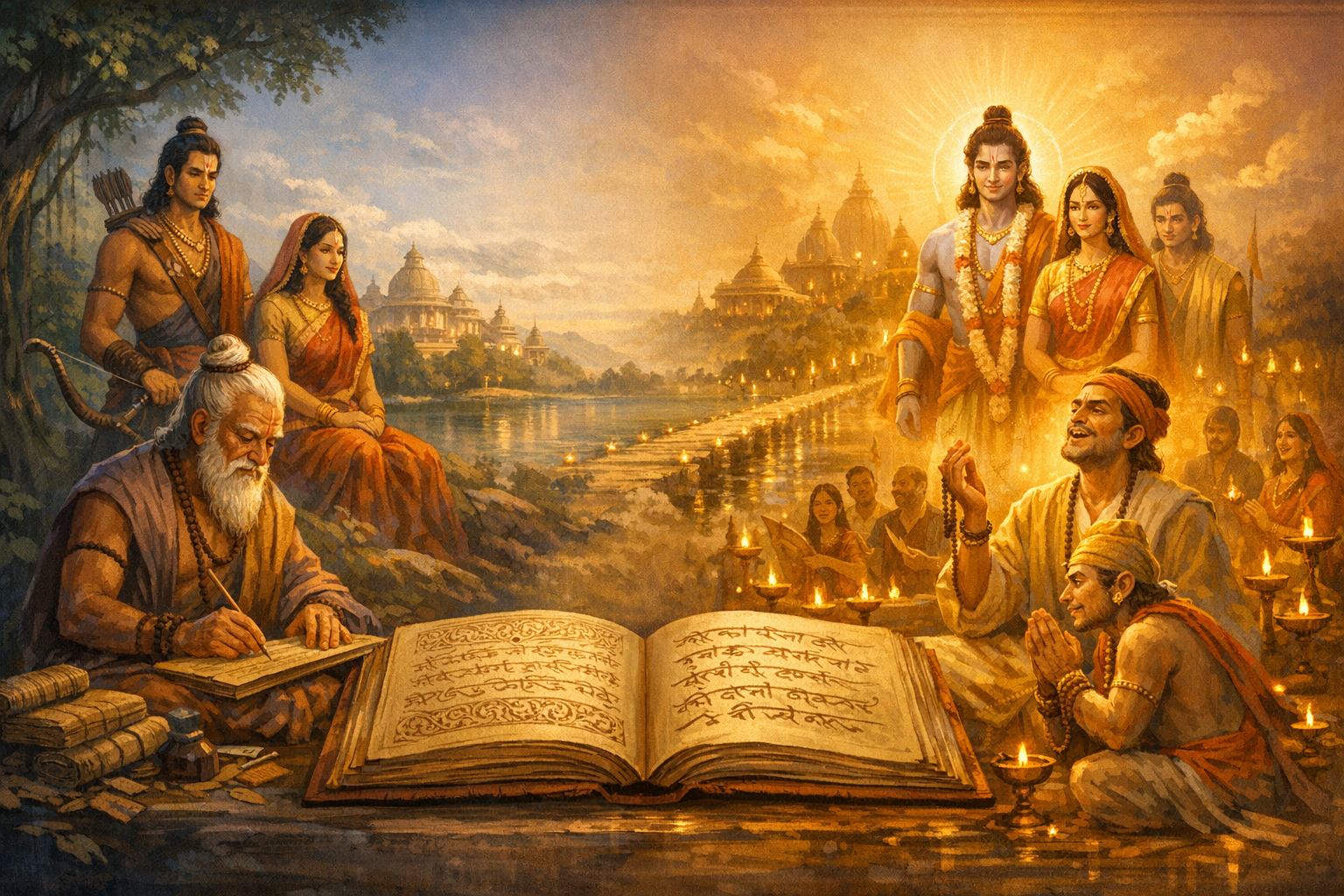
The figure of Rama stands at the confluence of history, literature, and devotion, appearing in two equally authoritative yet distinct horizons: Valmiki’s Sanskrit Ramayana and Tulsidas’ Awadhi Ramcharitmanas. Separated by nearly two millennia, these texts illuminate two complementary visions of the same revered presenceRama as Maryada Purushottama, the consummate human exemplar of dharma, and Rama as the Supreme Divine accessed through love, remembrance, and grace within the Bhakti Tradition. A careful, text-grounded comparison reveals how social context, language, theology, and performance traditions shaped each work while preserving a shared core of ethical clarity and spiritual aspiration.
Valmiki’s Ramayana, often dated between the mid–first millennium BCE and the early centuries CE, belongs to the genre of itihasa, a narrative that preserves memory while teaching norms. Composed in classical Sanskrit predominantly in the anuṣṭubh meter, it integrates courtly poetics with a clear narrative arc across seven kandas. Its tone is moral-philosophical and consistently human-centered, even when celestial beings appear; Rama is recognized as extraordinary, sometimes as an avatara of Vishnu, yet his path is lived as a human prince whose agency, emotions, and decisions exemplify dharma under constraint.
Tulsidas’ Ramcharitmanas, composed in 16th-century North India, speaks in Awadhi and in the cadences of doha, chaupai, and other vernacular meters. It arose in a period of dynamic devotional renewal, making the sacred narrative intimate, singable, and accessible beyond the learned circles of Sanskrit. Structurally indebted to the seven-kanda template, Ramcharitmanas reframes the epic through a devotional lens, blending narrative with theology and contemplative instruction. Its performance-friendly idiom nourished katha traditions, Ramlila theatre, and household recitation, ensuring a living, communal relationship with Rama.
Theologically, the two works draw a shared circle around dharma but inscribe different emphases inside it. Valmiki’s idiom foregrounds maryadaright orderin a world where the king, kinship, and counsel must align with duty and restraint. In contrast, Tulsidas builds an interior pathway where devotion (bhakti), remembrance (smarana), and the power of the Divine Name (Rama-nama) become the principal means of liberation, even as ethical conduct and righteous rule remain essential. The result is not contradiction but a meaningful complementarity: the outer form of righteous life and the inner flame of loving awareness.
In Valmiki’s canvas, Rama is the Maryada Purushottama par excellence. He feels grief, wrestles with uncertainty, seeks counsel, and acts decisively within the limits of human agency. His heroism is ethical before it is supernatural; every major action is a lesson in proportion, prudence, and principle. The plot’s force comes from seeing dharma tested through exile, loss, and war, showing how right order can be preserved in time’s most difficult passages.
In Tulsidas’ vision, Rama is unequivocally the Supreme Divine whose liladivine playappears in human costume to redeem beings and establish compassion-infused order. Omniscience, grace, and the salvific potency of devotion are consistently foregrounded. This theological framing does not diminish worldly responsibility; rather, it transfigures it, suggesting that social duty, personal virtue, and governance flourish most when rooted in loving remembrance of the Divine.
Language constitutes more than medium; it is message. Sanskrit in Valmiki’s Ramayana encodes courtly universality and philosophical precision, privileging statecraft, counsel, and ethical analysis. Awadhi in Ramcharitmanas supplies intimacy, musicality, and direct affect, inviting congregational singing, domestic recitation, and shared emotional participation. The shift from scholastic to vernacular idiom parallels a shift from primarily instructive narrative to participatory devotion.
Valmiki’s Sita is rendered with psychological depth and ethical clarity. Her unwavering commitment, articulated in scenes such as the forest dialogue before exile, reads as a profound statement on autonomy, partnership, and fidelity to dharma. Tulsidas, drawing on the wider puranic and Adhyatma Ramayana stream, often interprets Sita through a theological keyinvoking the maya-Sita motif to safeguard her inviolable purity and to underscore Rama’s divinity. In devotional reception, this move aims to honor both Sita’s transcendental sanctity and the narrative’s didactic purposes.
Hanuman in Valmiki is the ideal envoy-warrior whose intelligence, humility, and strength carry the plot from Kishkindha to Lanka; devotion is present, but service and discernment dominate. In Tulsidas, Hanuman becomes the paradigmatic bhakta, his unswerving love the standard of spiritual attainment. This devotional emphasis radiates into cultural life through independent compositions such as the Hanuman Chalisa and through the centrality of Sundar Kanda recitation as a practice of courage and hope.
Lakshmana’s portrait also refracts each text’s priorities. Valmiki gives him a clear moral-intellectual profilefierce loyalty allied with sharp judgment, sometimes prone to vehemence, yet teachable within the familial dharma. Tulsidas models Lakshmana as seva personified, the soul’s tireless attendance on the Divine, softening edges to foreground loving service as spiritual method.
Narrative texture shows similar recalibrations. Valmiki’s account of Surpanakha, the golden deer, the appeal to the ocean, and the bridge to Lanka unfolds with the logic of statecraft, vow, and retribution tempered by mercy. Ramcharitmanas retains the narrative skeleton but elevates devotional significances; for instance, later North Indian tellings inspired by Tulsidas popularize the motif that the power of Rama-nama renders even stones buoyant, a poetic enshrinement of the Name’s grace for household devotion.
On ethics of conflict, Valmiki frames war as dharma-yuddha, governed by norms that bind even enemies to a shared code. Tulsidas preserves that ethic while deepening the affective palette: compassion for the errant, admiration for valor in foes, and an insistence that victory without humility misses the spirit of dharma. As a result, both texts instruct the polity while humanizing the battlefield.
The Uttara Kanda has long invited careful reading. In Valmiki, the post-war arc explores the costs of kingship, public opinion, and the tragic separation of Rama and Sita. Tulsidas condenses and theologically reframes select episodespresenting some events, such as Sita’s ordeal and banishment, as lila intended to teach detachment, uphold public trust in kingship, and prepare the stage for Sita’s ultimate return to transcendence. Where the Shambuka episode appears in brief devotional transmission, it is typically situated as a didactic assertion of social order, yet premodern and modern readers alike offer multiple hermeneuticsallegorical, symbolic, and historicalseeking reconciliation with the broader dharmic ethos of compassion and justice.
Kingship in both texts culminates in the ideal of Rama-rajya. In Valmiki, it is the fruit of law, counsel, and just distributiona polity of security and prosperity. In Tulsidas, the same vision glows with the light of bhakti: governance is ethical when the ruler and the ruled align their conduct with remembrance of the Divine, making compassion and fairness the instinct of the state. For contemporary readers, this synthesis of institutional order and interior virtue offers a compelling template for public ethics.
Intertextual currents further clarify Tulsidas’ orientation. The Ramcharitmanas resonates with puranic devotionalism and is deeply conversant with the Adhyatma Ramayana’s advaita-inflected bhakti, which advances the maya-Sita interpretation and contrasts nirguna and saguna worship. Tulsidas crafts a harmonizing synthesis in which the Personal Divine is the most approachable gateway to the Absolute, while the Divine Name becomes the simplest, subtlest, and most powerful means of spiritual transformation.
Textual history also differentiates the two. Valmiki’s Ramayana exists in multiple recensionsbroadly Northern and Southernwhose variants inform critical editions and regional performances. Ramcharitmanas, while stable in core structure, flourished in oral performance and commentary, producing a shared North Indian devotional vernacular. Both canons are best seen as living rivers whose tributaries include commentary, performative arts, and regional retellings.
The social lives of these texts are as formative as their contents. Valmiki’s work shapes classical education, Sanskrit poetics, and the ideals of statecraft across the subcontinent. Tulsidas’ epic animates village kathas, Ramlila pageantry, and household recitation cycles, where Sundar Kanda is invoked for courage and Ayodhya Kanda for ethical guidance. Together they demonstrate how scriptural authority deepens when it is simultaneously studied and sung, reasoned and remembered.
Across dharmic traditions, the Ramayana’s moral-spiritual grammar radiates widely. Jain tellings such as Vimalasuri’s Paumachariyam recast events through ahimsa-centered ethics, while the Buddhist Dasaratha Jataka reimagines the family drama to teach renunciation and compassion. Sikh teachings honor the sanctity of the Divine Name, a principle consonant with Tulsidas’ emphasis on Rama-nama, and many Hindu paths receive Sita, Rama, and Hanuman as models of steadfastness, love, and service. This pluriform reception underscores a shared civilizational goal: to cultivate virtue, wisdom, and compassion in personal and public life.
Reading both texts together thus yields a durable hermeneutic. Valmiki anchors ethical clarity, historical memory, and the discipline of action. Tulsidas infuses the same arc with accessible devotion, interiorization, and the salvific power of grace. The human ideal and the Supreme Divine meet in practice: one learns how to act rightly in the world and how to root action in loving awareness.
For contemporary seekers, students, and citizens, the comparison offers practical guidance. Valmiki’s Rama motivates integrity under pressurehow to decide, whom to trust, when to show mercyand reminds that dharma is measurable in the welfare of the most vulnerable. Tulsidas’ Rama teaches the sustaining arts of remembrance, surrender, and joy, revealing that moral heroism becomes durable when nourished by devotion. Together, they suggest that just institutions and just hearts grow together.
In sum, Valmiki’s Ramayana and Tulsidas’ Ramcharitmanas should not be read as rivals but as resonant modes of the same sacred song. One articulates the grammar of righteous life in time; the other releases the melody of divine grace that makes that grammar livable. Holding both, the dharmic world hears a complete chord: Rama as the measure of humanity and Rama as the measureless Divineguiding the journey from ethical clarity to spiritual freedom.
Inspired by this post on Hindu Blog.
