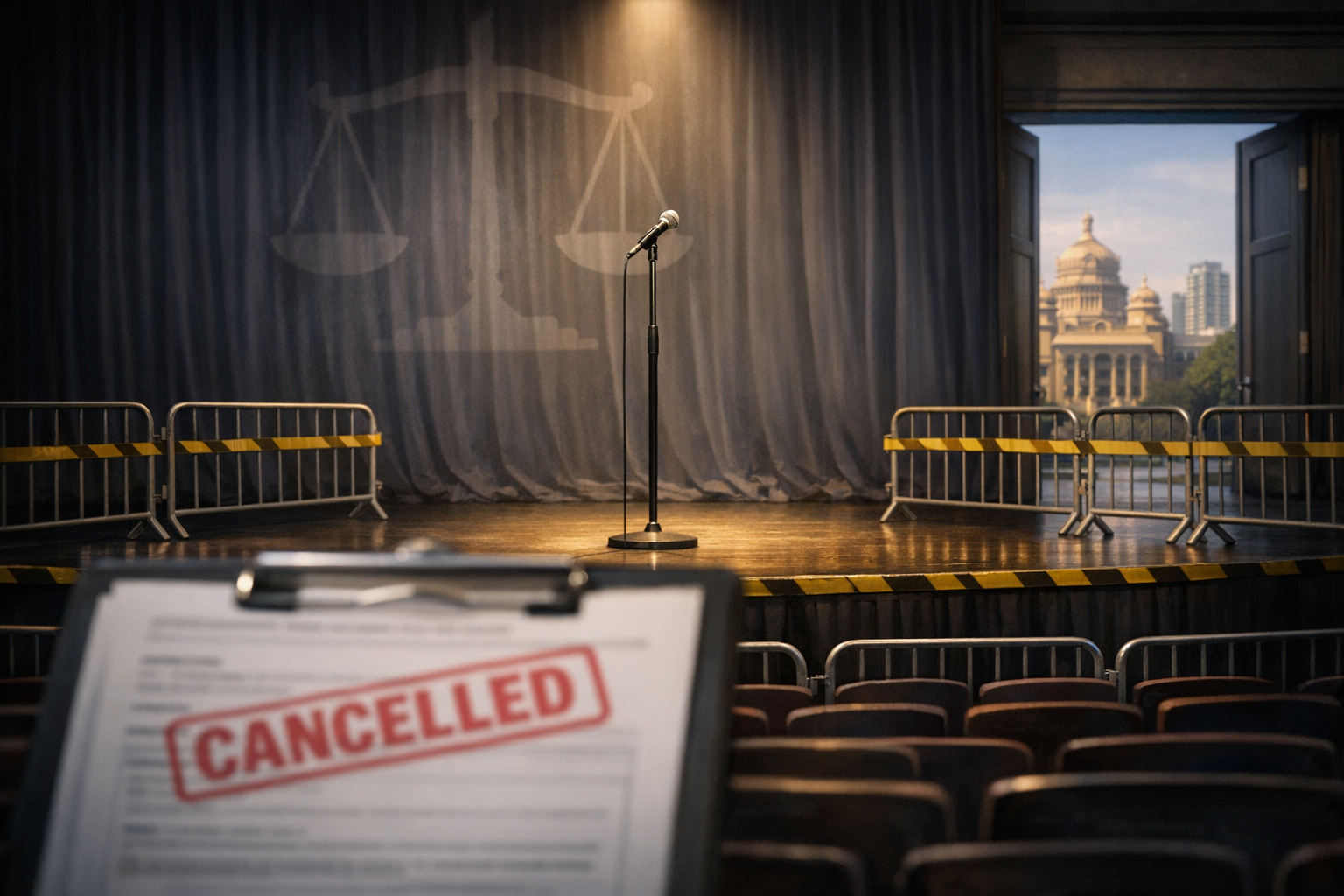
Bengaluru’s scheduled stand-up comedy performance by Munawar Faruqui on 18 April 2026 was cancelled following objections raised by Hindu Janajagruti Samiti (HJS) and Sri Ram Sena, accompanied by the submission of a formal complaint to the Bengaluru Police. This development has become a focal point in the ongoing national conversation about how India balances freedom of expression, public order, and community sentiment in plural civic spaces.
At a societal level, the episode illustrates a familiar tension: artistic expression seeks room to thrive, while segments of the community assert concerns over potential offence and the risk of public disturbance. The institutional challenge for city authorities, venues, and police lies in harmonising these interests through transparent, legally robust procedures that protect both civic peace and constitutional freedoms.
Based on information available, the documented facts are straightforward: the show was planned for 18 April 2026 in Bengaluru; HJS and Sri Ram Sena publicly objected; a formal complaint was lodged with the Bengaluru Police; the event was subsequently cancelled. No additional details have been provided regarding the specific grounds cited in the complaint, the exact venue permissions in question, or whether the cancellation arose from an organizer decision, venue determination, or a police order. Any further inferences would be speculative.
The constitutional and legal backdrop is pivotal. Article 19(1)(a) of the Indian Constitution guarantees freedom of speech and expression, while Article 19(2) permits reasonable restrictions on enumerated grounds such as public order, decency, and morality. Administrative frameworks governing live performances typically involve venue no-objection certificates, municipal compliances, and police permissions or intimations addressing crowd management, emergency response, and public safety. The state’s responsibility to maintain law and order is not optional; it is a core duty. Equally, any restriction must be narrowly tailored, reasoned, and consistent with constitutional standards.
In practice, public performances in Bengaluru and other Indian metros generally proceed through multi-agency coordination: organizers arrange venue contracts and safety measures; venues ensure fire and structural clearances; police assess anticipated footfall, route plans, and deployment needs. Where objections arise, authorities may seek clarifications, recommend additional safeguards, orwhere a credible, imminent threat is assessedadvise against proceeding. While this provides necessary context, it should not be read as determinative of the specific administrative pathway in the present instance, which has not been officially detailed.
Event cancellations tend to occur via one of three pathways: a voluntary organizer withdrawal in light of risk or cost; a venue’s decision to rescind availability; or a police order (or advisory) grounded in public order concerns. The present episode is reported as a cancellation following community objections and a formal complaint. The legality and proportionality of any such action, where applicable, ordinarily rest on whether authorities can show clear linkage to the constitutionally permissible grounds for restriction and whether less restrictive alternatives were considered.
Stakeholder perspectives help clarify the broader stakes. For audiences and ticket-holders, cancellations generate disappointment and erode trust in the reliability of civic events. For organizers and artists, they create financial loss, reputational uncertainty, and potential self-censorship pressures. For law enforcement, the task is to prevent escalation and protect life and property. For community organizations, voicing objections is a legitimate democratic practice, provided it is exercised through peaceful, lawful means that respect the rights of others.
The civic and economic impacts extend further. Local vendors, transport providers, and small enterprises around planned venues often prepare inventory and staffing around performance schedules. Abrupt cancellations can result in unsold stock and lost day-wages. Over time, recurrent disruptions risk lowering a city’s attractiveness as a live-events destination and can chill cultural expression that ordinarily flourishes in a high-trust environmentan asset for Bengaluru’s identity as both a technology and culture hub.
Jurisprudentially, Indian constitutional thought has cautioned against a “heckler’s veto,” wherein the possibility of hostile reaction by some becomes the basis to curb otherwise lawful speech. The normative benchmark encourages the state, wherever feasible, to provide targeted security and crowd-management measures rather than impose blanket prohibitions. Restrictions, when absolutely necessary, should demonstrate a proximate, specific, and credible risk to public order falling within Article 19(2), and should be accompanied by reasoned, time-bound orders open to scrutiny.
Pattern recognition also matters. Across Indian cities, episodes of event cancellations, withdrawals, or venue refusals have periodically surfaced when particular performances or speakers attract organized opposition. While each case turns on its facts, the aggregate effect can be a drift toward risk-aversion that narrows permissible public discourse. Conversely, a process-driven, transparent approachone that favours counterspeech, clear content advisories, and on-site safeguardshelps preserve both order and openness.
A dharmic unity lens offers further guidance. Traditions across Hinduism, Buddhism, Jainism, and Sikhism emphasise ahimsa, respectful debate, and the pursuit of truth without coercion. India’s civilisational ethos celebrates many paths and voices. In contemporary civic life, that ethos translates into firm rejection of intimidation, a preference for non-violent dissent, and an insistence on legal, proportionate responses that protect both community sentiments and fundamental freedoms.
A constructive, multi-stakeholder roadmap can reduce future flashpoints. Early, good-faith engagement between organizers, venues, community representatives, and police can surface concerns before they harden into confrontation. Clear codes of conduct for performers and audiences, along with grievance channels for objecting groups, create avenues for redress short of disruption. When paired with transparent ticketing policies and contingency communication plans, these measures enable swift, orderly responses to emerging risks.
For organizers, practical safeguards include robust risk assessments; content and age advisories; structured Q&A or post-event dialogue formats when appropriate; trained crowd marshals; and rapid escalation protocols that integrate with police liaison teams. Documenting all permissions, safety plans, and compliance steps builds an administrative record that can be decisive if decisions are later challenged.
For law enforcement, precision and transparency are key. Liaison officers dedicated to community dialogue can de-escalate tensions early. If a restriction becomes unavoidable, reasoned orders that specify factual grounds, applicable legal provisions, and the time-bounded nature of the measure uphold the rule of law and invite constructive accountability. Wherever conditions allow, targeted protection should be preferred over pre-emptive bans.
For community and religious organizations, peaceful protest, petitions, and formal complaints remain legitimate democratic tools. Prioritising dialogue, participating in mediated conversations, and supporting counterspeech over coercion protect the broader social contract. In a diverse polity, the right to object and the right to perform both find space under a framework of mutual restraint.
For citizens and audiences, media literacy and verification habits help. Relying on official communications for status updates, avoiding rumor amplification, and channelling disappointment into lawful feedback loops strengthen civic norms. Many residents will recognise, from everyday experience, the shared costs of disruptionmissed plans, lost incomes for daily-wage workers, and a dent in the city’s reputation.
For city governance, the strategic objective is durable cultural vibrancy. Predictable, fair, and timely permissions; responsive policing; and visible support for both safety and speech invite organizers to continue investing in Bengaluru as a premier performance destination. A well-signalled city policy that rejects intimidation while addressing legitimate safety concerns builds trust across all constituencies.
In sum, the cancellation of Munawar Faruqui’s Bengaluru showfollowing objections by HJS and Sri Ram Sena and a formal complaint to the Bengaluru Policehighlights the fine balance India must continually achieve: safeguarding public order without normalising a veto on expression. The path forward lies in transparent law-and-order decision-making, early community dialogue, and a renewed commitment to the dharmic principles of non-violence and respectful disagreement. That is how a plural society protects both harmony and voice.
Inspired by this post on Hindu Jagruti Samiti.