Within Vedic literature and the Sanskrit epics, maternal figures shape the transmission of dharma, ethics, and social resilience. Foremost among them, Sita devidevout wife of Lord Rama in the Ramayana and mother of Lava and Kushaoffers a precise case study in spiritually empowered motherhood.
Although born and raised in royalty, Sita voluntarily embraced the austerities of vanvas, accompanying Rama into the forest during exile. This choice, framed within the Ramayana’s ethical universe, signals not passive acquiescence but conscious alignment with dharma and shared duty.
Read as an ethics-of-care, Sita’s conduct integrates courage (śaurya), truthfulness (satya), and steadfastness (dhrti). Her forest years illustrate how domestic roles in Vedic culture became sites of tapas (austerity) and moral leadership, modeling resilience without rancor.
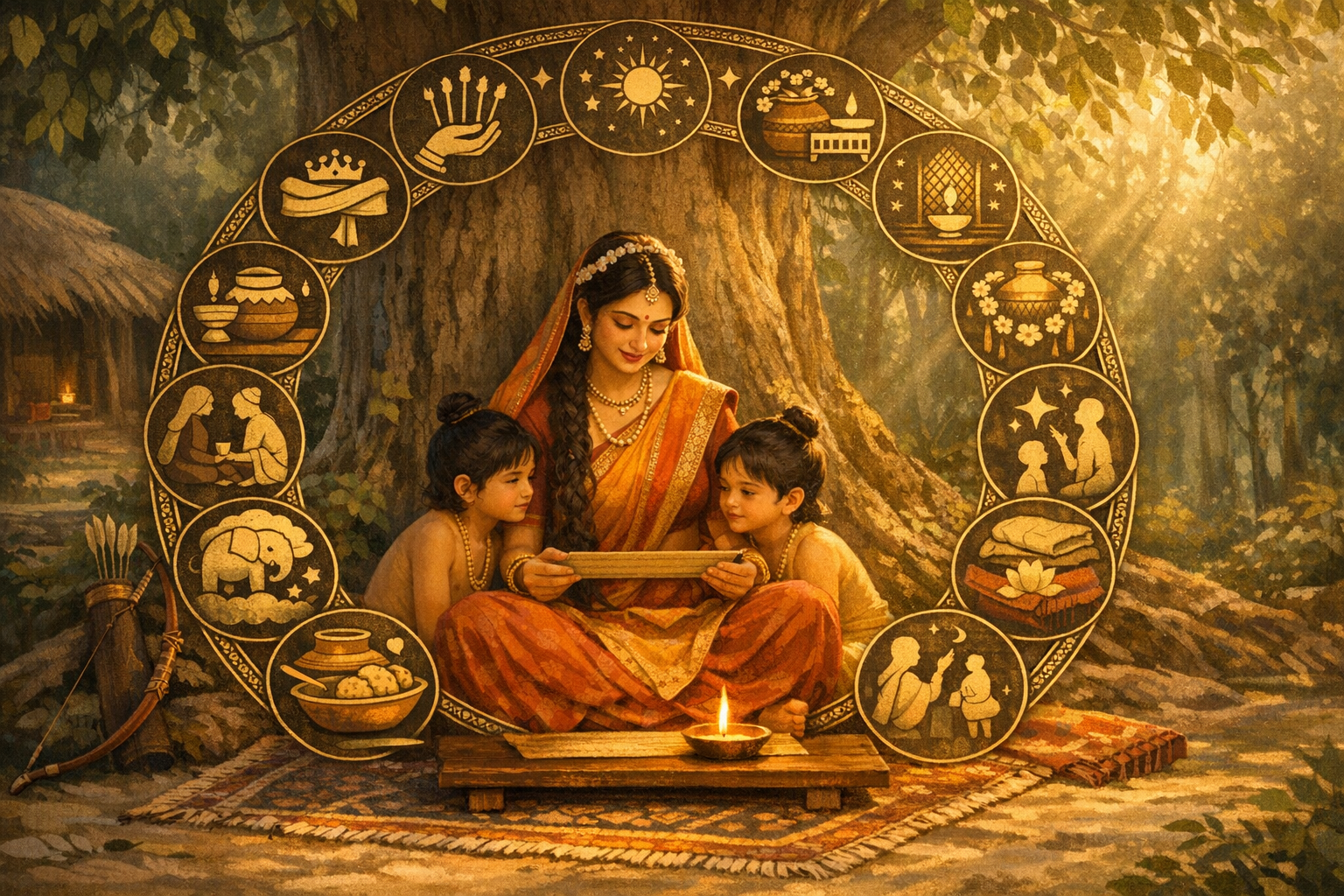
As mother, Sita’s formative influence is inseparable from the pedagogy of Lava and Kusha. In Valmiki’s āśrama, the twins learn verse, archery, and ethical discernment; they eventually recite the Ramayana before Rama’s court, demonstrating how maternal nurture and scriptural learning sustain cultural memory.
Methodologically, Sita’s narrative underscores a recurring Vedic pattern: women as guardians of lineage (vamśa), custodians of ritual purity, and transmitters of values across generations. The Ramayana thereby links familial love with public virtue, showing how motherhood advances social coherence.
Comparable depth appears in the Mahabharata through Kunti, whose life traverses political instability and moral ambiguity. Kunti’s counsel to the Pāṇḍavas, her poise in adversity, and the famous Kunti-Gita in the Bhagavata Purana together portray reflective leadership grounded in devotion and prudence.
Gandhari’s trajectory complements this profile in a different key. Her self-imposed blindfold symbolizes solidarity and ethical protest, while her remonstrations to Duryodhana reveal a mother’s attempt to avert adharma. The Mahabharata uses this tension to probe responsibility, restraint, and consequence.
The Bhagavata Purana refines motherhood into an explicit theology of love. Devaki embodies faith amid danger, while Yashoda represents vātsalya-bhaktiintimate, unconditional devotion to the Divine as child. Together they map maternal devotion onto the grammar of bhakti, bridging household life and transcendence.
Other Puranic and Itihasa mothers exemplify catalytic guidance. Suniti directs the young Dhruva toward single-minded sādhana, transforming injury into spiritual ascent; Devahuti, instructed by Kapila, shows how the guru-śishya relationship can be tenderly domestic, with a mother as ardent seeker.
From the earlier Vedic stratum, Aditithe ‘unbounded’embodies cosmic maternity and the preservation of ṛta (cosmic order). As mother of the Ādityas and associated with the Vāmana narrative, Aditi extends the idea of motherhood beyond household boundaries into metaphysical guardianship.
Anasūyā and Arundhatī further illustrate household asceticism fused with ethical clarity. Anasūyā’s famed chastity and nurturing of sages, and Arundhatī’s presence as a guiding star in ritual and folklore, align maternal dignity with the stability of social and celestial order.
Taken together, these figures specify a framework for ‘nurturing leadership’ deeply consonant with Hindu Dharma: courage restrained by compassion, authority tempered by humility, and learning enlivened by service (seva). The pattern is less prescriptive than exemplary, inviting contextual application (svadharma) rather than uniform rule.
This ethos resonates across Dharmic traditions. In Buddhism, Mahāpajāpatī Gotamī’s leadership of the bhikkhunī saṅgha centers compassionate discipline; in Jainism, Queen Triśalā’s auspicious dreams ground Mahāvīra’s narrative in maternal sanctity; in Sikh tradition, Mata Khīvī institutionalizes care through langar, and Mata Gujri’s courage under duress exemplifies steadfastness. These parallel arcs affirm a shared civilizational respect for mothers as ethical anchors and knowledge-keepers.
For contemporary families, these narratives offer practical heuristics. First, moral formation benefits from calm example more than coercion; second, learning is most durable when braided with affection; third, resilience grows when duty is held together with empathy. Such lessons translate readily into parenting, mentorship, and community leadership.
From an interpretive standpoint, Vedic literature and the epics do not reduce motherhood to private sentiment; they place it at the center of polity, pedagogy, and pilgrimage. Sita’s forest dwelling, Kunti’s counsel, Gandhari’s warnings, and Yashoda’s love together furnish a portable ethics for times of crisis and change.
In the Ramayana, Sita devi’s voluntary embrace of hardshipand her later quiet service as mother and teachercrystallizes this vision. Her life dignifies sacrifice without romanticizing suffering, and it locates power in fidelity to truth, kindness, and resolve. In celebrating such mothers, Vedic traditions invite a collective recommitment to unity, compassion, and dharma across Hinduism, Buddhism, Jainism, and Sikhism.
Inspired by this post on Dandavats.