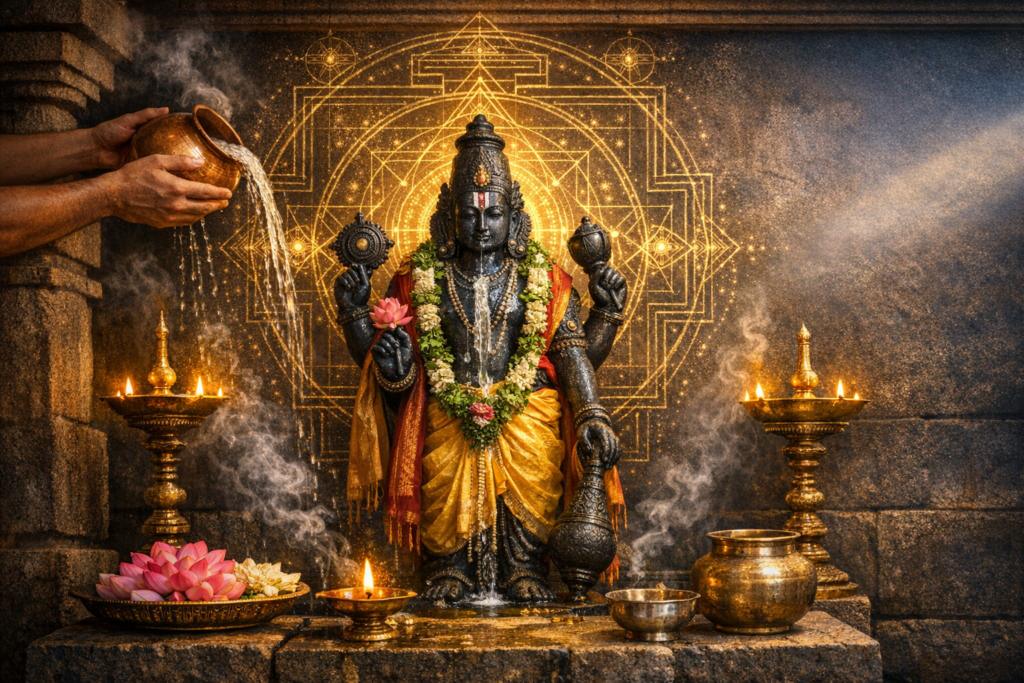
The teaching known as The Nectar of the Moment: Finding Immortality in a Mango has long circulated in Hindu Stories as a meditation on presence, memory, and release. Set in a quiet ashram, it presents a dying Guru who turns the most ordinary act—tasting a mango—into a complete sadhana, demonstrating how attentive awareness, breath, and remembrance can resolve fear and reveal the truth of the Atman. Read as a Hinduism Answers parable and a philosophical case study, it maps an experiential pathway from anxiety to moksha through the simplest possible means: breath awareness, mindful tasting, and one-pointed attention.
In the hush of the ashram, the Guru’s breathing became shallow, a steady cadence that made visible the thin veil between the physical body and the eternal Atman. Around him, disciples were heavy with grief; to them, death appeared as an ending that would sever the Guru-Shishya Tradition they cherished. Observing their distress, the Guru quietly asked for a ripe mango. The request startled those gathered, for it seemed strangely ordinary at such a solemn hour, yet it carried the unmistakable clarity that marked his teachings.
When the mango arrived, the Guru did not rush. He invited the disciples to steady their attention on the rhythm of inhalation and exhalation, to let the mind rest in dhyana, and to observe the senses without grasping. He then held the fruit, attended to its fragrance, and took a slow bite. After a moment of complete stillness, he indicated that the nectar they sought was not confined to the fruit; it appeared when breath, mind, and sensation converged in undivided awareness. The peace that arose was not produced by the mango; it was uncovered by attention itself.
This scene functions as a precise commentary on Hindu philosophy. The Upanishads and the Bhagavad Gita describe the Atman as unborn, undying, and unchanged by the fluctuations of prakriti. Bhagavad Gita 2.20 presents this succinctly by affirming that the Self is beyond birth and death, while the thread of remembrance in Bhagavad Gita 8.6 explains how consciousness inclines toward what it holds most steadily. In the story, the mango becomes a pedagogical instrument: by settling attention into one-pointedness, the Guru aligns the final moments with fearless clarity, transforming a looming threshold into a lucid recognition of what is unconditioned.
The doctrinal core—what one remembers most deeply at the end—sits at the intersection of metaphysics and practice. In the Gita’s psychology of attention, memory shapes trajectory. Consequently, habitual japa, breath awareness, and dhyana are not ornamental; they are functional methods that stabilize remembrance so that, when the body softens and breath thins, the mind naturally returns to its trained object: the imperishable. The Guru’s instruction to taste the mango with complete attention made the ordinary sensory world an ally to liberation rather than a distraction from it.
Yogic anatomy helps explain the technical underpinnings of this teaching. Classical accounts enumerate prana-vayus, with udana vayu governing upward movement at life’s end, and describe how attention and pranayama can harmonize these flows. Practices such as nadi-shodhana and gentle lengthening of the exhalation stabilize the nervous system and quiet ruminative thought. Contemporary physiology notes that slow, regular breathing enhances vagal tone, weaving breath and consciousness into a coherent state of equanimity. In the story, the Guru’s unhurried breath, sensory clarity, and unfragmented attention illustrate this integration without recourse to technical jargon.
The mango’s symbolism extends into aesthetics and devotion. In Indian aesthetic theory, rasa refers to the distilled savor of experience when attention is refined; in bhakti, ananda ripens through loving remembrance. The fruit thus serves as a bridge between form and formlessness, reinforcing that immortality in Hindu thought does not mean an endless extension of time, but direct recognition of that which is not in time. The moment becomes amrita when attention is whole, just as the mango’s sweetness becomes apparent when the palate is quiet and receptive.
Convergences across dharmic traditions affirm the same center of gravity. Buddhism cultivates maranasati and moment-to-moment mindfulness to dissolve fear and clinging. Jainism emphasizes samayik, equanimity and self-restraint, and upholds a peaceful, detached orientation toward life’s final chapter guided by compassion and nonviolence. Sikhism teaches simran, remembrance of the Naam, so that consciousness rests in devotion and fear subsides. Each approach, while doctrinally distinct, seeks the same transformation: from agitation to clarity, from fragmentation to unity, honoring the shared dharmic ethos of inner peace and compassionate awareness.
For householders and practitioners, a sequence of small, rigorous disciplines emerges from the story. First, establish daily breath awareness, allowing attention to settle on the gentle arc of inhalation and the slightly longer, softer exhalation. This stabilizes the mind-body connection and habituates ease in uncertainty. Second, integrate japa—audible at first, then progressively quieter—so that a single sacred name or mantra becomes the mind’s default. In times of stress, the mind will then return where it has most often rested.
Third, practice mindful eating. Before the first bite, pause to feel the breath, note the fragrance, and receive the taste fully without haste. This is not indulgence but training in non-distraction; the senses are instructed to work in harmony with dhyana rather than reactively. Fourth, undertake a regular discipline of forgiveness and reconciliation. Anger and regret agitate attention; kshama lightens the heart and clears memory, allowing a tranquil field of awareness to arise.
Fifth, study foundational texts such as the Upanishads and the Bhagavad Gita with a focus on interiorization. Short, consistent engagement is superior to sporadic intensity; over time, śraddha matures into insight. Sixth, align life with seva. Service steadies attention by orienting it beyond the narrow self and regularizes a compassionate baseline from which fear diminishes. Seventh, consider end-of-life planning that reflects dharmic values: quiet surroundings, supportive companionship, scripture recitation, and continuity of familiar practices in breath awareness and japa. None of these steps are dramatic; they are cumulative and, together, they prepare attention for clarity when it matters most.
Philosophically, the story functions as a concise primer in pratyahara and dhyana applied to the threshold of dying. Ethically, it affirms that acceptance is not passivity but lucid participation in reality as it is. Psychologically, it demonstrates that the mind can be trained to choose its object, even when circumstances narrow. The Guru does not propose escape; he demonstrates presence so complete that fear has nowhere to take root.
Tradition concludes the narrative with unadorned simplicity. After a few slow breaths and a final, attentive savor of sweetness, the Guru’s features grew peaceful. The disciples, once flooded by grief, found themselves drawn into the same clarity—less like spectators of an ending and more like witnesses to a teaching fully embodied. The mango was returned to the plate, not as a sign of denial but as a seal upon a lesson: when attention is whole, the ordinary reveals the extraordinary; when remembrance is steady, the final moment is continuous with every moment that came before.
Thus the story answers, in practice and in principle, how peace can be found in life’s last seconds. It does so without spectacle, using the humblest of means to show that immortality, in the Hindu sense, is not acquired but recognized. Breath awareness, dhyana, japa, mindful receiving of the world, and compassionate living form a single, integrated yoga of remembrance. In this convergence, Hinduism, Buddhism, Jainism, and Sikhism affirm a shared horizon: the cultivation of fearless clarity and the honoring of every being’s journey toward inner peace.
Inspired by this post on Hindu Blog.