-
Powerful Mantra Chanting: How Disciplined Japa Shapes Body, Mind and Life

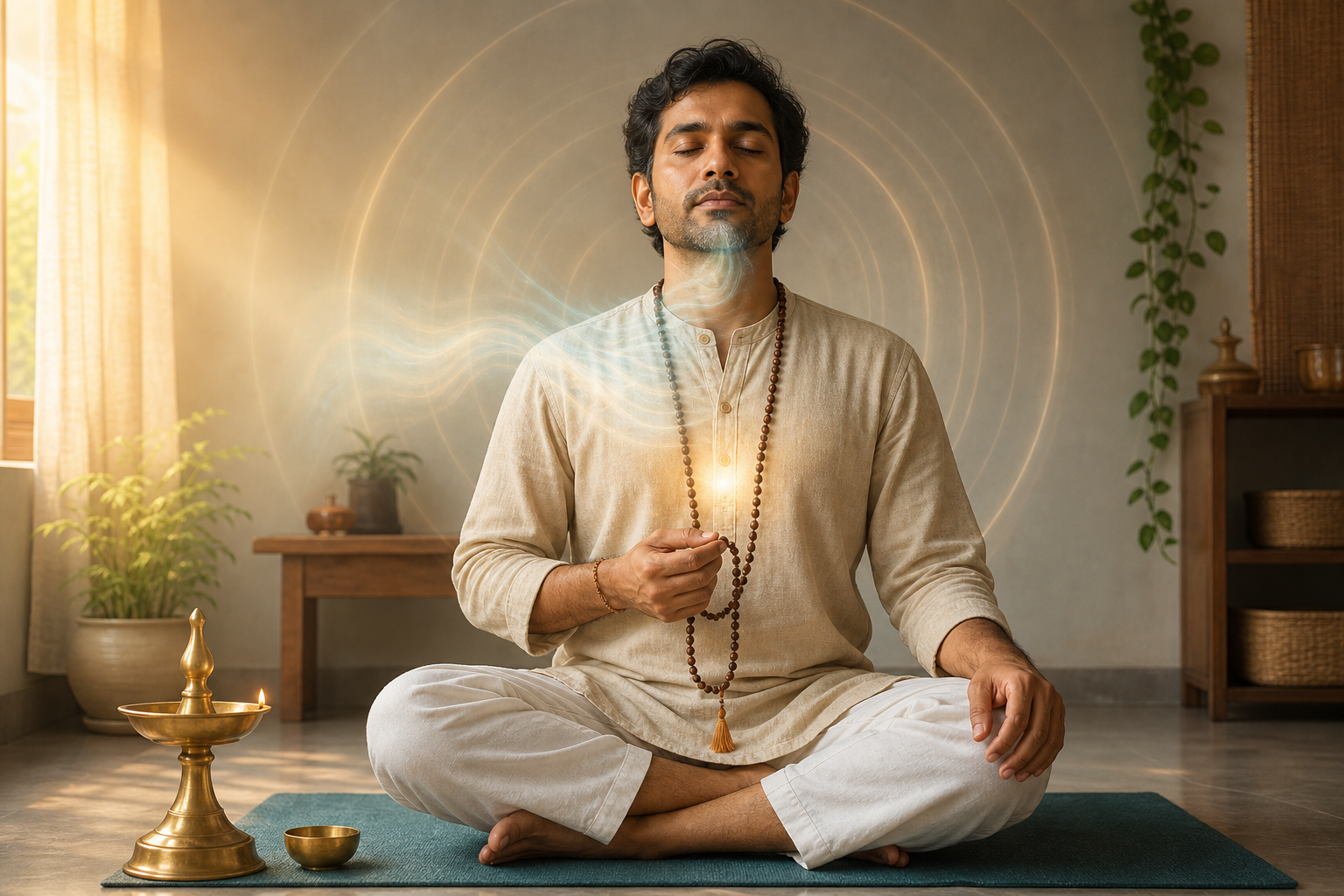
Mantra chanting can influence the body, mind, and daily life when practiced with discipline and moderation. Sacred repetition supports mental focus, steadier breathing, emotional balance, and spiritual awareness, but it should not become compulsive or disconnected from daily duties. The traditional comparison with bathing is useful: purification is beneficial, but excess is not wisdom. A…
-
Unveiling the Science and Spiritual Intelligence of Namaskar: An Evidence-Based Exploration

Namaskar (Namaste or Namaskaram) is both a refined salutation in Hindu dharma and a practical mind–body discipline. By joining the palms at the heart in Anjali Mudra, the gesture promotes postural integrity, calmer breathing, and prosocial connection. Slow, nasal respiration synchronized with a gentle bow increases parasympathetic activity and heart rate variability, supporting emotional regulation…
-
Become the Witness: Rise Above Matter and Realize Consciousness with Timeless Dharmic Wisdom

This long-form, academically grounded essay explains why over-identification with matter creates volatility and how dharmic traditions teach a precise, trainable alternative: witness-consciousness (sakṣi-bhāva). Drawing from Sāṅkhya–Yoga, Advaita Vedānta, the Bhagavad Gītā, Buddhist mindfulness, Jain anekāntavāda, and Sikh practices such as Naam Simran, it shows the deep unity of Hinduism, Buddhism, Jainism, and Sikhism. Readers gain…
-
Knower of the Field: Cutting-Edge Insights into Consciousness, Experience, and Dharmic Unity

This essay examines consciousness through the Bhagavad-Gita’s kshetra–kshetrajna lens and connects it with current neuroscience and philosophy of mind. It clarifies arousal versus awareness, reviews global neuronal workspace and integrated information theory, and explains how predictive and recurrent processing shape experience. Drawing on cell biology, it traces how neuronal excitability, glial modulation, and plasticity ground…
-
Ajapa Natanam of Shiva: Awaken Inner Stillness through the Silent Breath-Dance of Consciousness

Ajapa Natanam in the Shaivite tradition points to a silent, breath-led dance where mantra arises naturally without deliberate chant. By aligning breath and consciousness through gentle, attentive awareness, the practice cultivates inner stillness, clarity, and emotional balance. Its symbolism mirrors Nataraja’s iconography: the damaru as cosmic pulse, the flame as purification, and apasmara as subdued…
-
Vrindavan Wisdom with HG Gopinath Acharya Prabhu: How Remembrance Unlocks Nectar

This Vrindavan reflection, associated with HG Gopinath Acharya Prabhu, clarifies a core teaching of the Srimad-Bhagavatam: constant remembrance of Krishna leads to the same Supreme Truth that yogic disciplines seek. It highlights how unwavering focusthrough bhakti or yogatransforms consciousness and grants access to the ‘nectar’ of divine grace. The discussion draws parallels with Buddhist mindfulness,…
-
Is Consciousness Within? Sri Sri Ravishankar’s Transformative Insight for Daily Awareness

A disciple once asked Sri Sri Ravishankar, “Is there consciousness within me?” The reply pointed to immediate experience: awareness is what allows one to ask, hear, and see. This simple recognition invites a rigorous, experiential understanding central to Hindu philosophy and in harmony with Buddhism, Jainism, and Sikhism. The insight is practical: by noticing breath…
-
Awaken Inner Awareness: Sri Sri Ravi Shankar on the Proof of Consciousness Within

A disciple asked Sri Sri Ravishankar, “Is there consciousness within me?” The response revealed a precise truth: the ability to ask, hear, and understand already confirms awareness. This insight aligns with Hindu philosophy and echoes across Buddhism, Jainism, and Sikhism, highlighting unity in spiritual diversity. Practical methodsconscious breathing, sensory noticing, and brief pausesmake this recognition…
-
Enlightenment Through Balance: How Meditation, Music, and Reason Shape Altered Consciousness

This article presents a practical, cross-traditional pathway to enlightenment as an altered state of consciousness. It explains why integrating music (chanting, bhajan, kirtan) with reflective inquiry and silent dhyana stabilizes attention and deepens practice. The popular left–right brain framing is acknowledged as a helpful metaphor, while emphasizing evidence-informed mindfulness of breath and gentle pranayama. A…
-
Ultimate Guide to Upanishadic Planes of Consciousness: Master the Secrets of Akasha

This article offers a clear, complete guide to the Upanishadic planes of consciousness, explaining Akasha as both physical space and the subtle field of awareness. It unpacks the Mandukya Upanishad’s four stateswaking, dreaming, deep sleep, and Turīyaas a practical map for inner exploration. It also presents the Taittirīya Upanishad’s Pancha Kosha model to show how…
-
Why pranayama can control the mind

Exploring the intricate dance between breath and the intricate workings of the inner world, this piece unveils the profound connection between pranayama and the mind’s elusive control. In a wilderness tale of wit and deception, a poodle’s survival instincts, as it masters the art of camouflage, parallel the human mind’s ceaseless strategizing. By observing the…