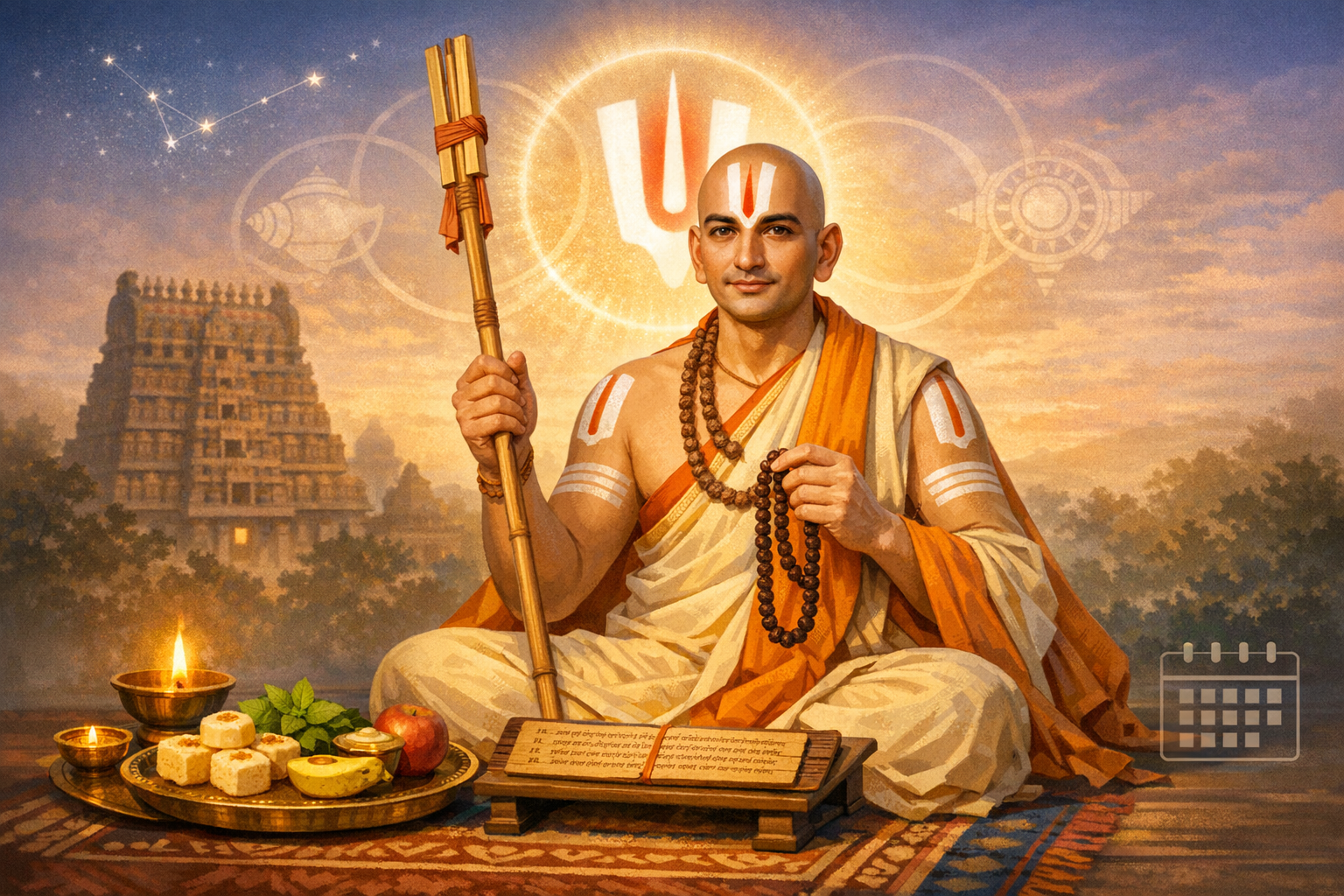
Ramanuja Jayanthi 2026, observed as Sri Ramanujacharya Jayanti, will be marked on 22 April 2026 in most regional panchangs. The day commemorates the birth anniversary of Sri Ramanujacharya, the foremost exponent of Vishishtadvaita Vedanta and a foundational figure of the Sri Vaishnava sampradaya. Marking this Jayanti sustains a living bridge to a millennium of bhakti, rigorous philosophy, temple culture, and community service across Bharat and the broader dharmic world.
Because Hindu festivals follow the lunisolar Hindu calendar, minor regional variations are natural. Many North and West Indian almanacs situate Sri Ramanujacharya Jayanti in the bright fortnight of Chaitra, while Sri Vaishnava communitiesespecially in Tamil regionsoften observe the acharya’s thirunakshatram on the Thiruvadirai (Ardra) star in Chithirai Masam. In 2026, the widely referenced date is 22 April; however, individual temples may schedule utsavams on adjacent days if the relevant sunrise tithi or nakshatra falls differently, so consulting a trusted local panchang remains best practice.
Historically, Sri Ramanujacharya (1017–1137 CE) reshaped India’s spiritual landscape through a rare synthesis of deep scriptural hermeneutics and accessible devotion. Active across Sriperumbudur, Kanchipuram, Srirangam, and Melukote/Thirunarayanapuram, his principal worksSri Bhashya (on the Brahma Sutras), Vedartha Sangraha, and the Bhagavad Gita Bhashyapresent a coherent, textually grounded system that guided temple administration, pedagogy, music, and inclusive access to sacred spaces for centuries.
Vishishtadvaita articulates a qualified non-dualism in which Brahman (Narayana) is one without a second, yet always together with real attributes and modes. Its ontology (tattva-traya) distinguishes Ishvara (the Supreme), chit (sentient beings), and achit (insentient matter), all inseparably related to the Supreme. Sadhana unfolds as sustained bhakti-yoga or prapatti (sharanaagati), upheld by the compassionate mediation of Sri (Lakshmi) and the living guru-parampara. The system is technically preciseclarifying scripture with robust logicwhile remaining tender in its ethical core, elevating compassion, service, and surrender as integral to realization.
In contemporary practice, Ramanuja Jayanti brings communities together through temple abhishekam for the acharya’s vigraha, special alankaram, and collective recitations. Sri Vaishnava temples traditionally conduct Divya Prabandham parayanam and Satrumurai, including Ramanuja Nootrandadi, and many add stotras such as Yatiraja Vimsati composed by Vedanta Desika. Discourses on Sri Bhashya, Gita Bhashya, and accessible introductions to Vedartha Sangraha, as well as kirtans and processions around the mada veedhis, enrich the day.
A thoughtful home observance in 2026 may begin with a simple sankalpa after sunrise, puja to Sri Lakshmi-Narayana, and homage to the acharya through Guru-parampara dhyana. Devotees may chant Om Namo Narayanaya, read a short, reputable translation of a passage from Vedartha Sangraha or a concise biography of Sri Ramanuja, and recite Vishnu Sahasranama or selections from the Divya Prabandham. Offering a sattvic naivedyamilk-based sweets, soaked legumes, or seasonal fruitsand sharing prasad with family and neighbors aligns the day with the inclusive ethos of Sri Vaishnavism.
Many observe upavasa or a light, sattvic diet on Ramanuja Jayanthi, dedicating time to service (kainkaryam) and study. Annadanam at local temples, support for Sanskrit- and Veda-learning institutions, and quiet acts of kindness toward elders, children, and animals reflect the acharya’s lifelong emphasis on inclusion and dignified access to worship. The spirit of seva that Ramanuja championed resonates with kindred dharmic valueskaruna in Buddhism, ahimsa in Jainism, and seva in Sikh traditionstrengthening bonds across the larger Indic family.
Communities often use the Jayanti to introduce younger generations to the language of Vishishtadvaita. Study circles explain key ideaschit, achit, Ishvara; sharanaagati; upasana; guru-bhaktiwith faithful, readable translations. Short selections from Sri Bhashya’s introductory sections or lucid summaries of Vedanta demystify terms without diluting rigor, preserving intellectual continuity alongside devotional warmth.
Pilgrimage and virtual darshan also mark the day. Sriperumbudur (birthplace), Srirangam (the living heart of Sri Vaishnavism), Melukote/Thirunarayanapuram (a center of scholarship and service), and Kanchipuram (a historic seat of worship and learning) host special utsavams. Many pilgrims additionally reflect on contemporary commemorationssuch as the 108-foot Statue of Equalityas symbols of a living legacy grounded in ethical action rather than monumentality alone.
Timing considerations matter for those who value precision. Many households begin meditative japa during Brahma Muhurta, perform puja in the morning while the relevant tithi and nakshatra prevail, and conclude with an evening arati. Because panchang calculations vary by longitude and local sunrise, checking a trusted regional almanac for 22 April 2026 helps align personal observance with community practice.
Beyond ritual, Sri Ramanujacharya Jayanti offers a moment to reaffirm a unifying civilizational ethic. Ramanuja’s insistence that devotion and knowledge culminate in compassionate action forms a principle widely shared across Hindu, Buddhist, Jain, and Sikh traditionseach honoring ethical discipline, service, and inner transformation. Celebrated in this integrative spirit, Ramanuja Jayanthi becomes not only a remembrance of an acharya, but a shared vow to embody wisdom with humility and to deepen harmony across the dharmic spectrum.
For 2026, the essentials are clear: the Ramanuja Jayanthi 2026 date is 22 April 2026. Preparing a simple home puja, participating in temple recitations, engaging in charitable service, and studying even a few core ideas of Vishishtadvaita can shape the day into a holistic sadhanauniting head, heart, and hands. In doing so, communities honor Sri Ramanujacharya not merely as a figure of history, but as an ongoing guide for living thoughtfully and inclusively in the present.
Inspired by this post on Hindu Pad.