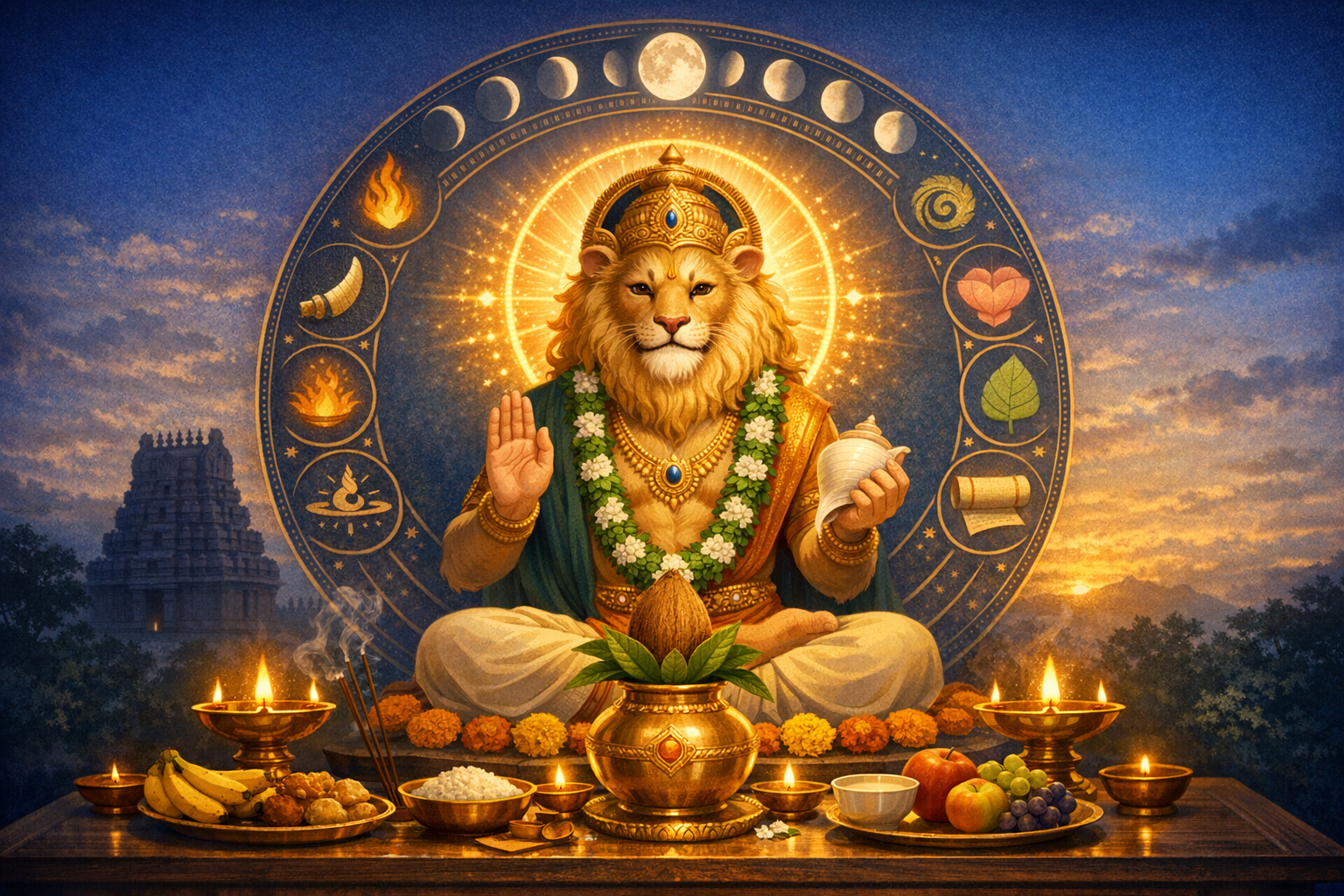
Nrusimha Navaratri is a sacred nine-day observance in the Vaishakh month that venerates the Narasimha (Nṛsiṁha) avatāra of Lord Vishnu as the protector of dharma and the remover of fear. In 2026, Nrusimha Navaratri begins on 22 April and culminates on 30 April with Nrusimha Chaturdashi (Narasimha Jayanti). Across households and temples, these nine nights invite disciplined worship, scriptural recitation, and ethical reflection centered on courage, compassion, and steadfast devotion.
This festival follows the lunar cycle from Vaishakha Shukla Panchami through Chaturdashi. The 2026 dates correspond to 22 April (start) through 30 April (culmination), with Narasimha Jayanti observed on Vaishakha Shukla Chaturdashi. As lunar tithis vary by geography, practitioners rely on a trusted regional Panchang for exact start–end times of each tithi and for local muhurta guidance.
Traditional timing emphasizes worship aligned to tithi and sandhyā (twilight) observances, with many lineages highlighting pradoṣa and madhyāhna windows for Narasimha Jayanti worship. Regional sampradāyas may differ on preferred puja windowsmadhyāhna for some Vaishnava traditions and sunset–pradoṣa for othersrooted in the Puranic remembrance of the Lord’s manifest appearance at dusk. Adherence to the local Panchang and family paramparā (lineage practice) maintains both accuracy and continuity.
Scriptural foundations of Nrusimha Navaratri lie most prominently in the Bhagavata Purana (notably the Prahlāda caritra in Skandha 7), the Vishnu Purana, and allied Vaishnava traditions, where Narasimha epitomizes the union of fierce protection and boundless grace. The narrative resolves a profound ethical paradox: Narasimha appears neither fully man nor lion, neither day nor night, neither indoors nor outdoorsaffirming the subtlety with which dharma is upheld without violating cosmic law.
Devotional practice during these nine nights often contemplates Nava-Narasimha, the nine revered manifestations celebrated especially in Ahobilam: Jwala, Ahobila (Ugra), Malola (Lakshmi-Narasimha), Kroda (Varaha-Narasimha), Karanja, Bhargava, Yogananda, Chatravata, and Pavana. Communities frequently map daily meditation to one of these forms, reflecting on a progressive spiritual arcfrom invoking protective fire (jwala) and righteous strength (ugra) to resting in grace (malola) and inner stillness (yogananda), culminating in purification (pavana). Local customs may vary, and such mappings are best adopted with guidance from one’s guru or temple.
A typical home puja vidhi during Nrusimha Navaratri includes sankalpa (statement of intent with place, date, gotra, and purpose), śuddhi (purification through ācamana and prokṣaṇa), and kalasha sthāpana (optional) with a tulasi leaf and Vishnu symbols. Shodashopachara or Panchopachara worship may be offered with gandha, puṣpa, dhupa, dipa, and naivedya; tulasi leaves and sattvic offerings are preferred. Devotees maintain a clean altar, observe daily snāna, and conclude with ārati, kṣamā-prārthanā (prayer for forgiveness), and prasāda distribution within the family and community.
Mantra and stotra recitation deepens the vrata’s contemplative core. Commonly recited are the moola mantra “Om Ugram Viram Mahavishnum Jvalantam Sarvato Mukham, Nrisimham Bhishanam Bhadram Mrityor Mrityum Namamy Aham” and the Nṛsiṁha Gāyatrī“Om Nrisimhaya Vidmahe, Vajranakhaya Dhimahi, Tanno Simhah Prachodayat.” Many also chant Prahlāda’s hymns from the Bhagavata Purana (Skandha 7), Narasimha Kavacham (traditionally attributed to the Brahmāṇḍa Purāṇa), and Adi Shankaracharya’s Sri Lakshmi-Narasimha Karavalamba Stotra, aligning devotion with scriptural authority.
Fasting (upavāsa) practices range from phalahara (fruit and milk) to full-day fasts observed especially on Chaturdashi, with parāṇa (fast-breaking) as per tithi on the following day. Balanced, health-conscious observances are encouraged: elders, expectant mothers, and those with health conditions may adopt a moderated fast or sattvic diet under guidance. Charity (anna-dāna), respect for all beings (ahiṁsā), and truthfulness (satya) are integral to the vrata’s ethical discipline.
Muhurta selection honors both tithi and regional praxis. For Narasimha Jayanti on Vaishakha Shukla Chaturdashi, many traditions privilege madhyāhna puja; others emphasize sandhyā/pradoṣa, recalling the Lord’s appearance at dusk. Temple traditions (notably in Pancharātra and Vaikhānasa āgamas) may set precise kala (time) for abhiṣeka, alankara, and utsava; households align with local temple schedules and Panchang-based recommendations.
Regional celebrations add profound texture. In Andhra Pradesh and Telangana, sacred centers such as Ahobilam and Simhachalam attract large congregations, while temples like Yadadri and Nacharam Lakshmi Narasimha Swamy Temple hold special abhiṣekams, alankarams, and parayanams. In Odisha, Karnataka, Tamil Nadu, and North India, Narasimha sannidhis and dedicated shrines conduct elaborated sevas; Vaishakh-linked festivals such as Chandan Yatra in Puri underscore a broader Vaishnava seasonal rhythm that often overlaps this fortnight.
Practitioners frequently report an emotional arc across the nine nights: families speak of fearlessness awakened by protective grace, children learn Prahlāda’s steadfastness, and communities experience a shared ethic of justice tempered by compassion. These reflections resonate across dharmic traditionsBuddhist, Jain, Sikh, and Hindu alikewhere fearless compassion, truthfulness, and the protection of the vulnerable are celebrated as universal virtues. Nrusimha thus stands as a symbol of the timely, principled response to adharma, inspiring unity in ethical action.
For planning in 2026, a practical day-by-day outline helps coordinate home and temple observances: Day 1 (22 April): Vaishakha Shukla Panchami; Day 2 (23 April): Shashthi; Day 3 (24 April): Saptami; Day 4 (25 April): Ashtami; Day 5 (26 April): Navami; Day 6 (27 April): Dashami; Day 7 (28 April): Ekadashi; Day 8 (29 April): Dwadashi/Trayodashi depending on local tithi timings; Day 9 (30 April): ChaturdashiNarasimha Jayanti. As tithis can shift across time zones, Panchang verification ensures precision for each locality.
A concise observance checklist supports a calm, methodical practice: confirm local tithis and preferred muhurta; prepare a clean altar with tulasi, gandha, and sattvic naivedya; choose a sustainable fast appropriate to health; schedule daily parayana (Prahlāda caritra, Narasimha stotras); plan modest charity; and align home worship with nearby temple utsavas to deepen collective devotion. Families may also set a learning goalcommitting to a daily passage from the Bhagavata Puranato strengthen scriptural literacy during the nine nights.
Environmentally responsible offeringslimited plastics, natural lamps, biodegradable flowers, and mindful prasad distributionenhance the sanctity of the observance while honoring reverence for all life. Communities often find that such thoughtful choices elevate both the aesthetic and ethical character of the festival.
As Nrusimha Navaratri 2026 unfolds from 22 to 30 April, the vrata invites disciplined worship, fearless ethics, and compassionate service. Culminating on Nrusimha Chaturdashi (Narasimha Jayanti), the festival affirms a core dharmic insight: when devotion is unwavering and conduct is righteous, protection arises precisely when and how it is most needed. In that shared confidence, communities discover renewal, families nurture virtue, and seekers deepen intimacy with the protecting presence of Narasimha.
Inspired by this post on Hindu Pad.