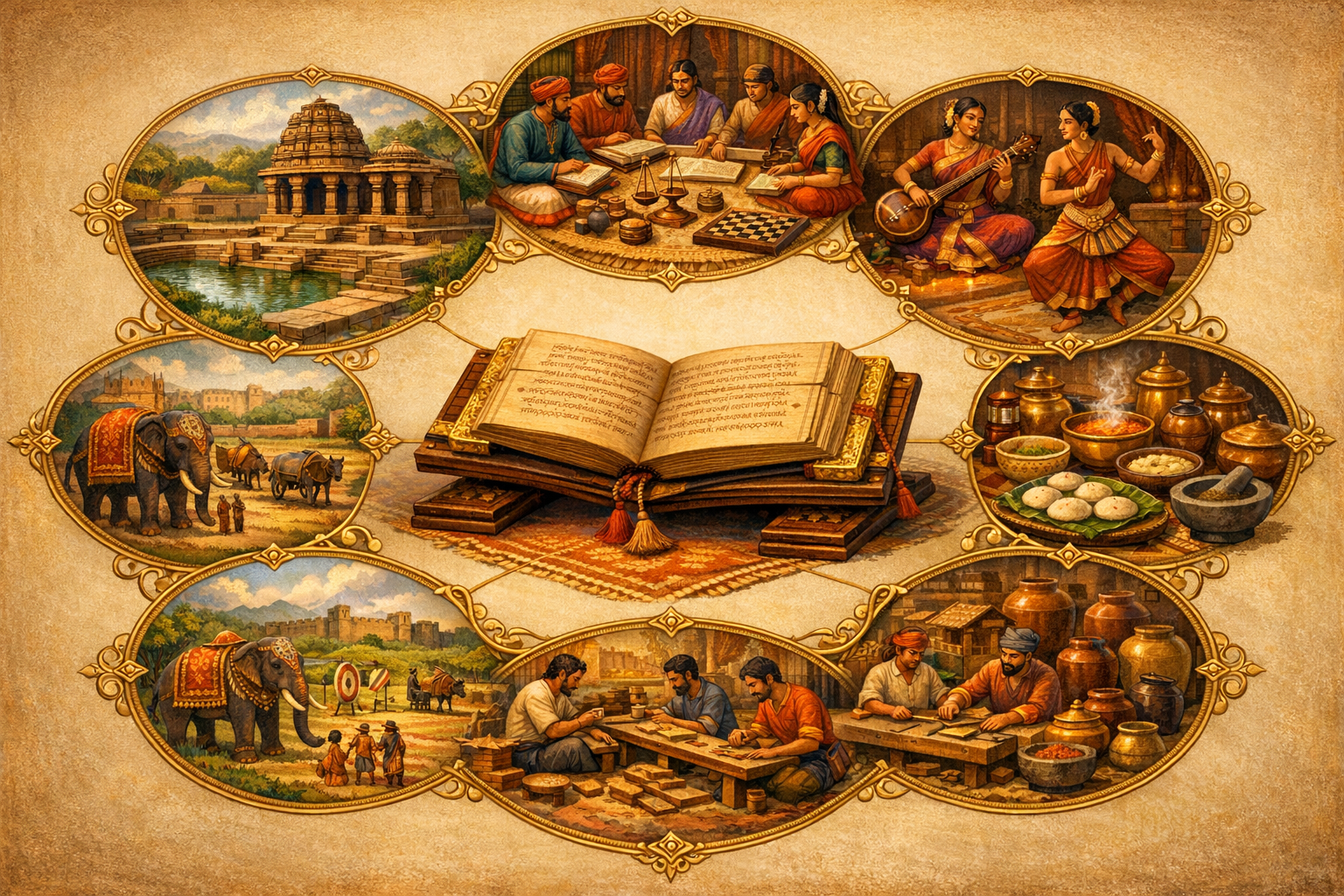
Manasollasa, also known as Abhilashitartha Chintamani, stands as one of the most expansive Sanskrit encyclopedic treatises of medieval India. Attributed to King Someshvara III of the Western Chalukya dynasty (r. 1126–1138 CE), it weaves statecraft, social ethics, arts, sciences, agriculture, culinary practice, music, and architecture into a single, integrated vision of good governance and cultured living. Unlike narrowly framed manuals, this text reveals the composite intellectual world of the Deccan, where policy, aesthetics, and everyday life were treated as mutually reinforcing domains of dharma and public welfare.
Composed in a courtly milieu at Kalyana (in today’s Karnataka), Manasollasa reflects the Western Chalukya dynasty’s commitment to administrative rigor, cultural patronage, and scholarly synthesis. Its Sanskrit prose and verse emulate the normative shastra style while remaining attentive to practical, real-world detail. In doing so, it offers historians and practitioners alike a rare, textured account of medieval India’s political economy, civic institutions, artistic systems, and domestic lifeworlds.
The treatise is organized in multiple large books subdivided into numerous chapters, each devoted to a defined thematic domain. Topics range from rajadharma (the duties of rulership) and dandaniti (law and penal policy) to urban planning, village administration, revenue systems, weights and measures, crafts and guilds, performance traditions, and paka-shastra (the science of cookery). This breadth marks the work as a civilizational handbook rather than a single-discipline manualan encyclopedic compendium intended to “delight the mind” even as it instructs the ruler and society at large.
At its ethical core, Manasollasa advances an ideal of kingship anchored in compassion, justice, and competence. The ruler is enjoined to protect life and property, cultivate prosperity, nurture learning, and balance firmness with restraint. Council structures, ministerial qualifications, and advisory protocols are treated with precision, emphasizing character, expertise, accountability, and the careful distribution of authorityprinciples that resonate with other Hindu scriptures and classical texts of polity such as the Arthasastra and the Dharmasastra literature.
On administration, the text presents a multi-tiered statecapable of collecting revenue, maintaining public works, and adjudicating disputes while remaining attentive to local autonomy. Administrative manuals and account-keeping procedures (often grouped under income–expenditure, or aaya–vyaya) are framed as disciplines that enhance both efficiency and fairness. The emphasis falls on intelligible ledgers, predictable taxation, and moral oversightan approach that aligns with a systemic vision of governance rather than ad hoc rule.
Legal and penal provisions are presented under the wider discipline of dandaniti, where due process, proportionality of punishment, and the prevention of abuse are recurring concerns. Judges and assessors are cautioned against bias; evidence, witness reliability, and reputation matter, but their weight is to be calibrated carefully. The text thus binds procedural rectitude to the dharmic obligation of rulers to be protectors of all, a theme echoed across Indian traditions of ethical statecraft.
Urban planning in Manasollasa foregrounds the layout of streets, markets, water-supply systems, storage facilities, and civic amenities such as rest-houses and hospitals. Emphasis on wells, tanks, embankments, and canals reflects a nuanced understanding of hydrology and urban resilience in monsoon ecologies. Temple districts, artisan quarters, and commercial zones are mapped as interdependent units, ensuring that the sacred, the civic, and the mercantile reinforce one another.
Village administration receives sustained attention, with records, land classification, irrigation management, and community deliberation treated as pillars of rural prosperity. Collective irrigation works, dispute resolution, crop rotation, and seed stewardship all appear as parts of a self-regulating agrarian ecology. The text values local assemblies and officers who maintain cadastral maps, water-sharing agreements, and grain reservesforeshadowing institutional practices identified in inscriptions and copper-plate grants across medieval India.
Manasollasa is explicit about economic order: guilds (shreni), market inspectors, and standardization of weights and measures ensure confidence in trade and fair prices. Merchant caravans, warehouse protocols, and the ethics of lending and borrowing are woven into a broader rubric of trust and reputation. The goal is prosperity with predictabilityan economy robust enough to fund public works and cultural life, yet disciplined by moral norms and oversight.
Agriculture and horticulture emerge as scientific arts. The treatise details soil preparation, seed selection, seasonal calendars, irrigation design, and orchard management for fruits and medicinal plants. The agricultural voice is practical and technicalconcerned with moisture, pests, storage, and transportrevealing the agronomic intelligence that underwrote medieval India’s food security.
Animal husbandry, particularly the management of horses and elephants, is treated with the specificity expected of a royal court. Breeds, provenance, physical marks (lakshana), training methods, stable hygiene, nutrition, and veterinary care are systematized into protocols for military readiness and ceremonial display. With elephants and horses central to transport, warfare, and prestige, this technical corpus is both zoological guidance and statecraft by other means.
Military organization in Manasollasa includes fortification principles, soldierly discipline, logistics, and the ethical constraints on force. Espionage and intelligence are subordinated to the common good rather than intrigue for its own sake; victory, while desired, is to be framed by dharma, treaty observance, and judicious restraint. The insistence on chain-of-command clarity and provisioning reflects a modern-sounding sensitivity to systems management.
The arts occupy a conspicuous place in the treatise, in both their sacred and secular dimensions. Painting, sculpture, jewelry, textiles, and architecture are approached through canons of proportion, materials science, and workshop practice. Aesthetic theory engages the language of rasa and bhava without disconnecting from artisans’ lived techniquesdemonstrating how philosophical aesthetics and technical craft knowledge coevolved.
The musicology and dance sections situate sangita within a continuum extending from Bharata’s Natyashastra through medieval performance lineages. Ragas and talas are catalogued alongside instruments such as veena and percussion ensembles, with guidance on pedagogy, repertoire, and stagecraft. The account anticipates later codifications like Sarngadeva’s Sangita Ratnakara while preserving earlier regional practices, thereby documenting continuity and innovation across centuries.
Architecture, including temple design, is discussed with attention to site selection, orientation, proportion, and ornament. Manasollasa references typologies that medieval Indian architects recognized, including the dravida, nagara, and vesara idioms familiar in the Deccan. Beyond sacred structures, the text extends architectural reason to palaces, gardens, waterworks, and civic halls, aligning built form with ritual calendars, processions, and community life.
Leisure and sport receive careful appraisal. Archery, equestrian games, board games such as chaturanga (a precursor of chess), and regulated hunting are framed as physical disciplines that cultivate focus, judgment, and restraint. Even in describing the chase, ethical guardrails and seasonal prohibitions signal an ecological awareness consistent with broader dharmic sensibilities.
Paka-shastra in Manasollasa is among the most vivid windows into medieval Indian domestic science. It treats kitchen design, fuel economy, vessels and their thermal properties, sequencing of preparation, and the pairing of textures and tastes. Recipes and references include apupa (fried or baked cakes), payasa (milk-based puddings), shrikhand (strained yogurt confection), and iddarikasteamed cakes strongly reminiscent of contemporary idliamong many others, evidencing regional foodways, fermentation knowledge, and culinary taxonomy.
Perfumery, cosmetics (anulepana), and daily wellness practices appear as extensions of Ayurveda and aesthetic culture. Hair oils, unguents, and fragrant distillations are catalogued with plant sources, extraction methods, and seasonal suitability. These sections illuminate trade in aromatics, the chemistry of emulsions and infusions, and the cultural value of sensory refinement in courtly and household contexts.
Ritual life, temple management, and festival organization are treated as public institutions, not merely private piety. The text describes priestly functions, endowments, processional logistics, and the social economy of festivals that draw artisans, merchants, ascetics, and householders into a single civic rhythm. Such chapters reveal a plural civic commons in which brahmanas and sramanas coexist within a broader fabric of dharmic lifea historical pattern of inclusivity that speaks to the shared ethical aspirations of Hindu, Buddhist, Jain, and, in later centuries, Sikh communities.
Education and knowledge systems are integral to the vision of a thriving realm. Grammar (vyakarana), logic (nyaya), hermeneutics (mimamsa), medicine, astronomy, and the arts find place within a curricular ecology that links mastery to character formation. The guru–shishya relationship, libraries of palm-leaf manuscripts, and the discipline of copying and preserving texts are all seen as state-support-worthy endeavors.
Philologically, Manasollasa is attentive to terminology, classification, and intertextual allusion. It transmits earlier insights while marking contemporary practice, often harmonizing competing traditions rather than enforcing narrow orthodoxy. This reconciliatory tendency makes it invaluable for comparative religion and intellectual history, offering corroboration for how multiple streams of dharmic thought were lived rather than merely theorized.
Art historians draw on Manasollasa for descriptions of vesara idioms and workshop organization; musicologists for ragas, talas, and performance pedagogy; culinary historians for early attestations of recipes and techniques; economic historians for guilds, price oversight, and weights and measures; and scholars of governance for rajadharma, justice, and intelligence structures. Its encyclopedic range thus underwrites a genuinely interdisciplinary historiography of medieval India.
When compared with the Arthasastra and other statecraft texts, Manasollasa appears less single-mindedly political and more civilizational in scope. It shares with earlier treatises a concern for taxation, security, and diplomacy, yet goes further in integrating aesthetics, domestic science, and festival culture into the architecture of the state. Policy and culture are not rivals here; they are reciprocal conditions for collective flourishing.
The treatise’s enduring relevance is evident in contemporary discussions of public administration, sustainable water management, heritage architecture, craft revival, performing arts pedagogy, and food heritage. Its insistence on fair markets, guild self-regulation, transparent accounting, and civic infrastructure reads as a premodern blueprint for ethical development. By demonstrating how dharma operates from the granary to the concert hall, from the temple tank to the court of law, Manasollasa offers a holistic template for balanced social progress.
For readers today, the text’s most engaging quality may be experiential: it invites the imagination to taste a sweet shrikhand, hear the plucked veena, watch a festive procession circle a vesara temple, and follow a tax ledger reconciled with moral clarity. Such moments collapse temporal distance, revealing medieval India as neither exotic nor unknowable but methodical, creative, and ethically self-aware. That discovery fosters a renewed appreciation for the shared civilizational roots that continue to nourish Hindu, Buddhist, Jain, and Sikh traditions.
Scholarly editions and translations in the modern era have widened access to Manasollasa and encouraged cross-disciplinary research. Even where philological debates persist over terminology or dating of specific layers, consensus affirms the text’s authority as a primary source for the Western Chalukya period and the Deccan at large. Its cumulative effect is to make visible a world where policy, piety, pleasure, and production formed a single fabric.
In sum, Manasollasa is more than a royal mirror; it is a mirror to society. It frames governance as a cultured art, culture as a public trust, and daily life as a site of knowledge and care. Read in this spirit, the text becomes both archive and guidean encyclopedic testament to medieval India’s ingenuity and a living prompt for unity-in-diversity across the dharmic world.
Inspired by this post on Hindu Blog.