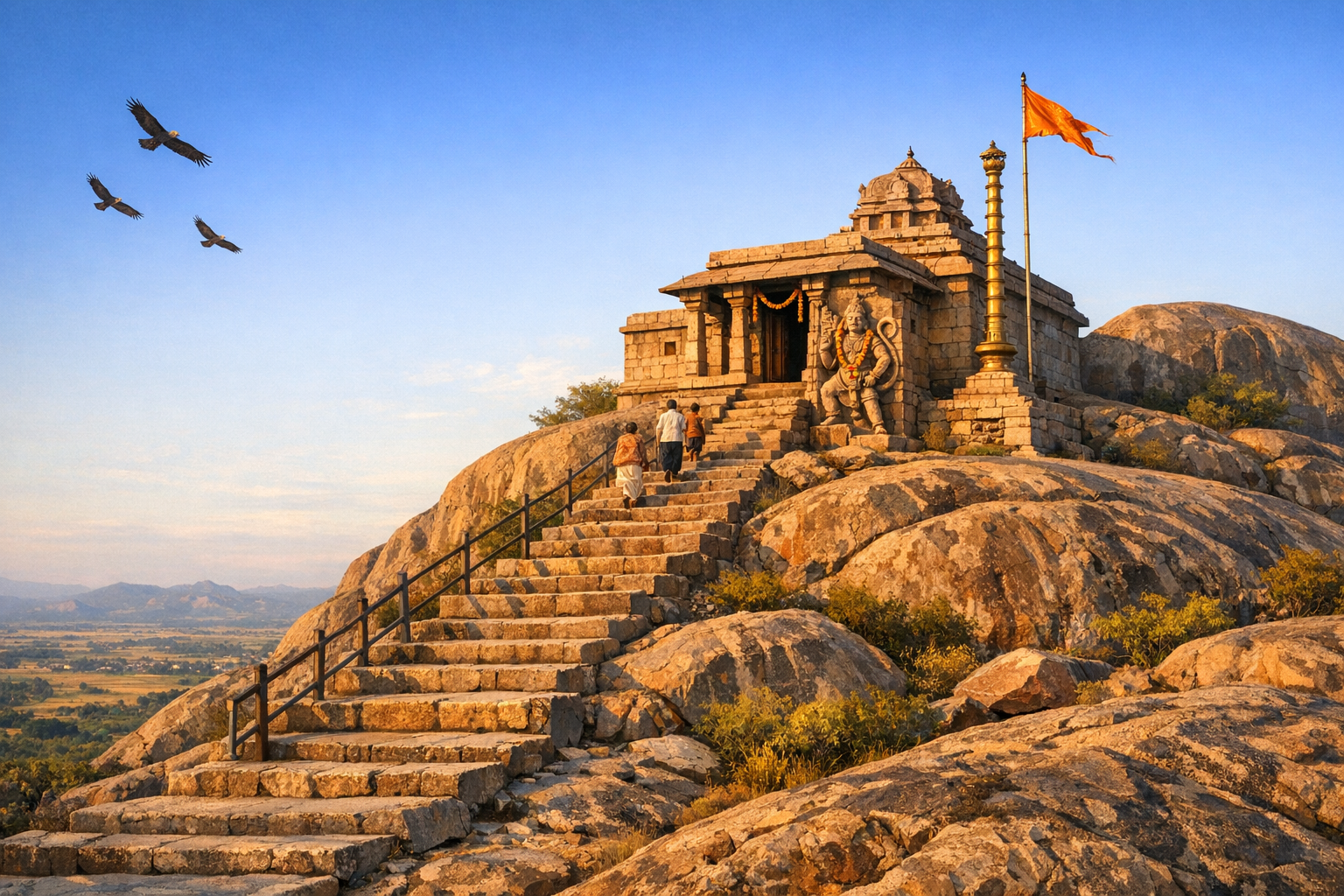
Sri Kshetra Haddinakallu Hanumantharaya Temple widely known as the Eagle Stone Hill Temple is a hilltop shrine in Haddinakallu, Karnataka, dedicated to Lord Hanuman (Anjaneya). Set upon a rugged granite height with wide-open vistas, the temple unites sacred geography with living ritual, drawing pilgrims for darshan and seekers of Karnataka’s distinctive hill-temple experience.
Situated on a prominent inselberg remembered as Eagle Stone Hill, the site illustrates how ancient Indian sanctuaries were sited to harmonize geology, ecology, and devotion. The knurled bedrock, pockets of scrub, and frequent sightings of raptors tracing thermals infuse the toponym with meaning and accentuate the sentinel symbolism long associated with Hanuman.
Local oral tradition places the temple’s foundation in the 8th century CE under a regional ruler, aligning it with the early-medieval phase of Karnataka’s cultural history. In the absence of securely dated inscriptions available in the public domain, the attribution remains provisional; nevertheless, it coheres with broader patterns of Hanuman devotion and hill-shrine patronage that accompanied the consolidation of regional polities in peninsular India during this period.
Architecturally, the complex reads within a Dravidian hill-temple typology: a compact garbhagriha adjusted to uneven rock, a modest mandapa for congregational worship, and circumambulatory paths contoured to natural ledges. Exposure atop the hill typically favors robust granite masonry, restrained superstructures, and orientations that mitigate monsoon winds characteristics consistent with ancient temples in Karnataka adapted to demanding topography.
The regional epithet Hanumantharaya is telling. While Hanuman worship spans the subcontinent, the raya suffix in Karnataka underscores a protective, sovereign guardianship befitting hilltop shrines that visually oversee agrarian settlements and movement corridors. Iconography at comparable sites commonly presents Veera Anjaneya bearing the gada, right hand in abhaya, and tail arched upward an image of shakti governed by unwavering bhakti to Sri Rama.
The ritual repertoire aligns with practices widespread at Hanuman temples: tailabhisheka (oil anointment), alankara, recitation of Hanuman Chalisa and selections from Sundara Kanda, and archana offered through the fivefold panchopachara. Devotees often undertake vratas for inner strength, clarity in undertakings, and familial protection, expressing personal vows through simple offerings and collective kirtan.
The festival cycle pivots around Hanuman Jayanti and allied Rama Navami observances, with heightened footfall on Tuesdays and Saturdays traditionally linked to Hanuman worship in many regions. New-moon (Amavasya) and full-moon (Purnima) evenings frequently draw extended pradakshina and bhajan gatherings, embedding the temple within the cyclical rhythm of Hindu festivals in Karnataka.
The ascent itself shapes the devotional encounter. Traversing weathered rock with steady breath and measured steps invites a dhyana-like one-pointedness that many pilgrims carry into darshan. At the summit, the meeting of prana, space, and sound bells, mantra, and birdsong against an open horizon intensifies the sense of presence associated with a hill shrine.
In regional perspective, Haddinakallu forms part of a wider network of ancient hill temples whose elevated placement conveys both physical oversight and metaphysical guardianship (kshetrapala). Historically, such siting interwove Temple Architecture with practical wayfinding for agrarian communities and traders, transforming sacred precincts into cultural beacons as well as spiritual refuges.
The temple’s devotional ethos also speaks across dharmic traditions. Hanuman’s seva, steadfast discipline, and humility resonate with Sikh ideals of selfless service, echo the Buddhist emphasis on right effort, and complement the Jain ethic of restraint and resolve. This shared moral vocabulary affirms unity in diversity across Hinduism, Buddhism, Jainism, and Sikhism, reinforcing the shrine’s relevance as a locus of ethical inspiration.
As a cultural resource, the site merits sensitive stewardship. Stone steps inevitably wear under sustained footfall, monsoon runoff can etch channels into paths, and unregulated litter harms both sanctity and ecology. Low-impact pathways, rainwater channelling, discreet signage, and volunteer-led cleanliness drives (seva) approaches proven effective at comparable hill shrines would strengthen long-term conservation at Eagle Stone Hill.
Community participation remains foundational. Local residents, priests, and visiting devotees together sustain rituals, orient first-time visitors, and transmit oral histories that anchor the temple’s intangible heritage. Responsible visitation modest attire, mindful photography, soft-spoken conduct, and pack-in/pack-out waste discipline preserves the contemplative tenor essential to worship.
Visitor planning benefits from attention to season and safety. Post-monsoon months typically offer clearer skies and cooler mornings; during hotter periods, early ascent and adequate hydration are prudent. Footwear with reliable grip, deference to elders and children on steeper pitches, and courtesy during peak festival hours help everyone receive darshan with ease and dignity.
From a research standpoint, the temple invites multidisciplinary documentation: epigraphic surveys to test the proposed 8th-century origin, architectural recording and 3D photogrammetry for condition mapping, and ethnographic work to preserve song, rite, and local narrative. Collaboration among regional heritage bodies, academic institutions, and the community can deepen knowledge while guiding conservation decisions.
In sum, Sri Kshetra Haddinakallu Hanumantharaya Temple fuses devotion to Hanuman with the drama of Eagle Stone Hill’s landscape. Whether approached as a Hindu pilgrimage destination, a vantage on Karnataka’s ancient architecture, or a living classroom in landscape-temple integration, the shrine invites reverence, reflection, and collective care.
Inspired by this post on Hindu Pad.