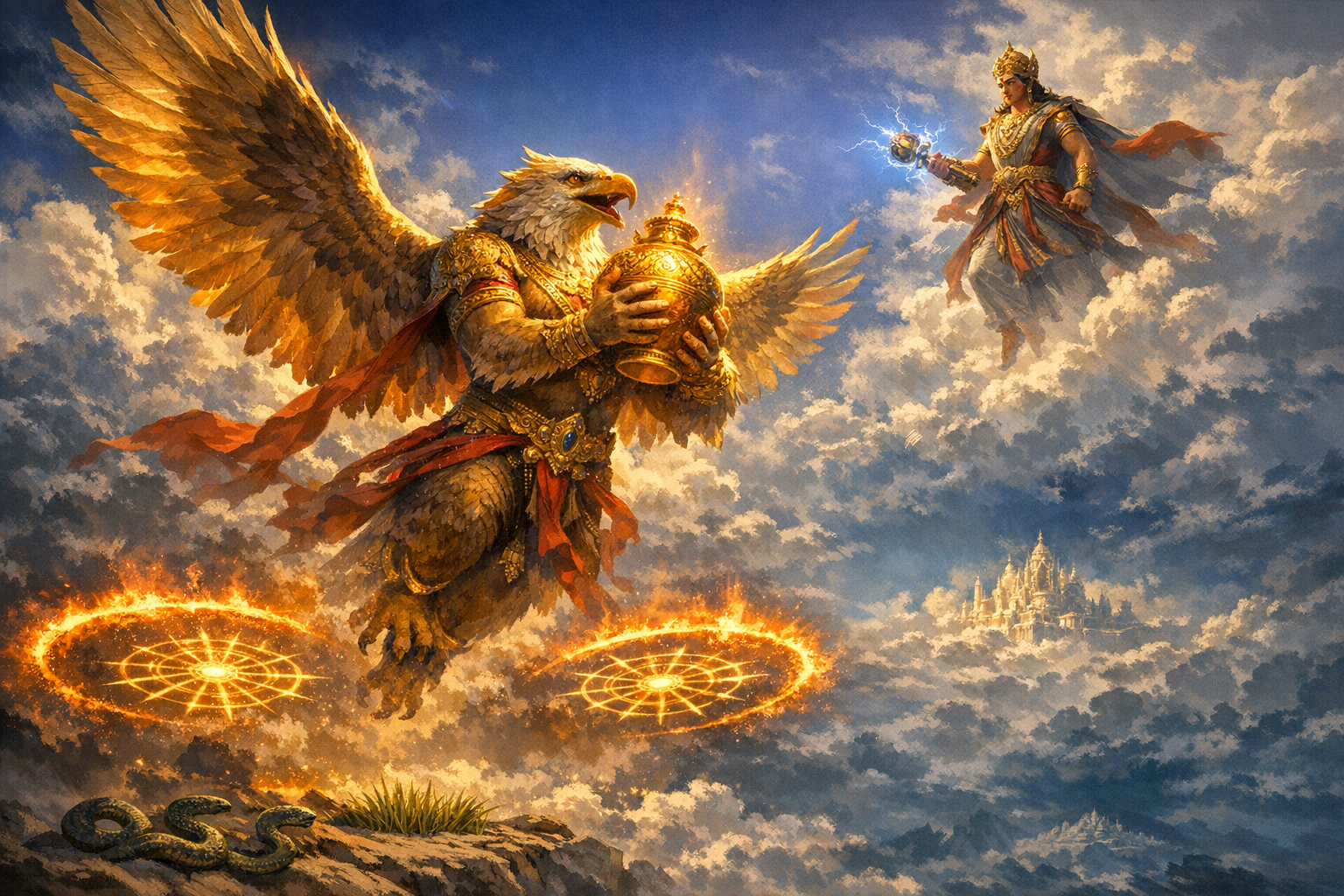
Within the sacred corpus of Ancient Indiaespecially the Mahabharata (Ādi Parva) and later Puranic tellingsGaruda, the divine eagle and king of birds, undertakes an awe-inspiring ascent to obtain amrit, the nectar of immortality, from the guarded realm of the devas. This episode is revered as an epic synthesis of filial devotion, cosmic scale, and measured valor, situating Garuda as both a mythic protagonist and a profound ethical exemplar in Hindu Stories.
The narrative impetus is anchored in the bond of maternal love. Vinata, mother of Garuda and consort of the sage Kashyapa, becomes enslaved to her sister Kadru after a fateful wager concerning the color of the divine horse Ucchaiḥśravas. Outraged by deceit yet bound by dharma, Garuda vows to liberate Vinata. The Nāgas, Kadru’s sons, demand amrit as the ransoman impossible price that propels Garuda’s ascent into the very heart of heaven’s defenses.
Classical sources emphasize Garuda’s gigantic form and effortless modulation of size. Descriptions portray a span so vast that the horizon dims beneath his wings, yet he can contract to a needle’s breadth to pass through lethal apertures. This pliancy of form symbolizes supreme mastery over prāṇa and mind in Vedic literature: power yoked to restraint, velocity tempered by precision.
On the journey, Garuda’s strength is matched by discernment and compassion. He carries away a colossal elephant and tortoise locked in ceaseless combat, yet avoids harming ascetic Valakhilya sages precariously suspended from a branch he dislodges. By carefully relocating the branch before taking his meal, Garuda integrates kṣātra (heroic prowess) with ahiṃsā (care for living beings), anticipating later dharma syntheses in Indian philosophy.
Approaching the devas’ stronghold, Garuda confronts a multi-layered defense: a ring of searing flames, twin revolving wheels armed with blades, vigilant deities, and serpentine sentinels. Mahabharata accounts detail how he quenches the conflagration by inhaling and releasing clouds and waters, then contracts his form to pass between the inexorable spokes. The guardians fallnot from wanton aggressionbut from a targeted, necessity-bound campaign focused on a single ethical objective: liberating a wronged mother.
Clashes with the devas ensue, culminating in Indra’s deployment of the vajra forged from the ascetic power of the sage Dadhīci’s bones. Accepting the strike in reverence to the sacrifice underlying that weapon, Garuda reaffirms a principle central to dharmic ethics: even adversaries merit honor when they embody sacrifice and righteousness. Unbowed, he secures the vessel of amrit and ascends further, luminous and unassailable.
At this summit, earthly conflict yields to spiritual recognition. Vishnu grants Garuda boonsimmortality without the need to drink the nectar, freedom from fatigue, and the eternal honor of serving as Vishnu’s vahana in Vaikuntha. By renouncing personal claim to amrit, Garuda converts a quest for power into a testament of self-restraint, establishing a model of dispassion prized in the Upanishadic current of Indian thought.
Garuda then fulfills the ransom: he places the amrit before the Nāgas on the condition that Vinata’s bondage end. Indra, with Garuda’s foreknowledge and tacit consent, swiftly recovers the nectar once it is set upon kuśa grass for ritual ablutions. In the aftermath, the Nāgas lick the blades of grass and their tongues splita mythic aetiology that explains serpents’ bifurcated tongues while underlining that deceit rarely yields undiluted reward.
Reconciled, Indra offers further boons: enmity between Garuda and the serpents is sanctioned as a natural order, and Garuda’s eminence among birds is affirmed. The episode closes not with domination but with restored balance, where cosmic hierarchy, ethical reciprocity, and personal vows concur. Such closure typifies the Mahabharata’s preference for dharma-yuddhacombat framed by moral boundariesover conquest for its own sake.
Philosophically, the tale admits layered readings. In one yogic lens, amrit signifies liberating knowledge; Indra symbolizes the sovereign mind; the devas and revolving wheels, the vigilant senses; the Nāgas, latent compulsions; and Garuda, the awakened prāṇa capable of transporting awareness beyond obstruction. The victory lies less in seizing an elixir than in mastering inner forces, then relinquishing the prize in favor of a higher fidelity to dharma.
Across the broader dharmic sphereHinduism, Buddhism, Jainism, and Sikhismthe narrative of courage joined to compassion resonates as a shared ethical ideal. Garuḍa figures prominently beyond Hindu scriptures, appearing in Buddhist literature and in the monumental art of Southeast Asia; the Samudra Manthana reliefs at Angkor Wat temple Cambodia, for instance, visualize the quest for amrit as a civilizational parable about cooperation, vigilance, and moral aspiration. Emphasizing these common values fosters unity in diversity, a hallmark of the subcontinent’s spiritual heritage.
Temple iconography, classical dance, and vernacular retellings continually renew the memory of this episode. As Vishnu’s mount, Garuda is not merely a vehicle but a living symbol of vigilant service, filial duty, and fearless yet ethical actionmotifs that inform daily practice as much as metaphysical speculation. The story thus bridges scripture and society, anchoring cosmic drama in the recognizable intimacies of family, promise, and trust.
For contemporary readers, the arc from gigantic force to deliberate restraint offers a compelling template for leadership and public life: command strength, calibrate its use, honor legitimate sacrifice even in opposition, and keep promises once made. In a world often tempted by spectacle and domination, Garuda’s ascent for amrit models a different powerone that protects, restores, and unifies.
Primary attestations reside in the Mahabharata (Ādi Parva), while later Puranasincluding the Garuda Purana and Padma Puranadevelop thematic and iconographic nuances. Complementary traditions such as the Samudra Manthana, where Mohini reallocates the nectar among the devas and asuras, further clarify that legitimacy in the use and distribution of amrit is inseparable from dharma.
Philological threads trace Garuda back to Vedic precursors such as Suparṇa and Garutmān in the Ṛgveda. The evolution from avian abstraction to the anthropo-avian icon seen beside Vishnu illustrates both textual continuity and the consolidation of Vaiṣṇava theology across Ancient Texts and temple art.
Inspired by this post on Hindu Blog.