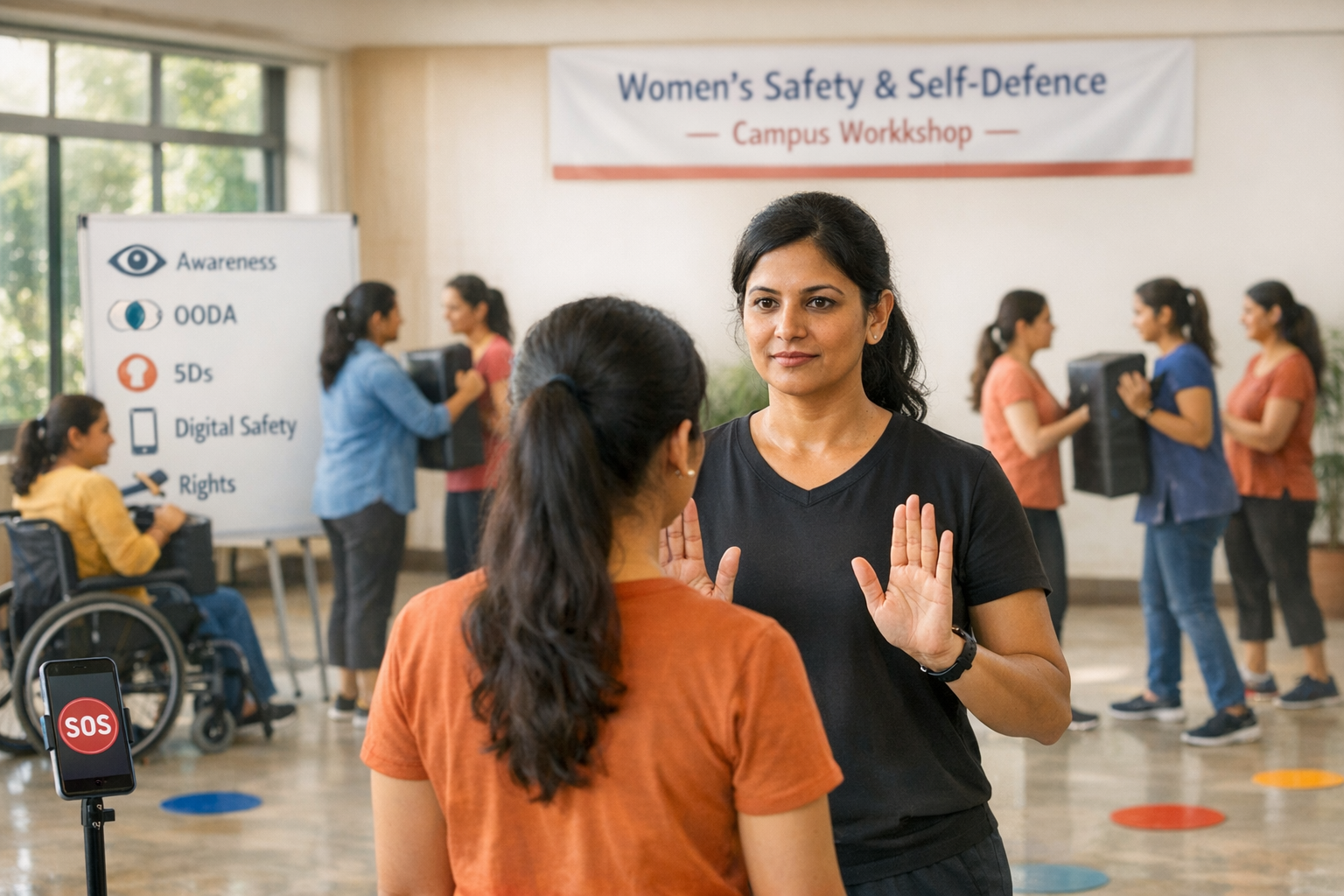
At a Women’s Day programme in Chembur, Mumbai, Hindu Janajagruti Samiti (HJS) facilitated a comprehensive women’s safety and self‑defence workshop on campus, integrating practical skill-building with rights literacy and confidence training. Designed for students navigating urban commutes and dense public spaces, the session combined scenario-based practice with clear guidance on India’s legal protections for women, campus reporting mechanisms, and evidence-informed personal safety strategies.
The workshop framed safety as a learnable competency rather than a state of fear, emphasising that preparation, situational awareness, and community support reduce exposure to risk. Positioned within a campus-safety context, the programme connected everyday student routineslate classes, internships, extracurricular events, and travelto practical tools for avoidance, de‑escalation, and, if necessary, proportionate self‑defence.
A unifying dharmic perspective guided the pedagogy. Across Hinduism, Buddhism, Jainism, and Sikhism, shared ethical tenets prioritise ahimsa, self‑restraint, and protection of self and others through proportionate action. The workshop acknowledged disciplines such as kalaripayattu and Gatka as traditions of service, discipline, and community guardianship, while drawing on Buddhist mindfulness and Jain vows to reinforce calm presence, ethical intent, and non‑excess in response. This value frame ensured that self‑defence was taught as responsibility, not aggressionanchored in dignity and collective well‑being.
Clear learning outcomes were articulated at the outset: (1) develop situational awareness and early risk recognition; (2) practise assertive boundary‑setting and verbal de‑escalation; (3) learn simple, high‑leverage physical responses to common holds and assaults; (4) apply bystander intervention methods to support peers; (5) strengthen digital safety habits; and (6) understand the Right of Private Defence (IPC 96–106), relevant Indian Penal Code provisions (e.g., 354, 354A–D, 509), and campus reporting channels such as the Internal Complaints Committee (ICC) mandated by UGC’s 2015 regulations.
Instruction followed a trauma‑informed and evidence‑based approach. Drills prioritised gross‑motor movements that remain accessible under stress, progressive intensity to protect joints, and repeated scenario practice to build reflexive responses. The design accounted for diverse abilities, offering seated or alternative‑position options and emphasising informed consent for all partner drills. Confidence-building was layered through small wins: stance, movement, voice, and exit strategies.
Situational awareness was taught through two widely used frameworks. Cooper’s Color Code helped participants calibrate attention (moving from unalert “white” to calm alert “yellow,” focused “orange,” and action‑ready “red”) without living in hypervigilance. The OODA loop (Observe–Orient–Decide–Act) was applied to campus‑specific scenarioshostel corridors, libraries, rideshares, and festival spacesso that learners could recognise anomalies, orient quickly to exits, decide on the least risky option, and act with commitment.
Pre‑incident indicators were discussed in practical terms: boundary testing by strangers or acquaintances, target selection behaviours (e.g., path‑blocking, unwanted proximity), and subtle grooming or distraction tactics. Students were encouraged to trust reasonable intuition when it signals a deviation from normal baselines, to avoid isolated spaces when possible, and to privilege exit routes over confrontation whenever safe to do so.
Verbal boundary‑setting emphasised concise, direct language delivered with a firm tone and squared posture. The instruction modelled phrases that name the behaviour, state the limit, and signal consequence, alongside non‑verbal cueseye contact, hand placement for space management, and angled footwork toward exits. A bystander intervention framework (often taught as the “5Ds”: Direct, Distract, Delegate, Document, and Delay) was adapted to campus norms to ensure peers can support safely without escalation.
Physical skills focused on balanced stance, protective hand positioning, and movement that creates angles to exits. For striking, the emphasis remained on robust, low‑complexity toolspalm‑heel strikes, elbows, knees, and low‑line kicksdirected at accessible anatomical targets (eyes, nose, throat, groin, shins, and knees) to create a brief window to disengage. Instruction reinforced the principle “stun to run”: use proportionate force only to break contact and reach safety.
Common grab scenarios were addressed with high‑leverage mechanics rather than strength contests. Wrist releases used rotation toward the attacker’s thumb gap and bodyweight drops; hair‑grab responses prioritised base, two‑hand control at the root, and movement to the outside; bear‑hug defences began with posture protection, base widening, hips back, and targeted strikes to create space. Each drill ended with a turn‑and‑go exit to condition disengagement.
Ground survival covered head protection, framing with the forearms, bridging and shrimping to create space, and technical stand‑ups to regain mobility. The focus remained on damage mitigation, directional movement toward lighted areas or help, and immediate re‑establishment of distance.
Environmental and improvised‑tool considerations were presented with legal caution. Everyday objectsbags, books, pens, keyscan serve to shield, distract, or create space in a pinch, but learners were advised not to carry prohibited items or purpose‑built weapons. Spatial awarenessdoors that swing inward, bottlenecks, lighting, CCTV coveragewas highlighted to favour safe egress over prolonged engagement.
Digital safety modules addressed smartphone SOS features, emergency contact setup, sharing live location with trusted peers, ride verification, and staggered route disclosure on social media. Strategies for reporting digital harassment, preserving screenshots and metadata, and adjusting privacy controls were demonstrated to reduce online‑to‑offline risk transfer.
The legal segment explained the Right of Private Defence in India (IPC 96–106): actions taken in reasonable apprehension of danger are protected within proportional limits, with Section 97 covering defence of body and property and Sections 99–100 describing restrictions and circumstances in which stronger force may be justified. Offences commonly implicated in harassment and assault include IPC 354 and 354A–D, as well as Section 509. Students were encouraged to use 112 (all‑India emergency), Mumbai’s 103 helpline for women and children, and 181 (state women’s helpline where operational), and to seek assistance in filing First Information Reports (FIRs) when appropriate. The UGC (Prevention, Prohibition and Redressal of Sexual Harassment of Women Employees and Students in Higher Educational Institutions) Regulations, 2015 were outlined, emphasising the role of the ICC and the right to a timely, confidential process.
Post‑incident priorities were sequenced as safety‑first, medical care, and reporting. Guidance included preserving potential evidence (avoiding unnecessary washing of hands or clothing where feasible), making contemporaneous notes of time, place, and witnesses, and contacting trusted peers or mentors for accompaniment. Students were signposted to campus counselling resources and state‑supported services to address psychological well‑being after distressing events.
Injury prevention in training received explicit attention: structured warm‑ups, safe striking surfaces, progressive loading, hydration, and cooldowns. Learners retained full opt‑out rights from any drill without explanation, and instructors modelled consent checks throughout. This approach protected joints and soft tissues while reinforcing the message that self‑defence should increase capability without compromising health.
Accessibility and inclusion were embedded. Drills were adapted for different mobility profiles (e.g., seated leverage, hand‑release variations, wheelchair manoeuvring), sensory‑sensitive alternatives were offered for loud environments, and buddy systems supported participants who preferred not to train alone. Confidentiality norms and non‑stigmatizing language were observed to maintain psychological safety.
Community‑building outcomes were visible in collective practice: groups rehearsed bystander strategies, participants articulated clearer boundaries, and peers coordinated exit planning in scenario walk‑throughs. Such sessions typically increase self‑efficacy, help‑seeking behaviour, and willingness to intervene safely, contributing to a campus culture where deterrence is social as much as individual.
To support replication, an implementable blueprint was shared: a 120‑minute module that covers awareness (20 minutes), verbal skills (20), physical fundamentals (40), bystander methods (20), legal and reporting pathways (15), and Q&A (5). Recommended safeguards included a trainer‑to‑student ratio that allows supervision, a designated safety officer with a first‑aid kit, pre‑session briefings on consent and opt‑out, and post‑session handouts summarising helplines, ICC contacts, and practice drills. Quarterly refreshers help retain skills under stress and align with academic timetables.
Evaluation strategies were proposed to sustain quality: brief pre/post knowledge checks, observed scenario performance with simple rubrics, anonymous feedback to surface barriers, and a living dashboard that maps campus risk hotspots (lighting gaps, visibility, crowding) for joint action by student bodies and administrators. This continuous‑improvement loop turns one‑off workshops into an evolving safety programme.
Ethical guardrails were reaffirmed. De‑escalation remains the first and best option; force, if unavoidable, must be proportionate and purpose‑limited to enable escape. Pursuit of an aggressor is discouraged; seeking help and reporting promptly is encouraged. The approach aligns with dharmic principlesvaluing life, preserving dignity, and protecting communitywhile remaining squarely within Indian law.
Overall, the HJS‑led women’s safety and self‑defence session at the Chembur college exemplified how community organisations and higher‑education institutions can collaborate to deliver practical, lawful, and values‑aligned training. By uniting evidence‑based methods with the shared ethical core of Hinduism, Buddhism, Jainism, and Sikhism, such programmes equip students to act early, speak clearly, and move to safetytransforming preparedness into a culture of care on campus and beyond.
Note: This article summarises an educational session and general safety principles. It does not constitute legal advice or a guarantee of outcomes. In an emergency, prioritise personal safety and contact 112 immediately.
Inspired by this post on Hindu Jagruti Samiti.