On March 11, 2026, during a visit to Hajipur in Bihar, Antarrashtriya Hindu Parishad (AHP) chief Dr Pravin Togadia articulated an unambiguous grassroots vision: ‘Hanuman Chalisa Kendra in Every Village.’ Framed as a nationwide, community-centric initiative, the call emphasizes cultural continuity, spiritual discipline, and citizen-led social capital under the umbrella of Hindu Dharma, while remaining consonant with the broader ethos of dharmic unity across Hinduism, Buddhism, Jainism, and Sikhism. The emphasis on scalable, hyper-local centers is notable: it positions devotion not as a private pursuit alone but as a structured, community-building practice aligned with seva (service), civic responsibility, and inclusive fellowship.
Positioned within India’s long tradition of Bhakti, the Hanuman Chalisa is traditionally attributed to Goswami Tulsidas and has, for centuries, functioned as both a devotional hymn and a pedagogical primer on virtues such as courage, humility, steadfastness, and service. In contemporary society, regular recitation often serves as a practical routine for mental focus and emotional regulation, much like structured breath-led practices in Yoga. By proposing a lattice of Hanuman Chalisa Kendras, the AHP vision effectively pairs a familiar spiritual discipline with a replicable institutional form—one that is simple enough to start in a single household yet robust enough to scale across districts, states, and the diaspora.
Technically, a Hanuman Chalisa Kendra can be understood as a modular micro-institution built around three pillars: sadhana (spiritual practice), sangathan (community organization), and seva (service). The sadhana core is the recitation cycle—daily or weekly—supported by accessible learning resources in local languages and scripts. The sangathan layer provides the organizational scaffolding: a small, trained volunteer team for scheduling, communications, safety, and inclusion. The seva layer converts devotional energy into tangible social benefit—health awareness sessions, educational tutoring, disaster-preparedness orientation, or blood-donation drives—implemented in partnership with existing community institutions.
From an implementation standpoint, a basic kendra blueprint can follow a phased approach. Phase 1 (initiation) begins with a consistent recitation schedule, a simple code of conduct, and a volunteer rota. Phase 2 (stabilization) adds pedagogy—introductory sessions on the meaning, meter, and message of the Hanuman Chalisa; basics of breath and voice discipline; and guidance for respectful congregational practice. Phase 3 (integration) formalizes seva modules—civic cleanliness drives, support for elders, student mentoring—and establishes linkages with local temples, gurudwaras, Buddhist viharas, and Jain derasars for collaborative, dharmic unity programs. Phase 4 (scaling) leverages district-level coordination, training-of-trainers, and digital tools for calendaring, content access, and impact tracking.
Academic clarity is enhanced by mapping the Hanuman Chalisa’s structure to practical pedagogy. Each chaupai can be introduced with its central value—shraddha (faith), dhairya (fortitude), viveka (discernment), daya (compassion)—and followed by reflective questions that connect text to contemporary life. This didactic framing enables the kendra to function as a living classroom of the Bhakti Tradition, where scriptural resonance meets real-world ethics. Such an approach preserves devotional integrity while also nurturing civic virtues: punctuality, teamwork, accountability, and service-mindedness.
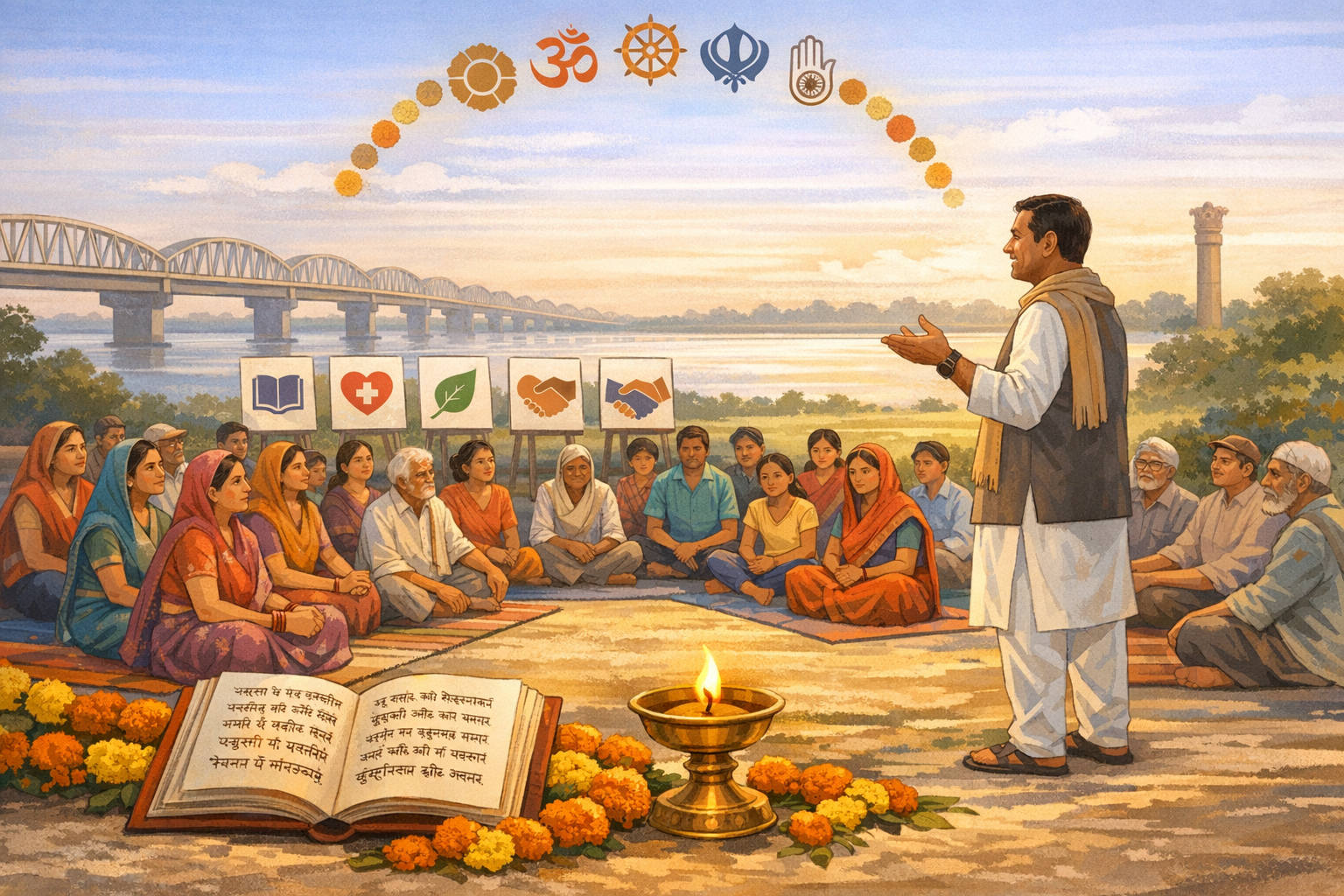
While rooted in Hindu practice, the proposed network readily accommodates the blog’s civilizational objective of dharmic unity. Programming can deliberately include inter-dharmic goodwill segments—short reflections on Sikh seva traditions (langar and paath), Jain maitri-bhav and ahimsa, and Buddhist metta (loving-kindness) contemplations—presented in a manner that honors each tradition’s autonomy and sacredness. This strengthens social cohesion without diluting distinct identities, reinforcing the longstanding Indian ethos of Religious Pluralism and unity in spiritual diversity.
In the sociological lens, kendras operate as community nodes that accumulate what scholars term bonding and bridging social capital. Bonding capital arises from regular, familiar interaction in small groups, improving trust and mutual aid. Bridging capital grows when these centers collaborate with other dharmic institutions, schools, resident associations, and self-help groups. Such networks increase household resilience during shocks, improve information flow, and create low-cost avenues for civic problem-solving—attributes that are essential to community development in both rural and urban India.
Public-health and well-being perspectives also merit emphasis. Group recitation requires synchronized breath, posture, and attention, echoing evidence-informed principles seen in breathwork and mindful chanting. These practices can support emotional balance and stress reduction when taught responsibly. Kendras can incorporate brief, optional modules on voice care, breath control, and safe practice guidelines to ensure inclusivity for elders, children, and individuals with health conditions.
A youth-and-women-forward strategy is critical for sustainability. Youth engagement thrives on creative roles—leading recitation segments, designing multilingual learning aids, organizing local heritage walks, and assisting with digital outreach. Women’s leadership can guide pedagogy for children, curate family-friendly scheduling, and strengthen safety protocols. Training materials—short facilitator notes, checklists, and sample run-sheets—ensure that participation does not depend on prior expertise but grows through mentored practice.
Localization is essential. In Hajipur and the Vaishali region, for example, operating in Maithili, Bhojpuri, and Hindi increases accessibility. Oral-learning support—call-and-response formats, transliteration aids, and audio guides—helps first-time participants and non-readers. Seasonal programming can align with local cultural calendars, ensuring that the kendra rhythm complements agricultural cycles, examinations, and festival periods.
To express seva without mission drift, kendras can adopt a lightweight portfolio approach. Quarterly priorities—such as school support, elder care, environmental stewardship, or health awareness—keep efforts focused. Partnerships with local clinics, teachers, and resident associations reduce duplication and enhance legitimacy. Clear boundaries help avoid partisanship and ensure that the centers remain non-confrontational civic spaces committed to harmony and care.
Governance and compliance frameworks protect the initiative’s integrity. Basic by-laws should set expectations regarding nondiscrimination, respectful conduct, grievance redress, protection of minors, and adherence to local regulations on public gatherings and sound. A transparent ledger for kendra expenses—displayed physically and, when possible, digitally—builds trust. Simple feedback loops (suggestion boxes, periodic surveys) enable iterative improvement and preempt conflict escalation.
Digitally, a minimal toolset can serve the network: a shared calendar, a searchable repository of pedagogical resources, and optional opt-in messaging for event reminders. Low-data, multilingual content ensures equitable access. Privacy-respecting practices—consent-based contact lists, role-based access, and minimal data retention—maintain community confidence while enabling coordination at block, district, and state levels.
Measurement should be fit-for-purpose. Leading indicators include attendance regularity, newcomer retention, volunteer training completions, and the proportion of sessions run by newly trained facilitators. Outcome indicators align with the kendra mission: participant-reported growth in devotional understanding, enhanced neighborly trust, hours of seva delivered, and the diversity of collaborating institutions across dharmic traditions. Periodic, lightweight evaluations—perhaps at the end of each seasonal cycle—keep the process reflective rather than burdensome.
Potential risks—perceived exclusivism, noise concerns, or inadvertent politicization—can be mitigated through design. A published code of conduct, thoughtfully chosen timings, and explicit non-partisanship protect the social license to operate. Programming that showcases shared dharmic values—compassion, truthfulness, discipline, and service—signals an open, civic orientation that welcomes dialogue and coexistence.
Viewed through the lens of cultural stewardship, the call from Hajipur proposes more than a devotional routine. It outlines a low-cost, high-trust institutional grammar for everyday life—one that fortifies Cultural Heritage, fosters Hindu Unity without negating Religious Pluralism, and renews the ethical foundations of the Hindu Society. By tying Bhakti Tradition to practical seva, the Hanuman Chalisa Kendra model functions as a living bridge between scripture and society, reverence and responsibility, contemplation and contribution.
The strategic intent is clear: if even a fraction of India’s villages and urban neighborhoods operationalize such kendras with inclusive design, careful governance, and collaborative spirit, the result would be a distributed network of micro-institutions capable of nurturing character, cohesion, and care at scale. Rooted in Hanuman’s exemplar—strength yoked to humility, valor tempered by service—this initiative has the potential to advance not only Hindu Dharma but also the shared civilizational aspiration of unity across dharmic traditions. In doing so, it affirms a time-tested truth: disciplined devotion, when aligned to community well-being, becomes a generative force for social harmony.
Inspired by this post on Struggle for Hindu Existence.