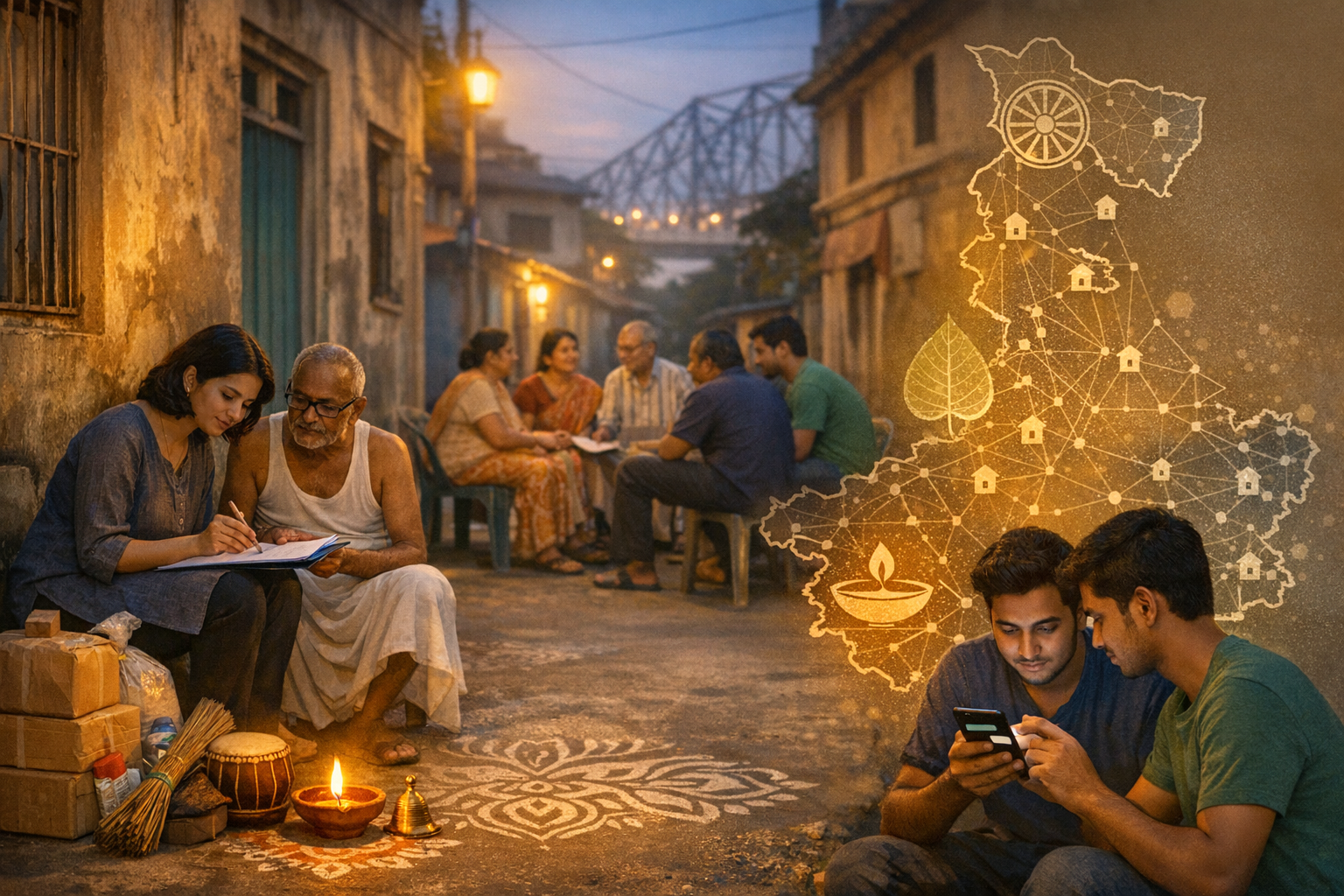
Across West Bengal, reports describe a quiet, networked mobilization associated with Rashtriya Swayamsevak Sangh (RSS) affiliates that frames a ‘jagaran’ (awakening) narrative around culture, identity, and civic participation. The effort is widely portrayed as “silent” because it relies on neighborhood-level meetings, devotional gatherings, and service initiatives rather than large rallies, and is frequently interpreted as positioning against Mamata Banerjee and the Trinamool Congress (TMC). While supporters contend that such work seeks to maximize Hindu turnout, critics warn of polarization risks. An evidence-based view benefits from separating organizational mechanics, legal-constitutional boundaries, and socio-cultural textures from partisan claims.
In organizational terms, the Rashtriya Swayamsevak Sangh (RSS) is a cadre-based civil society formation whose affiliates (often called the Sangh Parivar) operate through shakhas, seva (service) projects, and cultural programming. Although the Bharatiya Janata Party (BJP) is electorally focused and the RSS claims institutional independence, the two frequently align in issue framing and grassroots rhythms, especially during high-stakes cycles. West Bengal’s evolving party systemmarked by the Left’s decline, the TMC’s consolidation, and the BJP’s rapid growth during the 2010shas created a competitive arena in which civil society activism and electoral messaging often overlap in perception if not in formal intent.
The ‘jagaran’ idiom in Bengal borrows from a long Indian repertoire of devotional nights, bhajans, and cultural outreach that emphasize awakening to social and spiritual duties. In political seasons, such gatherings may acquire a civic valence: neighborhood cleanliness drives, relief work, or language-and-heritage programs are woven with appeals to constitutional participation. Observers in Kolkata, Howrah, and North 24 Parganas repeatedly describe these as low-decibel touchpointsshort meetings, doorstep interactions, and WhatsApp remindersrather than showpiece events. The format makes the initiative difficult to measure directly but influential in shaping informal opinion networks.
West Bengal’s electoral landscape adds nuance to these efforts. The TMC’s programmatic governancefeaturing schemes such as Duare Sarkar service delivery camps, Lakshmir Bhandar, and Swasthya Sathianchors a welfare narrative, while the BJP emphasizes security, alleged border vulnerabilities, citizenship debates, and cultural dignity. Within this contest, Hindu identity is a recurrent theme, not least because of demographic realities and refugee-linked communities. The ‘silent’ label thus refers less to secrecy and more to incremental, interpersonal, and service-oriented mobilization that often escapes mass-media optics.
Turnout engineeringlegally permissible when non-coercive and non-discriminatoryis the operative technical layer. Across India, parties and aligned networks have refined booth-level strategies involving voter list verification, transportation logistics, and get-out-the-vote routines. In BJP ecosystems, concepts like panna pramukh (page-in-charge) provide granularity: one volunteer tracks a small cluster of voters, ensuring accurate rolls, issue feedback, and day-of turnout nudges. When replicated at scale, these micro-structures can materially influence participation without necessarily relying on mass persuasion.
In Bengal, three social terrains recur in field accounts. First, refugee-descended groups such as the Matua community are central to citizenship and identity debates; their aspirations and anxieties animate both welfare and rights discourses. Second, districts along the international border, with layered histories of migration, policing, and commerce, are sensitive to narratives around security and documentation. Third, urban and peri-urban youth ecosystemsespecially on campusesabsorb a mix of employment ambitions, cultural assertion, and online mobilization. The ‘jagaran’ motif travels through all three settings but adapts to context.
Residents in Barasat and Bongaon recount small devotional-civic meets that blend kirtan, neighborhood service, and information-sharing about documentation and welfare entitlements. Community organizers describe these as confidence-building spaces where volunteers help seniors navigate ID issues, inform families about government schemes, and encourage lawful participation. In Jangalmahal, accounts highlight service camps and temple-based cultural programs that are framed as heritage preservation rather than explicit political canvassing. The consistency of presencemore than the intensity of any single eventappears to be the key to influence.
Digital channels magnify these micro-interactions. WhatsApp groups, local Facebook pages, and language-specific micro-influencers circulate devotional content, short historical explainers, and logistical reminders. While such distribution can empower civic awareness, it also carries mis/disinformation risks, especially when emotionally charged claims are shared without verification. Community moderators interviewed in Kolkata and Siliguri stress the importance of fact-checking and platform hygiene, a reminder that robust participation and information integrity must develop together.
Service (seva)especially in times of crisisdeepens social capital. In Bengal, memories of cyclone relief (for instance, after Amphan), pandemic assistance, and flood support often surface when residents explain why they trust particular volunteer clusters. This is not unique to any one formation: TMC-linked clubs, Left-leaning unions, religious charities, and non-partisan NGOs also cultivate legitimacy through help at the point of need. The political economy of trust in West Bengal thus grows from repeated, hyperlocal acts whose cumulative impact outlasts campaign cycles.
Counter-mobilization is equally systematic. TMC’s ward-level intermediaries and club networks, built over a decade of incumbency, facilitate rapid scheme enrollment, grievance redress, and public events. Their narrative stresses stability, welfare benefits, and Bengali linguistic-cultural pride. Between these architecturesRSS-linked ‘jagaran’ circuits and TMC club ecosystemsvoters routinely navigate dense, overlapping webs of service, identity, and neighborhood leadership.
The legal-constitutional guardrails are unambiguous. The Election Commission of India’s Model Code of Conduct and the Supreme Court’s jurisprudence (including Abhiram Singh v. C.D. Commachen, 2017) caution against soliciting votes in the name of religion, caste, community, or language. Faith-inspired civil society initiatives may lawfully encourage participation, provide services, or discuss public policy, but explicit appeals that hinge on communal identity breach red lines. In practice, distinguishing cultural outreach from electoral inducement requires close attention to language, timing, and the presence or absence of quid pro quo.
An additional layer involves the conceptual difference between Hindu dharma and Hindutva politics. Dharma in the Indian civilizational frame corresponds to ethical duty, pluralism, and spiritual striving; it embraces coexistence with Buddhism, Jainism, and Sikhism as part of a dharmic family. Hindutva, by contrast, is a modern political ideology that mobilizes cultural identity in the public sphere. Conflating the two erodes both spiritual integrity and democratic norms. A dharmic approach emphasizes sarva dharma sambhāva (equal regard for all faiths), non-violence, and unity in diversityprinciples crucial for West Bengal’s composite society.
Historical memory matters. West Bengal has witnessed politically tinged processions around Ram Navami and controversial episodes where religious festivities became flashpoints. The 2021 assembly cycle also saw allegations of post-poll violence. Against this backdrop, any ‘awakening’ narrativehowever civically framedmust actively prevent sectarian escalation, discipline rumor flows, and coordinate with law enforcement to ensure safety for all communities. The test of legitimacy is not just formal legality but the reduction of social fear and grievance.
Comparative experience from other states illuminates strategy transfer and limits. In Uttar Pradesh and Assam, booth-management and identity-forward narratives have yielded measurable gains for the BJP, often accompanied by RSS-linked social work. In Tripura, civil society-cum-party convergence shaped a rapid partisan reconfiguration. Yet West Bengal’s linguistic pride, club culture, and entrenched welfare networks produce an ecology where replication is never mechanical; strategies arrive but transform, constrained by context and counter-strategy.
Socio-economic issues remain the ultimate hinge. Employment, industrial policy, urban infrastructure, and rural livelihood programs structure everyday political talk in Bengal’s tea stalls and commuter trains. When identity discourse outruns material governance debates, polarization fatigue sets in; when service delivery falters, identity narratives reassert themselves as substitutes for performance. A balanced public conversation therefore benefits from re-centering policy outcomeshealth, education, jobsover symbolic one-upmanship.
From an analytical standpoint, three measurable variables will likely determine the 2026 stakes: differential turnout across Hindu, Muslim, and smaller dharmic communities; the stickiness of welfare benefits amid opposition narratives; and the credibility of neighborhood intermediaries regardless of party or affiliation. Each variable has a technical component (lists, logistics, grievance handling) and a normative one (fairness, inclusion, and non-discrimination). Effective participation that strengthens democracy must answer to both.
Dharmic unity offers a constructive anchor in this contested space. Buddhists (including the Barua community), Jains, Sikhs, and Hindus share philosophical lineages and historical interdependence in Bengal’s ports, towns, and pilgrimage circuits. Community roundtables that foreground ethical commonalitiesahimsa, satya, seva, and danahelp depoliticize ritual life and set social norms of mutual respect. When civil society emphasizes shared dharmic values, the room for zero-sum mobilization narrows and space opens for principled, issue-based politics.
To evaluate claims around a ‘silent anti-Mamata’ push, method matters. Triangulation through turnout data, ward-level swing analysis, ethnographic observation of neighborhood events, and content audits of digital channels offers a fuller picture than headline narratives. Where language explicitly seeks votes “as Hindus” or “against a community,” it likely violates jurisprudential norms; where language stresses constitutional duty, welfare evaluation, or governance comparisons, it sits within permissible civic discourse. Precision in description is a public good in polarized times.
There is also an inter-institutional story. The Election Commission’s monitoring, media self-regulation, and community peace committees function as guardrails, but their efficacy depends on citizen trust. Non-partisan fact-checkers and academic centers in Kolkata and beyond can contribute by publishing rapid, accessible primers on election law, misinformation hygiene, and grievance redress options. Embedding such resources in Bengali, Hindi, and English supports inclusivity and reduces rumor-driven mobilization.
The upshot is not a prediction but a framework. If ‘jagaran’ remains a cultural-service canvas oriented to lawful participation across communities, its civic contribution will be defensible. If it drifts into explicit communal appeals or becomes a proxy for exclusionary messaging, it will erode both democratic legitimacy and dharmic ethics. The same standard applies to every party or network, regardless of ideology.
For readers parsing Bengal’s churn, three takeaways stand out. First, turnout mechanicsmundane but decisiveoften outweigh spectacle. Second, welfare credibility and neighborhood problem-solving shape loyalties more durably than slogans. Third, unity among dharmic traditions, coupled with interfaith respect, provides the ethical ballast required to keep political competition peaceful and plural.
In sum, West Bengal’s “quiet mobilization” sits at the intersection of grassroots organization, identity narratives, and the constitutional promise of equal citizenship. Recognizing the difference between devotional culture and electoral appeals, affirming legal boundaries, and investing in shared dharmic values can reduce polarization while protecting democratic choice. That is the path most consistent with India’s civilizational grammar and the state’s composite heritage.
Inspired by this post on Struggle for Hindu Existence.