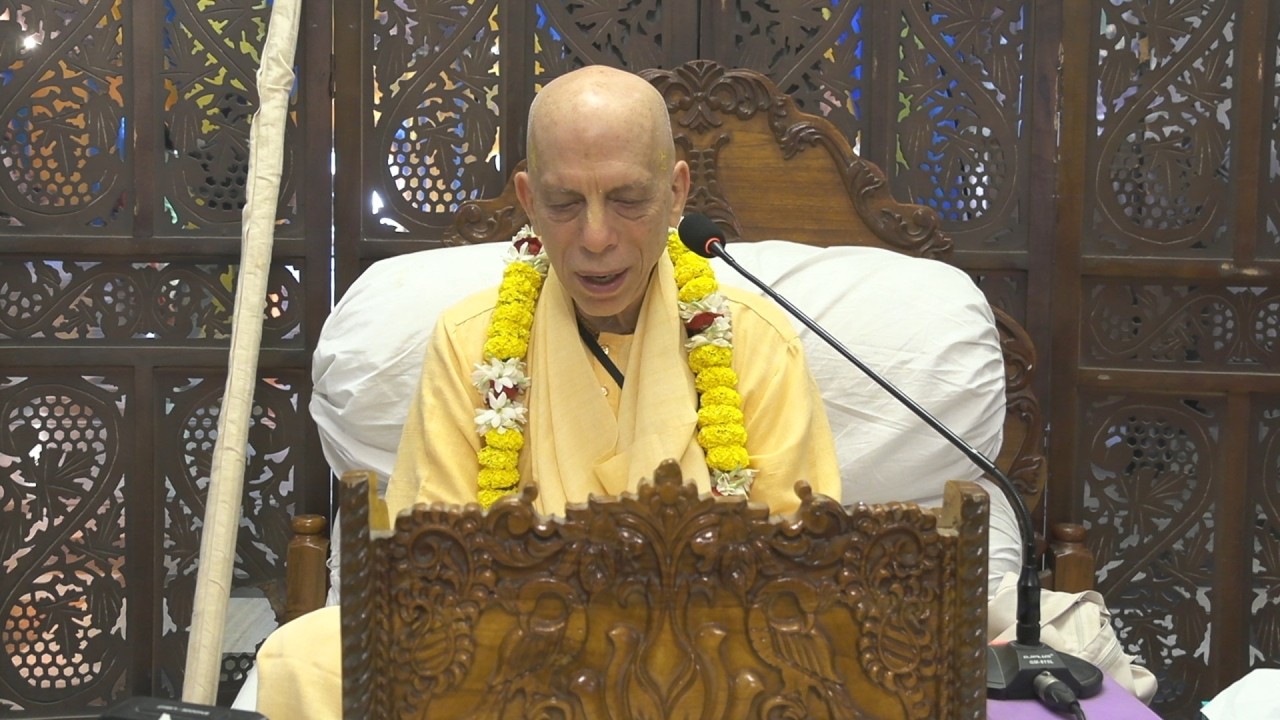
Srimad-Bhāgavatam 3.24.11 captures a luminous turning point in the narrative of Kardama and Devahūti: having worshiped the Supreme Lord with gladdened senses and a purified heart, Brahmā speaks, signaling the imminent descent of the Lord as Kapila. The verse’s concision belies its depth. It establishes the devotional atmosphere (bhakti-bhāva), the theistic teleology of avatāra, and a hermeneutic key for understanding what follows: Kapila’s systematic, compassionate exposition of theistic Sāṅkhya for the deliverance of embodied beings. Read through the living tradition of ISKCON Mayapur—where H.H. Prahladananda Swami and other ācāryas consistently emphasize the practical application of śāstra—this moment binds narrative, theology, and sādhanā into a coherent spiritual pedagogy.
The phrase “with gladdened senses and a pure heart” strikes an important theological chord. In Vaiṣṇava exegesis, purified senses do not negate embodiment; they reorient it toward service (sevā). Sattva-guṇa, when refined by bhakti, yields clarity, gratitude, and joy—inner states that both result from and further enable worship. Brahmā’s worship, before he speaks, models a cardinal sequence for all readers of the Bhāgavatam: contemplation begets devotion; devotion prepares understanding; understanding guides action.
Contextually, Kardama Muni and Devahūti are poised to receive the highest blessing: the Supreme Personality of Godhead will appear as their son, Kapila. The verse’s reference to “His intended activities as an incarnation” underscores the purposiveness of avatāra. In the Bhāgavatam, divine descent is not an episodic miracle but a pedagogical and salvific intervention: the Lord discloses knowledge (jñāna), revivifies remembrance (smṛti), and opens the way to liberation (mokṣa) through devotion-centered practice (bhakti-yoga).
The purport tradition consistently connects this scene to Bhagavad-gītā’s Fourth Chapter, especially 4.1–4.3 (paramparā, the disciplic transmission of yoga) and 4.9, “janma karma ca me divyam.” Properly understood (tattvataḥ), the Lord’s appearance and activities liberate the knower from rebirth. Srimad-Bhāgavatam 3.24.11 thus frames the hermeneutic horizon: readers are invited not only to witness an avatāra-līlā but to internalize its meaning in a way that transforms ontology (self-understanding) and praxis (daily discipline).
Theistic Sāṅkhya, as Kapila will present it (notably in the ensuing chapters, such as SB 3.25), employs a rigorously analytical map of reality to recover the person’s relation to the Supreme. By enumerating elements (tattvas)—from mahat-tattva and ahaṅkāra through mind (manas), senses, subtle tanmātras, and gross elements—Sāṅkhya discloses the architecture of prakṛti, not as an end in itself but as a means to distinguish the conscious self (puruṣa) and ultimately take shelter of Paramātmā/Īśvara. In the Bhāgavatam’s theistic arc, analysis culminates in devotion; knowledge ripens into love.
Philologically, the translation’s emphasis on Brahmā’s “gladdened senses” highlights a classical Bhakti Tradition insight: spiritual cognition is deeply ethical and affective. Where modernity may default to cognition stripped of devotion, the Bhāgavatam teaches that clarity is a function of purity, and purity a function of the heart’s orientation to the Supreme (bhagavad-dhī). Far from being opposed to reason, devotion refines the very conditions under which reason sees truly.
The householder context (gṛhastha-dharma) sharpens this lesson. Kardama and Devahūti do not exit history to receive grace; grace enters their household. The narrative therefore validates an integrative spirituality: duties honored, relationships ennobled, and renunciation embraced in due time (as Kardama will), all within a continuum of remembrance of the Lord. This framework resonates strongly with contemporary practitioners seeking to harmonize family responsibilities with steady sādhana.
From a comparative perspective, the Bhāgavatam’s theistic Sāṅkhya speaks across dharmic traditions. The analytic impulse to discern constituents of experience parallels Buddhism’s Abhidharma analysis of aggregates (skandhas) and Jainism’s tattva doctrine of soul, karma, and liberation, while Sikh teachings on nām-simran and sevā converge with bhakti’s heart of remembrance and service. These streams differ in metaphysics but converge in ethical clarity, contemplative discipline, and compassion. Honoring that unity in spiritual diversity strengthens inter-traditional understanding without collapsing meaningful distinctions.
Hermeneutically, a clarification is vital: while classical Sāṅkhya in some darśana lines trends toward non-theistic dualism, the Bhāgavatam’s Kapila is an avatāra—Īśvara revealing a theistic Sāṅkhya whose telos is bhakti-yoga. Gaudīya Vaiṣṇava ācāryas emphasize this theistic reading, aligning SB 3.24–3.33 with Bhagavad-gītā’s integrated vision of knowledge (jñāna), action (karma), and devotion (bhakti). The analytic method is retained; its culmination becomes loving service to Śrī Bhagavān.
Epistemologically, Bhagavad-gītā 4.9 suggests that “understanding” is not a mere notional assent but realized knowledge (vijñāna). Sravaṇa (attentive hearing), kīrtana (articulate remembrance), and manana/smaraṇa (deep reflection) progressively transmute scriptural concept into lived conviction. Brahmā’s sequence—worship preceding speech—codifies this pedagogy: what is spoken has first been sanctified in practice.
In the devotional culture of ISKCON (International Society for Krishna Consciousness), and especially at ISKCON Mayapur—the cradle of Gaudīya Vaiṣṇavism’s contemporary outreach—such verses are treated as portals from narrative to practice. Discourses associated with H.H. Prahladananda Swami often stress how śāstra-study, mantra-japa, and kīrtana align the senses toward service, producing the very “gladdened” receptivity that the verse attributes to Brahmā. The result is not escapism but clarified engagement: duty performed with devotion, intellect illumined by humility.
Ethically, the scene affirms that leadership is founded on worship. Before offering guidance to Kardama and Devahūti, Brahmā offers worship to the Supreme. This ordering resists ego-driven intervention and re-centers counsel on dharma rather than personal preference. For contemporary readers navigating family, community, or institutional responsibilities, SB 3.24.11 recommends a reliable protocol: pause, purify, perceive, and then proceed.
Practically, three lines of application emerge. First, scriptural immersion: study Srimad-Bhāgavatam 3.24–3.33 alongside Bhagavad-gītā Chapter 4 to integrate avatāra-theology, paramparā, and theistic Sāṅkhya. Second, contemplative discipline: maintain steady mantra-japa and kīrtana so that the senses become “gladdened,” as the verse models. Third, ethical steadiness: anchor household and professional life in yama–niyama-like virtues—truthfulness, nonviolence, self-restraint, cleanliness, and contentment—ethics that are honored across Hinduism, Buddhism, Jainism, and Sikhism.
Philosophically, the verse positions avatāra as both revelation and remedy. Revelation, because divine descent discloses what unaided reason cannot fully grasp: the Lord’s nature and purpose. Remedy, because the avatāra directly addresses existential confusion by re-establishing dharma and by modeling the path of return. In this sense, Kapila’s teachings will not merely catalog reality; they will rehabilitate the practitioner’s vision so that devotion arises as the most reasonable and fulfilling response to truth.
For readers invested in the unity of dharmic traditions, SB 3.24.11 offers a bridge. It invites the analytic rigor beloved in philosophy, the contemplative depth cherished in monastic practice, and the devotional warmth central to bhakti-yoga. Sustained together, these yield a culture of learning that is both precise and compassionate—an ethos where Hinduism’s many paths, and the neighboring insights of Buddhism, Jainism, and Sikhism, can converse fruitfully under the shared canopy of reverence, inquiry, and service.
In sum, Srimad-Bhāgavatam 3.24.11 stands as a finely cut preface to Kapila’s descent: worship refines perception; perception informs speech; speech guides seekers to theistic Sāṅkhya and, beyond analysis, to loving service of the Supreme. Correlated with Bhagavad-gītā’s assurance that the Lord’s appearance and activities are liberating when understood in truth, this verse offers both an interpretive lens and a practical syllabus. It encourages intellectual seriousness without spiritual dryness, emotional warmth without sentimentality, and disciplined practice without rigidity—precisely the balance required for personal transformation and civilizational harmony.
Approached in this way, the Mayapur tradition’s living engagement with the Bhāgavatam becomes readily accessible: a householder can adopt it without abandoning responsibilities; a monk can deepen it without neglecting compassion; a student can test it without forfeiting rigor. Brahmā’s joy, the parents’ devotion, and Kapila’s promise converge here to offer a unifying, actionable wisdom for a plural, modern world.
Inspired by this post on Dandavats.