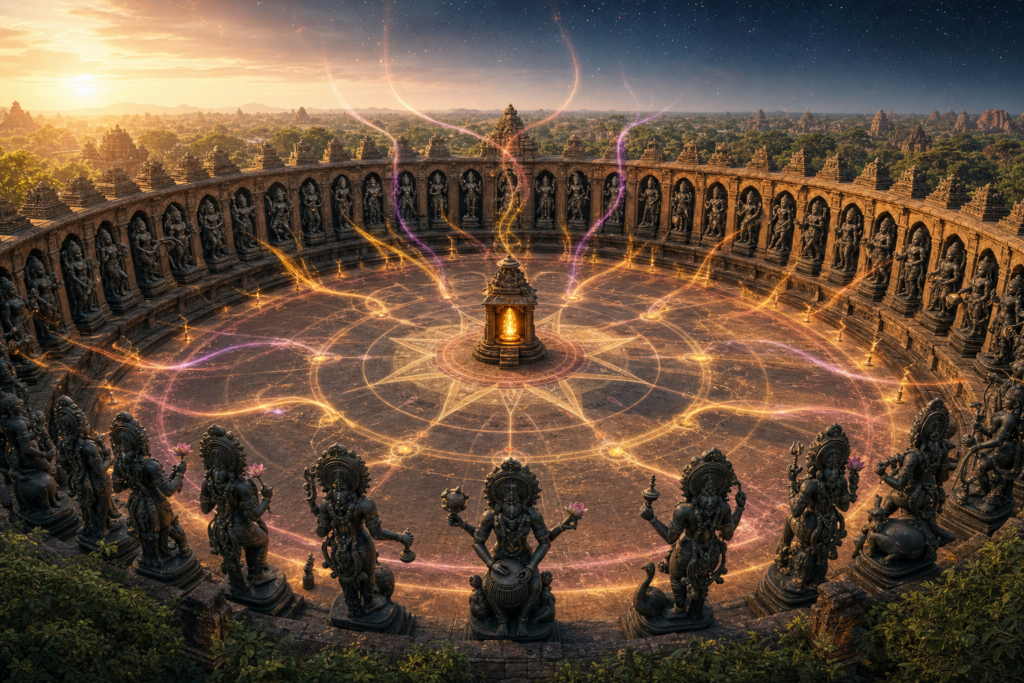
On the shores of the Arabian Sea at Prabhas Patan, the Somnath Temple endures as a living archive of India’s civilizational resilience. The span 1026–2026 has become a marker for collective remembranceoften evoked as Somnath’s “Trial by Fire”and a testament to unbroken faith sustained through rebuilding, renewal, and the quiet strength of cultural continuity.
Across the medieval period, Somnath faced repeated disruptions and yet returned, each time, as a carefully restored sacred space. Local communities, leaders, and artisan guilds continually reimagined the shrine, ensuring that worship, architecture, and sacred geography survived shifting political landscapes. In modern times, the reconstruction initiated with the guidance of Sardar Patel and the stewardship of K.M. Munshi reaffirmed that preservation of a sacred site is as much an ethical commitment as it is a historical project.
Somnath Swabhiman Parv frames this millennium as a celebration of self-respect rooted in memory, dignity, and shared custodianship. National reflections, including those by Prime Minister Narendra Modi, have described this observance as a renewal of collective resolvehonoring the past while inviting a forward-looking conservation ethos. Rather than valorizing conflict, the narrative emphasizes a moral victory: steadfast care for a sacred legacy through scholarship, service, and community engagement.
In this light, Somnath becomes a bridge across dharmic traditionsHinduism, Buddhism, Jainism, and Sikhismwhose shared values of ahimsa, karuna, seva, and satya nurture a culture of reverence and responsibility. While undeniably a Shaiva tirtha, the site’s meaning radiates beyond a single tradition by modeling how plural paths can converge around the protection of heritage, the pursuit of knowledge, and the cultivation of social harmony.
Historical inquiry strengthens this story. Epigraphy, chronicles, and archaeology invite a balanced historiography that resists distortion or polemics. Understanding Somnath’s past requires both academic rigor and empathetic attention to lived memoryacknowledging loss without animosity and celebrating renewal without erasure. This approach aligns with the broader dharmic ethos: transforming wounds into wisdom and remembrance into responsibility.
Visitors often describe an immediate sense of continuity: the ocean breeze, the cadence of aarti, and the rhythmic sound of conch shells that seem to bind centuries together. Pilgrims, students, and families alike find that Somnath’s story personalizes historyturning abstract timelines into touchable experienceand encourages a gentle, enduring confidence that faith, service, and community can rebuild what time has tested.
Looking ahead, sustainable heritage stewardship becomes essential. Documentation, digital archiving, and conservation science can work alongside community participation to protect temple architecture, support pilgrim management, and preserve coastal ecology. Education programsespecially for youthcan deepen understanding of Somnath’s layered past and inspire future custodians.
Somnath’s “1000 Years of Unbroken Faith” is thus less a claim of triumphalism than an invitation to unity in diversity. It asks society to strengthen bonds across dharmic communities, to practice compassionate remembrance, and to carry forward a shared cultural inheritance. In doing so, Somnath remains what it has long been: a lighthouse of resilience, ethical courage, and quiet, enduring hope.
Inspired by this post on Struggle for Hindu Existence.