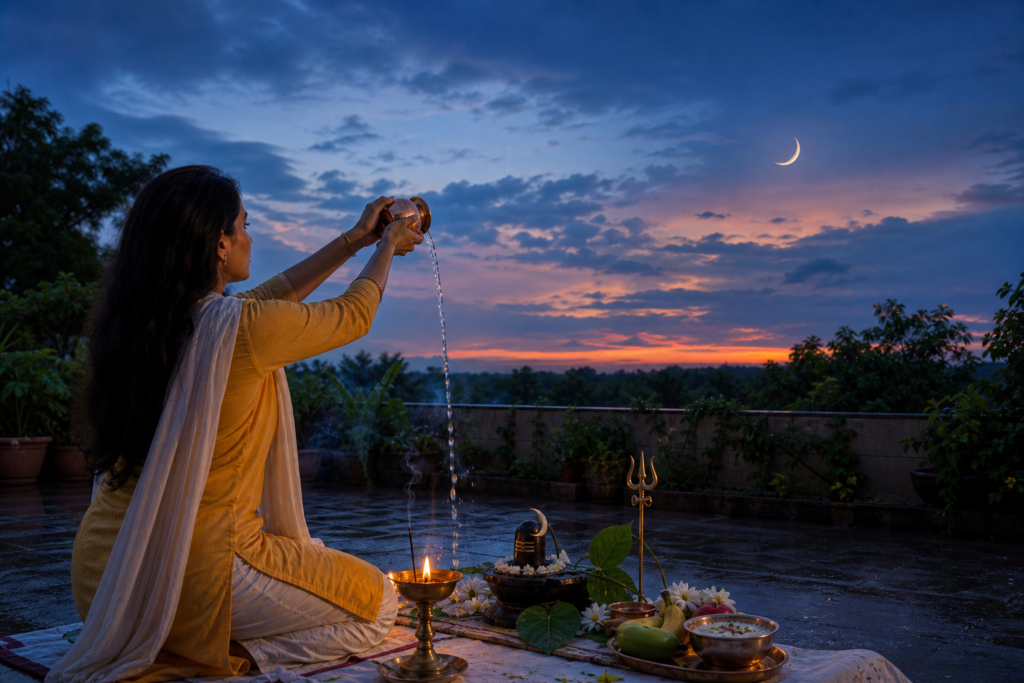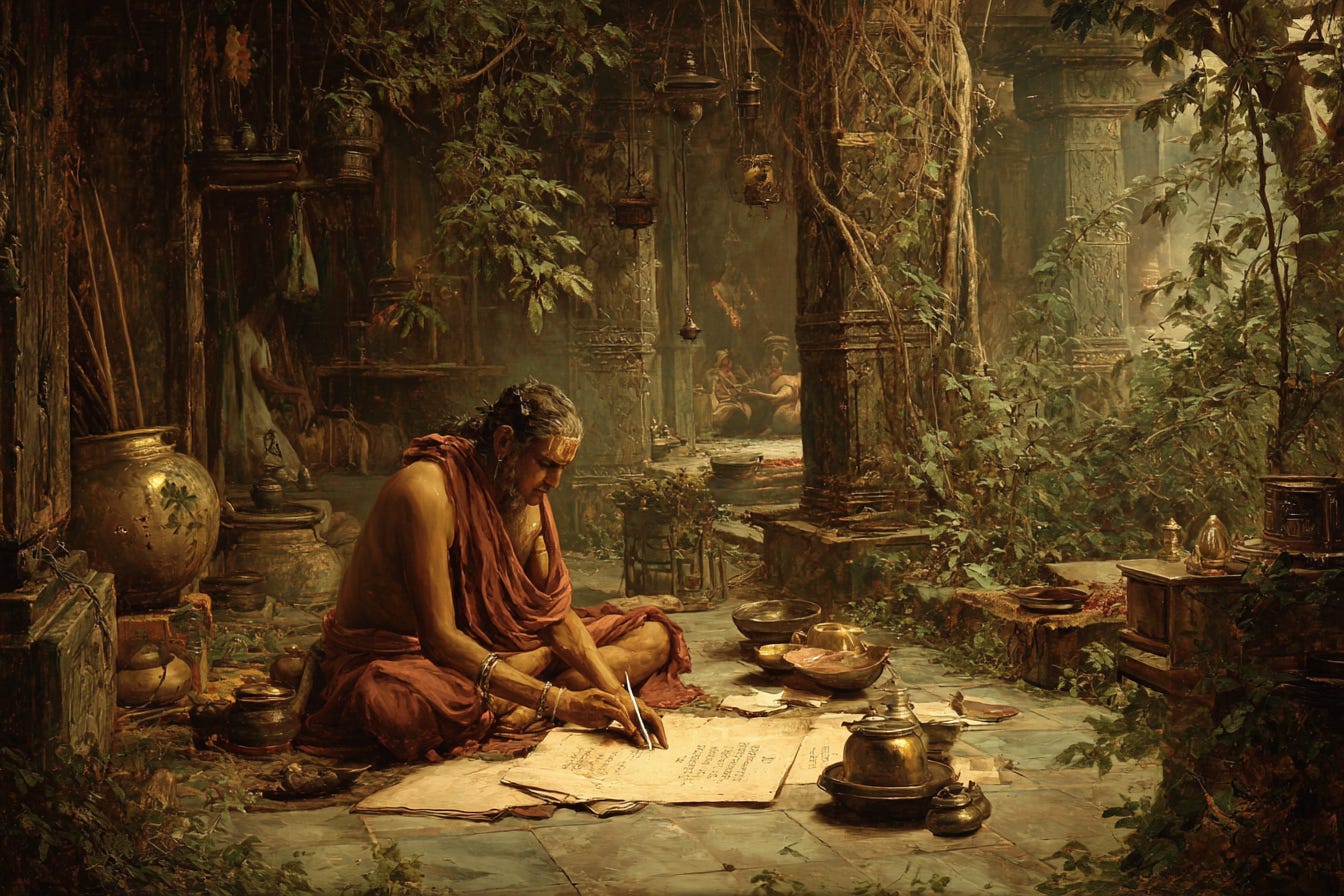
Kalidasa emerges as a representative poet of his era by yoking human emotion to the vastness of Nature and the moral compass of dharma. A luminous parallel appears in the picture of the hermitage in Kadambari, where human life blends seamlessly with the living world. This civilizational idealintimate coexistence between people and the cosmosanchors both the aesthetics and ethics of classical Indian literature.
In that hermitage, the wind bows plants and creepers in quiet homage, trees strew leaves as in Puja, and the courtyards are carpeted with shyamak paddy laid out to dry. Fruitsbanana, amalak, labali, badarigather in abundance. The woodland resounds with the lessons of young Brahmanas, while green parrots echo Vedic mantras by frequent hearing. Jungle fowl feed on offerings to Nature, goslings nibble the nibar paddy dedicated at Puja, and gentle does lick the limbs of hermit children. The hermitage thus dissolves aloofness between humans and the beings around them, a lesson reiterated across the land for centuries.
In the masterpieces of India, Nature participates in every thought and act. When human spaces shut Nature out, thought and conduct can grow stale and self-consuming. Sanskrit poets recognized Nature’s quiet governanceworking within yet appearing inertand infused a note of the Eternal into the full register of human joy and sorrow. Kalidasa stands at the heart of this tradition.
Ritusamhara likely belongs to Kalidasa’s early apprenticeship. Its song of youthful lovers’ union springs from deep passion and does not yet ascend to the higher self-purification (tapasya) that animates Sakuntala and Kumara-sambhava. Yet even here, the poet harmonizes desire with the seasons: summer moonlight resonant with waterfalls; Kadamba branches trembling in the first rains; the cooing of ducks in early autumn when paddy stands green; and the south wind of Spring murmuring through fragrant mango blossoms.
A governing principle follows: when emotions are planted in their rightful place within Nature, they lose violence; detached from this wider ground and confined to human interiors, they can appear inflamed. Comparative glimpses at early modern European lyrics show a different emphasismore interiorized passion with less environmental counterpointoften yielding a sharper and unmodulated intensity. Kalidasa’s ecology of feeling, by contrast, tempers desire without diminishing its depth.
In the third canto of Kumara-sambhava, the sudden advent of Cupid stirs a tremor of youthfulness. Kalidasa does not bracket passion within narrow bounds; he places the restless longing of Shiva and Parvati amidst Spring’s universal jollity. The effect resembles sunlight: a lens concentrating a single ray can ignite, while diffused rays warm without burning. Cupid’s artifices against Shiva are thus harmonized with the wider spirit of Nature, redeeming passion through context and proportion.
Across the poem, a vast universal background frames a question of perennial urgency: when Taraka devastates Heaven and throws order into chaos, where can heroism arise strong enough to overcome it? This is a problem for every age and each persona call to generate inner strength when external certainties falter.
Kalidasa’s works also reveal the historical tensions of his time. The simplicity and self-control associated with older Hindu life had waned; kings turned to self-indulgence, while Scythian incursions burdened the people. Outwardly, refinement in luxury, poetry, music, and the fine arts attained a striking polish, and Kalidasa’s verse displays the exquisite workmanship of the agerepresentative in its material richness. Yet within this richly gilt palace of pleasure, his Muse appears restless, yearning for a truth harder and more enduring than adornment.
Read in a dharmic frame shared across Hindu, Buddhist, Jain, and Sikh traditions, this vision affirms a coherent ethic: harmony with Nature, cultivation of self-restraint, and the birth of compassionate heroism oriented to collective welfare. By aligning intimate desire with the rhythms of the world and the demands of duty, Kalidasa models a civilizational synthesis that honors plurality while nurturing unity.
In this light, Kalidasa is both mirror and guidefully of his era yet gently corrective of it. His art transforms private passion into public virtue by situating it within Nature and dharma, offering readers a way to balance feeling with order, and beauty with responsibility.
Inspired by this post on Dharma Dispatch.