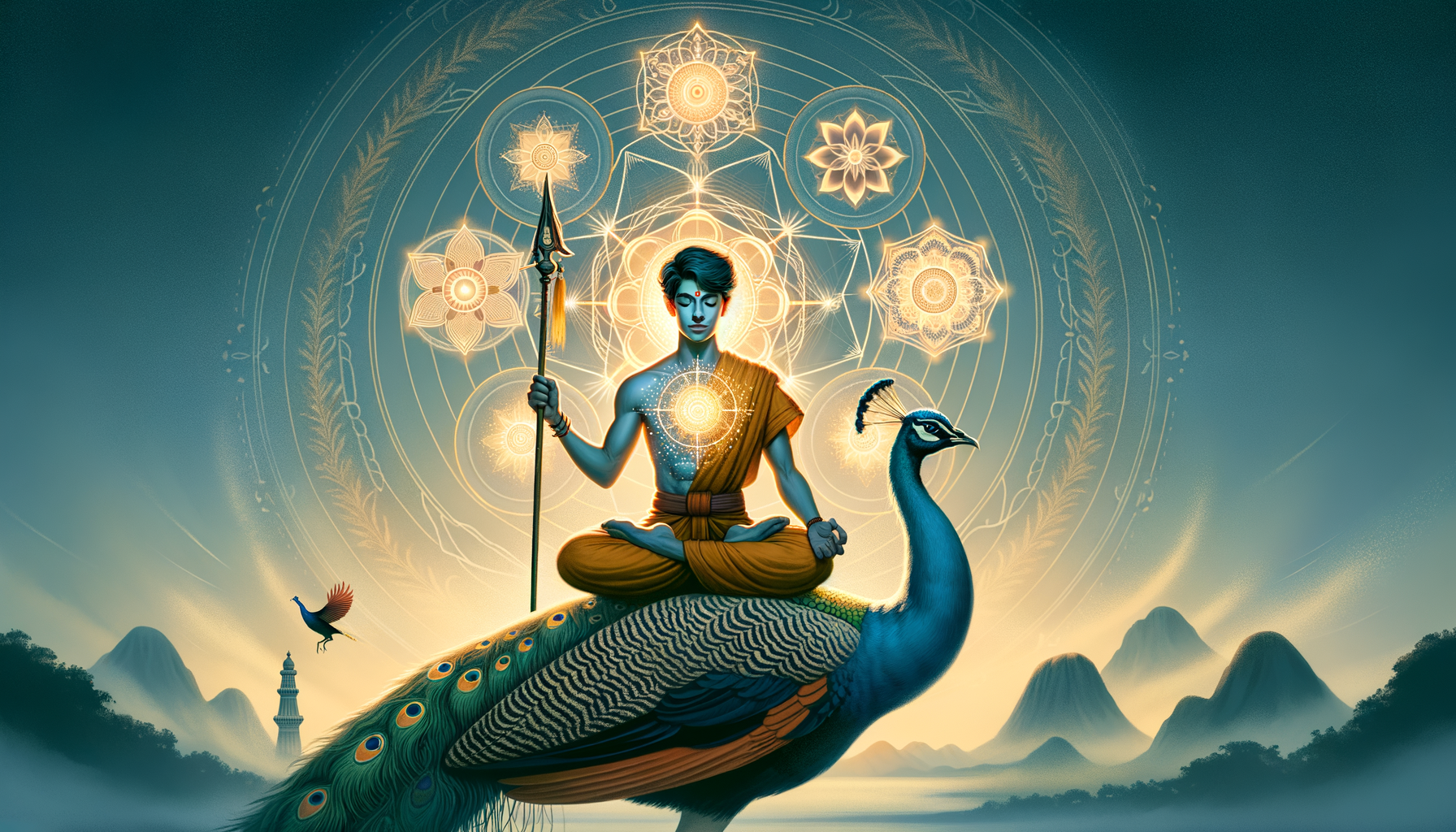
Muruga—revered as Kartikeya, Subrahmanya, and Kumara—has long been understood in Hindu traditions as a living expression of Kundalini Shakti, the transformative inner fire that elevates consciousness. Beyond the celebrated image of the youthful warrior who defeats Tārakāsura, Muruga symbolizes the disciplined awakening of latent spiritual energy and the ethical courage required to direct it toward clarity, compassion, and dharma.
Kundalini Shakti is classically described as the serpent power residing at the base of the spine, rising through the sushumna nadi from the muladhara toward higher centers of awareness. In this contemplative framework, Muruga represents the mastery and guidance needed for this ascent—embodying vigilance, refined focus, and the fearless resolve that allows Prana to become a steady current of insight rather than an impulsive surge.
The iconography of Muruga is rich with pedagogical meaning. The Vel (spear) is often read as the incisive wisdom that pierces ignorance, while the peacock—his vahana—signifies transmuted desire and pride held in disciplined balance. Traditional narratives connect the rooster emblem and peacock with the sublimation of fragmented energies into a luminous center, aligning with the yogic aim of integrating mind, breath, and intention.
Muruga’s six faces (Shanmukha) and the six sacred abodes (Arupadai Veedu) are frequently interpreted as a contemplative map echoing the progressive refinement of awareness akin to traversing inner levels. Without enforcing a one-to-one system, many practitioners find that contemplating these symbols alongside the movement from muladhara upwards fosters a grounded, methodical approach to inner practice.
Across devotional and yogic settings, mantra recitations such as “Om Saravanabhava” are paired with breath awareness, dhyana, and ethical living. Practitioners consistently note that steady attention to Pranic rhythms, supported by simple pranayama and mindful conduct, cultivates focus and serenity—qualities long associated with Muruga’s presence in both temple and sadhana contexts.
Festivals like Skanda Shashti are experienced not merely as historical commemorations but as annual opportunities to renew inner discipline. The victory of Muruga over asuric forces becomes a contemplative lens for overcoming the arishadvargas—lust, anger, greed, delusion, pride, and envy—thus reframing mythic triumph as ethical and psychological integration.
Scriptural sources such as the Skanda Purana amplify these meanings by presenting Muruga’s narratives as multilayered teachings. Read with an academic sensitivity to symbolism, these texts function as sophisticated guides to inner transformation, articulating how devotion (bhakti), knowledge (jnana), and disciplined action (karma) harmonize under the protective clarity of Shakti.
These insights resonate with the broader dharmic tapestry. In Buddhism, structured meditative ascent and energy cultivation parallel the disciplined inner heat of practice; in Jainism, tapas and self-restraint refine awareness; in Sikhism, the focused remembrance of the Divine through nam simran anchors courage and compassion. Such convergences affirm unity in spiritual diversity, honoring distinct paths while recognizing a shared commitment to ethical awakening and inner freedom.
Devotees and practitioners frequently describe tangible outcomes: renewed courage in adversity, sharpened focus in study and work, and a warmer compassion in relationships. In this sense, Muruga as Kundalini Shakti is not an abstraction but an experiential guide, helping individuals translate contemplative insight into resilient, service-oriented living.
Anchored in Yoga and the contemplative sciences, this reading of Muruga invites a practical synthesis: cultivate breath awareness, maintain ethical clarity, engage in steady meditation, and orient action toward the common good. As these elements cohere, the inner Vel of discernment grows luminous, and the peacock of transformed emotion stands steady—an image of poised strength in a complex world.
Ultimately, Muruga’s enduring appeal lies in the alignment of power with wisdom. As the embodiment of Kundalini Shakti, he models how inner fire can be awakened and directed responsibly—igniting fearlessness, deepening clarity, and fostering unity among the dharmic traditions through shared values of compassion, self-mastery, and reverence for truth.
Inspired by this post on Hindu Blog.