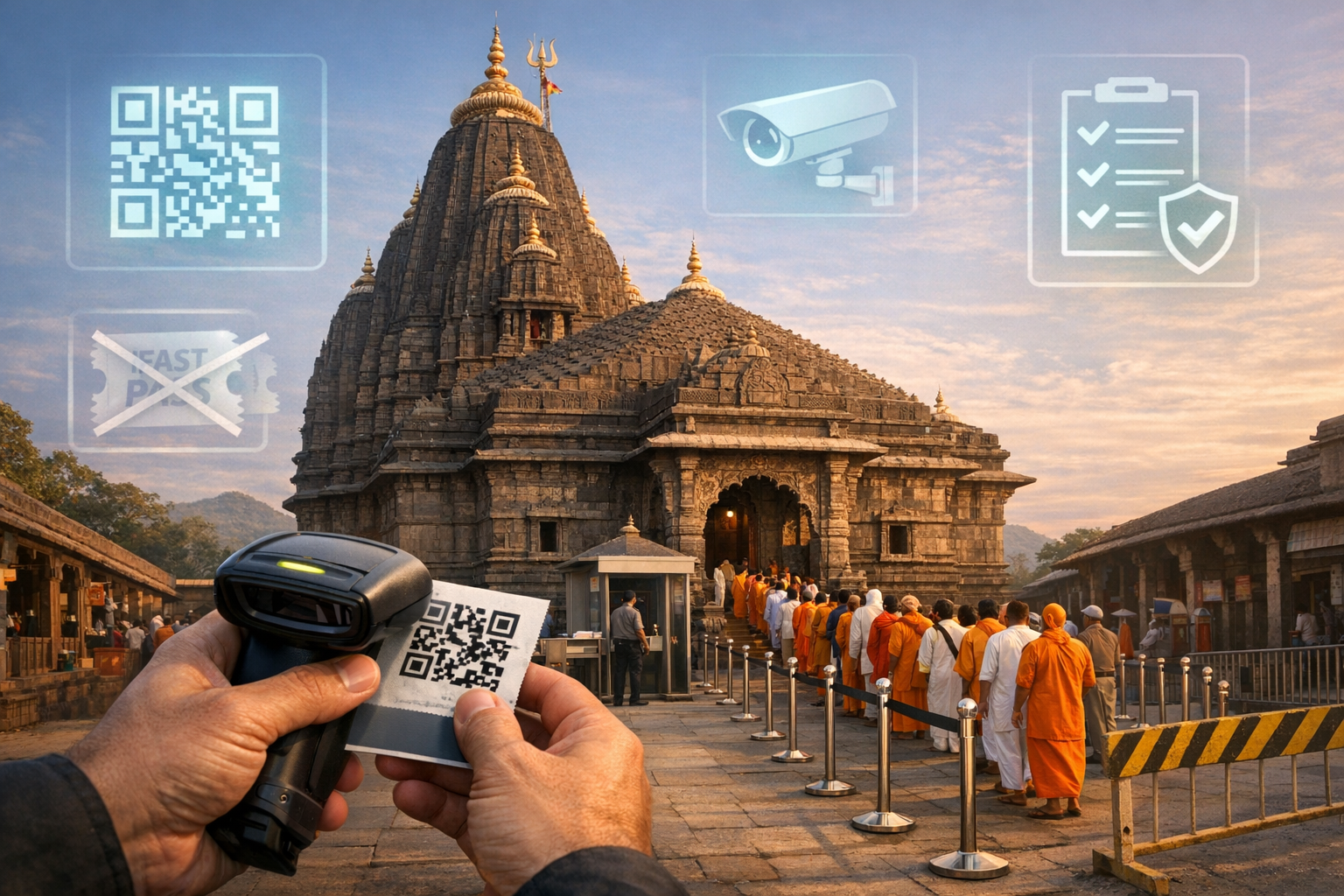
An alleged black-marketing racket offering illegal “quick darshan” at the Trimbakeshwar temple in Nashik has resulted in the arrest of a sitting temple trustee linked to the Nationalist Congress Party (NCP) and several accomplices. The case underscores long-standing vulnerabilities in pilgrimage management at high-footfall shrines and has reignited public demands for transparent, accountable, and devotee-centric reforms in temple governance across Maharashtra.
Trimbakeshwar, one of the 12 revered Jyotirlingas, attracts large numbers of pilgrims year-round, with crowds peaking during Shravan and Maha Shivaratri. In this context, the promise of “priority” or “quick” darshan has frequently become a magnet for illicit intermediaries who exploit demand-supply imbalances. The present crackdown signals heightened vigilance by law enforcement and a public expectation that religious institutions will reinforce systems that honor both dharma and due process.
According to initial reports, the arrests involve a temple trusteewho is also an NCP functionaryand multiple others for allegedly facilitating premium access outside official protocols. While the investigation is ongoing and all accused are entitled to the presumption of innocence, the episode spotlights systemic control gaps: unauthorized middlemen, opaque quota allocations, and weak audit trails that together create fertile ground for ticket diversion and black marketing.
Such rackets typically thrive on information asymmetry and operational loopholes. Common patterns include the diversion of priority slots, off-ledger cash collections, and collusion between external touts and insiders. Even without speculating about case-specific charges, similar incidents elsewhere have often triggered inquiries under provisions addressing cheating, criminal conspiracy, and violations related to public or charitable trusts. In Maharashtra, temple trusts function under the Maharashtra Public Trusts Act, 1950, which emphasizes fiduciary responsibility, financial transparency, and adherence to the trust’s stated religious and charitable purposes.
High-demand pilgrimage sites face a technical and managerial challenge: safeguarding fairness while managing throughput. When queues stretch for hours and emotions run high, devoteesoften traveling with elders and childrenseek reasonable convenience. If official facilities are insufficient or communication is unclear, informal markets arise. Closing these gaps requires not only policing but also a modern operations framework that aligns faith-based hospitality with contemporary queue science, digital systems, and strong internal controls.
Several practical reforms can materially reduce abuse risk while enhancing devotee experience. First, a unified, cashless, and quota-capped e-darshan platform with real-time inventory can deter diversion; each slot should be QR-coded, non-transferable, and auditable. Second, clear protocols for any legitimate priority access (e.g., differently abled devotees, senior citizens) should be publicly posted, time-stamped, and monitored through trail logs accessible to independent auditors. Third, a separation-of-duties modelwhere slot allocation, on-ground validation, and reconciliation are handled by distinct teamscan minimize collusion. Fourth, regular surprise audits, CCTV-backed crowd flow analysis, and anomaly detection on booking data create strong deterrents.
Further governance measures strengthen institutional integrity. A formal code of conduct for trustees, priests, and staff, backed by a sanctions matrix, deters misconduct. Annual third-party audits, whistleblower mechanisms with protection guarantees, and periodic public dashboards (summarizing bookings, cancellations, and VIP quota usage) reinforce accountability. Structured grievance redressalfeaturing on-site helpdesks, multilingual messaging, and after-visit feedback loopsbuilds trust and provides actionable insights.
Technology, thoughtfully applied, supports dharmic fairness. Scalable slotting engines can balance general, family, and accessibility-friendly queues. AI-based pattern checks can flag outlier behaviors (for example, repeated bookings funneled to the same device or ID clusters). Geo-fencing and time-window validations curb unauthorized resales. Importantly, design choices should reflect the spirit of seva, ensuring that convenience never becomes commodified privilege.
From an ethical perspective shared across dharmic traditionsHinduism, Buddhism, Jainism, and Sikhismequity of access and integrity of intent matter as much as ritual itself. Pilgrimage is a communal act of devotion; when a few monetize access through illegitimate means, the injury is spiritual as much as it is financial. Safeguards that uphold truthfulness (satya), non-harm (ahimsa), and right conduct (dharma) do not merely protect an institution’s reputation; they honor the shared values that bind diverse communities seeking the Divine through varied paths.
For devotees, the human stakes are tangible. Families often save for months, travel long distances, and stand in extended queues as an expression of faith. Discovering that access can be illicitly purchased can feel like a personal betrayal. Transparent processesclear signage, predictable slotting, and courteous crowd managementtransform that vulnerability into confidence, reinforcing the sanctity of darshan and the spiritual dignity of every visitor.
Institutionally, the path forward is clear: full cooperation with investigators; an independent operational audit of darshan management; immediate tightening of slot governance; and trustee-level oversight reforms that include compliance training and periodic disclosures. Public communication should remain factual and non-adversarial, emphasizing corrective action, devotee welfare, and continuous improvement. As due process runs its course, lessons learned at Trimbakeshwar can serve as a model for other temples facing similar pressures.
Ultimately, this episode should neither tarnish the sanctity of Trimbakeshwar nor cast aspersions on the faithful. It should catalyze a sustained, system-level upgradewhere devotion meets disciplined management, and where dharmic values guide modern governance. By centering fairness, transparency, and compassion, pilgrimage institutions can uphold sacred traditions while ensuring that every seeker’s path remains unobstructed by exploitation.
Inspired by this post on Hindu Jagruti Samiti.